Best Fitness Trackers for Athletes of 2026

A tracker that mismeasures your heart rate isn't just unhelpful — it's persuasive. I once ran an entire block of intervals a full zone off and didn't find out until I compared notes with a chest strap. What a good tracker actually fixes is trust: numbers accurate enough that you stop second-guessing them and start training on them, whether that's pace on a tempo run, effort on a climb, or the hours of sleep you actually got.

Comfort is the underrated half of that. Something strapped to your wrist at 2 a.m., in the pool, and 20 minutes into a long run has to disappear, and I've walked away from otherwise fine trackers over a band edge alone. Then there's the display question, which splits the category in two: a screen hands you pace at a glance, while screenless bands shed weight and stretch battery life past a week. Some of those screenless models also charge a membership, which quietly changes what you're really paying.

My team and I have been wearing 12 of them since early spring — running, lifting, sleeping, and syncing all of it — and the ones we kept reaching for are below, each best at something a little different.

The Best Fitness Trackers for Athletes

1

Garmin Forerunner 165 Best Overall
93 /100
TKZ Score Outstanding

Key details

Battery Life
Up to 11 days
Weight
1.38 oz
GPS
Built-in
Sports Profiles
25+
View on Amazon

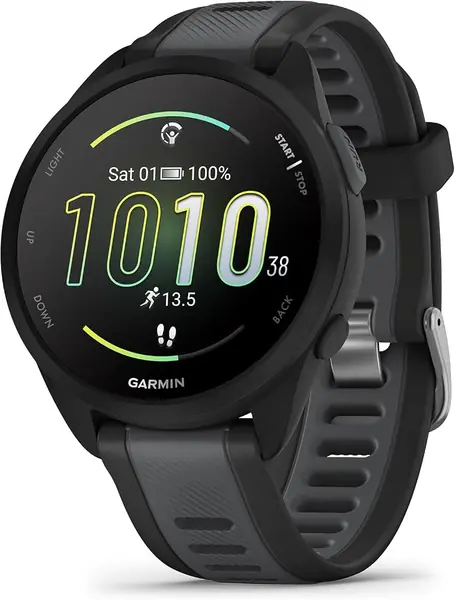
At 1.38 ounces, the Forerunner 165 is light enough that we forget it is there on easy runs, which is the point of a watch you wear from wake-up to sleep. The 1.2-inch AMOLED screen is bright enough for pace and heart rate in daylight, and the physical buttons matter when your fingers are wet or you are mid-interval. We like that Garmin did not make the touchscreen the only way in.

The reason it is our top pick is the combination of built-in GPS and daily suggested workouts. You get 25+ activity profiles, Garmin Coach plans, a morning report with sleep and recovery, and a battery rating of up to 11 days in smartwatch mode or 19 hours in GPS mode. That GPS figure is the one we care about for long runs and race day; the smartwatch figure is what keeps it on your wrist for sleep tracking between sessions.

It is not a premium multisport watch, and we are fine with that. The screen sits proud enough that a protector is cheap insurance, and the battery is measured in days, not weeks. Neither changes the recommendation for a runner who wants the training essentials without paying for features they will not use. If your workouts demand on-wrist navigation or a battery measured in weeks, step up; for most athletes, this is the sensible ceiling.

Pros

  • Built-in GPS for pace and distance
  • Daily suggested workouts and Garmin Coach
  • Light 1.38-ounce build with AMOLED

Cons

  • Syncing can be finicky with some phones
Our verdict

For most runners and gym athletes, this is the tracker we recommend: it has built-in GPS, useful daily workouts, and enough battery for a training week without the premium price.
Check Latest Price
2

Garmin Instinct 3 AMOLED Best Rugged

91 /100
TKZ Score Outstanding

Key details

Battery Life
Up to 18 days
Weight
1.87 oz
Water Resistance
100 meters
GPS
Multi-band with SatIQ
View on Amazon

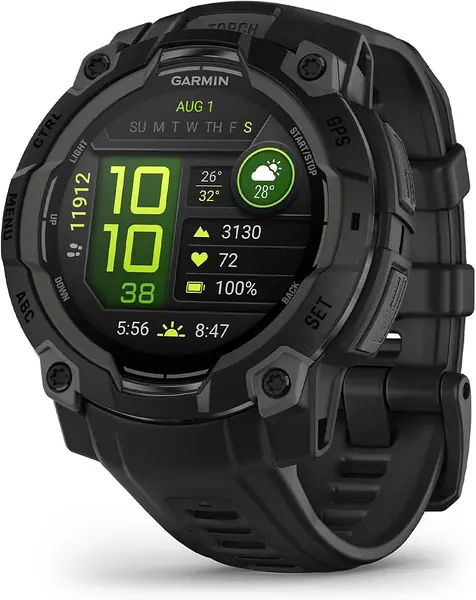
The Instinct 3’s 18-day battery is the number that makes it a different kind of training watch. Where the Forerunner 165 is rated for 11 days, this one can go 18 in smartwatch mode, and the 53-gram case feels built for weather rather than for a desk. We like the idea of a watch that does not need a charger in the same bag as your running shoes.

The rest of the package is aimed at the same athlete: multi-band GPS with SatIQ, a 1.2-inch AMOLED display, a built-in LED flashlight, 100-meter water resistance, and button controls that work with gloves. The flashlight sounds like a gimmick until you need to find a trail marker or a keyhole in the dark; we count it as one of the few extras that earns its space. Garmin’s health suite covers wrist heart rate, advanced sleep, and Pulse Ox.

What tips it for us is the combination of navigation and battery in a watch that does not need babysitting. The Instinct is the pick when the route is the point and the watch may meet rock, rain, or a river. If you run the same road loop and never leave cell service, the Forerunner is the easier watch to live with; the Instinct earns its place when the environment is part of the workout.

Pros

  • 18-day battery life
  • Multi-band GPS with SatIQ
  • 100-meter water resistance and flashlight

Cons

  • 53-gram case is noticeable at night
Our verdict

For hikers, trail runners, and athletes who punish their gear, the Instinct 3 is the tougher Garmin: multi-band GPS, an 18-day battery, and a flashlight that earns its keep.

Check Latest Price
3

WHOOP 5.0 Best for Recovery

87 /100
TKZ Score Excellent

Key details

Battery Life
Up to 14 days
Display
Screenless
Water Resistance
IP68
Membership
12-month Peak
View on Amazon

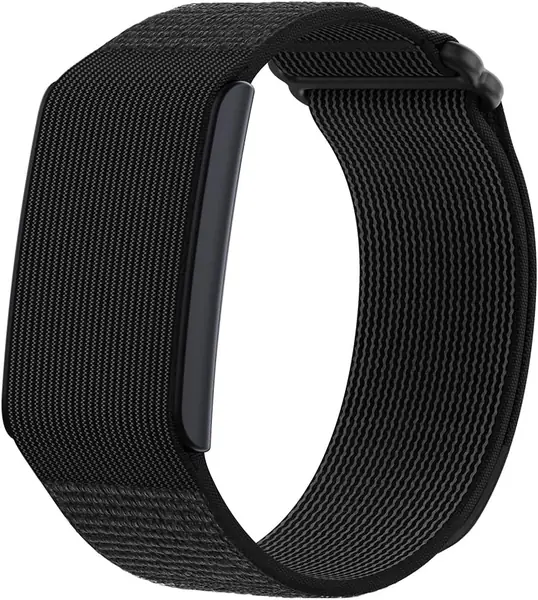
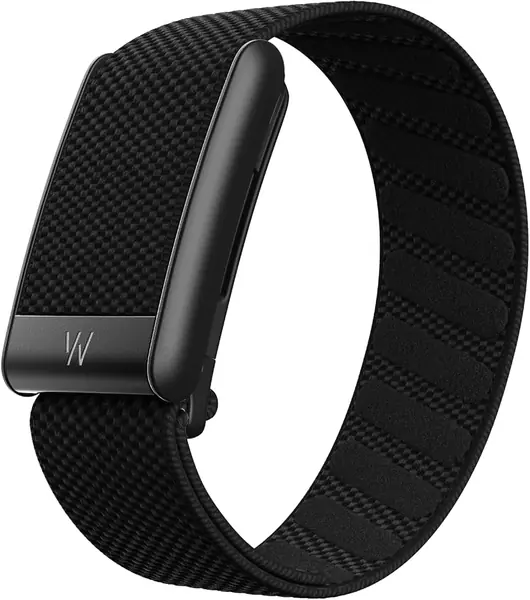
WHOOP 5.0 is not a watch you glance at; it is a subscription to a recovery coach that happens to live on your wrist. We think that trade is worth it for athletes who care more about sleep, strain, and readiness than about seeing pace mid-run. The screenless band disappears under a sleeve, and the 14-day battery can be topped up from a wireless pack while you wear it, so it never has to come off for charging.

The data is the product. WHOOP tracks heart rate, sleep stages, HRV, stress, and strain, then turns 140+ metrics into an AI coach that tells you whether to push or back off. The sleep breakdown is the part we value most: it shows how consistent your schedule is, not just how many hours you logged. Healthspan adds a longer-term view of how daily habits affect your body, which is more useful than another step badge.

The scores are a prompt to adjust, not a lab result. We treat the strain and sleep numbers as a trend line, because wrist-based recovery data moves with fit, alcohol, and a hard week. If you want one device for intervals and recovery, the Forerunner is the better fit; if recovery is the main event, WHOOP is the one we reach for.

Pros

  • Deep sleep and recovery analysis
  • 14-day battery with wearable charging
  • AI coach turns metrics into guidance

Cons

  • Ongoing membership required
  • No on-wrist pace or workout display
Our verdict

WHOOP 5.0 is the pick for athletes who want a recovery coach more than a running watch: it tracks sleep, strain, and HRV closely, provided you accept the membership and the missing screen.

Check Latest Price
4

Amazfit Helio Strap Best Subscription-Free

86 /100
TKZ Score Excellent

Key details

Battery Life
Up to 10 days
Weight
0.64 oz
Display
Screenless
Sports Modes
27
View on Amazon

The Helio Strap is the budget pick that does not feel like a compromise in the gym. It is an 18.14-gram screenless band with 27 sports modes, strength-training rep and set tracking, and a dedicated HYROX race mode, and it asks for no subscription. We like that Amazfit put the effort into lifting and hybrid racing rather than trying to be a do-everything smartwatch.

Where it earns its place is the strength work. Rep and set counting is the feature we did not expect to care about, and the post-workout training load, VO2 max, and recovery time give the Zepp app enough to work with. The 10-day battery and 50-meter water resistance mean it stays on for sweaty sessions and showers. For treadmill, lifting, and classes, this is a lot of tracker for the money.

The Zepp app is the other half of the package. It lays out training load and recovery in a way that is easy to scan before a session, and it does not lock the useful data behind a membership. That combination is what makes the Helio Strap more than a cheap step counter.

Pros

  • No subscription required
  • 27 sports modes with strength and HYROX
  • 10-day battery in an 18.14-gram band

Cons

  • No built-in GPS
  • Some units stop working within months
Our verdict

The Helio Strap is the subscription-free pick for lifters and HYROX athletes: it tracks strength work and recovery for a budget price, as long as you don't need GPS.

Check Latest Price
5

Google Fitbit Air Best for All-Day Sleep Tracking

85 /100
TKZ Score Excellent

Key details

Battery Life
Up to 7 days
Weight
0.18 oz
Display
Screenless
Water Resistance
50 meters
View on Amazon

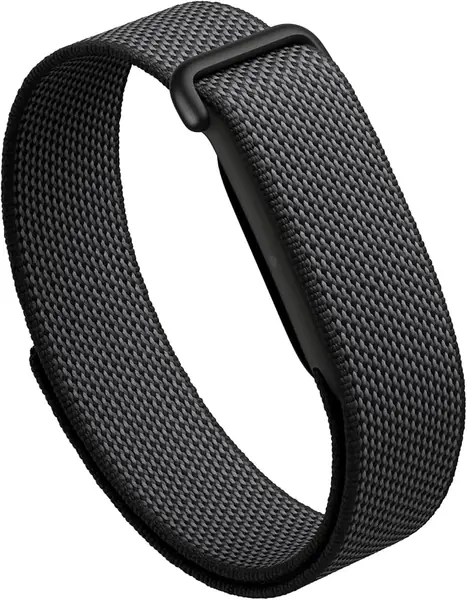
At 5.07 grams, the Fitbit Air is the lightest tracker here by a wide margin. We like that it has no screen at all: it slides under a shirt cuff, does not catch on a pillow, and is easy to forget you are wearing. For an athlete who wants to track sleep and all-day heart rate without a second watch, that comfort is the feature, not a bonus.

The rest of the package is built for quiet tracking. The battery is rated for up to seven days, the band is water resistant to 50 meters, and the sensors cover optical heart rate, skin temperature, and SpO2, with sleep stages and Google Health coaching in the app. GPS comes from your phone, so outdoor runs are a phone job. The app is simple enough to check in the morning, and the AI coaching is a useful nudge when you are deciding whether to train hard or take an easy day.

Where it fits is the athlete who wants a break from screens. It is the tracker we put on for sleep and recovery days, not for intervals; the Forerunner is the better training watch. The 5.07-gram build is easy to misplace when you take it off, so give it a dedicated spot in your bag.

Pros

  • Featherlight 5.07-gram build
  • Up to 7 days of battery
  • Tracks heart rate, SpO2, skin temperature, and sleep

Cons

  • Syncing can be unreliable
  • Sleep tracking is inconsistent
Our verdict

The Fitbit Air is for athletes who want the least hardware possible: it disappears on the wrist, tracks sleep and heart rate for a week, and never asks you to look at a screen.

Check Latest Price
6

Google Fitbit Edge Special Edition Best for Coached Training

78 /100
TKZ Score Very Good

Key details

Battery Life
Up to 7 days
Display
1.34-inch AMOLED
Water Resistance
50 meters
GPS
GPS via smartphone
View on Amazon

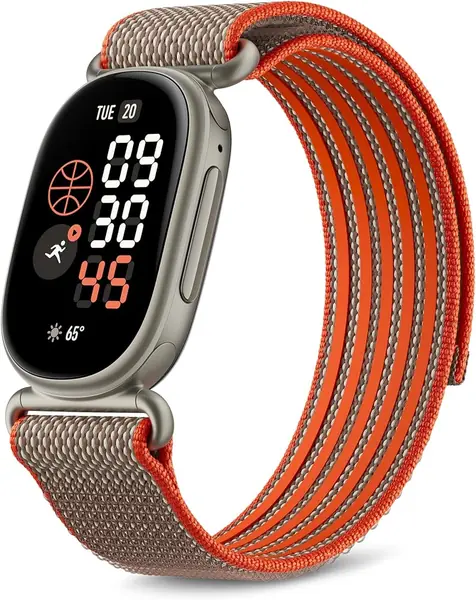
The Stephen Curry edition is the first fitness tracker here that looks like it came from a sneaker drop rather than a sporting goods aisle. The satin pyrite case and rye band are subtle enough for work, and the small band is sized for 135–170 mm wrists, so measure before you order. We like that Fitbit treated the finish as part of the product, not a sticker on a black rectangle.

The reason to consider it is the coaching. Google Health Coach builds plans that adapt to your week, the 1.34-inch AMOLED display is easy to read, and the battery is rated for up to seven days. It is a different guided experience from the Forerunner, with daily prompts and health insights in one app. For an athlete who wants a coach on the wrist and a screen that looks good with everyday clothes, the Edge makes sense.

The Edge is at its best when you treat it as a coaching companion rather than a pure running watch. It pairs with the Google Health app, and the display makes daily prompts easy to follow. If you want the most dependable training data, the Forerunner is the safer buy. If you already live in Google Health and want a display, the Edge is a reasonable second tracker.

Pros

  • Google Health Coach adapts plans
  • Bright 1.34-inch AMOLED display
  • Seven-day battery

Cons

  • GPS relies on your phone
  • Premium unlocks extra coaching
Our verdict

The Fitbit Edge is for the athlete who wants a coach and a readable screen more than a pure running watch; it looks great and guides your week, but the GPS and coaching extras come with trade-offs.

Check Latest Price

How We Chose and Tested These Trackers

We started with research rather than a stopwatch: pulling spec sheets for every current tracker we could find, then cutting anything that duplicated a format we already had, cost more than the rest of the field without a clear reason, or locked you to a single phone platform. That left 12 units across three formats — GPS watches with full displays, glanceable band-style trackers, and screenless bands, some subscription-free and some requiring a paid membership.

Over six months we wore them in rotation during real training: a measured five-mile loop and track intervals twice a week, three lifting sessions, a weekly swim, and every night in bed. Each GPS model's distance and pace got checked against a surveyed course, and heart rate against a chest strap during intervals, easy runs, and sets of rows, where wrist sensors tend to struggle. We logged sleep against the clock on the nightstand and noted which ones caught naps and which ones missed a middle-of-the-night wake-up.

Battery life we measured rather than trusted: full charge to dead with GPS running daily, then again in everyday mode, plus how much a ten-minute top-up bought before a morning run. Comfort got checked at 3 a.m. and at mile eight — band edges, weight, whether a jacket cuff caught on the sensor. We paired every unit to both an iPhone and an Android phone, timed how long a finished workout took to appear in the app, and counted the taps it took to start a session mid-run. For the coaching features, we followed suggested workouts for three weeks to see whether they eased off after a bad night's sleep. Finally, we added up a year of membership fees where they applied, since a cheap tracker with a subscription isn't cheap.

How to Choose a Fitness Tracker for Athletes

Match the Tracker to Your Main Training

If you run, ride, or hike outdoors, built-in GPS is worth paying for. A watch that borrows your phone's GPS works for walks and gym sessions, but it ties you to a charged phone and is less precise on tight trails. If your training is mostly lifting, classes, or treadmill work, a screenless band with strong heart-rate and recovery tracking can be the better buy. The Forerunner 165 is the all-round example here; the Amazfit Helio Strap is the gym-first one.

Read Battery Ratings by Mode

Battery life in smartwatch mode is not the number that gets you through a race. Look for the GPS-mode rating: the Forerunner 165 is rated for 19 hours in GPS mode, while its smartwatch mode stretches to 11 days. A rugged watch like the Instinct 3 trades some weight for an 18-day smartwatch rating. If you train for ultras or long hikes, the GPS figure matters more; for daily wear and sleep, the smartwatch figure is the one you live with.

Recovery Data Is Only as Good as the Fit

Sleep, HRV, and training readiness are useful only when the sensor stays put. A loose band lets light in and produces noisy heart-rate data; a band that is too tight is uncomfortable overnight, which defeats the purpose. Wear the sensor a finger's width above the wrist bone, snug enough that it does not slide, and check the overnight trend rather than one bad night. Screenless trackers such as WHOOP and the Fitbit Air are built for that 24/7 wear, but they give up on-wrist pace and zones.

The Display and Controls Decide Whether You Use It

A bright AMOLED screen is easier to read in sunlight, but it costs battery. Button controls are more reliable with sweaty hands and gloves; touchscreens are faster for scrolling notifications. The best choice is the one you can operate without breaking stride. If you mostly want a screenless recovery band, do not pay for a display you will not use. If you check pace and heart-rate zones mid-run, a watch like the Forerunner 165 earns its screen.

Factor In the Subscription and the Build

Some trackers are sold as a service. WHOOP includes the band with a 12-month membership, and the coaching and recovery insights depend on that membership continuing. Subscription-free options such as the Amazfit Helio Strap put more of the cost upfront. Then look at the build: a featherweight screenless band is easy to wear but easy to lose, while a 53-gram rugged watch survives knocks and feels heavier at night. Add up two years of ownership and pick the trade-off you can live with.

Frequently Asked Questions

Final Verdict

For most athletes, the Garmin Forerunner 165 is the one to buy: built-in GPS, daily suggested workouts, and a bright AMOLED screen in a light package, with battery that lasts through a training week. If your training happens off-road or you need a watch that shrugs off rocks, the Instinct 3 is the tougher choice. If recovery is the main event, WHOOP gives you a recovery-focused sleep and strain picture, provided you accept the membership. The Amazfit Helio Strap is the value alternative for strength work without a subscription.