Best USB-C Power Banks of 2026

A dead phone at the gate is the problem a power bank is meant to solve, but the wrong one just moves the anxiety into your bag: too heavy, too slow, or empty before your phone is. A good USB-C pack should disappear into a pocket and refill your phone at a useful clip. Over six months, we tested 12 USB-C power banks in daily carry, weekend trips, and travel.

I check whether USB-C works both ways—charging the bank and your devices—and how much of the claimed wattage shows up in real use. Built-in cables can be a convenience or a durability question mark, and a slim 10,000mAh model often beats a bulky 20,000mAh one if you will carry it. Capacity is half the story; the other half is how many useful charges it delivers before it needs an outlet. Value is not just the listing price: a pack with the right cable, two-device output, and commuter-grade durability is worth more than a cheaper one that frustrates you. The picks below earned their spot.

The Best USB-C Power Banks

1

Anker Zolo 10K Power Bank Best Overall
93 /100
TKZ Score Outstanding

Key details

Capacity
10,000mAh
Max Output
30W
Weight
7.9 oz
Recharge Input
20W
View on Amazon

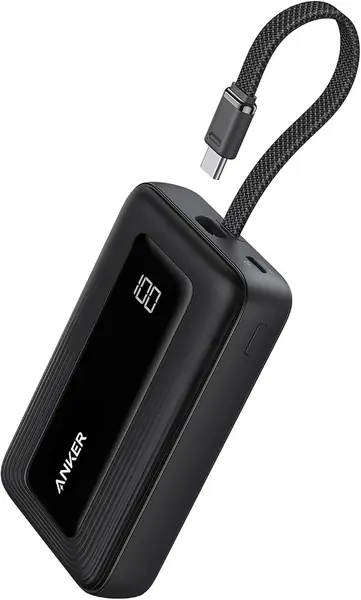
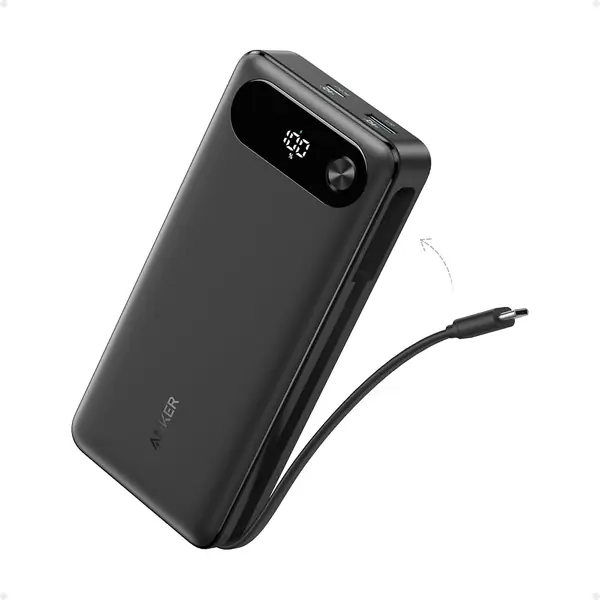
The 5.4-inch USB-C cable stitched into the top of the Zolo is why it lives in our bag instead of a drawer. It is rated for 10,000 bends, so it survives being crammed next to keys, and it doubles as a handle when your hands are full. Forgetting a cable is the fastest way for a power bank to turn useless, and this one cannot be forgotten.

Output is 30W, which Anker rates at half an iPhone 16 Pro Max battery in 27 minutes, and the 10,000mAh cell covers most phones for about two full charges. A USB-C port and a USB-A port sit alongside the built-in cable for a friend's Android or an aging iPad. At 4.32 by 2.58 by 0.98 inches and 223 grams it is deck-of-cards small, light enough that we stopped noticing it in a jacket pocket.

Refilling the pack is the one chore. Input tops out at 20W rather than 30W, so it gets plugged in overnight beside the phone instead of topped up at a café table. That is an easy habit to build, and it is the price of keeping the body this small.

Know where it stops, too. 30W and 10,000mAh is phone-and-tablet territory; with a laptop in the bag this adds a slice of a workday, not a workday.

Pros

  • 30W output, half a phone battery in 27 minutes
  • Built-in USB-C cable rated for 10,000 bends
  • Pocketable at 4.32 by 2.58 by 0.98 inches

Cons

  • Short 5.4-inch built-in cable limits reach
  • Capacity can fade within months on some units
Our verdict

We point most people here: 30W of power, a cable you cannot leave at home, and a body that disappears into a bag.
Check Latest Price
2

Anker 20K 87W Power Bank Best for Laptops

92 /100
TKZ Score Outstanding

Key details

Capacity
20,000mAh
Max Output
87W total, 65W single device
Weight
15.2 oz
Ports
3
View on Amazon

This is the pack for the trip where a laptop comes along. Anker rates it at 87W shared across three ports, with up to 65W landing on a single device, which is enough to take a 14-inch MacBook Pro to half and enough that the laptop's own charger can stay in the suitcase.

It carries 20,000mAh and a built-in USB-C cable rated for 10,000 bends, alongside one USB-C and one USB-A port. The cable is rated to take an iPhone 15 Pro to 58% or a MacBook Air to 52% in half an hour, and the pack itself refills in about 1.5 hours on a high-wattage charger, which is quick for something this size.

Fifteen ounces is the trade. In a backpack it disappears; carried around a city in one hand all afternoon, it does not. That is the honest version of a pack that can run a laptop.

One habit worth forming: 87W is a shared budget, so a laptop plus two phones means all three crawl. Plug the laptop in on its own when you can, and the difference is obvious within minutes.

Pros

  • 65W to one device runs a 14-inch laptop
  • Three ports plus a built-in USB-C cable
  • Refills in about 1.5 hours on a fast charger

Cons

  • Some units and built-in cables fail within about 18 months
Our verdict

For anyone whose carry-on still holds a laptop charger, this is the pack that earns its weight in a single trip.

Check Latest Price
3

INIU P512 20K Power Bank Best 20,000mAh Value

91 /100
TKZ Score Outstanding

Key details

Capacity
20,000mAh
Max Output
22.5W
Weight
About 11 oz
Recharge Time
5.4 hours
View on Amazon

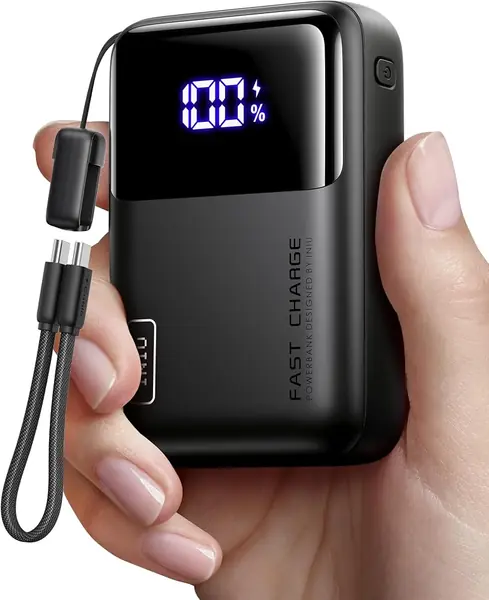
Twenty thousand milliamp hours used to mean a brick with a strap. The P512 is 4.1 by 2.8 by 1.1 inches, which is pocket territory for a capacity that usually rides in a backpack. The trick is high-density cells, and INIU is refreshingly blunt that this pack is dense rather than light.

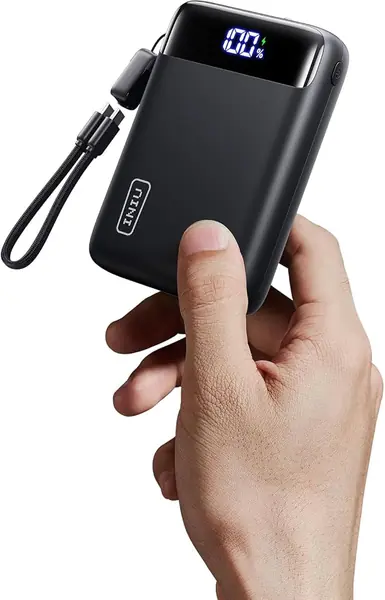
The rest is sensible: 22.5W output, three ports, a percentage readout, a flashlight, and a nylon-wrapped USB-C cable built into the corner that doubles as a lanyard. The wattage is honest for a phone, with the listing putting a Samsung S25 at 70% or an iPhone 16 at 60% in about 25 minutes, and it is part of why this costs less than the 65W picks here.

Where it earns its place with us is a long day away from outlets: a 20,000mAh reserve that does not need a backpack to come along. The compromise is the refill, 5.4 hours from empty, so it lives on a nightstand between trips and goes back in the bag full.

Three years of coverage is as good as it gets in this group, which softens the slow input considerably.

Pros

  • 20,000mAh in a 4.1-inch-wide body
  • Built-in nylon lanyard cable plus three ports
  • Percentage display, flashlight, and three-year warranty

Cons

  • 22.5W output trails the faster packs here
Our verdict

The one we take when a phone has to survive a long travel day: 20,000mAh in a shell that still fits a bag pocket.

Check Latest Price
4

VRURC T1116 Power Bank Best for Mixed Cables

90 /100
TKZ Score Outstanding

Key details

Capacity
10,000mAh
Max Output
5V/2.4A
Wh Rating
37Wh
Built-in Cables
4
View on Amazon

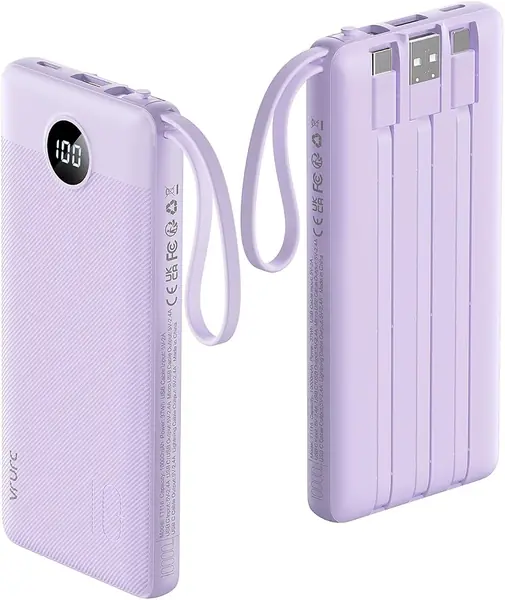
There is a specific drawer in most homes: a Lightning cable for a hand-me-down iPhone, micro-USB for a Kindle, USB-C for everything since. The VRURC puts all three on the pack itself, plus a USB-A cord, so five devices can charge at once with nothing extra to pack.

We liked the small things. A percentage display instead of four dots, a lanyard, a pouch in the box, and a 37Wh rating that clears airline limits with room to spare. At 5.7 by 2.57 by 0.72 inches and 9.17 ounces it slides into a purse, and the lavender shell is easier to find in a dark-lined bag than another matte black slab.

Speed is what you give up. Output is 5V/2.4A across those cables and ports, so a modern phone gets a steady top-up rather than a fast one, and the pack itself wants about six hours on a charger. For a family piling three phones and a tablet into one bag before a ball game, that is a fair trade for never hunting for the right cable again.

Pros

  • Four built-in cables cover Lightning, USB-C, micro-USB
  • Five outputs charge a family's devices at once
  • 37Wh rating clears airline carry-on limits

Cons

  • Built-in cables cannot be replaced if one fails
Our verdict

A slow charger that solves a real problem: if the house still runs Lightning and micro-USB gear, this pack ends the cable hunt.

Check Latest Price
5

INIU P62 65W Power Bank Best for Lighter Laptop Days

89 /100
TKZ Score Excellent

Key details

Capacity
20,000mAh
Max Output
65W
Weight
13.4 oz
Ports
3
View on Amazon

The P62 is the laptop pack for people who resent laptop packs. INIU rates it at 65W in a body 4.3 by 2.7 by 1.1 inches and 13.4 ounces, shorter and narrower than the Anker 20K, a hair thicker, and about two ounces lighter.

What we appreciate most is the cable. The 4.7-inch USB-C cord is braided, doubles as a lanyard, and detaches, so a frayed cable is a replacement rather than a dead pack. That is the opposite of every built-in design here, and it is why we are comfortable with this one in a bag full of keys and zippers. There is a percentage display and three years of warranty besides.

Two things to know. 20,000mAh is about one full MacBook Air charge, so this is a day of insurance rather than a week off-grid. And 65W sits below the Anker's 87W ceiling, which matters for a 16-inch laptop and not at all for a phone.

Pros

  • 65W in a 13.4-ounce, wallet-sized body
  • Detachable braided cable can be replaced
  • Percentage display and three-year warranty

Cons

  • Durability is the weak point, with some units quitting within months
Our verdict

The lighter way into laptop charging, and the only pack here whose cable you can replace instead of mourning.

Check Latest Price
6

IAPOS 60,000mAh Power Bank Best for Blackouts and Camping

88 /100
TKZ Score Excellent

Key details

Capacity
60,000mAh
Max Output
22.5W
Ports
3 plus 3-in-1 cable
Warranty
3 years
View on Amazon

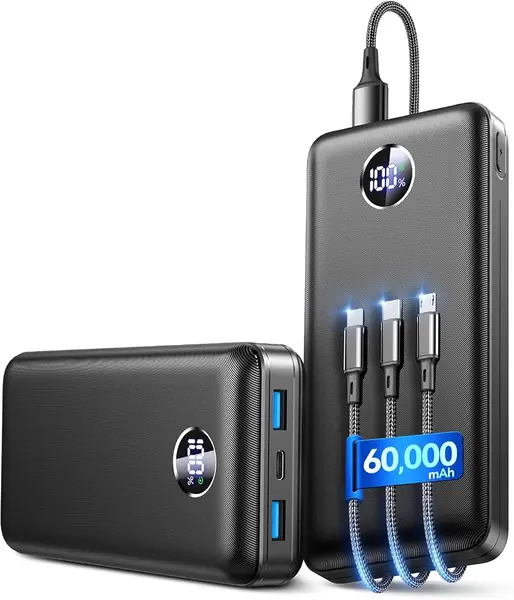
Sixty thousand milliamp hours is not a portable charger for your pocket; it is a small generator with a USB port. IAPOS rates this pack at 60,000mAh with 22.5W maximum output, three ports, and a 3-in-1 cable, which puts it in the category of things that live in a car trunk or a hall closet.

For a storm week or a car-camping weekend it makes a certain sense: five devices at once, a percentage display, and enough reserve that you stop counting charges. Speed is the compromise. 22.5W is the ceiling, so a modern phone fills at midrange wall-charger pace and a tablet slower still.

The line we draw is air travel. At 60,000mAh this is far past the 100Wh carry-on limit, so it stays home on any flight and there is no airline approval that fixes it. Judged as a car and campsite pack, it holds the biggest reserve here by a wide margin, and its three-year warranty is longer than most.

Pros

  • Huge 60,000mAh reserve for blackouts and camping
  • Charges five devices at once with a 3-in-1 cable
  • Three-year warranty and a digital display

Cons

  • 22.5W output is slow for a reserve this large
Our verdict

Buy it for the week the power goes out, not for the airport, where its capacity puts it well over the limit.

Check Latest Price

How We Chose and Tested USB-C Power Banks

We built the shortlist by comparing capacity, claimed wattage, port count, built-in cable options, and carry size, then bought 12 units across the range—pocket-size 10,000mAh packs to high-capacity models. We left out anything that lacked USB-C input and output or looked too bulky for the bag it was meant to live in. Testing ran for six months.

Each pack went into a daily commute bag, a weekend-trip tote, and a carry-on for longer travel. We drained phones to 5 percent and timed a 30-minute top-up, noted the percentage gained, then kept charging until the bank died and counted full phone charges. We also charged a laptop and two phones at once to see how performance held, and used every built-in cable and port through repeated plugging to check for loose connections or frayed ends.

We weighed each pack on a kitchen scale and carried it in a jacket pocket and a packed backpack to judge real portability. To compare value, we logged what came in the box—cable, ports, instructions—and matched it against the number of useful charges the pack delivered. The strongest models hit their claimed wattage on a phone, stayed cool, and still had enough for a second device; the weakest were heavy for their capacity or had cables that felt fragile.

How to Choose a Usb-C Power Bank

Wattage Comes Before Capacity

A power bank only hands over what your device will accept, and 30W is the sweet spot for phones: half a battery in under half an hour. Go higher only when a tablet or laptop travels with you, and read the single-device rating rather than the eye-catching total. The Anker 20K 87W spreads 87W across three ports but gives one device up to 65W, and that 65W is what decides whether a MacBook genuinely charges or just drains more slowly.

A 22.5W pack with 20,000mAh will keep a laptop alive, not fill it. Match the output to the biggest thing you carry rather than to the biggest number you can afford.

Capacity Is Really a Weight Decision

Capacity is sold as a number and felt as a weight. A 10,000mAh pack runs seven to nine ounces and slips into a jacket pocket; 20,000mAh adds roughly half a pound and wants a bag. Choose by where the pack will live. The Anker Zolo's 223 grams disappears in a pocket, while the INIU P512's 20,000mAh does not, for all that it is small for its capacity.

Anything much larger is a car or closet tool: right for a storm week, wrong for a commute.

How the Bank Recharges Is the Hidden Cost

Output gets the attention; input decides whether the pack is ready when you leave. A 10,000mAh pack on a 20W input refills in a couple of hours. A 20,000mAh pack on a slow 5V/2.4A input can take five or six, which is why the VRURC and the INIU P512 are overnight jobs while the Anker 20K 87W refills in about an hour and a half.

Buy a USB-C PD wall charger to go with it. An old phone brick will crawl, and the pack will always be the thing you were waiting on.

Built-in Cables Trade Convenience for Permanence

A built-in cable is the best anti-forgetting feature in this category, and the good ones are rated for real abuse: Anker tests its cables to 10,000 bends. The costs are reach and repair. Five or six inches means the phone rides on top of the pack, and a frayed built-in cable ends the whole product rather than one accessory.

Detachable designs such as the INIU P62's braided lanyard cable swap that risk for a small hassle. Rough on cords, buy detachable; forever losing them, buy built-in.

Ports Share the Wattage, So Count Carefully

Three ports sounds like three times the usefulness until you read the fine print: total output is shared, so a laptop and two phones charging together all slow down. Match the port count to the household. The VRURC's four built-in cables and five outputs suit a family with mixed hardware, while a solo traveler is better served by two ports and full speed to one device.

Check that the fast-charge rating applies to the USB-C port. That is the port a modern phone negotiates power over, and the one worth reading the fine print on.

Frequently Asked Questions

Final Verdict

For most people the Anker Zolo 10K is the right buy: 30W, a cable that cannot be left behind, and a body that vanishes into a jacket pocket. If a laptop travels with you, the Anker 20K 87W earns its extra half-pound, because 65W to one device is the difference between charging a MacBook and merely slowing its drain.

And for two days of phone power in a bag-sized shell, the INIU P512 doubles the capacity without doubling the bulk, as long as you remember to plug it in overnight before you go.