Best 100W Power Banks for Laptops of 2026

Your laptop drops to 8 percent in an airport terminal, every outlet is taken, and the next four hours of work depend on a battery you don't have. That's the moment a 100-watt power bank stops being an accessory and becomes the reason the trip goes fine. These packs have enough output to actually run a laptop, not just trickle a phone back to life.

We've spent the past seven months putting 12 of them through carry-ons, commutes, and long days away from a desk. The number sellers lead with is a single-port figure — 100 watts on one USB-C port often drops once a second device joins in. Watt-hours are the quieter spec: they decide whether the bank clears the airline limit and roughly how many laptop charges you get.

The picks below run from slim packs that vanish into a tote to high-capacity bricks with a display that shows exactly what's left, including a few with the cable built in so you can stop untangling the nest at the bottom of your bag.

The Best 100W Power Banks for Laptops

1

UGREEN Nexode 20,000mAh 130W Best Overall
91 /100
TKZ Score Outstanding

Key details

Battery Capacity
20,000mAh
Weight
1.06 lb
Total Output
130W
Max USB-C Output
100W
View on Amazon

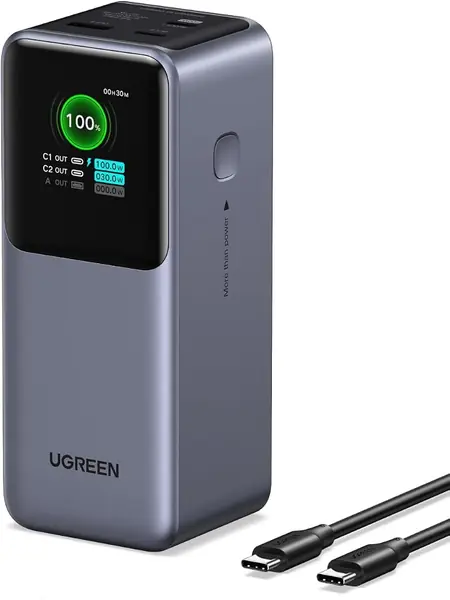
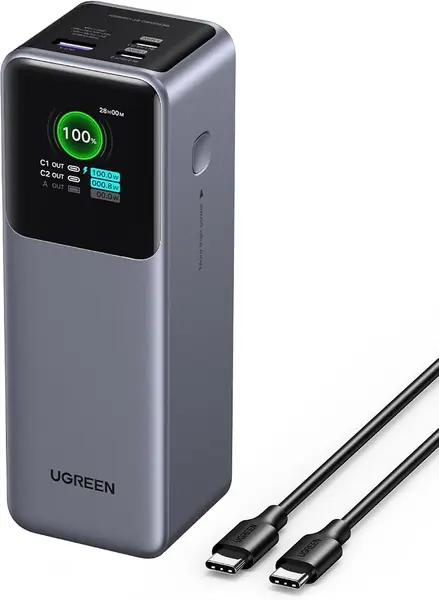
The 130W total output is the number that makes the UGREEN Nexode 20,000mAh 130W our top pick. One USB-C port carries the full 100W a laptop needs, leaving roughly 30W for a phone or tablet, and the 20,000mAh battery works out to 72Wh—small enough to treat as a daily carry rather than a travel-only brick. We like that the bank does not make you choose between a fast laptop charge and a second device.

The TFT screen is more useful than the usual four dots. It shows the battery percentage, the wattage moving in and out, and an estimate of remaining time, so we could see whether a laptop was actually pulling 100W or settling for a slower profile. The column shape slips into a backpack pocket more easily than the square 25,000mAh banks here, and the 65W input refills faster than the basic 20W ports on cheaper banks, so a lunch break can make a real difference.

What holds it back is capacity rather than power. A 72Wh pack will not carry a power-hungry 16-inch laptop through a full day of heavy work the way a 25,000mAh model can, and the 130W total is shared once you add a third device. For commuting, school, and a day of mixed use, that is the right trade. We keep coming back to it because it gives the two things a laptop bank needs most—a real 100W port and a clear read on how much power is left—without the bulk of the largest packs.

Pros

  • Real 100W USB-C laptop output
  • Useful TFT display with watts and time
  • 72Wh capacity is airline-friendly

Cons

  • Noticeable heft for a 20,000mAh bank
Our verdict

We recommend the UGREEN Nexode 20,000mAh 130W for most laptop bags, thanks to its 100W port, useful display, and airline-friendly capacity.
Check Latest Price
2

Anker 25,000mAh 165W Best for Multiple Devices

90 /100
TKZ Score Outstanding

Key details

Battery Capacity
25,000mAh
Total Output
165W
USB-C Ports
3 at 100W each
Built-in Cables
Two USB-C
View on Amazon

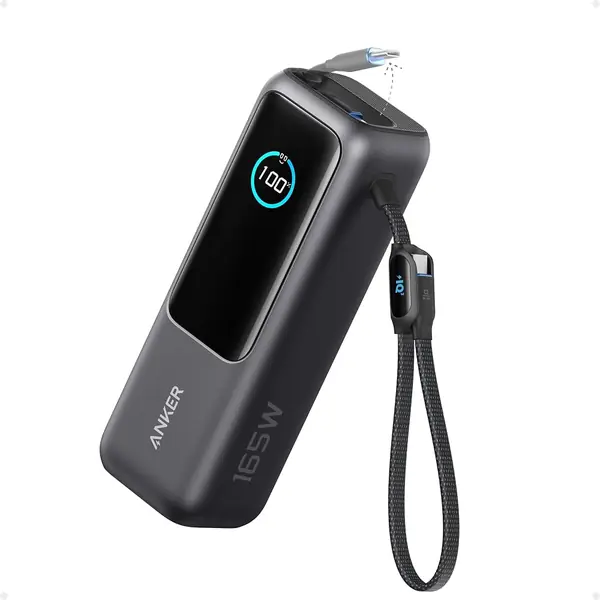
Two built-in USB-C cables separate the Anker 25,000mAh 165W from the rest of this group. The long one extends to 2.3 feet and is rated for 20,000 retractions; the short one runs 0.98 foot and doubles as a carry strap. Add three USB-C ports that each accept up to 100W and a USB-A port, and the Anker can feed a laptop, phone, tablet, and earbuds without a tangle of loose cables.

We think that cable arrangement is worth the bulk if you travel with more than one device. The retractable cable reaches from a seat-back pocket to a lap, while the short cable keeps a phone close without a tail hanging off the tray. The 165W total output is the part to understand: three 100W ports do not add up to 300W, and the bank will allocate power as devices ask for it. For a laptop plus a couple of smaller devices, that is plenty; for two 100W laptops at once, it is not.

The 25,000mAh capacity is marketed as flight-ready, but with 25K packs you should still check the printed watt-hour rating against your airline's limit. We rate it as the most convenient multi-device bank here when the cables save you from packing three of your own. It is a travel tool more than an everyday pocket bank, and that is exactly how it should be judged.

Pros

  • Two built-in USB-C cables
  • Three 100W USB-C ports
  • 25,000mAh for long travel days

Cons

  • Heavy enough to notice in a backpack
  • Built-in cables are a wear point
Our verdict

We recommend the Anker 25,000mAh 165W for travelers who want two built-in cables and enough ports to charge a laptop, phone, and tablet together.

Check Latest Price
3

UGREEN Nexode 25,000mAh 200W Best for High-Power Laptops

89 /100
TKZ Score Excellent

Key details

Battery Capacity
25,000mAh
Weight
1.12 lb
Total Output
200W
Max USB-C Output
140W
View on Amazon

If the top pick's 130W total feels like a ceiling, the UGREEN Nexode 25,000mAh 200W lifts it. USB-C1 alone can deliver 140W, USB-C2 up to 100W, and the bank can push 200W across its ports. That makes it the pick for a 16-inch MacBook Pro, a high-power Windows laptop, or a handheld gaming PC that wants more than the standard 100W profile.

The 25,000mAh capacity, or 90Wh, is the other half of the argument. It sits under the common 100Wh airline limit and gives you more room for a long flight or a full day away from outlets. We also like the TFT display: it shows remaining time, live output and input wattage, and voltage, which is more than most banks offer and helps you see when a laptop has dropped to a slower profile. The 140W port is the one to use for the biggest laptop; the second port is better saved for a phone or tablet.

This is a desk-away-from-desk bank, not a pocket one. The column body takes up real bag space, and the 200W total is shared rather than available to every port at once. For someone carrying a single 13-inch laptop, the lighter 20,000mAh top pick makes more sense. For a 16-inch machine or a Steam Deck, the extra headroom is the reason to accept the size.

Pros

  • 140W from a single USB-C port
  • 200W total across three ports
  • TFT display shows live power data

Cons

  • Noticeable weight in a small bag
Our verdict

We recommend the UGREEN Nexode 25,000mAh 200W when a 16-inch laptop or Steam Deck needs the highest USB-C wattage and capacity matters more than weight.

Check Latest Price
4

INIU 25,000mAh 100W Best Compact 25K

88 /100
TKZ Score Excellent

Key details

Battery Capacity
25,000mAh
Weight
15.8 oz
Ports
2 USB-C, 1 USB-A
Max Output
100W
View on Amazon

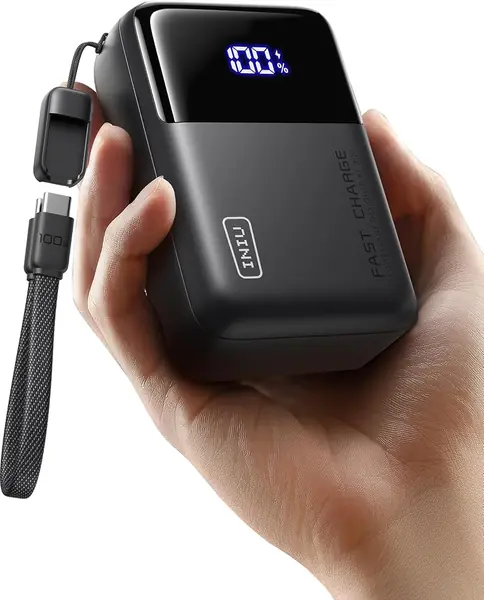
A 25,000mAh battery that fits in a jacket pocket is the INIU's opening argument. The body measures 4.3 by 2.7 by 1.4 inches and weighs 15.8 ounces, so it is compact for the capacity even though it is not truly pocket-light. It has two USB-C ports and one USB-A, a display, and a 100W USB-C output. The included 0.4-foot USB-C cable is a nice touch because it can live in the bag without adding much bulk.

We like it as the travel compromise: more capacity than a 20,000mAh bank, less bulk than the 25,000mAh bricks with built-in cables. The 100W port can feed a laptop while the other USB-C port handles a phone, and the display is large enough to read at a glance. The 25,000mAh rating puts it in the same travel class as the larger picks, but it is close enough to the 100Wh airline ceiling that the printed watt-hour label is worth a look before you fly.

The caveats start with weight. At 15.8 ounces it will pull on a light jacket, and the compact body is thick enough to feel in a slim bag. We treat the three-year warranty as part of the value, because a bank this dense is doing a lot in a small shell. It is not the bank for someone who wants one cable built in and nothing else to carry. It is the bank for someone who wants the most capacity in the smallest shell and is willing to keep its short cable in the bag.

Pros

  • 25,000mAh in a compact body
  • 100W USB-C output
  • Three-year warranty

Cons

  • Reliability is the weak spot over time
Our verdict

We recommend the INIU 25,000mAh 100W for travelers who want high capacity and 100W in a small footprint, with the caveat that long-term reliability varies.

Check Latest Price
5

EcoFlow Rapid 25,000mAh 170W Best Value High Output

86 /100
TKZ Score Excellent

Key details

Battery Capacity
25,000mAh
Weight
20 oz
Total Output
170W
Max USB-C Output
140W
View on Amazon

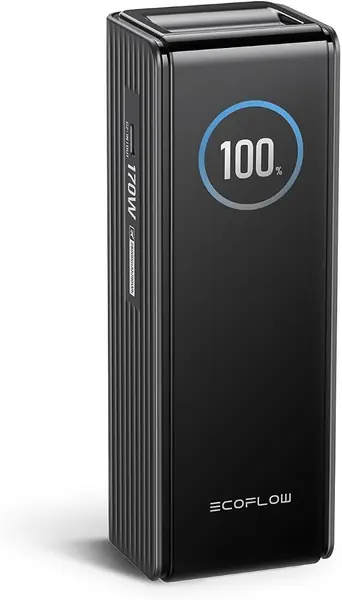
The EcoFlow Rapid 25,000mAh 170W pairs two 140W USB-C ports with a 25,000mAh battery for less than the premium 25K banks here. It also has a 33W USB-A port, a TFT screen that shows battery level and per-port output, and a 170W total output. On paper, it looks like the value pick of the group.

The 140W ports are the useful part. They can charge a 16-inch laptop at its full rate or top up a Steam Deck and a phone at the same time, and the 25,000mAh capacity gives you enough for a long travel day. The screen is genuinely informative rather than decorative: it shows the battery percentage, charging speed, and how much each port is pulling. The square body takes up more room than the column-shaped UGREENs, so it belongs in a backpack rather than a pocket.

That combination is why it earns the value slot. You get the 140W ceiling and the capacity for less money than the premium picks, and the two-year warranty helps. The display makes it easy to see when a laptop has settled for a lower wattage. If you mostly charge a phone and a 13-inch laptop, the lighter 20,000mAh UGREEN is the easier carry; if you need 140W on a budget, this is the one.

Pros

  • Two 140W USB-C ports
  • 170W total output
  • 25,000mAh capacity

Cons

  • Heavy at 20 ounces
  • Reliability is less proven than the top picks
Our verdict

We recommend the EcoFlow Rapid 25,000mAh 170W when you want 140W USB-C ports and high capacity for the least money in this group, and can live with the weight.

Check Latest Price
6

Baseus Blade 20,000mAh 100W Best Flat Design

85 /100
TKZ Score Excellent

Key details

Battery Capacity
20,000mAh
Ports
2 USB-C, 2 USB-A
Max Output
100W
Thickness
0.78 in
View on Amazon

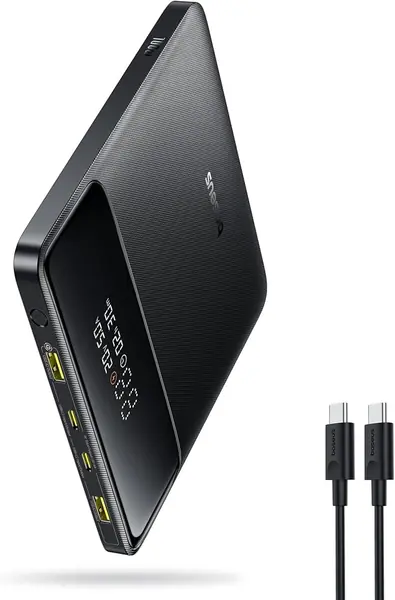
The Baseus Blade 20,000mAh 100W is built around a flat, square body that measures 5.27 inches on each side and 0.78 inch thick. It has two USB-C ports, two USB-A ports, a digital display, and a 100W USB-C output. The shape is the point: it slides into a laptop sleeve beside a 13- or 14-inch notebook without creating the usual brick-shaped bulge.

The flatness also makes it stable on a tray table or desk, and the 100W port is enough to run a laptop while a second device charges from another port. A 100W USB-C cable is included, which matters because the bank has no built-in cable. The 20,000mAh capacity is the same class as the top pick, so it stays in airline-carry-on territory, though you should still check the printed watt-hour rating against your airline's rule.

The 451-gram weight is noticeable when you pick it up, and the flat shape means the ports sit on one edge, so a right-angle cable is easier to manage in a tight sleeve. Those are small things, but they matter if you plan to carry it every day. The square body also spreads the weight across a laptop sleeve instead of concentrating it in one lump.

This is the one for the specific person who wants a laptop bank to disappear into a sleeve or briefcase. It does not have the built-in cable convenience of the Anker or the capacity of a 25,000mAh pack, but it is easier to pack than either. If you carry a backpack with a padded laptop compartment, the flat shape earns its place; if you want a bank for a jacket pocket, choose the INIU instead.

Pros

  • Flat body slides into laptop sleeves
  • 100W USB-C with four ports
  • 20,000mAh capacity in a slim body

Cons

  • Square shape is awkward in a pocket
Our verdict

We recommend the Baseus Blade 20,000mAh 100W for commuters who want a laptop bank to lie flat in a sleeve rather than ride in a pocket.

Check Latest Price
7

REWONDER 20,000mAh 100W Best for Cable-Free Commutes

84 /100
TKZ Score Excellent

Key details

Battery Capacity
20,000mAh
Ports
4
Max Output
100W
Built-in Cable
27.6 in retractable
View on Amazon

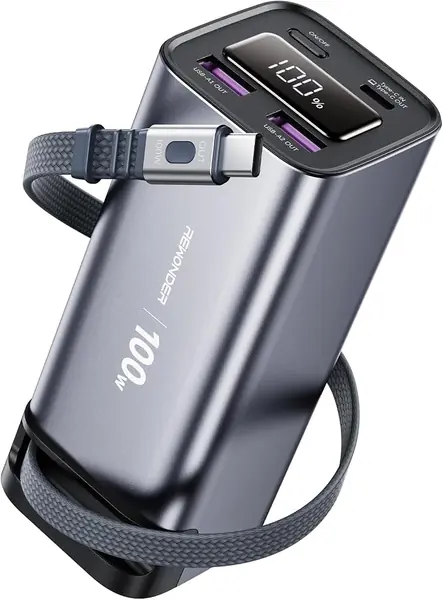
The REWONDER 20,000mAh 100W puts a 27.6-inch retractable USB-C cable inside the bank, with a magnetic catch to keep the end tidy. That cable is rated for 100W, and there is a second 100W USB-C port plus two 22.5W USB-A ports. The idea is simple: leave the house with the bank and no loose cable, then pull out as much cable as you need.

The rest of the package is practical for the money. The 20,000mAh capacity is 72Wh, the LED display shows the remaining percentage, and the bank is UL and FCC certified. It weighs 458 grams, so it is not the lightest 20,000mAh option here, but the rounded body is easy to hold. The retractable cable is the feature that makes it worth considering over a plain budget bank: it reaches from a bag to a lap without adding a separate cable to lose.

It is the budget pick for the buyer who wants that convenience without the Anker's price. At 458 grams it is a bag bank, not a pocket one, but the rounded body is easy to slide into a backpack. For a student or commuter who wants one less thing to forget for a laptop, that is a fair trade. The 72Wh capacity and 100W cable are enough for a light laptop day, and the percentage display makes the remaining power easy to read.

Pros

  • 100W retractable built-in cable
  • Four ports including two USB-A
  • Clear percentage display

Cons

  • Only one cable included for four ports
Our verdict

We recommend the REWONDER 20,000mAh 100W for budget-minded buyers who want a retractable 100W cable and a display without paying premium prices.

Check Latest Price
8

TALIX 10,000mAh 100W Best for Light Day Trips

79 /100
TKZ Score Very Good

Key details

Battery Capacity
10,000mAh
Weight
9.88 oz
Ports
3
Max Output
100W
View on Amazon

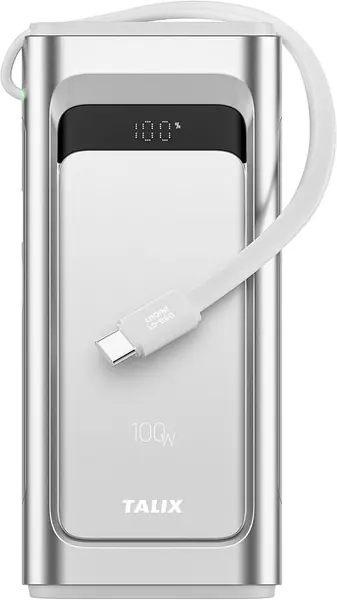
The TALIX 10,000mAh 100W starts with a deliberate limitation: 10,000mAh is enough for a partial laptop charge rather than a full workday. That is the right way to read it. It is a small, 280-gram bank with a built-in USB-C cable, a 100W USB-C output, two more ports, and a digital display.

The size is the reason to pick it. At 5.59 by 2.56 by 0.95 inches and 280 grams, it disappears into a small bag, and the built-in cable means there is nothing to forget. The 100W output is genuinely useful for a MacBook Air or a thin Windows laptop, and the 30W input means it refills faster than a basic 10W or 18W bank. The display shows the remaining percentage, which is more than you get on many small packs.

The obvious trade is capacity. A 10,000mAh bank will not carry a 16-inch laptop through a workday, and it will not charge a phone and a laptop several times over. The 100W output also depends on the device negotiating that profile and on the built-in cable staying healthy. If you need a full day of laptop power, a 20,000mAh or 25,000mAh bank is the better tool.

This is a commuter top-up, not a primary laptop battery. It is the smallest and lightest pick here, and the built-in cable makes it easy to keep in a bag for the day you forgot to charge. If your laptop is your main work machine and you regularly run it down, spend the capacity elsewhere.

Pros

  • Light at 280 grams
  • 100W USB-C in a tiny body
  • Built-in USB-C cable

Cons

  • Only one cable included for three ports
Our verdict

We recommend the TALIX 10,000mAh 100W as a light commuter bank for a laptop top-up when you want the smallest carry.

Check Latest Price

How We Chose and Tested 100W Power Banks

We started with a list of about 40 models and narrowed it by reading spec sheets: whether the bank could hold laptop-class output on a single port, whether it stayed under the 100-wh cap most airlines use, how many ports it offered, and whether the built-in cable was genuinely retractable or just a short stub. That left 12, which we bought at retail and used for seven months.

Every bank went into the same rotation. We timed how long each took to push a drained laptop from 10 percent to 50 percent, then ran it again with a phone plugged into the second port to see whether the laptop's speed fell. We weighed each one on a kitchen scale, carried it in a tote alongside keys and a water bottle, and recharged the bank itself on a stopwatch to see how fast it was ready for round two.

Once a month we ran a full discharge cycle and logged how much capacity had slipped, and we worked the retractable cables and opened the port covers every time we used them to see what jammed first. Displays got checked against reality — we compared the percentage on screen with how much charge the laptop had actually gained. We also priced everything per watt-hour, because a bank that costs more for the same capacity has to earn the difference somewhere.

By the end, the ones we kept reaching for were the boring ones: no dropped connections, no sudden capacity drops, no fighting with a cable that wouldn't retract.

How to Choose a 100W Power Bank

Match the port, not the total

Power banks advertise total output, but a laptop only sees one port. Our top pick can send 100W through one USB-C port and about 30W through another, while a 200W bank may reserve 140W for its first port. Three ports labeled 100W do not mean 300W; the Anker's 165W total shows how quickly the math changes. We put single-port wattage ahead of total output because that is what determines whether a laptop charges at full speed. Check the total only after that to see what is left for a phone.

Read capacity in watt-hours for travel

Capacity tells you how long the bank lasts, not how fast it charges. A 20,000mAh bank is usually around 72Wh, while a 25,000mAh pack lands around 90 to 93Wh. That matters because 100Wh is the common airline carry-on ceiling; a 25K pack is close enough that you should check the printed label before flying. Expect less usable energy than the cell rating suggests after conversion losses, so a 20,000mAh bank is a workday top-up, not a week of laptop power.

Choose the shape and weight you will carry

Weight is where 100W banks separate. A 10,000mAh model like the TALIX can weigh 280 grams and vanish into a small bag; 25,000mAh packs run from about 15.8 ounces to 20 ounces, and that difference is felt by the end of a commute. Shape matters as much: the Baseus Blade lies flat in a laptop sleeve, while column-shaped UGREENs fit a water-bottle pocket. We prioritize a flat or compact shape for daily carry and save the biggest capacity for travel days when the bag is already full.

Decide whether built-in cables are worth it

Built-in cables remove the most common travel failure: forgetting the cable. The Anker goes further with two built-in USB-C cables, and the REWONDER uses a retractable 100W cable that tucks into the body. The trade is repairability. A built-in cable that stops working can take a port with it, while a detachable cable can be replaced for little. We prefer built-in cables for a one-bag commute and detachable cables for a shared family bank or a laptop bag that already carries cables.

Use the display and warranty as buying tools

A display is not a gimmick on a 100W bank. It shows whether a laptop is pulling the wattage you paid for, how much capacity is left, and when the bank has dropped into a slower mode; the UGREEN and EcoFlow screens show live output, and the REWONDER shows a simple percentage. Warranty length is the other clue: 18 months to three years is common in this set, and a brand that stands behind the cells is worth more than a slightly higher peak wattage.

Frequently Asked Questions

Final Verdict

For most people, we recommend the UGREEN Nexode 20,000mAh 130W. It is the best balance here of a true 100W laptop port, airline-friendly capacity, and a display that tells you what the bank is doing, without the weight of a 25,000mAh brick.

If you routinely charge a laptop and two other devices at once and want the cables built in, the Anker 25,000mAh 165W is the better buy, provided you accept the extra weight and premium.