Best Power Banks of 2026

The airport gate is where a power bank proves itself. I've stood in a boarding line watching my phone slide past 10 percent while every outlet in sight was occupied by someone else's laptop charger, and the only thing that saved the next six hours of boarding passes, rideshares, and messages was a battery pack buried at the bottom of my tote. That's the job: not a gadget you admire, but the thing that keeps your day running when the nearest wall socket is taken. Over the past six months, we've tested 12 of them, from slim pocket packs to bricks that will refill a laptop, and the differences aren't subtle.

Here's what the spec sheet won't tell you. The mAh figure on the box is measured at the internal cells, not at your phone, so a chunk of it disappears to heat and conversion loss before a single percentage point shows up on your screen. Weight is the honest tell, since capacity costs ounces and the banks that can genuinely top off a laptop are ones you'll feel in a jacket pocket. Built-in cables, which almost every maker now brags about, turn out to matter far more in daily use than in the marketing photos, because the one morning you forget a cord is the morning you need one.

The Best Power Banks

1

Anker 20,000mAh 87W Power Bank Best Overall
92 /100
TKZ Score Outstanding

Key details

Capacity
20,000 mAh
Weight
15.2 oz
Max Output
87W total
Built-in Cable
USB-C
View on Amazon

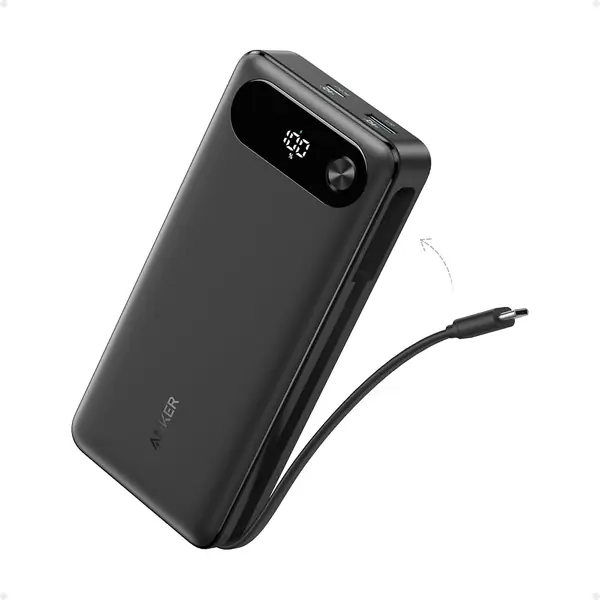
The built-in USB-C cable is the first thing we noticed, and it is why this Anker became our default pick. It tucks into the side of the pack, runs long enough to use a phone while charging, and removes the small packing failure that leaves most people with a dead bank and no cable. Three ports and 87W of shared output mean it can keep a phone, tablet, and thin laptop moving without making you choose one.

The 20,000mAh capacity is the practical middle ground: enough for a couple of phone refills and a tablet top-up, with enough left over to push a laptop through a meeting or a long airport wait. We also appreciate that the USB-C cable is part of the pack rather than an accessory; it is one less thing to lose in a bag. The pack can share power across three devices at once, which matters more than a big single-device number when everyone in the car is low.

The 87W figure is not a marketing ornament. It is the reason this one can stand in for a laptop charger in a pinch, while a basic 10,000mAh pack cannot. Sharing that output across three ports is the useful part: phone, tablet, and laptop can all be plugged in at once, though the pack will divide the wattage rather than give each device its maximum. For a single bag that covers a workday and a weekend, that flexibility is the point.

Pros

  • Built-in USB-C cable saves a packing step
  • 87W shared output handles phone, tablet, and laptop
  • 20,000mAh is a practical travel capacity

Cons

  • Heavier than pocket-size 10,000mAh packs
  • Single-device output tops out at 65W
Our verdict

For most phone and tablet days, plus the occasional laptop top-up, the Anker 20,000mAh 87W is the power bank we recommend.
Check Latest Price
2

Anker 25,000mAh 165W Laptop Power Bank Best for Laptops

91 /100
TKZ Score Outstanding

Key details

Capacity
25,000 mAh
Weight
10.6 oz
Total Output
165W
USB-C Output
100W each
View on Amazon

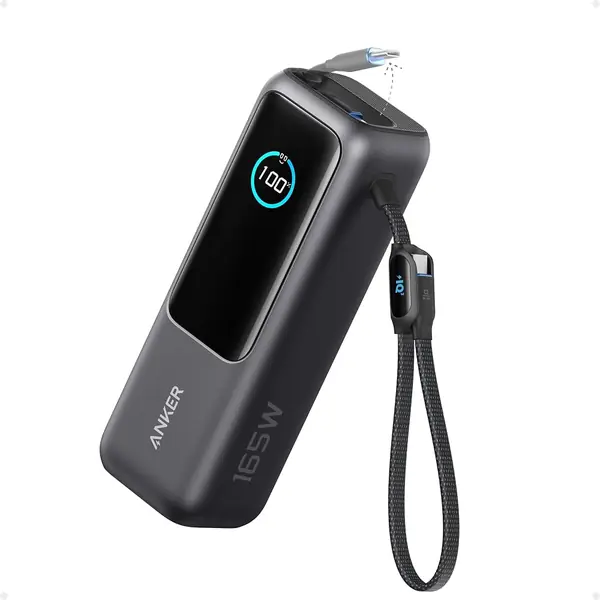
A laptop changes what you need from a power bank. The Anker 25,000mAh 165W is built for the traveler who opens a laptop in an airport lounge, a cafe, or a rental car and cannot afford to watch the battery percentage slide. Three USB-C ports, each capable of 100W, plus a retractable cable and a second short cable make it a complete charging kit rather than a battery with a port.

We like the retractable cable more than we expected. It extends and retracts into the body, so the pack can charge a laptop without a separate cable tumbling out of a bag. The second 0.98 ft cable doubles as a carrying strap. With 25,000mAh on tap, it can refill a phone several times and still leave room for a tablet or a laptop; that is the kind of reserve that turns a delay into a non-event.

The retractable cable reaches 2.3 ft, which is long enough for a table but short for charging from a couch. The payoff is the output: 100W per USB-C port can fast-charge a laptop, and the pack itself can recharge from a 100W charger in about two hours. If your travel is phone-first, the smaller Anker is easier to live with; if work comes with you, this one earns its place.

Pros

  • 165W total output with three 100W USB-C ports
  • 25,000mAh supports laptop and phone charging
  • Retractable built-in cables simplify packing

Cons

  • Heavy at 10.6 oz
  • Some units stop working after months
Our verdict

If your bag has to keep a laptop alive, the Anker 25,000mAh 165W is the pack we reach for, with three 100W USB-C ports and built-in cables.

Check Latest Price
3

IAPOS 60,000mAh Power Bank Best for Off-Grid Trips

90 /100
TKZ Score Outstanding

Key details

Capacity
60,000 mAh
Weight
15.5 oz
Max Output
22.5W
Device Charging
5 at once
View on Amazon

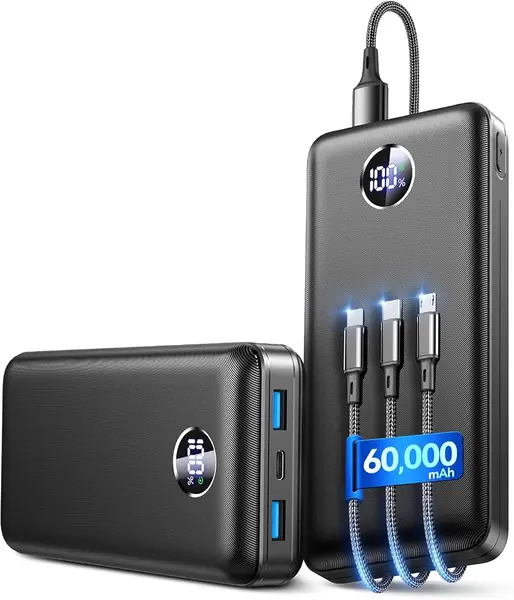
Sixty thousand milliamp-hours is not a number you buy for a commute; it is the number you buy when the outlet is a distant memory. The IAPOS 60,000mAh has enough reserve for a long road trip, a festival weekend, or a household outage, and it can charge five devices at once through its ports and built-in 3-in-1 cable.

The surprise is that it is not a brick. At 15.5 oz and 5.9 by 2.95 by 1.1 in, it fits in a backpack and is easier to carry than its capacity suggests. We like the 3-in-1 cable because it removes the chance of arriving with the pack but without the right cord. The digital display is a small thing that becomes important when the pack takes hours to refill; you can see where it stands before a trip.

For phones, tablets, and a group's cables, it is a lot of reserve for the money. We see it as the pack that lives in the trunk or the camping bin, not the one that goes in a pocket. The capacity is the whole point; if you need a pack that slips into a jacket, choose a 10,000mAh model instead.

Pros

  • 60,000mAh reserve for multi-day trips
  • Charges up to five devices at once
  • Built-in 3-in-1 cable and digital display

Cons

  • Above airline carry-on limits
  • 22.5W is slow for laptop charging
Our verdict

For road trips, camping, and outage duty, we recommend the IAPOS 60,000mAh for its huge reserve and five-device charging.

Check Latest Price
4

Zmmyuluo 10,000mAh Power Bank Best Budget with Cables

89 /100
TKZ Score Excellent

Key details

Capacity
10,000 mAh
Weight
6.6 oz
Built-in Cables
Four
Ports
Three
View on Amazon

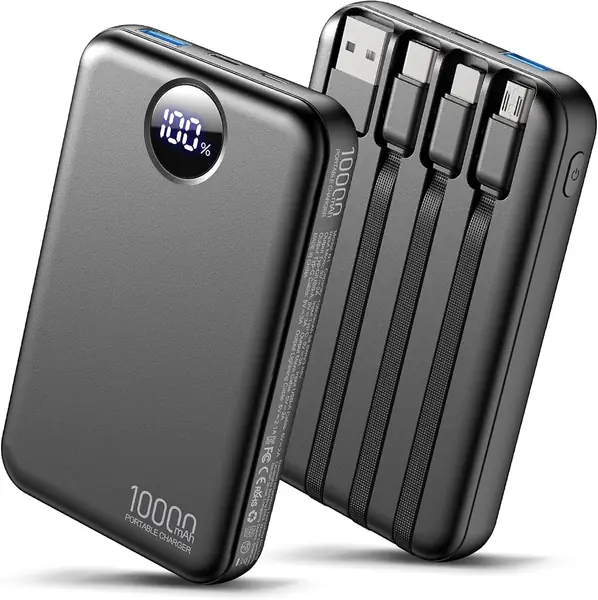
The budget end of the power bank shelf is full of packs that save money by making you supply the cable. The Zmmyuluo flips that: four built-in cables mean an iPhone, an Android phone, a tablet, and a pair of earbuds can all find a connection without a separate pouch of cords. That is the kind of convenience that matters when you are packing in a hurry.

At 188 g and 0.77 in thick, it is small enough to disappear into a tote or a jacket pocket. The LED display shows a percentage rather than four vague dots, which we appreciate on a pack this size; you can see whether it is worth taking before you walk out the door. It also has enough ports to charge several devices at once, so one pack can cover a group's phones at dinner.

The four cables are the reason to choose it, and the LED display makes the pack easy to manage. As a spare portable charger for a commute, a day out, or a second bag, it makes a strong case for itself. We recommend it when cable-free convenience is the priority.

Pros

  • Four built-in cables cover most devices
  • LED percentage display is easy to read
  • Pocketable at 6.6 oz and 0.77 in

Cons

  • Charging speed is modest for newer phones
Our verdict

We recommend the Zmmyuluo 10,000mAh as our budget pick when you want built-in cables, a pocketable body, and a clear battery readout.

Check Latest Price
5

BLAVOR 20,000mAh Solar Power Bank Best for Camping

88 /100
TKZ Score Excellent

Key details

Capacity
20,000 mAh
Max Output
20W USB-C
Built-in Cables
Four
Extra Charging
Wireless phone and watch
View on Amazon

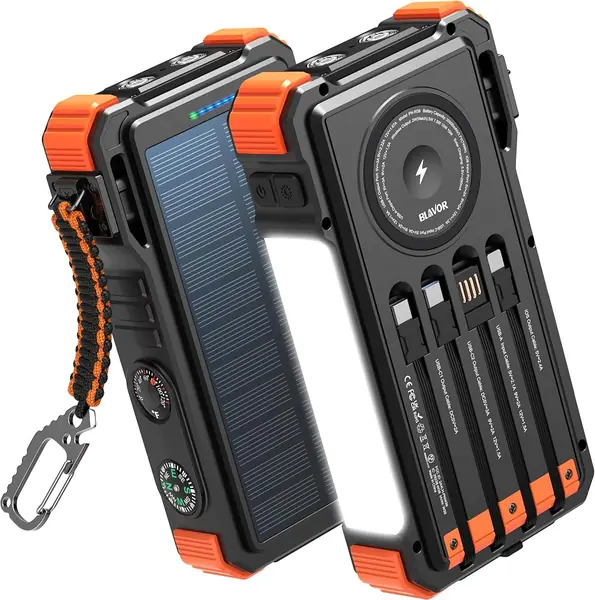
A camping power bank has to do more than top up a phone in a hotel room. The BLAVOR 20,000mAh brings a wireless charging pad, a dedicated Apple Watch charger, four built-in cables, a flashlight, and an IPX5 shell into one pack that can sit on a tent floor without much worry.

We like the watch charger more than the flashlight, and that is saying something. On a weekend trip, a phone and a watch can both charge overnight without a tangle of cables, and the wireless pad is a convenient place to drop a phone. The four built-in cables cover the rest of the family's gear, and the pack can handle up to six devices at once. The rubberized frame feels tougher than the average travel pack, which is the point when it is bouncing around in a duffel.

The solar panel is the part to keep in perspective. It is a trickle top-up for an emergency, not a way to recharge a 20,000mAh pack in an afternoon; treat the wall charger as your main source. For car camping or a basecamp, the solar trickle is a bonus rather than the reason to buy. The wireless pad and watch charger are the features that earn this pack a place in the tent.

Pros

  • Wireless phone and Apple Watch charging
  • 20,000mAh supports multi-device camping use
  • Four built-in cables plus flashlight and IPX5 shell

Cons

  • Heavy and bulky for backpacking
Our verdict

We recommend the BLAVOR 20,000mAh for campers who want wireless phone and Apple Watch charging, a flashlight, and a tough shell in one pack.

Check Latest Price
6

Evopow 2-Pack 10,000mAh Power Bank Two-Pack Backup

86 /100
TKZ Score Excellent

Key details

Capacity
10,000 mAh each
Thickness
0.55 in
Pack Count
2
Output And Input
3 outputs, 2 inputs
View on Amazon

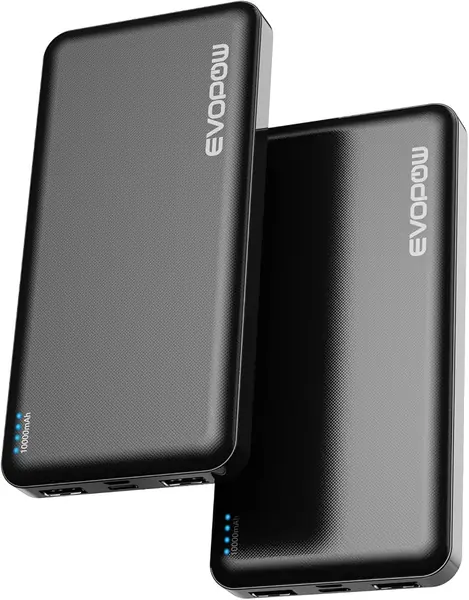
Two packs solve a different problem than one high-capacity pack. Instead of carrying a brick that has to serve every trip, the Evopow two-pack lets one 10,000mAh unit live in the car and the other stay in a bag, so you are less likely to leave the house with an empty battery.

Each pack is 0.55 in thick and 219 g, with three outputs and two inputs. The USB-C port handles both directions, so you can recharge the pack through the same port you use for a phone. We like the pair for its flexibility: two people can charge at once, or one can stay plugged in at home while the other travels. At 37Wh each, they are also well under the usual airline carry-on limit.

The pair is best understood as backup power rather than a daily driver. They are easy to stash, and the two-pack means you can keep one in the car and one in a bag without moving it back and forth. For a family or a couple who want a cheap safety net, that is a sensible trade.

Pros

  • Two 10,000mAh packs for home and car
  • Three outputs and two inputs
  • Slim 0.55 in body

Cons

  • 2.4A output is slow for modern phones
  • No charging cable included
Our verdict

We recommend the Evopow two-pack as a budget backup pair: two slim 10,000mAh packs, enough ports for a family, and no pretense of fast charging.

Check Latest Price
7

Ridge Magnetic 10,000mAh Power Bank Best for Magnetic iPhone Charging

83 /100
TKZ Score Excellent

Key details

Capacity
10,000 mAh
Max Output
20W
Built-in Cables
USB-C and Lightning
Attachment
MagSafe compatible
View on Amazon

The Ridge is the rare power bank that looks as if it belongs on a phone rather than in a drawer. It snaps onto a MagSafe iPhone, folds out into a kickstand, and has charging cables built into the body, so it can charge a phone, a tablet, or a watch without a separate cable.

We like the kickstand more than any spec on the page. It holds the phone at an angle for a video call or a show while the pack charges, which makes the Ridge useful in a hotel room or at a desk where outlets are scarce. The built-in cables are a close second: one is USB-C, one is Lightning, and the magnetic attachment means you can charge wirelessly without lining up a port. The LED charge indicator is easy to read at a glance.

The 10,000mAh cell is sized for a phone and a watch, not a laptop, and the 20W ceiling means it is not the pack for a quick top-up on a power-hungry phone. Those choices keep the Ridge compact, but they also make it a day-out accessory rather than a week-away workhorse.

What stays with us is the kickstand. A power bank is usually a thing you tolerate; the Ridge is a thing you can set on a cafe table, angle toward your face, and forget about while it charges. That is a small pleasure, but it is the one that makes this pack easy to recommend to the right person.

Pros

  • MagSafe attachment doubles as a kickstand
  • Built-in USB-C and Lightning cables
  • Wireless watch charging pad

Cons

  • Premium price for a 10,000mAh pack
  • Battery life can fall short on heavy days
Our verdict

We recommend the Ridge for iPhone owners who want a magnetic pack with a kickstand, built-in cables, and watch charging.

Check Latest Price

How We Tested the Best Power Banks

We built the shortlist around the things that change how a power bank lives in a bag: the watt-hour rating that decides whether it clears a TSA checkpoint, how many devices it can charge at once, and whether the built-in cable is long enough to reach a phone that's still in its case. From roughly 40 contenders we bought 12, spread across price points, capacities, and body styles, and put them all into rotation for six months.

Every bank went through a workweek commute, a cross-country flight, and a weekend camping trip. We weighed each one on a kitchen scale before it left the house, then carried it in a jacket pocket and a crossbody bag to see how the weight actually sat. We timed charging speed from a dead phone to 50 percent and again to full, noted what a 30-minute top-up added, and counted the real number of full recharges each one delivered per charge rather than trusting the claim on the packaging. At the end of the six months we ran the same drain test again to see how much capacity had slipped.

Durability got its own round: each bank was dropped from waist height onto concrete three times and then carried loose in a tote alongside keys and a water bottle. Units that rattled, ran hot under load, or shipped with a built-in cable too short to be useful went straight into the disappointing pile. We also left the solar model in direct midday sun for an hour to see what it would really gain, and the answer on a phone-sized bank is a trickle, not a rescue, which is worth knowing before you count on one for an off-grid trip. Prices were tracked for the full test period to see which ones actually earned what they cost.

How to Choose a Power Bank

Match Capacity to Your Time Away

A 10,000mAh pack is the daily-carry size. It can usually refill a phone once or twice, depending on the phone and the cable, and it stays light enough for a jacket pocket. A 20,000mAh pack is the better travel default if you also carry a tablet or want a laptop top-up. Above 25,000mAh, you are buying reserve for road trips, camping, or outages, and the pack gets heavier and bulkier. Choose the smallest capacity that covers your longest usual stretch without an outlet.

Look at Wattage, Not Just Ports

A USB-C port can be physically present and still deliver only a slow charge. For a phone, 20W is comfortable; a tablet benefits from 30W or more; a thin laptop wants 45W, and a laptop-first pack should offer 65W to 100W on a single port. Total output matters when you charge several devices: an 87W pack shared across three ports is not giving 87W to each one. Check the single-port maximum before you buy for a laptop.

Decide Whether Built-in Cables Are Worth It

Built-in cables are the most useful convenience in this category, until one breaks. They save you from packing a cable and are ideal for a bag you grab in a hurry. A detachable cable can be replaced; a built-in one may take the pack out of service if it fails. We prefer built-in USB-C on a travel pack, and we still want at least one standard port for a longer or replaceable cable. Choose built-in cables for convenience, not as your only connection.

Plan for Air Travel and Heat

Most airlines allow power banks in carry-on bags only and cap them at 100Wh without approval, which is roughly 27,000mAh at 3.7V. A 50,000mAh or 60,000mAh pack is a road-trip tool, not a flyer, unless the carrier approves it in advance. Keep the pack in your carry-on, not a checked bag, and do not use one that is swollen, hot, or damaged. Heat is the enemy of battery life, so avoid leaving a pack on a dashboard or charging it under a pillow.

Frequently Asked Questions

Final Verdict

For most people, the Anker 20,000mAh 87W is the power bank to buy. It has enough capacity for a phone and tablet, enough output to top up a thin laptop, and a built-in USB-C cable that removes a common packing failure. It is the one we recommend because it covers the most trips without becoming a brick.

If your work bag includes a laptop, the Anker 25,000mAh 165W is the better tool. For road trips and outages, the IAPOS 60,000mAh is the better reserve, but leave it home on flight days. For a light, cheap second pack, the Zmmyuluo 10,000mAh is the easier carry.