Best Power Banks for Steam Deck of 2026

The Steam Deck's low-battery warning has a way of landing mid-boss, three hours into a flight, with the seat-back outlet out of reach. A power bank solves that — but only if it can push enough wattage to run the Deck and charge it at the same time. Plenty of banks advertise huge capacity and then sag under the load, so the Deck keeps draining anyway, just more slowly.

We've spent six months cycling a dozen of them through couch sessions, a long-haul flight, and a few weekend trips, and the differences rarely come down to the number printed on the shell. Weight matters more than raw capacity once the thing lives in a backpack, and a built-in cable is one less thing to forget on the way out the door. Value, meanwhile, is really cost per hour of extra playtime — not cost per milliamp-hour.

None of these turn a Steam Deck into an all-day device; think of a bank as roughly doubling your session rather than erasing the limit. The picks below split along that line, with some leaning portable, some leaning capacity, and a couple handling both well enough that I finally stopped watching the gauge.

The Best Power Banks for Steam Deck

1

NEWQ NQ-SD-02 Best Overall
92 /100
TKZ Score Outstanding

Key details

Capacity
20,000mAh
Max Output
65W
Weight
8.92 oz
Attachment
Clip-on bracket and stand
View on Amazon

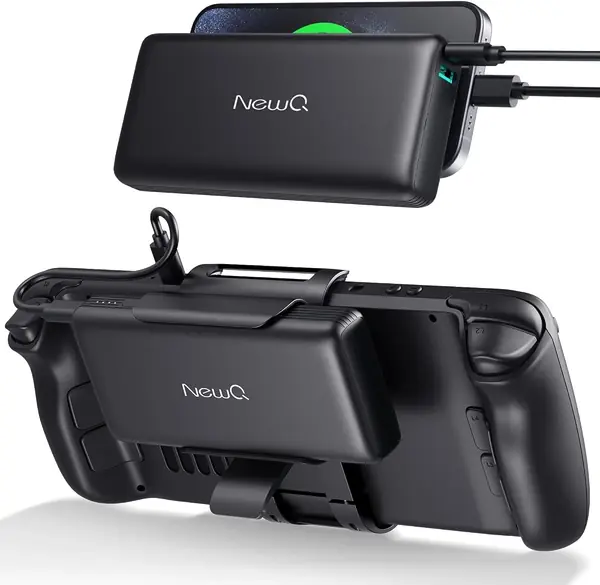
The NEWQ NQ-SD-02 is the most complete clip-on solution here: it adds a battery, a stand, and a short cable in one piece. A pair of clips holds the 20,000mAh pack against the back, the hidden bracket flips out as a stand, and the short USB-C cable keeps the connection tidy. At 253 grams, it adds less heft than most of the 20,000mAh packs on this list, and the 65W output is enough to hold the Deck's charge while you play. That combination is why it is our top pick.

The 65W figure matters more than the capacity headline. The Deck pulls up to 45W, so a 65W port leaves room for the bank to run the Deck and still recover charge; a 45W bank is adequate, but it has no margin. We also like the two included cables: the short one keeps the pack tight to the Deck, and the longer one lets you set the bank on a table. The 20,000mAh battery is good for a second long session, not a week off the grid.

The catch is the case. The clip system is not suitable for a case, and that is the first thing to check. A bare Deck clips in cleanly; a chunky protective shell or a skin can foul the bracket. If you always play with a case, the magnetic Antank or a cabled bank is the easier fit. For everyone else, the stand and the short cable are the details that make this feel like an accessory rather than a battery you tolerate.

Pros

  • Clips to the Deck and doubles as a stand
  • 65W output keeps the Deck charging during play
  • Light for a 20,000mAh pack at 253 g

Cons

  • Does not fit with a protective case
Our verdict

We pick the NEWQ for Deck owners who want the battery and stand in one piece: 65W, 20,000mAh, and a clip-on design that keeps the console playable.
Check Latest Price
2

Anker 20K 87W Best Cable-Free Option

91 /100
TKZ Score Outstanding

Key details

Capacity
20,000mAh
Weight
15.5 oz
Cable
Built-in USB-C
USB-C Output
65W single device
View on Amazon

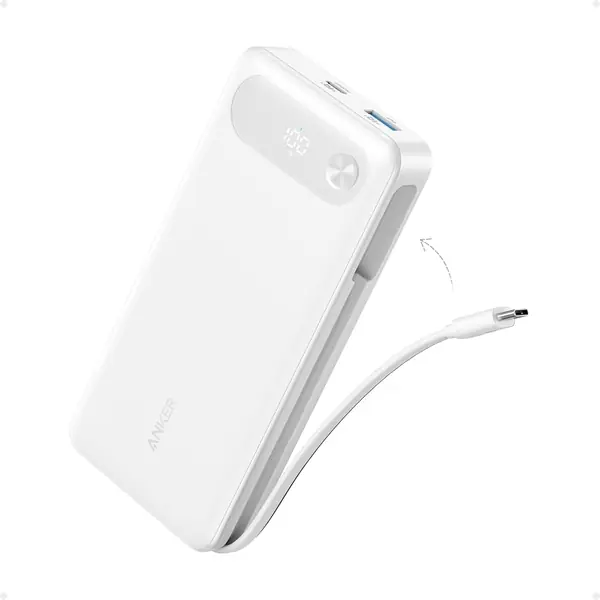
The cable is the feature here. Anker builds a USB-C cable into the 20,000mAh body, so there is no loose cord to forget and no adapter to lose in a bag. The single-device output tops out at 65W, which is more than the Steam Deck needs, and the built-in cable is rated for the same fast charge. We like this one for travel because it is the simplest bank to hand to someone who does not want a pouch full of cables.

At 15.5 ounces, it is not a pocket battery. It is a bag battery: slide it into a backpack or a tote and accept that it will be noticeable. The payoff is capacity and speed. The pack is rated to refill in about 1.5 hours with a 100W charger, which is quick for a 20,000mAh pack, and the 87W total is shared across the built-in cable and the extra ports. Charge the Deck alone when you want full speed; adding a phone splits the output.

The built-in cable is also the part that decides how long this stays useful. It cannot be swapped if it fails, so treat the cable as the wear item and keep the strain relief clean when you coil it. The 18-month warranty is shorter than INIU's three-year coverage, but the Anker is the more polished travel object. If you want a cable-free bag and mostly charge one device at a time, this is the cleaner choice than a separate cable and bank.

Pros

  • Built-in USB-C cable means no cord to forget
  • 65W single-device output matches the Deck's full speed
  • Recharges in about 1.5 hours with a 100W charger

Cons

  • Built-in cable cannot be replaced if it fails
  • Heavy at 15.5 oz for a 20,000mAh pack
Our verdict

Choose the Anker 20K 87W if you want a built-in cable and 65W single-device charging; we accept the 15.5-ounce weight for the simpler travel kit.

Check Latest Price
3

Antank Magnetic 20K Best Magnetic Mount

90 /100
TKZ Score Outstanding

Key details

Capacity
20,000mAh
Max Output
45W
Warranty
1 year
Attachment
Magnetic back mount
View on Amazon

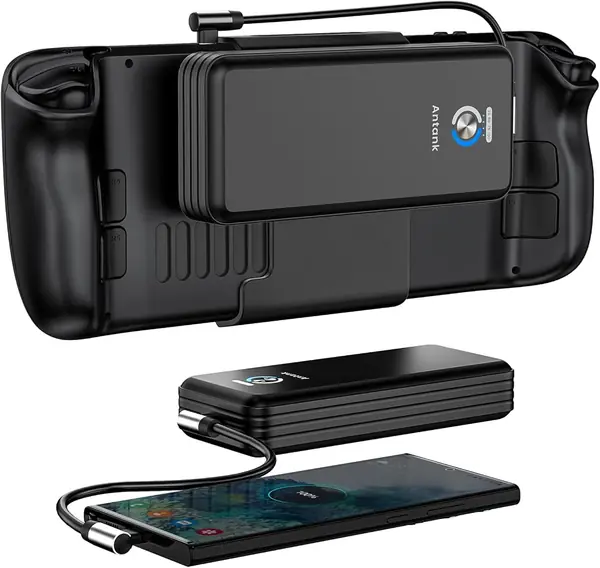
A 20,000mAh battery hanging off the back of a handheld is a physics problem. The Antank solves the attachment with a magnetic back mount that slides on and off, and the hold is strong enough that the pack does not flop around in normal play. It also works as a kickstand, which is a small thing until you want to set the Deck down on a train tray. The 45W output is exactly the Steam Deck's top charging rate, so it can keep up while you play; it just has no headroom for a laptop.

The trade-off is weight. The pack is dense, and the balance shifts toward the back of the Deck. We noticed it most when holding the Deck up for a long session; resting it on a table or your lap hides the penalty. That is the cost of the magnetic convenience, and it is why we treat this as a handheld-play accessory rather than a travel bank for everything. The plastic bracket is the part to watch. It is the wear item, and a cracked clip turns the whole setup into a battery you have to carry separately.

For a Deck owner who wants the battery attached and does not use a bulky case, the Antank is the magnetic pick. The 45W speed is enough, the kickstand is useful, and the detachable mount is less fussy than clips. If you need to charge a laptop too, or you want the lightest possible back-mounted pack, the NEWQ is the better fit. If you mostly carry the bank in a bag, a cabled design is simpler.

Pros

  • Strong magnetic mount holds the bank on the Deck
  • 45W output matches the Deck's full charging rate
  • Detachable mount doubles as a kickstand

Cons

  • Adds noticeable weight to the back of the Deck
  • Plastic bracket is the wear point
Our verdict

The Antank is the magnetic option we recommend when you want the Deck to stay one piece, as long as you can live with the extra heft.

Check Latest Price
4

INIU 25K 100W Best High-Capacity Travel

89 /100
TKZ Score Excellent

Key details

Capacity
25,000mAh
Max Output
100W
Weight
15.8 oz
Warranty
3 years
View on Amazon

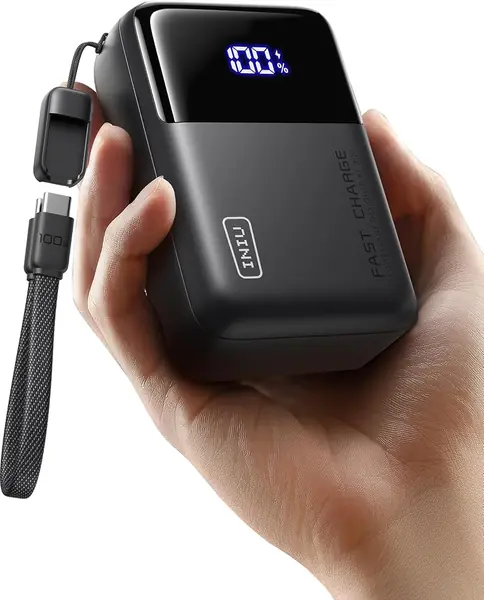
The INIU 25K 100W is the travel bank we reach for when the Deck is not the only device that needs power. The 25,000mAh capacity sits at the top of what most airlines allow in a carry-on without extra approval, and the 100W USB-C port has enough headroom to charge a laptop or run the Deck at full speed. It is not pocket-sized, but the 4.3 by 2.7 by 1.4-inch body fits a tech pouch, and the detachable 0.4-foot cable means you can replace the cord instead of replacing the bank.

We like the port layout: two USB-C and one USB-A, with a digital display that shows the remaining charge instead of four vague dots. The 100W figure is the reason to choose it over a 65W pack; the Deck will not use the extra wattage, but a laptop will. The detachable cable is also a practical advantage over built-in designs, because the cable is the part that usually fails. INIU backs it with a three-year warranty, the longest coverage among the picks here.

The caveat is long-term battery health. The capacity and price are right, but this is a pack to buy with the warranty in mind rather than as the only battery you trust on a critical trip. At 15.8 ounces, it is a bag battery, not something you clip to the Deck. For a long travel day with a Deck and a phone, it is a strong value; for the lightest handheld setup, the NEWQ or Antank makes more sense.

Pros

  • 25,000mAh capacity for long travel days
  • 100W USB-C output handles a laptop or Deck
  • Detachable cable and 3-year warranty

Cons

  • Long-term battery health is the open question
  • At 15.8 oz, it is a bag battery
Our verdict

We take the INIU 25K 100W on long travel days: 25,000mAh, 100W, a replaceable cable, and a three-year warranty make it the strongest bag battery here.

Check Latest Price
5

JUOVI 65W 20K Best Budget

88 /100
TKZ Score Excellent

Key details

Capacity
20,000mAh
Max Output
65W
Warranty
3 years
Ports
2 USB-C + 2 USB-A
View on Amazon

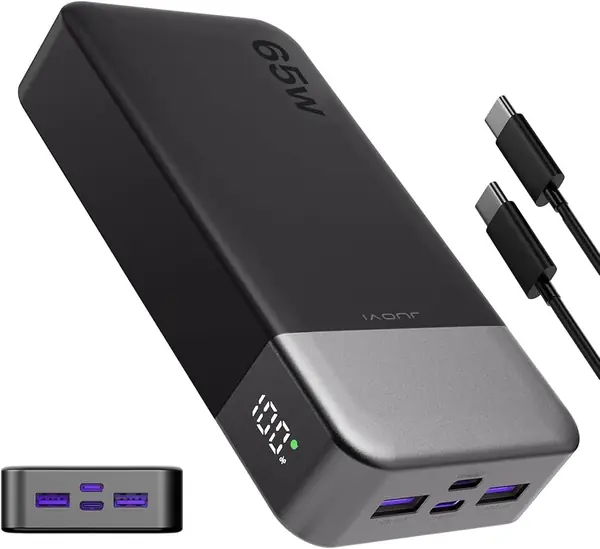
The budget pick does not feel like a compromise on the two numbers that matter. JUOVI puts 65W USB-C output and a 20,000mAh battery into a pack that costs less than the other 65W options here, and it adds four ports, a digital display, and a three-year warranty. For a Steam Deck owner who wants full-speed charging without paying for a premium travel bank, that is a lot of the right stuff.

The 65W port is the one to use. It is enough to charge the Deck at its full rate, and the 20,000mAh capacity gives you roughly a second long session. The four ports are useful for a phone, earbuds, or a controller, but the output is shared. Plug in the Deck alone when you want the fastest charge; add another device and both slow down. The display is a small convenience we appreciate, because it tells you exactly how much is left instead of making you guess.

The trade-off is consistency. This is a budget pack, and the charging handshake is the thing to check first: if it stops and restarts under load, return it. It also runs warm when delivering full power, which is normal for a compact 65W bank but worth knowing. The 400-gram body is not light, and the boxy shape is happier in a backpack than a pocket. If you want the lowest-cost 65W option and you buy from a seller with easy returns, it is a sensible value.

Pros

  • 65W output at the lowest price among the 65W picks
  • 20,000mAh with four ports and a digital display
  • Three-year warranty at a budget price

Cons

  • Runs warm under sustained full-power charging
  • Shared output drops when multiple devices are connected
Our verdict

The JUOVI 65W 20K is our budget pick for a Deck owner who wants 65W and 20,000mAh without paying for a premium travel bank.

Check Latest Price
6

Anker 25K 165W Best for Multi-Device Power

87 /100
TKZ Score Excellent

Key details

Capacity
25,000mAh
Cables
Two built-in USB-C
USB-C Ports
3, up to 100W each
Total Output
165W
View on Amazon

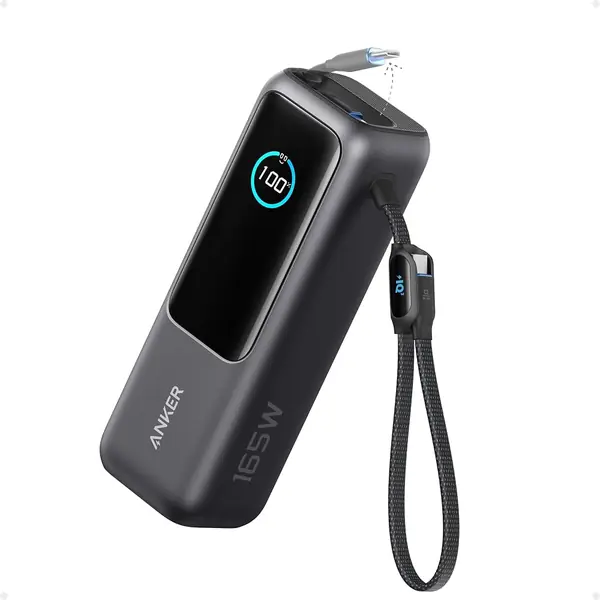
This is the one we bring when the Deck is not the only thing that needs power. The Anker 25K 165W has three USB-C ports that can each deliver up to 100W, plus two built-in cables, so it can charge a laptop, a Deck, a phone, and a controller without a nest of adapters. The 25,000mAh capacity is enough for a long travel day, and the retractable cable is the detail that keeps the whole kit tidy.

For the Deck alone, the 165W total is overkill; the value is in the multi-device load. The built-in retractable cable extends to 2.3 feet, which is long enough to reach a seat-back outlet or a nearby bag, and the second short cable doubles as a carry strap. We like the display and the four-port layout, but we do not pretend this is a handheld accessory. It is a 6.18-inch-long brick that lives in a backpack.

The price is premium, and the warranty is 18 months, shorter than the three-year coverage on the INIU 25K. The built-in cables are convenient but not replaceable, so the retractable one is the wear item. If you want one bank for a laptop and a Deck, this is the most capable pick here; if you want a Deck-only battery that clips to the console, the NEWQ is smaller and lighter. The Anker is the travel hub, not the pocket pack.

Pros

  • 165W total across three 100W USB-C ports
  • Built-in retractable and short cables
  • 25,000mAh capacity for multi-device travel

Cons

  • Heavy and bulky for handheld use
  • Built-in cables are not replaceable
Our verdict

For a laptop-plus-Deck load, we choose the Anker 25K 165W: three 100W USB-C ports and built-in cables are worth the bulk.

Check Latest Price
7

INIU 20K 65W Everyday Carry

86 /100
TKZ Score Excellent

Key details

Capacity
20,000mAh
Max Output
65W
Weight
13.4 oz
Cable
Detachable 4.7-inch lanyard
View on Amazon

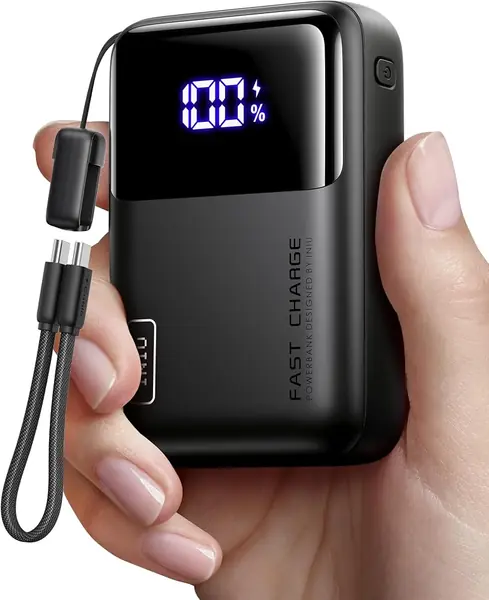
If the battery has to live in the same small pouch as the Deck, the INIU 20K 65W is the one we reach for. The body is 4.3 by 2.7 by 1.1 inches and 13.4 ounces, which is small enough to disappear in a backpack and light enough to carry all day. The detachable 4.7-inch USB-C cable doubles as a lanyard, so you get the convenience of an attached cable without the failure risk of a built-in one.

The 65W USB-C port is the right match for the Deck: enough for full-speed charging, with a little headroom for a phone or a tablet on the second port. The digital display shows the exact percentage, and the three ports are enough for a Deck, a phone, and earbuds. It will not run a high-power laptop at 100W, but that is not what this pack is for. For a Deck-first kit, the size and output are better balanced than a 25,000mAh brick.

The open question is long-term reliability. The three-year warranty is the reason this stays on our list, and it is longer than Anker's 18-month coverage. At 13.4 ounces, it is still a bag battery, not a pocket one. If you want the smallest 20,000mAh 65W pack here and you value a replaceable cable, this is the practical everyday choice.

The lanyard cable is a genuinely useful detail: it clips to a bag strap and keeps the cable with the bank, but you can swap it for a longer cable when you need to reach an outlet. That flexibility is what separates it from the built-in-cable Anker. The Anker is more polished; the INIU is easier to repair and easier to fit in a small bag.

Pros

  • Compact 20,000mAh body at 13.4 oz
  • 65W USB-C output and three ports
  • Detachable lanyard cable with 3-year warranty

Cons

  • Long-term battery health is the open question
Our verdict

We keep the INIU 20K 65W in the everyday bag: it is compact, has a replaceable cable, and carries a three-year warranty.

Check Latest Price
8

REWONDER 40K 65W Off-Grid Play

85 /100
TKZ Score Excellent

Key details

Capacity
40,000mAh
Max Output
65W
Cable
Not included
Airline Limit
154Wh; not for air travel
View on Amazon

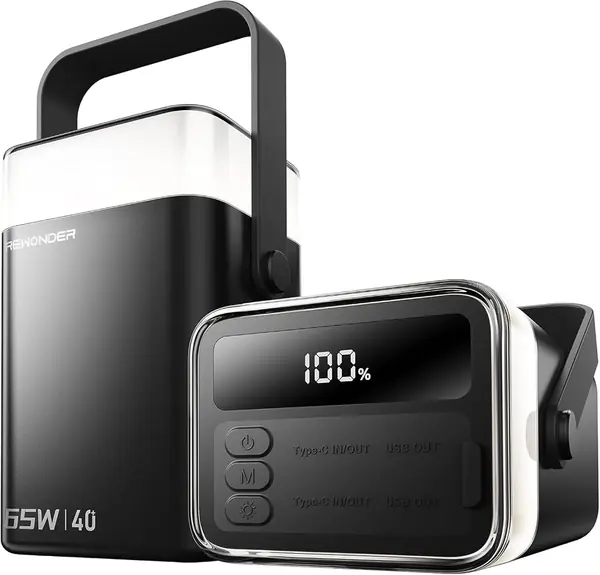
The REWONDER 40K 65W is the outlier: 40,000mAh and 154Wh in a pack with a handle, a silicone port cover, and a built-in LED light. That capacity is the point. It can run a Steam Deck for multiple sessions and still have room for a phone, a camera, or a drone battery. It is also the one pick here that is not intended for air travel, because 154Wh exceeds the standard 100Wh carry-on limit. This is a car-camping or road-trip battery, not a fly kit.

The 65W USB-C port is enough for the Deck at full speed, but the pack does not include a cable or a wall charger. To get the full 65W, you need a 5A USB-C cable with an E-Marker chip; a cheap cable can leave speed on the table. That is an extra purchase to plan for, and it is the kind of detail that turns a budget-looking pack into a less simple bargain.

We like the integrated light and the rugged cover for camping, and the handle makes a heavy pack easier to carry. The weight is the obvious cost: this is a pack you leave in the car or the tent, not one you clip to the Deck. We treat it as a specialist rather than a default. If your Deck time happens away from outlets and away from airports, the capacity is worth the bulk.

The setting it does not serve is air travel. The 154Wh rating is above the common 100Wh limit, and the pack is designed for ground use. If you split your time between flights and camping, keep a 20,000mAh or 25,000mAh pack for the plane and leave this one for the road. That is not a flaw in the battery; it is the boundary of what this battery is for.

Pros

  • 40,000mAh capacity for multiple Deck sessions
  • 65W USB-C output with a built-in LED light
  • Rugged cover and handle for camping

Cons

  • Exceeds the 100Wh airline limit; not for air travel
  • No cable or wall charger included
Our verdict

For off-grid Deck sessions and road trips, we choose the REWONDER 40K 65W; its 154Wh capacity is the reason and the airline limitation.

Check Latest Price

How We Tested Steam Deck Power Banks

We started by gathering every bank we could find that claimed at least 45W of USB-C power delivery and 20,000mAh of capacity, then narrowed the field to 12 models spanning the price range from budget picks to flagship bricks, including several with cables built into the body. Testing ran for six months, long enough for capacity claims to either hold up or quietly fade.

Each bank went into rotation for at least two weeks of real use: living-room sessions with the Deck plugged in mid-game, a cross-country flight, daily commutes, and a couple of weekend trips where everything rode in a backpack. The core test was simple — I ran the Deck down to 20 percent, plugged in, and kept playing, noting whether the charge level climbed or kept falling and how much extra playtime each bank actually delivered before it gave out.

We weighed every one on a kitchen scale and checked whether it slid into a bag's front pocket or took up the whole compartment. The built-in cables got plugged and unplugged dozens of times so we could watch the strain relief and see whether the cable stayed coiled where it should. Each bank took a few knocks — off the couch onto hardwood, rattling around in a bag with keys — and at the end of six months we re-ran a full Deck charge on all of them to see whether they still hit their early numbers.

Value, in the end, had less to do with the sticker than with how many extra hours a bank bought per ounce carried.

How to Choose a Power Bank for Your Steam Deck

Start with 45W, then decide how much headroom you need

The Steam Deck charges at up to 45W over USB-C PD, so a 45W bank is the floor for full-speed charging. A 65W bank gives you margin: it can hold the Deck's charge while you play and still have room for a phone, and it recovers the Deck's battery faster when the screen is off. The number to check is the single-port USB-C output, not the total across all ports. A bank that advertises 100W total but caps one port at 20W is not a Deck bank. We prefer 65W for a Deck-first pack and 100W only when a laptop shares the load.

Capacity, weight, and the airline limit

20,000mAh is the practical sweet spot: enough for a second long session without making the Deck back-heavy. 25,000mAh adds margin for a travel day, and most 25,000mAh packs still sit under the common 100Wh carry-on limit. The 40,000mAh REWONDER is a different animal at 154Wh, which exceeds that limit and is not intended for air travel. Check watt-hours, not just milliamp-hours, before you fly. Weight follows capacity: a 20,000mAh battery pack can be light enough to clip on; a 25,000mAh pack is usually a bag battery. Choose the smallest capacity that covers your longest usual day.

Decide how the bank stays with the Deck

A clip-on or magnetic bank makes handheld play possible without a cable draped across your lap, and a stand is a genuine convenience on a train or plane tray. The cost is weight on the back of the Deck and less compatibility with cases. The NEWQ's clip system wants a bare Deck; the Antank's magnet is easier to remove but still adds heft. If you always play with a protective case, start with a cabled bank and a short USB-C cable instead. Check vent clearance and case thickness before you commit to any attached design.

Ports, shared output, and cable choices

Charging the Deck alone is the fast path. Add a phone or a controller and the bank splits its output, so the Deck may charge more slowly or merely hold its level. Look for a bank that can deliver 45W or more on one USB-C port while other devices are connected, or charge the Deck by itself when speed matters. Built-in cables are convenient and hard to lose, but they cannot be replaced when they wear out. Detachable cables add a part to keep track of, yet they are the better long-term bet. The INIU 25K and 20K use detachable cables; the Anker 20K and 25K build them in.

Warranty and long-term battery health

High-capacity banks live hard lives, and the warranty is part of what you are buying. Three-year coverage from INIU is the longest here; NEWQ offers two years, while Anker's built-in-cable packs carry 18 months. A longer warranty does not guarantee a longer life, but it gives you a path if the battery stops holding charge. Recharge the bank with a 45W or higher USB-C PD charger when you can; a slow phone charger will take most of a day. Store it cool and partly charged if it will sit unused for months.

Frequently Asked Questions

Final Verdict

The NEWQ NQ-SD-02 is the one we recommend first for a Steam Deck owner. It delivers 65W, carries 20,000mAh, and clips to the Deck as a stand, so you can keep playing instead of balancing a battery and a cable on your lap. The caveat is the case: the clip system wants a bare Deck.

If you carry a case or want one bank for everything, the Anker 20K 87W is simpler to live with, while the INIU 25K 100W is the better travel bank for longer days. Start with the NEWQ unless the case is non-negotiable.