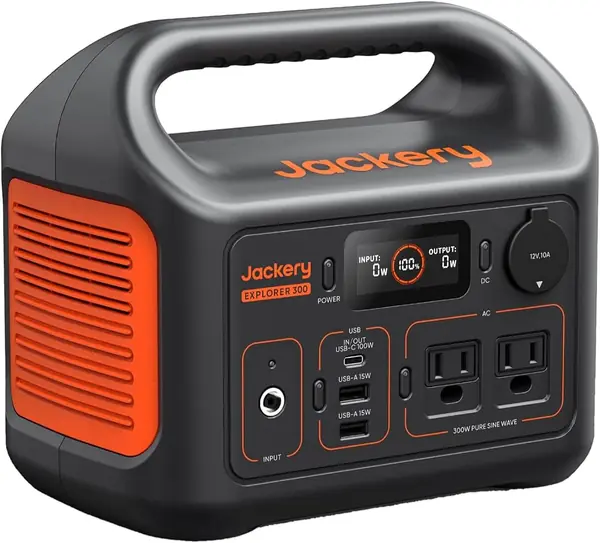
Jackery Explorer 300 Best Overall
Key details
- Capacity
- 292Wh
- Weight
- 7.1 lb
- AC Output
- 300W (600W surge)
- Battery
- LiFePO4, 4,000 cycles
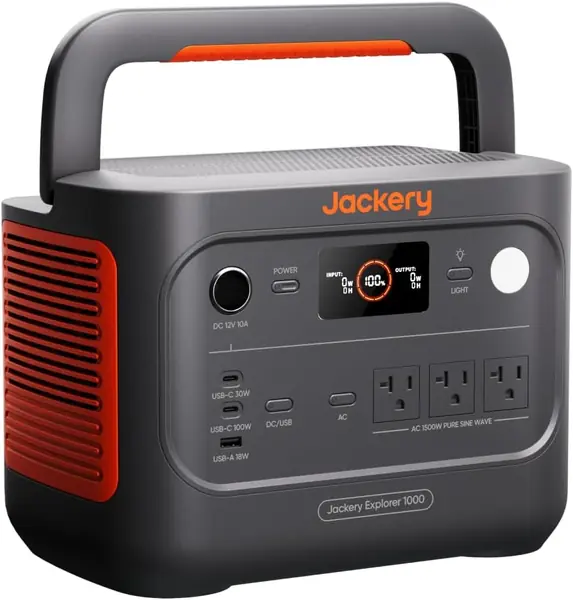
The first number we look at on a backup battery is not milliamp-hours; it is the weight you have to move in the dark. At 7.1 pounds with a built-in handle, the Jackery Explorer 300 is light enough to carry from a closet to the kitchen with one hand, yet its 292Wh battery and 300W AC output cover the devices most outages actually strand: phones, a router, a lamp, a laptop, a small fan. That balance is why it is our top pick.
The port mix is practical rather than merely long: two AC outlets, a 100W USB-C PD port, two USB-A ports, and a 120W car port. We reach for the USB-C port first for a laptop or tablet, and the AC outlets handle a lamp, fan, or router. The LiFePO4 cells are rated for more than 4,000 cycles to 70%, which is the kind of longevity we want in a unit that may sit for months between storms. The wall charger is included; a solar panel is not.
The 300W ceiling is the real boundary. It will not run a full-size fridge, a space heater, or a coffee maker, and the 292Wh capacity means you should think in terms of essentials rather than whole-room backup. For the common outage—phones, internet, light, and a laptop—the Explorer 300 is the easiest one to live with. Put it where you can grab it, top it up every few months, and it stops being a scramble when the lights go out.
Pros
- Light 7.1-pound body with a built-in handle
- 292Wh and 300W AC cover small essentials
- LiFePO4 cells rated for 4,000 cycles
Cons
- 300W output will not run major appliances
- Solar panel sold separately
For most outages, the Explorer 300 is our default: light enough to move, with real AC outlets, 100W USB-C, and long-life LiFePO4 cells.