Best Teleprompters for iPhone for Scripted Video of 2026

A teleprompter looks like a magic trick until someone explains it: beam-splitter glass sits at 45 degrees in front of your lens, reflecting your script off a phone while the camera looks straight through. The right one fixes the specific awkwardness of talking to a lens — you stop memorizing and start sounding like a person.

Over six months, my team and I set up, filmed with, and packed away 12 of them, from fold-flat phone rigs to 12-inch tablet-and-camera kits. Price turned out to be a poor predictor. What separated them was whether your phone fit the holder with its case on, whether the app mirrored text correctly and stayed paired to the remote, and whether the glass turned a nearby lamp into a white smear in the footage.

One thing shoppers overrate: the size of the glass. How far it sits from your lens and how wide that lens is matter more — a big panel plus a wide angle can put the glass edge in frame. Phone-only shooters and two-camera streamers need different rigs, and both are below.

The Best Teleprompters for iPhone for Scripted Video

1

Glide Gear TMP 100 Best Overall
92 /100
TKZ Score Outstanding

Key details

Glass
12 in, 70/30 beam splitter
Device Fit
Phones and tablets up to 10.5 x 8 in
Assembly
Ships fully assembled
Mounting
1/4-20 and 3/8-16 threads
View on Amazon

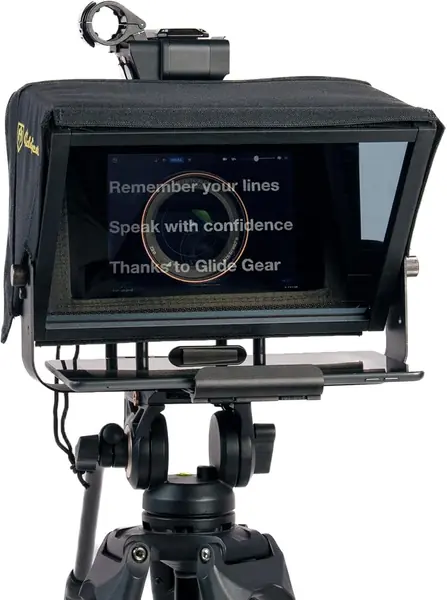
The TMP 100 arrived as a finished teleprompter: glass seated, hood attached, hardware already where it belongs. Our first clip was shot within minutes of unboxing, with no Allen wrench and no tutorial, and the frame is 6061 aluminum rather than molded plastic, so the corners don't flex when you push the hood up. We have handled enough rigs that rattle straight out of the box to notice the difference immediately.

For an iPhone, the tray is the part that matters, and it is generous: it takes devices up to 10.5 by 8 inches, so a phone sits centered with room on every side and its lens lands near the middle of the 12-inch 70/30 glass. The detail we appreciated most is an absence. Glide Gear ships no app, which means no proprietary software to learn or troubleshoot; the prompter works with any app that mirrors text, so you keep the script editor and the remote you already trust. Given how often a bundled app is the weak link on these rigs, that reads as a feature rather than a gap.

Set against the rest of this group, it is the least fussy of the metal-bodied prompters: nothing on it needs a second pair of hands, and the glass stays clean behind a hood that actually covers it. The AMBITFUL kit is the one to look at if the rig has to travel, and the NEEWER X14 is the one if you need a bigger reading surface for wide shots.

The rest is sensible rather than decorative: a padded carry case, a lifetime warranty, 1/4-20 and 3/8-16 threads underneath, and accessory mounts that will take a shotgun mic or a small light. Ours stays assembled on a shelf between shoots, which is the least glamorous thing we can say about a piece of gear and the reason it keeps getting used.

Pros

  • Arrives fully assembled and ready to shoot
  • Works with any mirror-text app, no lock-in
  • All-metal 6061 frame with padded case

Cons

  • Five pounds empty, before you add a camera
  • Tray stops short of a 12.9-inch iPad
Our verdict

We recommend it as the default for scripted iPhone video: it arrives assembled, holds a phone securely, and works with any app that mirrors text.
Check Latest Price
2

NEEWER X14 Best for Wide Shots

84 /100
TKZ Score Excellent

Key details

Glass
14 in, 75% light transmission
Device Fit
Tablets and phones up to 8.7 in
Build
Aluminum alloy
Mounting
Dual cold shoe, 1/4-inch threads
View on Amazon

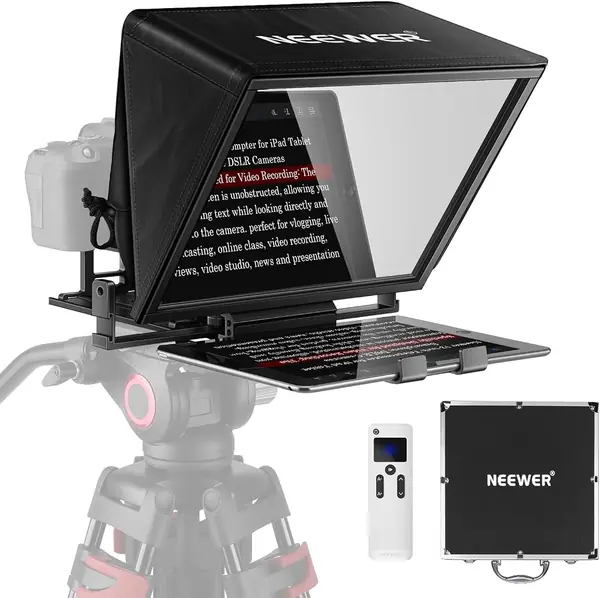
Fourteen inches of glass is the whole argument for the X14. A larger reading surface lets you push the camera back and still read comfortably, which is what wide and full-body framing need; the 7.5-inch rigs here ask you to crowd the lens instead. At 75% light transmission the splitter stays bright enough that the script does not wash out, and the aluminum body keeps the glass from drifting once it is set.

What we liked beyond the size is how little ceremony it takes. The frame folds open into a working prompter with no assembly, glass already seated and the hood built into the body, and it folds back into its case the same way, which matters when you are loading out at the end of a shoot. Dual cold-shoe mounts and 1/4-inch threads on both sides mean a mic and a light ride along instead of competing for the same hole.

The remote is the one part to plan around. The RT-110 pairs inside NEEWER's teleprompter app, so the scroll controls belong to that app; if you prompt from something else, expect to drag the script by hand or add a separate remote. For an iPhone behind 14 inches of glass in a wide shot, that is a small tax on an otherwise straightforward rig.

Pros

  • 14-inch glass lets you stand well back
  • Folds open with no assembly at all
  • Cold shoes and threads for a mic and light

Cons

  • Crowds a small desk when open
  • Phone and tablet tray maxes out at 8.7 inches
Our verdict

We rate it the pick for wide shots: the 14-inch glass lets you stand back, and it folds flat between shoots.

Check Latest Price
3

Desview T3 Best Midrange for Phones

83 /100
TKZ Score Excellent

Key details

Glass
70/30 splitter, 26-layer coating
Device Fit
Phones and tablets up to 10 in
Wide-lens Support
24mm and wider
Light Transmission
97%
View on Amazon

The T3 spends its budget on the glass, which is the right call at this price. A 70/30 beam splitter with a 26-layer coating and 97% light transmission is the specification that decides whether your script reads crisply and whether the camera sees a clean image, and it is the first thing we check on any rig at this level. Here it holds its own against prompters well above it.

Behind the glass, it handles what an iPhone shooter actually uses: horizontal shooting at 24mm and wider without dark corners, which covers the phone's own lens and most clip-on wide converters, plus a 2.2-pound frame that hangs off a light tripod without complaint. The phone clamp holds an iPhone flat against the front of the rig, and sliding it left or right is how you line the lens up with the middle of the glass.

The body is plastic and feels like it, which is how the T3 stays in the middle of this group on price, and the DESVIEW app with its Bluetooth remote is the piece to test on day one: import a real script, run the scroll, force-close the app and open it again before you trust either on a shoot. If you want a metal frame you can hand down, the Glide Gear is the step up.

Pros

  • 97% transmission glass at a midrange price
  • Handles 24mm and wider without vignetting
  • Light enough for a small tripod

Cons

  • Tablet tray falls short of the advertised size
Our verdict

Our midrange choice for phone-first creators: the coating and glass do the heavy lifting, and the plastic frame keeps it affordable.

Check Latest Price
4

AMBITFUL Mini Teleprompter Best Budget Kit

82 /100
TKZ Score Excellent

Key details

Glass
7.5 in coated
Weight
12.3 oz
Adapter Rings
49-77mm
Included Tripod
Mini desktop tripod
View on Amazon

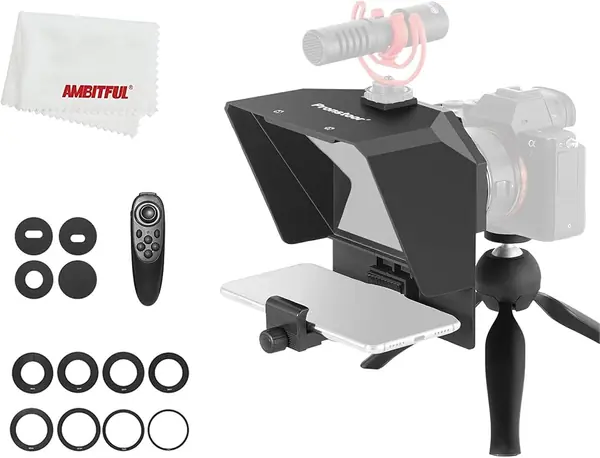
Three hundred fifty grams is what separates the AMBITFUL from everything else here. It is the prompter that lives in the bag instead of on the shelf, and the one that comes out when we are shooting anywhere that is not a desk: a kitchen counter, a hotel room, a table dragged into the garden.

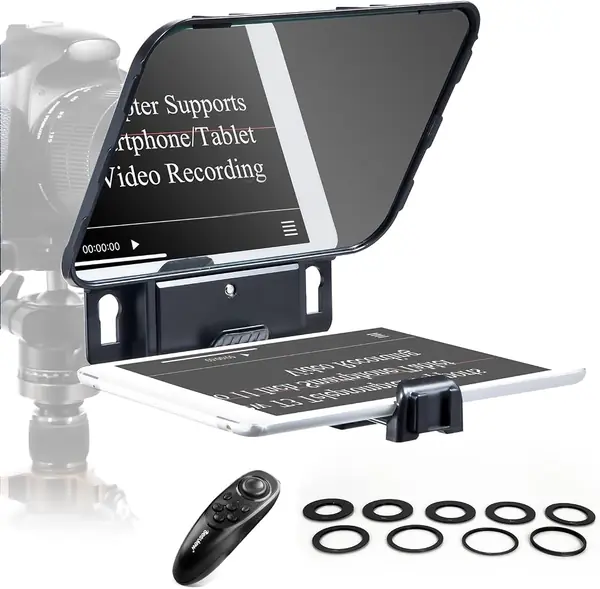
The kit is unusually complete for the size: 7.5 inches of coated glass, a phone clip, 49-77mm adapter rings for a real lens, a Bluetooth remote, and a small tripod to put it all on. Setup takes seconds once you have done it twice. The frame unfolds, the phone drops into the clip, and the hood is part of the body rather than a separate piece that gets lost in a drawer.

Small glass is the compromise, and it is not abstract. The phone sits close to the film, so keep your text large and expect to glance at it rather than read a paragraph at a time. That is the whole trade for something this light, and it is a fair one for vlogs, social clips, and one-take scripts. What we did not expect to appreciate as much is that the kit works on the day it arrives, with nothing else to buy.

Pros

  • 350 grams, easy to carry every day
  • Full kit with tripod, remote, and rings
  • No assembly required, up in seconds

Cons

  • Bundled tripod is tabletop height only
Our verdict

Buy the AMBITFUL if the prompter has to travel: at 350 grams with its own tripod, it is the kit we pack and forget.

Check Latest Price
5

Elgato Prompter Best for Desk and Streaming

81 /100
TKZ Score Excellent

Key details

Weight
1.52 lb
Control
Mac or PC, Stream Deck
Display
9 in FHD built-in
Camera Support
DSLR, webcam, smartphone
View on Amazon

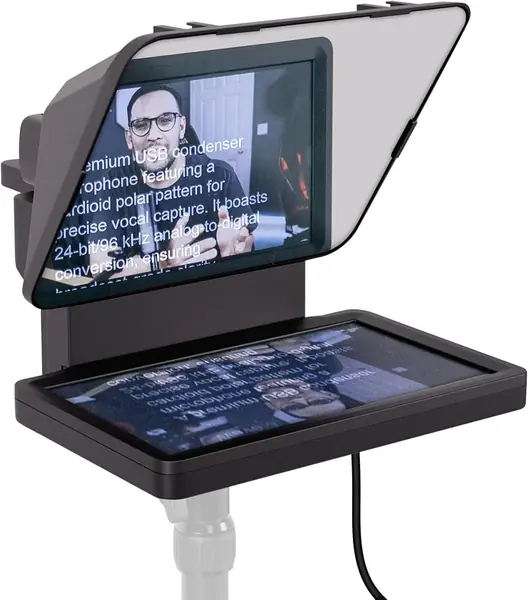
The Prompter takes your phone out of the loop entirely. Instead of clamping a device behind glass, Elgato builds a 9-inch FHD screen into the unit and treats it as a second monitor: drag any window onto it, whether that is a script, a document or a chat feed, and read from that. Your iPhone stays free to be the camera, and there is no second device to charge or mount.

We think that is genuinely the better arrangement at a desk. Nothing needs to be mirrored, no teleprompter app has to be trusted with your script, and you can write in the tool you already use. The 1.52-pound body is small enough to sit between you and a webcam, and Stream Deck support means scroll and pause can live on real buttons under your hand.

Two things hold it back. It needs a Mac or PC connected to drive the display, so it is a studio tool rather than something you carry to a location, and the screen's output can reflect into the lens if you shoot at an angle. The software is where our patience ran thinnest; Camera Hub is capable and occasionally fussy, and a shoot is a bad place to discover that.

So the Prompter earns its place for a specific setup: tutorials, calls, streams, anything shot from a chair in front of a computer. For scripted video on an iPhone away from a desk, the Glide Gear is the safer buy.

Pros

  • Built-in 9-inch screen frees your phone
  • Takes any window or app as a script
  • Compact 1.52-pound body

Cons

  • Requires a Mac or PC to feed the display
  • Built-in screen can reflect into the lens
Our verdict

We point desk-bound shooters here: the built-in screen keeps your iPhone free and your script in whatever window you like.

Check Latest Price
6

LENSGO TC7S Best for Pocket-Sized Setups

79 /100
TKZ Score Very Good

Key details

Glass
9.7 in coated
Device Fit
Phones, tablets under 8 in
Weight
15.9 oz
Folded Size
20.1 cm
View on Amazon

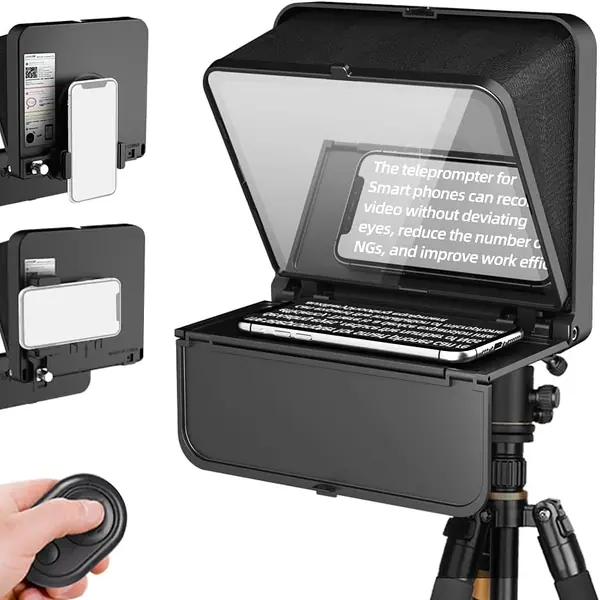
The TC7S assumes your phone is the whole studio. One phone clips into the front holder to display the script, the other shoots through 9.7 inches of glass, and the whole rig folds flat in about a second to a 20.1 cm package. It is the most portable thing here that still uses a beam splitter rather than a bare screen.

What we liked is the honesty of the design: no adapter rings, no assembly, no second bag. The Bluetooth remote pairs with the TCQI app, the frame unfolds and locks, and the shade wraps the back of the glass so a bright window behind you does not wash out the text. For a talking-head clip shot entirely on a phone, it is enough.

The glass is where the compromise lives. A phone's small sensor is fussier through a beam splitter than a dedicated camera is, so shoot a short test first and watch for a color cast or autofocus hunting before you commit a real take. Keep the type large, too; 9.7 inches read from close is comfortable without being generous.

Pros

  • Folds flat in about a second
  • 9.7-inch coated glass
  • Bluetooth remote included

Cons

  • Won't take a DSLR or mirrorless camera
  • Phone holder feels light for daily folding
Our verdict

Our pick for a phone-only, pocketable setup, as long as you test the glass on your own phone first.

Check Latest Price
7

GVM 12-Inch Teleprompter Midrange All-In-One

78 /100
TKZ Score Very Good

Key details

Glass
12 in anti-reflective
Device Fit
Phones and tablets up to 8.6 in
Build
Aluminum alloy
Assembly
No assembly required
View on Amazon

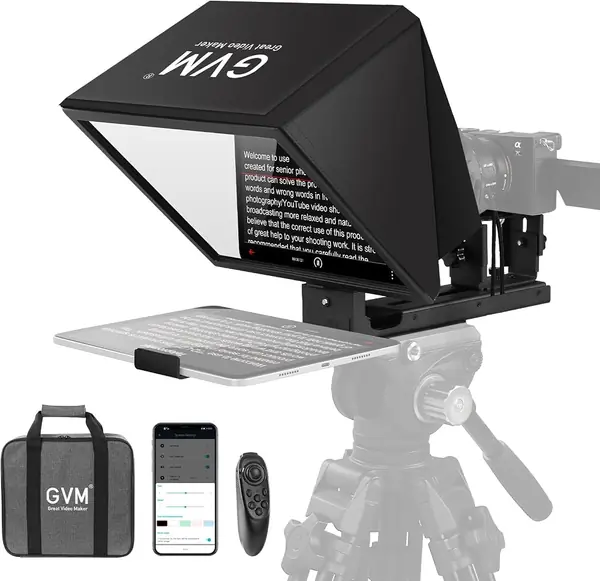
GVM's 12-inch rig is an all-in-one. The aluminum frame folds out of its own body with no assembly, the glass is already seated behind an anti-reflective coating, and the hood is part of the shell. Nothing in the box needs a wrench, which is more than we can say for a couple of the aluminum rigs here.

Twelve inches of glass is a sensible middle for a phone shooter who sometimes frames wider: more reading distance than the 7.5-inch kits, without the desk-eating footprint of a 14-inch unit. It takes a phone or a small tablet in the tray, ships with a wireless remote that runs through GVM's app, and folds down into a carry bag that comes with it.

Weight and finish are where the money went. Mostly metal with plastic knobs, enough mass that a light stand will not tip once the camera is on, and it feels like it will survive being packed and unpacked weekly, which is more than we can say for the plastic prompters in this group.

The caveat is track record. This is the least proven design on the page, with a much shorter history behind it than the Glide Gear or the NEEWER, so buy it for what the hardware is: a midrange folding rig with more glass than its price suggests. If you want certainty more than you want to save, spend up.

Pros

  • 12-inch glass at a midrange price
  • Aluminum body with no assembly
  • Holds a phone, a small tablet, or a camera

Cons

  • Tablet tray tops out at 8.6 inches
  • Packed kit is close to 14 inches across
Our verdict

A sensible middle: folding aluminum and a 12-inch glass, if you don't mind being an early adopter.

Check Latest Price
8

PaiPaiGo Dual Phone Teleprompter Best for Two-Phone Beginners

77 /100
TKZ Score Very Good

Key details

Weight
9.88 oz
Build
ABS plastic
Mount
Dual phone clips
Height
3 to 17 in
View on Amazon

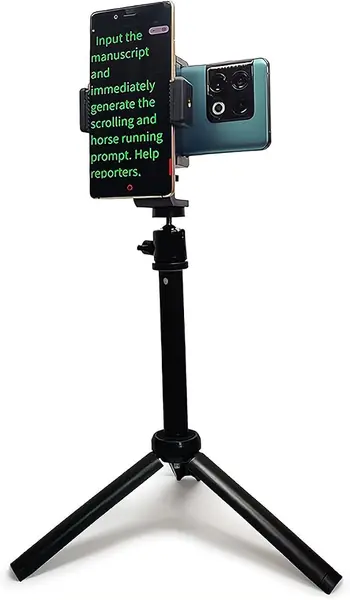
PaiPaiGo's rig has no glass, no battery, and no app. It is two phone clips on a small tripod: one holds the phone that records, the other holds the phone that shows your script, and you read from the second while the first rolls. That is the entire product, and for a lot of creators it is the entire requirement.

The hardware is simple to the point of being clever. The tripod extends from about 3 to 17 inches, the ball head tilts the clips to whatever angle your eyeline needs, and the rotation platform flips the assembly between landscape and portrait. It weighs 280 grams and breaks down into a bag you already own.

It works because a phone camera and a phone screen can sit within an inch of each other. That is not the same as reading through glass, where your eyeline and the lens are genuinely aligned; you will be glancing just off-axis, which we noticed for the first take and forgot about by the third.

Where it earns its place is the try-it test. Nothing to pair, nothing to charge, nothing to update, and if prompting turns out not to be for you, you have spent the least of anything on this page. The tripod is light, though, and the listing is honest about it: this is not the rig to hang a mirrorless camera and a lens from.

Pros

  • Cheapest way to start prompting
  • Nothing to pair, charge, or update
  • Adjusts from 3 to 17 inches on a ball head

Cons

  • Needs a second phone or tablet
  • Light tripod won't carry a real camera
Our verdict

The cheapest way to find out whether prompting suits you, provided you have a second phone to spare.

Check Latest Price

How We Tested iPhone Teleprompters

I started the way a shopper would: searching out every teleprompter that claims iPhone support, then cutting anything that couldn't hold a phone at all, had no iOS app, or gave no way to mount a camera behind the glass. That left 12 units, from fold-flat phone-only rigs to 12-inch tablet-and-camera kits, and we spent six months with them.

Most of the work happened at a desk in a spare room, on a tripod, running the same 90-second script on a phone, then a tablet, then a DSLR. I timed the first solo setup with a stopwatch and noted exactly where the instructions lost me, then repeated the build nine more times to see whether the no-assembly and one-second-fold claims held up. Each one got broken down and zipped into its carry case afterward, because that's where it lives between shoots.

Every session covered the same ground. Fit came first — the same phone bare, then in a case, then with a grip attached. On the software side I timed Bluetooth pairing, checked whether the remote woke the app after a long break, and played with scroll speed to see if it could be nudged finely enough to match my reading pace, then watched the recording back to confirm the mirrored text read cleanly. Lighting got its own pass: window light, a softbox, and a plain overhead bulb, watching for glare on the glass and a ghost of the script in the footage.

We also took them out of the house — a borrowed conference room for a live stream, a kitchen counter for a teleconference, a bright backyard for an outdoor take. Across all of it, the price spread rarely predicted the winner; the extra money generally bought larger glass for wider lenses and sturdier mounting, not a cleaner script on screen.

How to Choose a Teleprompter for an Iphone

The Phone Tray Matters More Than the Tablet Claim

An iPhone is small, so nearly every tray here will hold one; the real question is how the phone sits. You want it clamped flat, centered, and close to the glass, with the lens landing near the middle of the reading area, because an off-center phone pushes the text out of your eyeline. Buy for the phone you own, then decide whether tablet support is worth paying for before you compare tray sizes.

Watch the measurement itself, too. Trays are often described by the diagonal of the biggest tablet they take, and a diagonal figure tells you nothing about whether your phone will sit where you want it.

Glass Size Sets How Far Back You Can Stand

A 7.5-inch prompter keeps the phone close and forces large text; a 12- or 14-inch surface lets you move the camera back for a wide or full-body shot and still read at a glance. Bigger glass is heavier and bulkier, which is exactly why our top pick and the AMBITFUL sit at opposite ends of this guide.

The splitter ratio matters as much as the size. A 70/30 beam splitter sends most of the light through to the camera and reflects the rest up to your script, which is the standard compromise between a bright script and a clean image.

Rings, Lenses, and Dark Corners

If you only ever shoot on the phone, vignetting is mostly a non-issue: phone lenses are wide and the prompter sits close behind them. Add a mirrorless camera and the adapter rings become the deciding detail, since 49-77mm covers most kit lenses and small primes but not all of them.

Check your lens's filter thread before you order. A ring that doesn't match is the most common reason a new prompter can't be used on the first day, and a rig rated for 24mm or wider is the one that keeps corners clear once the camera moves back.

The App Is Half the Prompter

Bundled apps are where these rigs stumble, and the remote usually goes with them: several of the remotes here only control scrolling inside the maker's own app, so the software you didn't want becomes the software you have to use. The alternative is a prompter that ships without software and works with any app that mirrors text, which is a large part of why the Glide Gear earns the top spot.

Whatever you buy, import a full script, run it end to end, force-close the app, and open it again before a shoot rather than during one.

Match the Shape to Where You Shoot

Three shapes cover this category: a collapsible aluminum frame that folds into a bag, a desktop unit with its own screen, and a clip rig with no electronics at all. The foldaway suits location work, the built-in screen suits a desk where a computer is already running, and the clip rig suits a phone-only creator who wants nothing to charge.

All of them still need a tripod, except the kits that bundle a small one.

Frequently Asked Questions

Final Verdict

We recommend the Glide Gear TMP 100 for most iPhone shooters. It asks nothing of you on the day: it arrives built, holds a phone securely, and works with whatever mirror-text app you already trust, so no proprietary software sits between you and a take.

Two situations change the answer. If the prompter has to travel, the AMBITFUL kit weighs a fraction as much and brings its own tripod. If your scripts get read at a desk in front of a computer, the Elgato Prompter's built-in screen leaves your iPhone free to be the camera.