Best Running Watches for Beginners of 2026

A running watch only has to answer two questions — how far, how fast — and then get out of the way. The trouble: the category has gotten loud, with recovery scores, training load, sleep coaching, and a screen full of numbers you will not read at mile four. What a beginner needs is a watch that finds GPS quickly, holds it under tree cover, and still has battery left for Sunday's long run.

I've run with a watch on my wrist for years, and the habit that stuck is the dullest one: glance, adjust, keep going. My team and I spent six months running with 12 beginner-friendly watches, and the keepers were the ones we forgot about — clear in bright sun, synced to our apps without a fight, still charged after a week of runs.

Worth knowing before you shop: battery claims are usually measured in GPS-only mode, so a watch rated for two weeks may need charging every few days once notifications and an always-on display are on. The picks below suit people running their first miles, not chasing a podium.

The Best Running Watches for Beginners

1

Garmin Forerunner 165 Best Overall
93 /100
TKZ Score Outstanding

Key details

Weight
1.38 oz
Display
1.2-inch AMOLED
GPS Battery
Up to 19 hours
Battery Life
Up to 11 days
View on Amazon

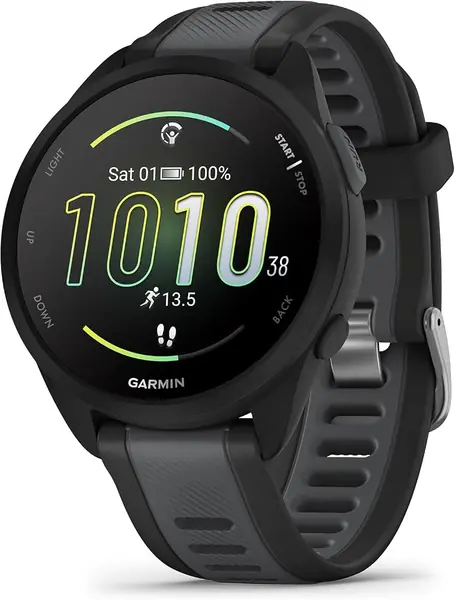
The Forerunner 165 makes the most sense for a beginner because it answers the question that stops a lot of new runners: what should I do today? The morning report rolls sleep, recovery, and a suggested workout into one glance, and Garmin Coach plans can give you a structure to follow without turning the watch into a second job. The 1.2-inch AMOLED screen is bright and easy to read, and the buttons sitting alongside the touchscreen are a detail we appreciate when hands are cold or wet.

That combination is why it is the best overall pick in this group. The 165 gives you guided training without burying it under a hundred metrics, and the daily suggestions are more useful to a beginner than a long list of sport profiles. At 1.38 ounces and 43mm, it stays comfortable on a run and still looks like a watch you can wear to work. Battery life is the other quiet advantage: up to 11 days in smartwatch mode and 19 hours in GPS mode, so a week of short runs does not turn into a charging routine.

The button-and-touch combination is the detail we care about more than we expected. Scrolling the morning report is quicker on the touchscreen, but starting and stopping a run is easier with the physical buttons, especially when the weather turns. That split makes the 165 feel thought-through rather than feature-stuffed, and it is the kind of small design decision that keeps a beginner's watch from becoming another gadget to manage.

Pros

  • Guided daily workouts and Garmin Coach plans
  • Bright 1.2-inch AMOLED with buttons and touch
  • Up to 11 days of battery, 19 hours in GPS

Cons

  • Phone pairing can take a few tries
Our verdict

We recommend the Forerunner 165 to any new runner who wants a watch to plan the workout, not just record it.
Check Latest Price
2

Garmin Forerunner 55 Best for Simple Controls

91 /100
TKZ Score Outstanding

Key details

Weight
1.31 oz
Display
1.04-inch LCD
GPS Battery
Up to 20 hours
Training Plans
5K, 10K, half marathon
View on Amazon

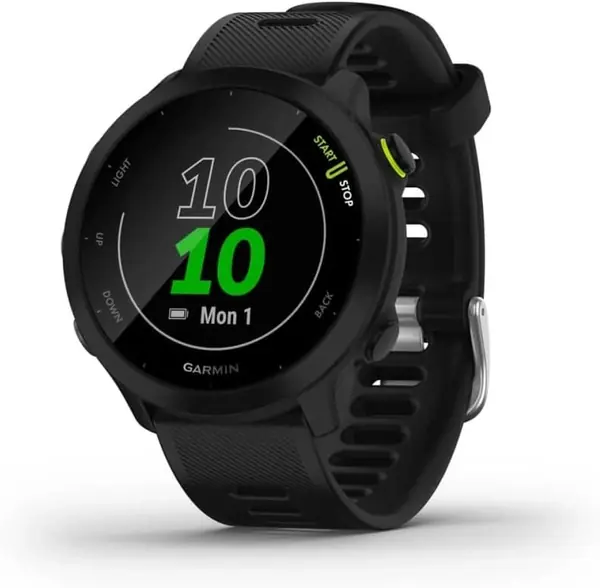
The Forerunner 55 starts with a button layout, and on a beginner's watch that is a feature, not a throwback. You can start a run, take a lap, and stop the timer without looking down or fighting a wet touchscreen. The 1.04-inch LCD is not as colorful as the AMOLED display on the 165, but it is easy to read at a glance and sips power. At 37 grams, the watch disappears on the wrist in a way that makes wearing it all day feel normal.

Where it earns its place is the training support. Daily suggested workouts take your current fitness into account, and the free plans for a 5K, 10K, or half marathon give a beginner a path instead of a pile of numbers. PacePro is there for race day, and the recovery timer reminds you not to turn every easy run into a race. Battery life is generous in everyday use, stretching for days between charges even with regular GPS runs.

Our reservation is accuracy. GPS pace can drift, and wrist heart rate can read low on some runs, so it pays to check the route map after a workout rather than treating every split as gospel. That makes the 55 a better fit for someone who wants simple structure and does not mind confirming the data. What keeps it in the beginner conversation is that none of the training features require a touchscreen to use.

Pros

  • Button-only controls are easy to use mid-run
  • Free 5K, 10K, and half-marathon plans
  • Long battery life between charges

Cons

  • Screen freezing can interrupt a workout
Our verdict

For a beginner who prefers pressing a button to swiping a screen, the Forerunner 55 is the simpler, steadier choice.

Check Latest Price

How We Tested Beginner Running Watches

We started by pulling every running watch in the beginner price range — the tier where most first watches live — and read through specs and owner reviews for the complaints that come up again and again: pace that drifts, watches that need a phone nearby, run screens buried three menus deep. From that pool we ordered 12 and wore them through six months of training, from easy weekday loops to a half-marathon build.

Accuracy came first. We ran the same measured five-mile rail trail and a 400-meter track with each watch — some side by side, two to a wrist — then compared distance and per-mile pace against the known measurements and against each other. We timed how long each took to find a signal outside a building and noted whether the track held under trees or cut the corners.

Battery life we tested the way you'd live it: full charge Sunday night, four or five runs that week, and a look at the percentage left on Friday. For connectivity, we paired each watch with both an iPhone and an Android phone, ran without the phone, and pushed the same run to two training apps to see whether it uploaded cleanly or stalled. Interface was less scientific — reading pace at a glance in direct sun, starting an interval session with sweaty fingers, and handing the watch to three people who'd never worn one to see if they could begin a run without help. Then we simply wore them: months of daily use turned up the frozen screens, dropped signals, frayed straps, and odd charge cycles that tell you more about quality than any spec sheet.

How to Choose a Running Watch for Beginners

Start with GPS you can check

A beginner's watch has to get distance and pace right before anything else, because a pace that jumps around makes every run feel like a test you're failing. We look for built-in GPS and, where possible, support for more than one satellite system; the Forerunner 55 lists GPS, GLONASS, and Galileo, which gives it more chances to hold a signal under trees and between buildings. On your first few runs, compare the map trace with a route you know. If the watch cuts corners or drifts, trust the route over the split.

Choose controls you can use mid-run

Touchscreens are pleasant for scrolling stats and notifications, but a run is not always a dry-hands activity. Buttons are easier to find by feel, work through gloves, and do not care about rain or sweat. The Forerunner 165 gives you both buttons and a touchscreen; the Forerunner 55 is button-only, which is why it feels so simple. Decide whether you adjust pace, laps, or music while moving. If you do, favor physical buttons you can operate without looking.

Match battery ratings to your longest run

Smartwatch battery life is the headline, but GPS hours are the number that matters on a run. A watch rated for a week of everyday use can still run out during a long training session if its GPS mode is short. The Forerunner 165 lists 19 hours in GPS mode and 11 days in smartwatch mode; the Forerunner 55 lists 20 hours. Either is generous for beginner training. Check the GPS figure against your longest planned run, then add a buffer.

Put coaching ahead of sport-mode count

Beginners do not need dozens of sport modes; they need someone to tell them what to do on Tuesday. Daily suggested workouts and adaptive plans are more useful than a long list of profiles because they turn vague goals into a session you can start. The Forerunner 55 includes free 5K, 10K, and half-marathon plans, while the Forerunner 165 adds daily suggestions shaped by sleep and recovery. If you will follow a plan, prioritize the guidance; if you just want distance and pace, a simpler watch can be enough.

Check fit, display, and water resistance

A running watch should disappear on your wrist, especially if you wear it overnight for sleep and recovery data. The Forerunner 55 weighs 37 grams, while the Forerunner 165 is 1.38 ounces; both are light enough to forget about. The 165's 43mm case is worth checking against your wrist if you usually wear smaller watches. A 50-meter water-resistance rating covers sweat, rain, and pool swimming. Check the case size and strap fit before you commit; a watch you fiddle with is one you stop wearing.

Frequently Asked Questions

Final Verdict

For most beginners, the Garmin Forerunner 165 is the watch we point to first. It gives you a clear daily workout, a screen you can read at a glance, and enough battery to stop thinking about charging, which is exactly the support a new runner needs. If you prefer physical buttons and a simpler display, the Forerunner 55 is the better fit; its button layout is easier to operate mid-run, and its training plans still give you structure. The 165 is worth the upgrade for the screen and guided suggestions; the 55 is the choice when simplicity matters more.