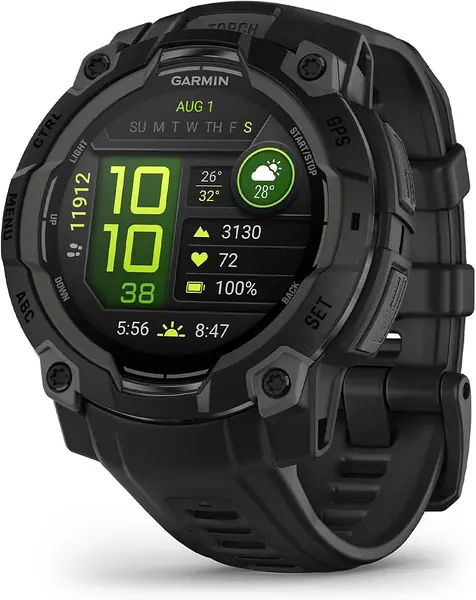
Garmin Instinct 3 AMOLED Best Overall
Key details
- Battery Life
- Up to 18 days
- Display
- 1.2 in. AMOLED, 1,000 nits
- Water Resistance
- 100 m
- GPS
- Multi-band with SatIQ
A flashlight on a wristwatch sounds like a spec-sheet gimmick until the sun sets earlier than you planned. On the Instinct 3 it's a real LED with several brightness levels and a strobe, and it's the extra we reached for most — at a dark trailhead, hunting for a dropped key, finding a tent zipper at 2 a.m. The rest of the watch follows the same logic: a 45 mm fiber-reinforced polymer case with a metal-reinforced bezel, 100-meter water resistance, and a rated 18 days between charges in smartwatch mode. That combination is why it's the watch we recommend first.
The 1.2-inch AMOLED display makes the case. At 1,000 nits it stays readable in direct sun, which matters more on a watch you glance at mid-run than resolution does. Underneath is Garmin's multi-band GPS with SatIQ, which shifts satellite modes to hold a track in tree cover and between buildings without flattening the battery. We were also glad of the barometric altimeter and 3-axis compass on hikes, where elevation gain is half the story you're trying to record.
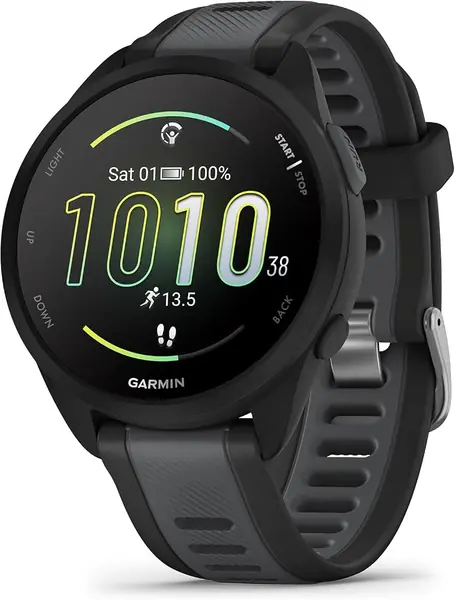
The compromise is coaching. The Instinct records and navigates beautifully, but adaptive daily workouts and race plans belong to the Forerunner 165, and if you want a watch that tells you what to run tomorrow, that's the one to buy instead. What keeps the Instinct on our wrist is the charging arithmetic: roughly two and a half weeks of wear changes how you use sleep tracking, because it stops being a decision about battery.
Pros
- Built-in LED flashlight with a strobe
- Multi-band GPS with SatIQ
- Up to 18 days of battery
Cons
- Button-only controls, no touchscreen
- 53 g is the heaviest on the wrist here
The GPS watch we tell most people to buy: rugged, readable in sunlight, accurate on multi-band GPS, and it runs for weeks between charges.