Best Smartwatches for Running of 2026

My phone died at mile nine once, and I finished that run with no pace, no distance, and no idea whether the last mile was faster than the one before it. That's the case for a running watch in one sentence: the numbers live on your wrist, one glance, no fumbling in a pocket. What the spec sheets won't tell you is which ones still make sense at mile six, when you're too tired to squint — or whether the extra money buys you anything you'll actually notice.

My team and I ran with 12 smartwatches over six months: dawn road loops, treadmill intervals, slow muddy Saturdays. The differences were rarely the ones advertised. A big, bright screen is lovely and eats battery; a watch promising weeks of life means weeks with GPS off. The ones that won got the unglamorous things right — a fast satellite lock, a battery still alive after a week of real training, a strap you forget you're wearing, a case that doesn't swallow your wrist.

What follows is what survived all that, and who each one is actually for.

The Best Smartwatches for Running

1

Garmin Forerunner 165 Best Overall
93 /100
TKZ Score Outstanding

Key details

Display
1.2-inch AMOLED
Weight
1.38 oz
GPS Battery Life
19 hours
Smartwatch Battery
11 days
View on Amazon

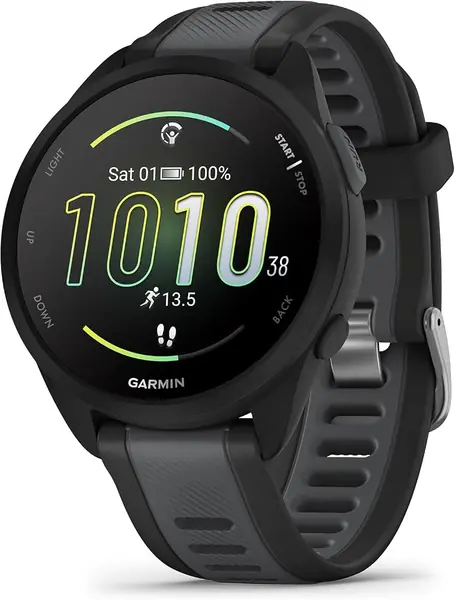
Nineteen hours is the number that should decide this one for most runners. That is how long the Forerunner 165 keeps GPS running on a charge, long enough to cover a marathon with hours to spare, and Garmin lists 11 days in everyday smartwatch mode. It all sits in a 43 mm case weighing 1.38 ounces, light enough that the charger ends up in a drawer rather than your gym bag.

Plenty of watches record a run. What earns the 165 the top spot here is what it does with the data afterward. It builds daily suggested workouts that shift with your performance and recovery, Garmin Coach lays out a 5K, 10K, or half-marathon plan and adapts it as you go, and the morning report puts sleep, HRV status, and your training outlook on one screen. We prefer that to a wall of numbers with no advice attached, because it answers the only question you have at 6 a.m.: how hard should today be.

The hardware keeps up. The 1.2-inch AMOLED stays readable in direct sun, the physical buttons do the work when your hands are wet or gloved, and more than 25 activity profiles cover cycling and pool sessions on the same wrist. It is also the least fussy watch in this group to live with: notifications, weather, and a week of battery in a case that fits a narrow wrist. That is about the highest compliment we can pay something strapped on at mile 20.

Pros

  • 19 hours of GPS battery in a light case
  • Daily suggested workouts and free race plans
  • Bright AMOLED plus buttons that work wet

Cons

  • No multi-band GPS or offline music
  • Pairing can take a second attempt
Our verdict

We recommend the Forerunner 165 to anyone building a running habit: 19 hours of GPS, a coach on the wrist, and a case light enough to sleep in.
Check Latest Price
2

Garmin Forerunner 265 Best for Race Training

92 /100
TKZ Score Outstanding

Key details

Display
1.3-inch AMOLED
GPS
Multi-band
GPS Battery Life
20 hours
Smartwatch Battery
13 days
View on Amazon

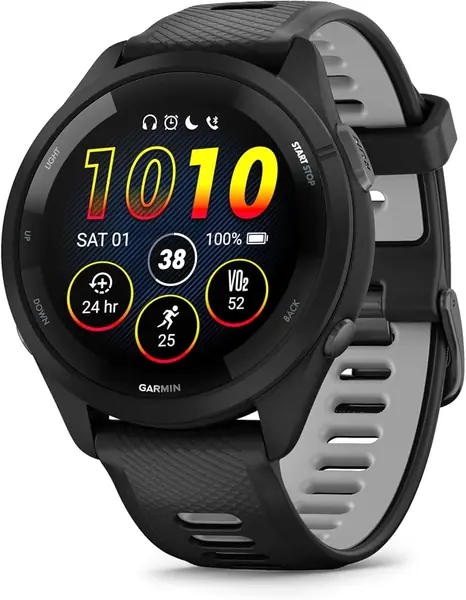
The Forerunner 265 takes the 165's formula and adds what a racer wants: multi-band GPS alongside Garmin's SatIQ mode, 8 GB for music on the wrist, and a larger 1.3-inch AMOLED in a 46 mm case. Battery runs to 13 days in smartwatch mode or 20 hours with GPS on. It costs meaningfully more than our top pick, and for one kind of runner that is the right trade.

That runner has a race on the calendar. Training readiness weighs sleep quality, recovery, training load, and HRV into a single score; the race widget lets you load a course and plan pacing; daily suggested workouts adapt to the event you entered rather than to a generic week. On a 46 mm case that is a lot of watch, but nothing else in this group gives you a clearer answer on whether you are ready to race or just rested.

The interface is the thing to budget time for. The menus go deep and the first week feels like learning a language, so treat Garmin Connect as the place you do most of your reading and the watch as the remote control for it. At 47 grams it is also noticeably heavier on the wrist than the 165, which registers more at mile 18 than on the sofa.

Pros

  • Multi-band GPS holds a line under cover
  • Training readiness and race-day pacing tools
  • 8 GB for music without your phone

Cons

  • Some units stop working without warning
Our verdict

If you are training for a goal race and want the most complete picture of your fitness, the Forerunner 265 is the upgrade we point you to.

Check Latest Price
3

Amazfit Active Max Best Battery Life

91 /100
TKZ Score Outstanding

Key details

Display
1.5-inch AMOLED
Battery Life
24 days
Satellite Systems
BeiDou, GLONASS, GPS, Galileo
Maps
Offline, turn-by-turn
View on Amazon

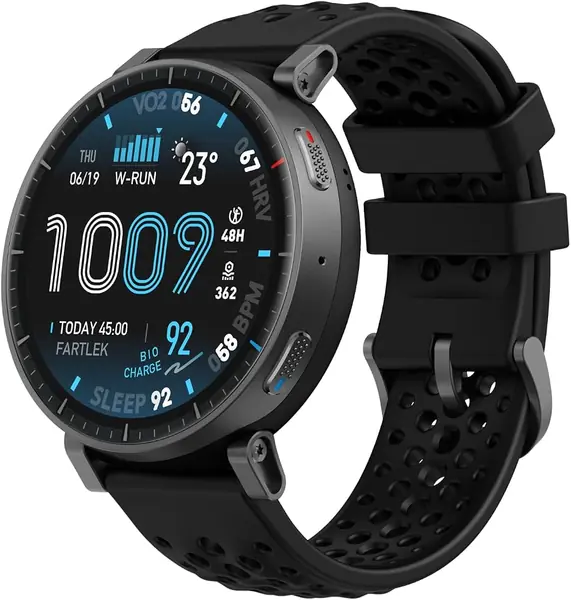
Forty-eight millimeters is a lot of watch, and at 1.97 ounces the Active Max is the heaviest thing on this list. On a small wrist it reads as equipment rather than jewelry. What the bulk buys is a 1.5-inch AMOLED rated at 3,000 nits, bright enough to read a split in direct sun without cupping a hand over the screen.

The rest of the package is unusually complete for the money. There is built-in GPS across five satellite systems, offline maps with turn-by-turn directions, 4 GB for music and downloaded routes, more than 170 workout modes, and Zepp Coach running plans that adapt to how you train. A BioCharge score shifts with your workouts and stress to suggest when to push and when to back off.

Battery is the headline. Amazfit lists about three weeks between charges, so the puck lives in a drawer and the watch stays on your wrist through an entire training block. Nothing else here goes that long between charges, and that changes how you use the thing: no charging ritual the night before a long run, no skipping a recorded walk because it might cost you tomorrow.

We think the Active Max is the best value in this set for anyone who wants a big readable screen, maps on the wrist, and a battery that outlasts their motivation. The compromises are real: the coaching is not as sharp as Garmin's, and positioning is solid on open roads but not in the 265's multi-band class under heavy tree cover. Buy it for the endurance and the display, and pay Garmin money if the numbers themselves are the point.

Pros

  • Three weeks between charges
  • 3,000-nit screen readable in direct sun
  • Offline maps with turn-by-turn directions

Cons

  • Charging base ships without a USB-C cable
Our verdict

We recommend the Active Max to runners who want a huge, sunlight-proof screen and weeks of battery, and do not mind a big case doing it.

Check Latest Price
4

Amazfit Bip 6 Best Budget

90 /100
TKZ Score Outstanding

Key details

Display
1.97-inch AMOLED
Battery Life
14 days
Weight
1.44 oz
Satellite Systems
BeiDou, GLONASS, GPS, Galileo
View on Amazon

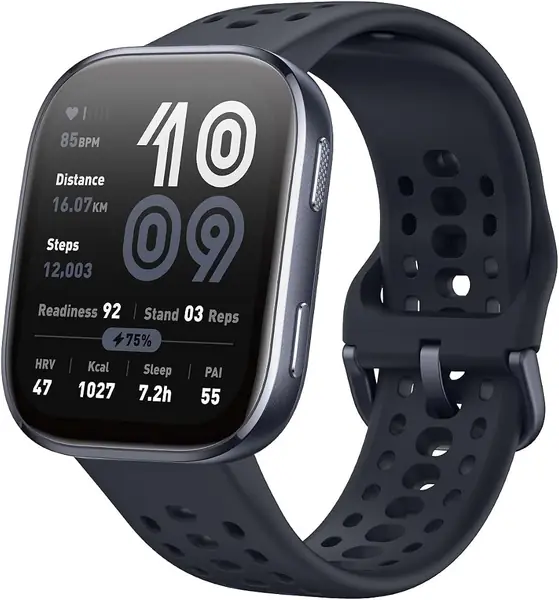
The Bip 6 is the least expensive watch here we trust with a training log, and its spec sheet reads like a watch from a tier above: a 1.97-inch AMOLED at 2,000 nits, 14 days of battery, five satellite systems, and free downloadable maps with turn-by-turn directions. The case is aluminum and weighs 1.44 ounces.

The screen is what sells it. At 1.97 inches it is larger than the display on Garmin's 265, and the brightness means you can read pace at arm's length in the sun, which decides whether you glance at your wrist mid-run or just guess. Fourteen days between charges makes it the watch that goes in a bag for a weekend without its charger. For a first running watch or a second one for travel, that combination is hard to argue with.

The place it feels budget is the guidance. You get more than 140 workout modes and AI coaching prompts, but not the day-by-day plan a Garmin builds from your recovery; if you already follow a coach or a club plan, that costs you nothing. Everything else about the Bip 6 behaves like a watch that costs considerably more, which is why it is the one we hand to someone who is not sure yet whether they will stick with running.

Pros

  • Large, bright 1.97-inch AMOLED
  • 14 days of battery per charge
  • Free maps and five satellite systems

Cons

  • 512 MB of storage fills quickly
  • Wide case sits large on slim wrists
Our verdict

For a first running watch or a travel spare, the Bip 6 gives you a big screen and two weeks of battery for very little.

Check Latest Price
5

Apple Watch SE 3 Best for iPhone Owners

89 /100
TKZ Score Excellent

Key details

Battery Life
18 hours
GPS
Built in
Case Size
40 mm
Compatibility
iPhone
View on Amazon

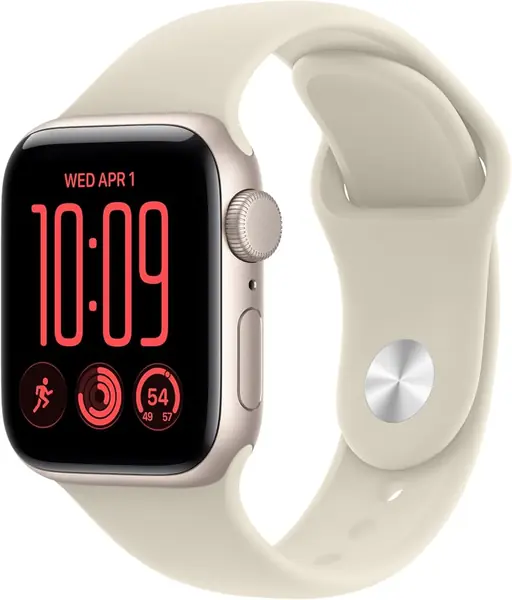
If the phone in your pocket is an iPhone and you want one watch for runs, work, and everything between, the SE 3 is the one we point to. It pairs with an iPhone without drama, tracks runs with real-time metrics, and brings safety features none of the running watches here list: fall and crash detection that can contact emergency services for you. Temperature sensing feeds the Vitals and Cycle Tracking apps, and Siri handles the rest from your wrist.

As a training tool it is simpler than a Garmin, and for plenty of runners that is the appeal: a workout app that records what you did, a screen that shows your metrics mid-run, and a phone that handles the analysis afterward. The 40 mm case is small enough to sleep in, which matters if you want the overnight data that everything else on this page builds its recovery scores from.

Battery is the honest trade. Apple rates it at 18 hours, so you charge daily, and sleep tracking only works if you give the watch a fixed window to top up, after dinner or during your morning shower. Fast charging makes that less of a chore than the number suggests. If you already plug in a phone every night, one more puck on the nightstand is not a lifestyle change.

Pros

  • Pairs cleanly with an iPhone
  • Fall and crash detection built in
  • Small enough to wear overnight

Cons

  • 40 mm case is small for larger wrists
Our verdict

We point iPhone owners who want one watch for runs and the rest of the day to the SE 3, as long as a nightly charge fits their routine.

Check Latest Price
6

CMF Watch 3 Pro Best for Android Budget Shoppers

84 /100
TKZ Score Excellent

Key details

Display
1.43-inch AMOLED
Battery Life
13 days
Weight
1.83 oz
Water Resistance
IP68
View on Amazon

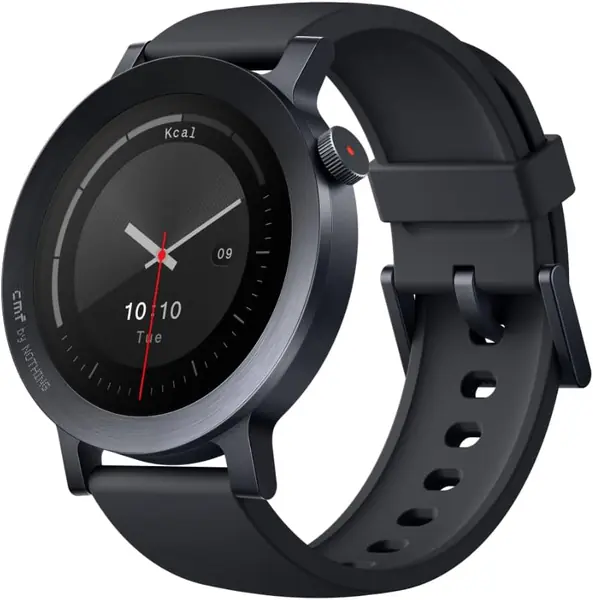
The Watch 3 Pro is the watch we stopped thinking about fastest, because it kept not needing a charger. CMF rates it at 13 days, and the 1.43-inch AMOLED is sharp at 416 x 416 and brighter than this price normally buys. In a metal case on a 22 mm band it reads as a proper watch rather than a plastic tracker, which is why it gets worn to dinner and not just to the trailhead.

Where the money shows is in the data. GPS does the job on runs, and Bluetooth calling through the dual microphones and speaker is genuinely useful when you leave the phone at home. Heart rate is the weak link: readings can land well off during hard efforts, and the step count is not the most careful we have used. Android pairing is easy; iPhones are the bumpier ride.

As a second watch, a travel watch, or a first smartwatch for someone who is not sure yet, we think it is a bargain: two weeks of battery, calls on the wrist, and a screen that holds up outdoors. As your only training tool, the accuracy question keeps it behind the Garmins here, because the runs you want to analyze deserve a watch you trust with heart rate.

Pros

  • 13 days of battery for the money
  • Crisp AMOLED in a metal case
  • Bluetooth calls and texts on the wrist

Cons

  • Heart-rate readings drift in hard efforts
  • Pairing is unreliable with iPhones
Our verdict

We think the CMF Watch 3 Pro is the bargain of the group for Android owners who want battery and looks, not lab-grade metrics.

Check Latest Price
7

Bvlrksc GPS Smartwatch Best for Budget Trail Runners

83 /100
TKZ Score Excellent

Key details

Display
1.46-inch AMOLED
Satellite Systems
BeiDou, GPS, Galileo, QZSS
Maps
Offline, built in
Water Resistance
IP68
View on Amazon

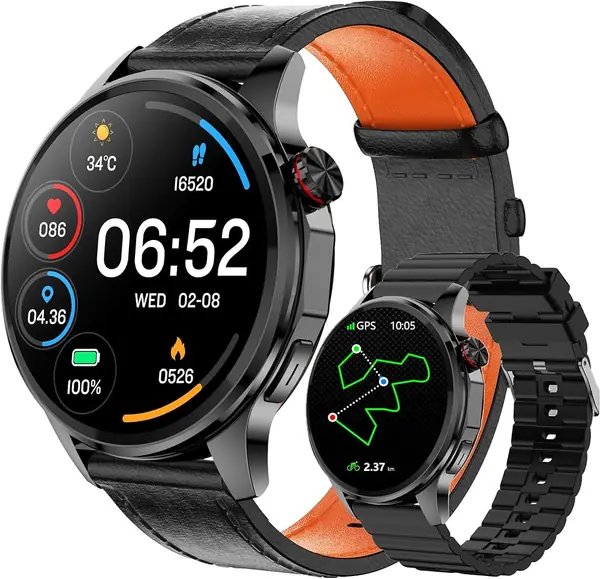
Offline maps are why this one made the list. The Bvlrksc watch pairs multi-system GPS with built-in offline maps, a compass, an altimeter, and a barometer, the sort of outdoor toolkit that normally costs a great deal more. It ships with two bands, leather and silicone, so it can pass at the office and take sweat on Saturday.

The rest is a mixed bag of good ideas. The 1.46-inch AMOLED is crisp, there are more than 100 sport modes, Bluetooth calling and text replies work on Android, and the AI extras, generated watch faces and a voice translator, are more fun to demo than to use mid-run. The listing gives a battery capacity but no day rating, so plan on charging it more often than the Amazfits until you know your own pattern.

We think it earns a place for the runner whose routes wander off-road and who wants a map on the wrist without premium-watch money. Treat it as a second watch for adventures rather than the one holding your training history, and test the phone pairing thoroughly while the return window is still open.

Pros

  • Offline maps, compass, altimeter, barometer
  • Two bands included, leather and silicone
  • 1.46-inch AMOLED with 100+ modes

Cons

  • Sync can drop between watch and phone
Our verdict

We see the Bvlrksc as a cheap second watch for trail days, where offline maps matter more than the polish of the app behind them.

Check Latest Price

How We Tested a Dozen Running Watches

We started with a pool of roughly 40 watches and narrowed it using spec sheets, return data, and one hard filter: built-in GPS rather than phone-tethered tracking. Cases had to span about 40 to 48 millimeters so there was something for a narrow wrist and something for a wide one, and every contender had to promise at least a week of battery. That left 12, across both phone ecosystems and a wide spread of prices.

Each watch went on the same rotation for six months: a 6-mile road loop, a set of treadmill intervals, and a longer Saturday effort that sometimes turned into a trail run. We started every watch cold at a wooded trailhead and timed how long it took to find satellites, then compared the distance it recorded against a route we'd measured ourselves. Battery was logged in hours of GPS-on running until the watch shut off, never taken from the box.

At noon we stepped into direct sun and read each screen, then noted how much brightness cost in battery. We wore them through rain and rinsed them under a tap after sweaty runs, keeping track of which cases scuffed first. Fit got the same treatment: lug-to-lug against a shirt cuff, and whether the case snagged a jacket sleeve mid-arm swing. Every watch was paired to an iPhone and an Android phone, then carried out the door without the phone to see where the Bluetooth signal dropped and whether calls still came through.

For the interface, a second tester who'd never seen the software was handed each watch and asked to build a workout from scratch — we counted the taps and the wrong turns. Reliability meant finishing what it started: no dropped miles, no failed sync, no missing night of sleep data. We also followed each watch's daily workout suggestions for a week straight, long enough to tell coaching from noise.

How to Choose a Smartwatch for Running

How the Watch Finds You

Every watch here uses satellites for pace and distance, but they do not all listen the same way. Single-band GPS is fine on open roads and in parks, and it wobbles between tall buildings or under dense trees, where the trace cuts corners and pace jumps around. Multi-band positioning holds a cleaner line in exactly those places.

If your routes are trails, city canyons, or tree-covered greenways, that upgrade earns its price, and the Forerunner 265 is the watch here that carries it. If you run the same flat loop three times a week, save the money and spend it on shoes.

Read the GPS Battery Figure, Not the Days

A watch rated for 11 or 14 days is quoting smartwatch mode: notifications, step counting, maybe an hour of GPS. Switch GPS on and that same watch may run 19 or 20 hours, which is the number that decides whether it survives your longest run. Add up your weekly running hours and compare; five hours a week eats a quarter of a 19-hour GPS budget before everyday wear is counted at all.

The other thing to check is charging speed and routine. A watch you top up in 20 minutes in the shower is a different proposition from one that wants two hours on a desk.

Coaching Is the Upgrade You Actually Feel

Past a certain point you are not buying better GPS, you are buying advice. Garmin builds daily suggested workouts that shift with your recovery; Amazfit's Zepp Coach and BioCharge score do a simpler version of the same job. That is worth real money if you are self-coached and prone to overtraining or skipping the easy days.

If you already follow a club plan or a coach who tells you what to run on Tuesday, skip it. The budget watches here record a run perfectly well, and you would be paying for a second opinion you do not need.

Fit, Weight, and Wet Hands

Cases here run from 40 mm to 48 mm and weights from 1.38 ounces to 1.97 ounces, which is the difference between a watch you forget about and one you notice at mile 15. If you plan to wear it overnight for sleep data, weight counts twice.

Controls matter just as much. Touchscreens are miserable with wet fingers, rain, or gloves, so the watches with physical buttons, the Garmins here especially, are easier to lap mid-run without breaking stride.

Match the Watch to the Phone in Your Pocket

This decision eliminates more options than any sensor comparison. The Apple Watch SE 3 only makes sense with an iPhone, and some watches here are built for Android first and pair with iOS reluctantly. Garmin and Amazfit work with either phone, which makes them the safer buy in a mixed household.

Settle compatibility before you compare GPS chips, because a brilliant watch that drops its connection to your phone is a paperweight with a strap.

Frequently Asked Questions

Final Verdict

Most people shopping for a running watch should buy the Garmin Forerunner 165. It has the GPS battery for a marathon, the coaching to fill a training week, and a case light enough to forget about, all for less than the watches it beats here on day-to-day usability.

Step up to the Forerunner 265 if multi-band positioning and music on the wrist matter for the races you are targeting. If you want one watch that handles iPhone life as well as your runs, the Apple Watch SE 3 is the better daily companion, provided you are willing to charge it nightly.