Best Amazfit Smartwatches of 2026

A smartwatch lives or dies by its battery, and that's the tradeoff the spec sheet never quite admits. Big, bright screens and always-on GPS are wonderful until you're at a hotel outlet at eleven at night waiting for a charge. What you want is a watch that tracks the whole day — sleep included — and still belongs on your wrist a week later, without a phone-company price attached.

I've had one on my wrist since spring, and over the past six months my team and I have worn 12 of them through runs, pool laps, and plenty of nights. The pattern: shoppers overrate the sport-mode count and underrate what you feel by hour three — a big case on a small wrist, a strap that gets slick with sweat, a screen that vanishes in sun. Offline maps and dual-band GPS are the two upgrades genuinely worth chasing.

Looks matter too, since this is jewelry you'll wear to work: a couple of these are tidy enough for a Tuesday meeting, and a couple are built for gravel and saltwater.

The Best Amazfit Smartwatches

1

Amazfit Active Max Best Overall
90 /100
TKZ Score Outstanding

Key details

Display
1.5-inch AMOLED, 3000 nits
Battery Life
Up to 25 days
GPS
Built-in GPS, offline maps
Water Resistance
50 meters
View on Amazon

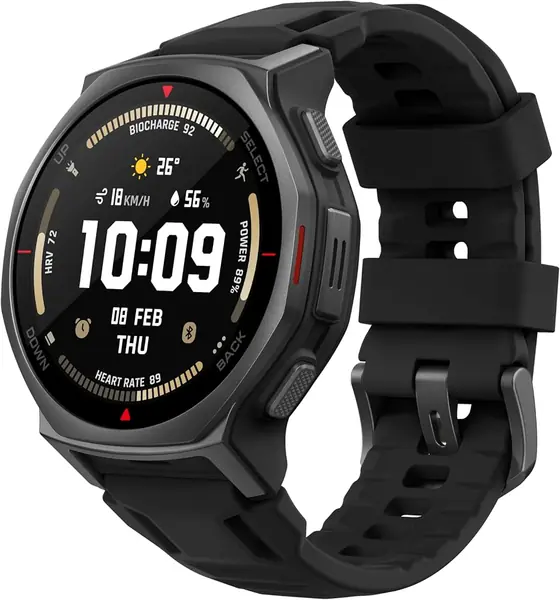
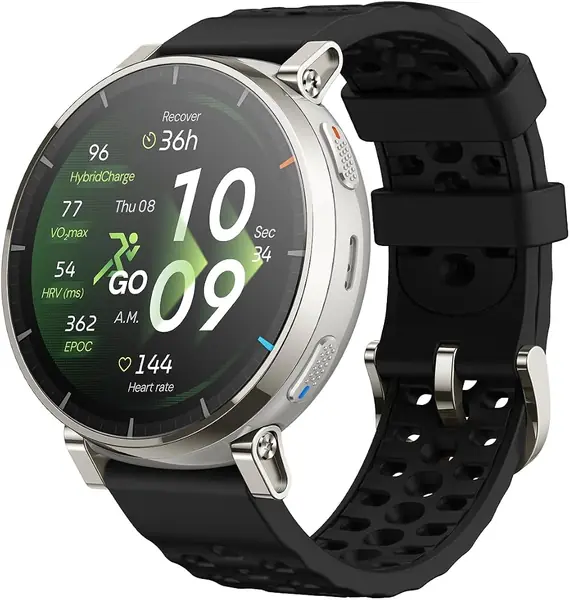
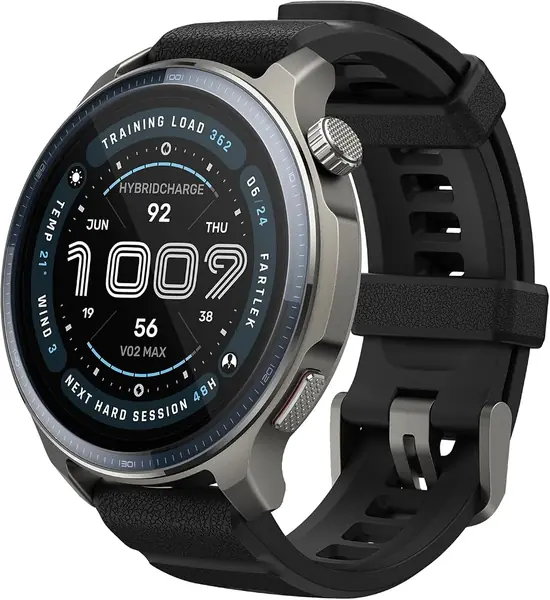
The Active Max makes its case before you even strap it on: a 1.5-inch AMOLED panel rated at 3,000 nits, a battery Amazfit rates for up to 25 days, and 4GB of storage for offline maps. That combination is why it is our top pick. The display is the part we appreciate most in daylight, because the extra brightness keeps pace, distance, and notifications readable when the sun is behind you.

The storage is more useful than it sounds. You can download maps and keep turn-by-turn directions on the watch, so a run or ride doesn't have to start with your phone in hand. With 170+ workout modes and the BioCharge readiness score, the Active Max covers strength sessions, long hikes, and everything between; we like that the training tools do not feel bolted onto a notification device.

The practical catch is in the box: you get the magnetic charging base but no USB-C cable, so plan for one. The 200 mAh battery also looks small on paper for a watch this size, though the long rating comes from typical use; heavy GPS and always-on mode will shorten it. We kept coming back to the Active Max because it handles the everyday work—steps, sleep, notifications, workouts—without turning charging into a nightly ritual.

Pros

  • Large 1.5-inch AMOLED screen at 3,000 nits
  • Up to 25 days of typical battery life
  • 4GB storage supports offline maps
  • 170+ workout modes with readiness tracking

Cons

  • 48mm case is large for small wrists
Our verdict

Our top pick for most people: a bright 1.5-inch screen, up to 25 days of battery, and offline maps make it a complete everyday fitness watch.
Check Latest Price
2

Amazfit Active 3 Best Premium Materials

89 /100
TKZ Score Excellent

Key details

Display
1.32-inch AMOLED, 3000 nits
Battery Life
Up to 12 days
GPS
Built-in GPS, offline maps
Case
Stainless steel, sapphire glass
View on Amazon

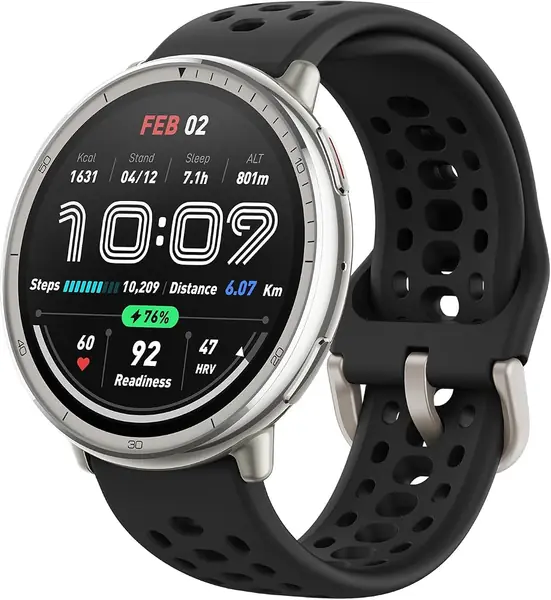
The Active 3 takes a different route to the same price point as the Active Max: a smaller 1.32-inch screen, a stainless steel case, and sapphire glass. The first thing we noticed is how much more like a traditional watch it looks. If you want an Amazfit that works with a jacket or a dress, this is the one in the group we reach for.

The four physical buttons are the detail we appreciate most. During a workout, you can start a lap or pause without stabbing at a touchscreen with sweaty hands, and the stainless frame and sapphire crystal should stand up to daily knocks better than a basic glass-and-plastic build. We also like that the 1.32-inch AMOLED panel still hits 3,000 nits, so the smaller size doesn't mean a dimmer screen.

The materials are the point. If you want the biggest screen and the lightest possible watch, the Active Max remains the better tool; the Active 3 is for the buyer who values a smaller case, sapphire, and buttons enough to accept the extra heft. We didn't mind the weight once the stainless case was on the wrist, but it is noticeable next to the larger watch. The 4GB of storage and offline maps are still here, so training features are not sacrificed.

Pros

  • Sapphire glass and stainless steel case
  • Four physical buttons for workout control
  • 1.32-inch AMOLED screen at 3,000 nits
  • 4GB storage and offline maps

Cons

  • 12-day battery trails the top pick's
Our verdict

Choose the Active 3 for its sapphire-and-stainless build and four physical buttons in a smaller case—especially if you want a watch that looks dressier than the Active Max.

Check Latest Price
3

Amazfit Balance 2 Best for Training and Navigation

88 /100
TKZ Score Excellent

Key details

Display
1.5-inch AMOLED, 2000 nits
Battery Life
Up to 21 days
GPS
Dual-band, six satellites
Storage
32 GB
View on Amazon

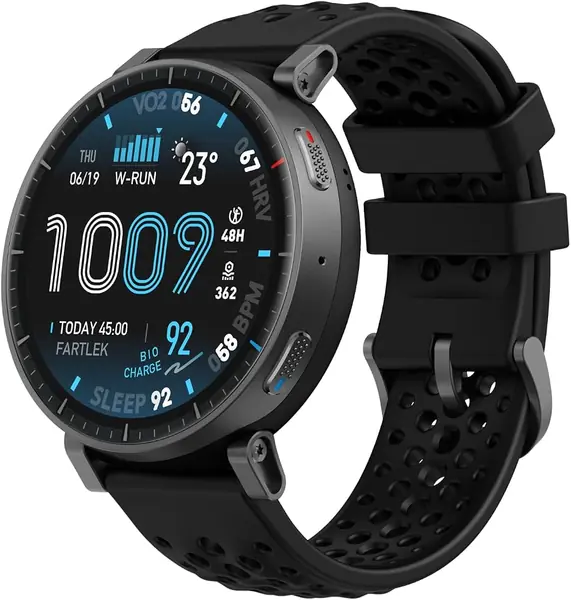
Dual-band GPS is the reason the Balance 2 costs more than the Active models, and it is the feature we care about most on a watch this serious. The watch uses six satellite systems and supports offline maps with turn-by-turn directions, so a run between tall buildings or a ride under tree cover has a better chance of staying on track. That is a real upgrade over a basic single-band watch, not just a line on a spec sheet.

The 32GB of storage is the other detail that makes it useful for travel. You can keep maps on the watch and leave the phone behind, and the included black and red silicone straps give you a quick way to change the look for race day. With 180+ sport modes, HYROX and golf modes, and a 1.5-inch sapphire-covered AMOLED screen, the Balance 2 is aimed at people who train across different sports rather than just log steps.

Battery life is rated at up to 21 days, which is long enough that charging becomes a weekend habit rather than a nightly one. The dual-band GPS and 32GB of maps are the reasons to choose it over the Active line. For the right buyer, the Balance 2 is the most complete training watch in this group.

Pros

  • Dual-band GPS from six satellite systems
  • 32GB storage for offline maps
  • Up to 21 days of battery life
  • 180+ sport modes including HYROX and golf

Cons

  • 47mm case is large for slim wrists
Our verdict

The Balance 2 is our pick for training with maps: dual-band GPS, 32GB storage, and 21-day battery make it a serious athlete's watch.

Check Latest Price
4

Amazfit T-Rex 3 Pro Best Rugged

87 /100
TKZ Score Excellent

Key details

Display
1.32-inch AMOLED, 3000 nits
Battery Life
Up to 17 days
GPS
Dual-band, six systems
Case
Titanium bezel, 10 ATM
View on Amazon

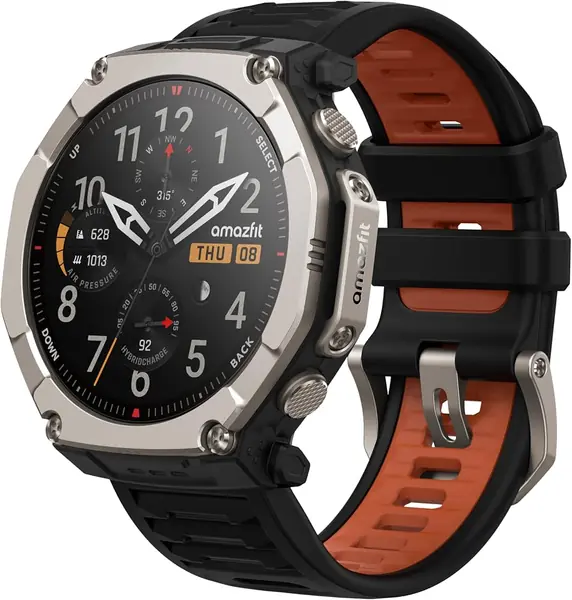
The T-Rex 3 Pro is the watch in this group we trust for a rough day outside. The titanium bezel and buttons, sapphire glass, and 10 ATM water resistance are the obvious hardware upgrades, but the built-in two-color flashlight is the detail that sold us: red for low light, white for a clear path, and a turbo mode when you need maximum visibility. It is the kind of feature you forget about until a trail run finishes after sunset.

Dual-band GPS from six satellite systems and offline maps put it in the same navigation class as the Balance 2, and the 180+ sport modes include HYROX training and a dive certification to 45 meters. The 1.32-inch AMOLED screen hits 3,000 nits, and the 17-day battery rating is long enough for a week of workouts plus a weekend away. We also appreciate the titanium case for a watch that is going to meet rocks and salt water.

The T-Rex 3 Pro is built around water, impact, and low-light use, so the titanium and dive-rated hardware cost more than a general-purpose Active model. For hikers, swimmers, and anyone who wants a flashlight on the wrist, it earns the premium.

Pros

  • Titanium bezel with 10 ATM and dive certification
  • Dual-band GPS and offline maps
  • Built-in two-color flashlight
  • Up to 17 days of battery life

Cons

  • Smaller 1.32-inch display than the top pick
Our verdict

The T-Rex 3 Pro is the rugged pick: titanium, 10 ATM water resistance, dual-band GPS, and a built-in flashlight make it a genuine trail and water companion.

Check Latest Price
5

Amazfit Active 2 Best Everyday Wear

86 /100
TKZ Score Excellent

Key details

Display
1.32-inch AMOLED, 2000 nits
Battery Life
Up to 10 days
GPS
Five satellite systems
Case
Stainless steel
View on Amazon

At 1.12 ounces, the Active 2 is the watch that disappears on the wrist. The stainless steel case gives it a more polished look than a basic fitness tracker, but it does not turn the watch into a heavy piece of jewelry. We noticed the weight most when switching back from the larger models: it sits close, doesn't snag on a sleeve, and is easy to forget during a long day.

The 1.32-inch AMOLED screen is bright enough at 2,000 nits for outdoor runs, and the watch covers the essentials with a 10-day battery rating, five satellite positioning systems, and free maps with turn-by-turn directions. With 160+ workout modes and 400 watch-face styles, it has more personality than we expected from an everyday model. We also like the stainless case at this end of the lineup; it makes the Active 2 feel less disposable than a basic tracker.

The Active 2 is the watch we put on for an ordinary day: a walk, a gym session, a full day at a desk, then sleep tracking. It does not have the training depth of the Balance 2 or the rugged hardware of the T-Rex, but it covers the basics with less bulk and a more polished look. That makes it our everyday pick for someone who wants a light, good-looking watch without the extra heft.

Pros

  • Light 1.12-ounce build
  • Stainless steel case with polished look
  • Up to 10 days of battery life
  • Five satellite systems and free maps

Cons

  • 512MB storage limits offline music
Our verdict

The Active 2 is our everyday pick: a light stainless case, a 10-day battery, and free maps make it an easy watch to wear all day.

Check Latest Price
6

Amazfit T-Rex Ultra 2 Best for Expedition Use

79 /100
TKZ Score Very Good

Key details

Display
1.5-inch AMOLED, 3000 nits
Battery Life
Up to 30 days
Case
Titanium, 100 meters
Maps
Preloaded color maps
View on Amazon

The T-Rex Ultra 2 is built for trips where charging is the enemy. The 30-day battery rating is the kind of number that changes how you pack: no charging brick for a long weekend, no scramble for a cable at a campsite. If your watch usually lives on a charger overnight, this one is built for the opposite routine.

The 1.5-inch AMOLED screen is bright at 3,000 nits, and the watch carries 64GB of storage plus preloaded color maps, route planning, checkpoints, and automatic rerouting. The built-in flashlight switches between white and green, and the titanium case is rated to 100 meters. We like that the navigation tools live on the watch rather than depending on a phone, because that is the whole point of a watch this serious.

The Ultra 2 is a specialist, not an all-rounder. The battery and maps are the reason to carry the extra hardware, and the titanium case should handle cold, wet, and rocky conditions without fuss. For a multi-day hike or a remote trip, the trade is easy to understand; for a desk job and a daily run, the smaller models make more sense.

Pros

  • Up to 30 days of battery life
  • 64GB storage with preloaded color maps
  • Titanium case rated to 100 meters
  • Built-in white and green flashlight

Cons

  • 51mm case is a lot for daily wear
  • Premium price limits it to dedicated trips
Our verdict

The T-Rex Ultra 2 is a specialist for multi-day trips: 30-day battery, 64GB of preloaded maps, and a titanium case make it a genuine expedition tool.

Check Latest Price

How We Tested: Six Months, Twelve Watches

We started by pulling the current lineup and reading through owner reviews, then narrowed by case size, display type, price, and the features people actually compare: offline maps, dual-band GPS, sapphire glass, rated battery life. Twelve watches made the cut. Each one got worn for at least a week straight as a daily driver — six months total — and we logged the battery percentage at bedtime and again at breakfast to see how fast it really drained.

Most of the testing happened where a watch actually lives: overnight in bed, on the same three-mile road loop, in a lap pool, at a desk, and on weekend hikes where we left the phone in the car on purpose to force the offline maps to earn their keep. We compared recorded distance against a measured loop, checked heart rate against a chest strap during intervals, and timed how quickly each watch locked onto satellites.

Reliability came down to noticing things: dropped notifications, a watch that re-paired slowly after we walked away from the phone, a touchscreen that stuttered while scrolling. We paired every watch to both an iPhone and an Android phone to see whether the experience held up on either. Durability got the doorframe treatment — sleeves, gym equipment, chlorinated water — and we checked the glass and bezel for scratches after week two. Then we wore them to the office and to the trailhead and asked which ones we'd keep wearing on our own time.

How to Choose an Amazfit Smartwatch

Start With Case Size and Weight

Case size is the first thing your wrist feels, and it is the hardest specification to live with if you get it wrong. The 44mm Active 2 and T-Rex 3 Pro are the easier everyday sizes; the 47mm Balance 2 and 48mm Active Max are still wearable but more noticeable; the 51mm T-Rex Ultra 2 is a specialist's watch. A case that overhangs the wrist will catch on sleeves and feel bulky overnight, so try the watch on before you commit.

Materials add weight, too. Stainless steel and sapphire make a smaller watch feel denser, while titanium keeps a large case lighter. If you sleep in the watch, prioritize a low profile over a bigger screen.

Battery Life Is a Range, Not a Promise

Amazfit's headline battery figures run from 10 to 30 days, but those are typical-use numbers. Dual-band GPS, always-on display, and high brightness shorten them, and a watch rated for a month can become a weekly charge during a heavy GPS week. Decide on a charging rhythm you can live with: 10 days suits someone who hates nightly charging, while 21 days or more is the better target for travel and remote work. Do not compare a typical-use rating with a GPS-workout rating; they measure different habits.

Match GPS to Where You Train

Single-band GPS from five or six satellite systems is enough for open-road runs, neighborhood walks, and most gym-to-street use. Dual-band GPS adds a second frequency for difficult environments such as tall buildings and dense tree cover, and it is the feature to pay for if your routes are technical. Offline maps are a separate decision: they let you follow a route without a phone, but only some models include enough storage for a full map set. If you run the same loop, save the money; if you explore, prioritize dual-band and maps.

Choose Materials, Water Resistance, and Smart Features

Sapphire glass and stainless or titanium cases make a watch feel more expensive, but they also add weight and cost. Water resistance matters more: 5 ATM or 50 meters covers pool laps and showers, while 10 ATM adds margin for water sports; a dive rating is a separate claim. On the smart side, notifications are standard, but calling and replies vary by phone. Buy for the workouts and notifications you use daily, not the longest mode list. Try the watch with your phone for a week before the return window closes.

Frequently Asked Questions

Final Verdict

We recommend the Amazfit Active Max as the default for most buyers. It nails the fundamentals: a bright 1.5-inch screen, up to 25 days between charges, offline maps, and more workout modes than most people will use. That combination makes it the easiest Amazfit to live with day after day.

Choose the Active 3 if you want a smaller, sapphire-and-stainless watch with physical buttons; the Balance 2 if dual-band GPS and on-watch maps matter for training; and the T-Rex 3 Pro if your workouts involve water, trails, or darkness. Those are specific upgrades, not reasons to overbuy.