Best Trail Running Watches of 2026

The best trail runs make everything else go quiet — the climb evens out your breathing, the descent takes all your attention, and you forget to check the time. Then you look down and the watch is doing something dumb: the screen washes out in the sun, the GPS line wanders through the trees, or the battery drops 20 percent in an hour.

A trail watch should get out of the way and get the details right. My team and I have worn seven of them over eight months — muddy singletrack, exposed ridge lines, weekday road miles — timing battery drain, squinting at screens at noon and at dusk, and letting each one's maps steer us at unfamiliar junctions.

New buyers fixate on sport modes; nobody needs a hundred of them. What separates these watches is whether the GPS holds a clean line under tree cover, how fast you can rearrange the data screens, whether the case works with jeans and a T-shirt, and whether the extra cost buys real function. Some picks below are race-day tools; others you could wear all week.

The Best Trail Running Watches

1

Garmin Forerunner 965 Best Overall
92 /100
TKZ Score Outstanding

Key details

Battery
23 days; 31 hours GPS
Navigation
Full-color maps; multi-band GPS
Weight
1.87 oz
Display
1.4 in AMOLED
View on Amazon

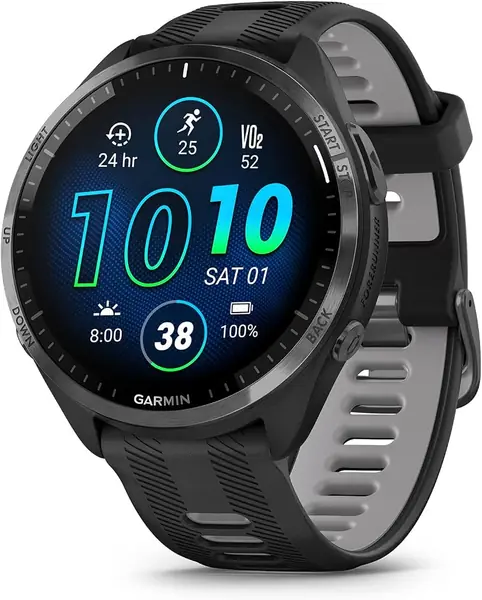
Full-color maps and a 53-gram body are an unusual pair. The Forerunner 965 puts both on your wrist, along with a 1.4-inch AMOLED screen and multi-band GPS. It sits between the simpler running watches and the heavier adventure models, and that middle ground is exactly where a lot of trail runners live.

We recommend it for most trail runners because the balance is right. The maps are detailed enough to follow a route, the 31-hour GPS rating covers a long day out, and the 23-day smartwatch rating keeps it off the charger between runs. At 53 grams, it stays comfortable through a full afternoon, and the training readiness and daily suggested workouts give structure without turning every run into a test. The titanium bezel adds some protection without much bulk, and the buttons work when the touchscreen is awkward with gloves. It is the watch we hand to a friend who wants one device for daily training and weekend trails.

The 1.4-inch AMOLED screen is bright and easy to scan, even when the trail is shaded. We also like that Garmin gives you both buttons and a touchscreen, because wet fingers and thick gloves make one control method unreliable. The maps are the reason this one earns the top spot: you can see the route, not just a line on a blank screen. For a first trail watch that will not feel limiting in a year, that combination is hard to beat here.

Pros

  • Full-color maps and multi-band GPS
  • Light 53-gram build for long days
  • 31 hours of GPS battery

Cons

  • GPS runtime trails the fēnix 8's 47 hours
Our verdict

For most trail runners, the Forerunner 965 is our pick: full-color maps and multi-band GPS in a 53-gram body with proven all-day battery.
Check Latest Price
2

Garmin fēnix 8 Best Rugged Option

88 /100
TKZ Score Excellent

Key details

Battery
16 days; 47 hours GPS
Navigation
GPS, GLONASS, Galileo
Weight
2.82 oz
Water Resistance
100 m
View on Amazon

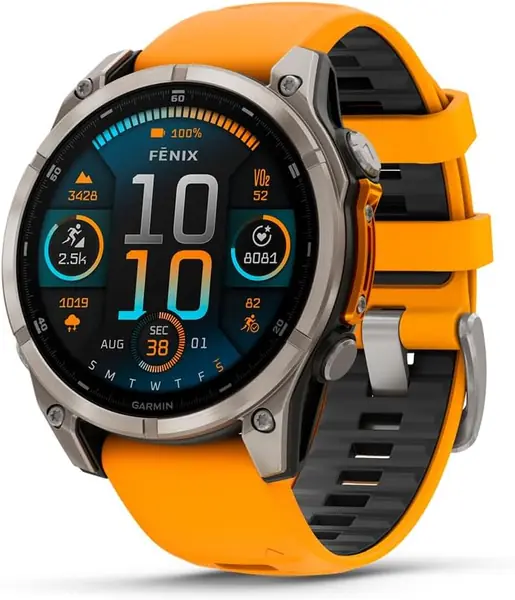
The fēnix 8 answers a different question: how much battery and armor can you strap to your wrist before the weight starts to matter? At 80 grams, it is the heaviest watch in this group, and you feel that on the first climb.

What that weight buys is real: 47 hours in GPS mode, a 100-meter water rating, a sapphire lens, and a titanium bezel. We like the built-in speaker and mic for calls when the watch is paired to a phone, and the 1.4-inch AMOLED screen is bright enough to read stats and navigation prompts in the trees. The 16-day smartwatch rating is not the longest here, but it is still a multi-day figure rather than a nightly charge. The training and recovery tools are the same deep Garmin library you get on the Forerunner, which makes the fēnix 8 feel like a training watch that happens to be armored.

For a fastpacking trip or a race where 31 hours is not enough, the fēnix 8 is the Garmin we trust. It is not the watch we recommend for every training run, but the extra armor and runtime are worth it when the route is remote and the day is long. The 47-hour GPS rating is the number that keeps it in the conversation for ultras and multi-day routes.

Pros

  • 47 hours of GPS battery
  • 100-meter water resistance and sapphire lens
  • Built-in speaker and mic

Cons

  • Premium price for a specialist watch
Our verdict

We recommend the fēnix 8 for long, rough trail days, where its 47-hour GPS battery and 100-meter case justify the extra weight.

Check Latest Price
3

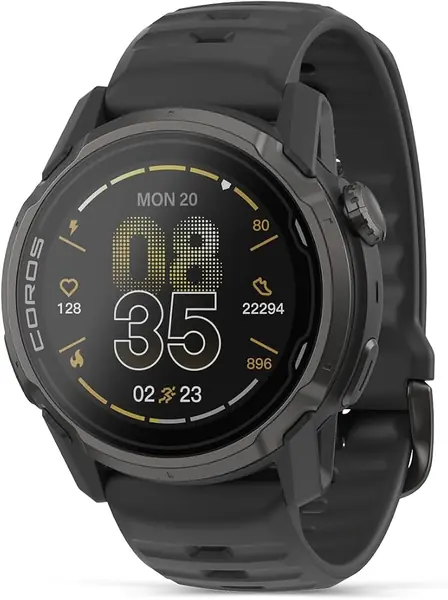
COROS APEX 4 Best Battery Value

87 /100
TKZ Score Excellent

Key details

Battery
34 days; 41 hours GPS
Navigation
Global maps; turn-by-turn
Weight
1.98 oz
Display
1.2 in MIP
View on Amazon

The APEX 4 leads with a number that gets attention: 34 days between charges, or 41 hours with all systems GPS. That is the kind of battery that makes a week of back-to-back runs feel unremarkable, and it is why we treat this as the battery-first pick in the group.

The rest of the package is built for trail use: global maps with turn-by-turn, dual-frequency GPS, a titanium bezel, sapphire glass, and a 56-gram body. The 42mm case is the smallest here, which we appreciate on narrow wrists, and the 1.2-inch MIP screen is built for sunlight and battery life. The watch also records voice pins and takes hands-free calls, which is more than we expect from a battery-first model.

We like the APEX 4 for long, self-supported days because the 34-day smartwatch rating is the longest here, and the maps are easy enough to follow without a phone. The controls are straightforward, and the watch does not feel fragile when you brush a rock or shove it into a pack. It is not the most feature-dense watch here, but it covers the trail basics with room to spare.

Pros

  • Up to 34 days between charges
  • 41 hours of all-systems GPS
  • Global maps with turn-by-turn

Cons

  • MIP screen is dimmer than AMOLED
Our verdict

The APEX 4 is our battery-first choice, with 41 hours of all-systems GPS and turn-by-turn maps in a lighter, less expensive package.

Check Latest Price
4

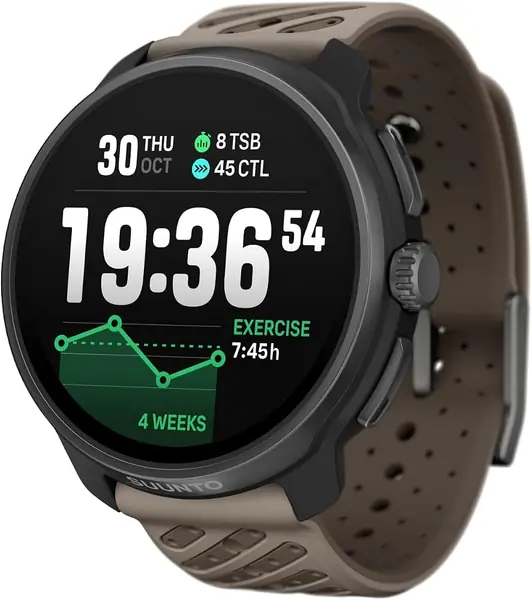
Suunto Race 2 Best Large Display

86 /100
TKZ Score Excellent

Key details

Battery
18 days; 55 hours GPS
Navigation
Offline maps; dual-band GPS
Display
1.5 in AMOLED
Sport Modes
115+
View on Amazon

A 1.5-inch AMOLED screen changes how a trail watch feels on the wrist: maps, climb profiles, and stats are suddenly easy to read at a glance. The Race 2 is the biggest-screen option here, and it leans into that.

The navigation package is serious: offline maps, dual-band GPS, and 55 hours in best GPS mode. That is the longest GPS rating in this group, and it gives you margin for a long race or a full day of route-finding. The 18-day smartwatch rating is similarly generous, and the titanium band and crown make the watch feel more expensive than a plastic training tool. The 115+ sport modes cover more than running, which matters if your trail season includes skiing, paddling, or climbing.

We like the Race 2 for map-heavy days because the screen makes route decisions faster. The three-button layout, including the crown, is easy to use with gloves, and the watch is comfortable enough for all-day wear. For long days where the route should look like a map rather than a squiggle, it earns its place.

Pros

  • 1.5-inch AMOLED display
  • 55 hours in best GPS mode
  • Offline maps and dual-band GPS

Cons

  • Large 1.5-inch case may overwhelm small wrists
Our verdict

Our large-screen pick is the Race 2: the biggest, brightest map screen here and 55 hours of GPS, with a case that will feel large on small wrists.

Check Latest Price
5

Apple Watch Ultra 4 Best for iPhone Trail Runners

85 /100
TKZ Score Excellent

Key details

Battery
2+ days; 45 hours workout
GPS
Dual-frequency
Case
49 mm titanium
Connectivity
GPS + Cellular
View on Amazon

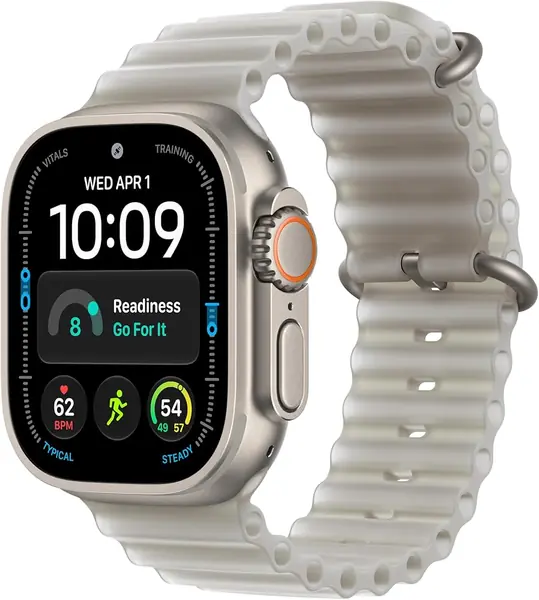
The Ultra 4 is the one here that still feels like a smartwatch first: a 49mm titanium case, cellular connection, and a bright screen that handles calls and messages between trailheads.

For trail use, the important specs are dual-frequency GPS, a titanium case, and up to 45 hours of max extended workout tracking. The 2+ day battery is a big improvement for an Apple Watch, and the health features are the other draw: heart-rate sensing and the readiness score that tells you when to push. This is the watch that makes the most sense if you want one device for training and the rest of your day.

We recommend the Ultra 4 for iPhone users who want one watch for trail runs, calls, and daily health tracking. The 45-hour extended workout rating covers a long day out, and the cellular connection covers the part where you need a ride home. The 49mm case is a lot of watch, but the screen earns its size when you are checking a route with tired eyes.

Pros

  • Dual-frequency GPS and cellular
  • 49mm titanium case
  • 45 hours of extended workout tracking

Cons

  • Shorter battery than dedicated trail watches
Our verdict

For iPhone users, the Ultra 4 is the trail-capable smartwatch we recommend, with cellular and heart-health features in exchange for charging every couple of days.

Check Latest Price

How We Tested Seven Trail Watches Over Eight Months

We started with a shortlist of about 20 current models and cut it down by reading spec sheets and trail-running forums, filtering for watches that paired a multi-band GPS with offline maps, a battery rated for long efforts, and a case that wouldn't feel like a brick on a six-inch wrist. That left seven, which we wore over eight months, rotating each one through at least a month on different wrists — mine included — so nothing got judged on one good week.

Most of the work happened on a five-mile loop with heavy tree cover, where we ran two watches at once and laid the tracks over each other afterward to see whose line wandered. We also took all seven to the same unfamiliar trail network for a weekend and let each one's turn-by-turn cues lead us at junctions, noting where a prompt arrived too late to act on. Anything over three hours got a battery log: starting percentage, hourly readings, and how much faster the drain got with navigation running.

For displays, we read the screens at noon in direct sun and again at dusk, and counted how often we shaded them with a hand. We built a custom data screen on each watch, timed how long setup took, then wore the watch to the grocery store to see whether it read as a running gadget or a watch. Over eight months we noted every frozen screen, dropped GPS fix, and failed phone sync, plus how each case and band held up against sweat, sunscreen, and one memorable rock scrape.

Value came last: once the basics were settled, we asked what each watch did beyond them and whether that was worth the jump in price.

How to Choose a Trail Running Watch

Start With Navigation, Not Just GPS

Every watch here can record a route, but they do not all help you find your way back. A basic GPS watch shows a breadcrumb trail; a mapping watch shows the trail network, junctions, and nearby water. Multi-band or dual-frequency GPS adds another layer by using more satellite signals, which helps in dense forest and deep valleys. If you run marked local trails, a breadcrumb and route alerts may be enough. For remote or unmarked routes, prioritize full-color maps and turn-by-turn guidance, as on the Forerunner 965 and APEX 4.

Match Battery to Your Longest Day

Smartwatch-mode days are not the number to shop by. Look at GPS runtime, because that is what disappears when you are recording a run with maps and satellite tracking. A 30-hour rating covers a long day for most runners; 40 to 55 hours gives useful margin for a 100K, a fastpack, or a race where you are not sure how long you will be out. The Forerunner 965 lists 31 hours, the APEX 4 41, the fēnix 8 47, and the Race 2 55. Always-on screens and music shorten those figures.

Weigh Fit and Armor Together

Trail running exaggerates weight. A watch that feels fine at the kitchen table can bounce on descents, and a 49mm case can crowd a small wrist. The Forerunner 965 is 53 grams, the APEX 4 is 56, and the fēnix 8 is 80; that difference is noticeable over a long day. Armor matters too: sapphire lenses resist scratches, titanium bezels shrug off knocks, and 100-meter water resistance is useful for river crossings and foul weather. If you scramble or run in brush, pay for the tougher case. If you mostly run smooth singletrack, the lighter watch is the better trade.

Choose the Screen You Can Read

AMOLED screens make maps and stats look sharp, and they stay readable in shade. The cost is battery life, which is why some long-distance watches use MIP displays instead. MIP is sunlight-friendly and power-sipping, but it looks flatter and dimmer indoors. Controls matter as much as the panel: touchscreens are quick in dry weather, while physical buttons are easier with gloves or wet hands. The Forerunner 965 and fēnix 8 give you both; the APEX 4 leans on buttons and a touchscreen, while the Race 2 pairs a crown with buttons.

Pick the Ecosystem You'll Actually Use

The watch is only half the purchase; the app and the data it feeds are the other half. Garmin offers the deepest training and recovery library, with readiness scores and suggested workouts. COROS and Suunto keep the interface simpler and the battery claims aggressive. Apple's Ultra 4 makes the most sense if you already use an iPhone and want cellular, health insights, and the Apple ecosystem on your wrist. Choose the phone compatibility first, then the training features you will actually open after the run.

Frequently Asked Questions

Final Verdict

For most trail runners, the Garmin Forerunner 965 is the watch we recommend: full-color maps, multi-band GPS, 31 hours of GPS battery, and a 53-gram build that stays comfortable on long days. It is the best default here because it covers navigation and training without making you choose between a map screen and a wearable weight.

If your longest days run past 31 hours, the Garmin fēnix 8 stretches GPS runtime to 47 hours and adds a 100-meter case. Battery-first runners who want turn-by-turn maps for less should look at the COROS APEX 4, while the Apple Watch Ultra 4 is the natural choice for iPhone users who want cellular and health features in the same device.