Best Rugged Smartwatches of 2026

A rugged smartwatch has one job: keep working when everything else in your pack quits. Trouble is, "rugged" gets stamped on plenty of watches that are just a plastic case with a thicker strap, and some genuinely tough ones fumble the basics — a GPS fix that drifts, a heart rate that spikes every time you grab a handrail, a battery that taps out on day two.

Over seven months, my team and I wore eight contenders on trail runs, in the pool, on gravel rides, and through a few wet overnight trips, plus the ordinary week of desk work and yard chores. Battery life separated them fastest, but durability, build quality, and plain old looks mattered just as much — a watch you don't want on your wrist doesn't get worn.

One thing worth knowing before you shop: sport-mode counts are padding; offline maps and dual-band GPS are not. If you wander where there's no signal, a watch that points you back to the trailhead beats a hundred modes you'll never open. The picks below are the ones we kept reaching for.

The Best Rugged Smartwatches

1

Garmin Instinct 3 AMOLED Best Overall
91 /100
TKZ Score Outstanding

Key details

Battery
Up to 18 days
Water Resistance
100 m
Display
1.2 in. AMOLED, 1,000 nits
Navigation
Multi-band GPS with SatIQ
View on Amazon

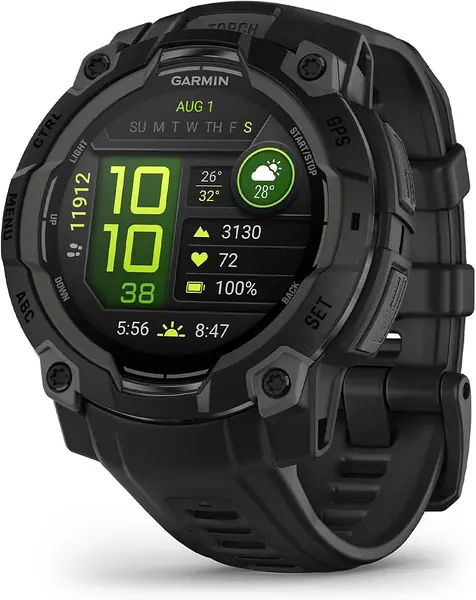
The Instinct 3 AMOLED is the watch we hand someone who says they want it to survive rain, rock, and two weeks without a charger, and still be readable at noon. The 45 mm case is fiber-reinforced polymer with a metal-reinforced bezel, it weighs 53 grams, and it carries a 100-meter water rating — the kind of number that lets you stop thinking about your wrist at the river crossing. Garmin claims 18 days in smartwatch mode from a 350 mAh battery, and the 1.2-inch AMOLED panel is rated to 1,000 nits.

What settled it for us is the navigation stack: multi-band GPS with SatIQ, a 3-axis compass, and a barometric altimeter, three separate ways to answer where am I when the sky closes in and the trail does not. We also came to appreciate the buttons. Gloves, rain, and cold hands all argue against tapping at glass, and the Instinct line is the only one here that works entirely on physical controls.

The built-in LED flashlight, with variable intensities and strobe modes, is the small thing we reached for most; once you have light on your wrist you notice every time you pick up a phone instead. Where it gives ground is the screen. At 1.2 inches it is the smallest AMOLED in this group, and the Amazfit pair put maps on a much larger panel, so if reading a route from your wrist matters more than the case and the buttons, that is the trade to weigh. The band is a standard 22 mm width, which makes a nylon strap for summer nearly free.

Pros

  • Bright 1,000-nit AMOLED with 18-day battery life
  • 100-meter water rating in a 53-gram case
  • Multi-band GPS, compass, and barometric altimeter
  • Built-in LED flashlight with strobe modes

Cons

  • 1.2-inch display is the smallest AMOLED here
Our verdict

We tell most people to buy the Instinct 3 AMOLED: a bright screen, a battery that runs weeks, and 100-meter water resistance in a 53-gram case.
Check Latest Price
2

Amazfit T-Rex 3 Best Value

90 /100
TKZ Score Outstanding

Key details

Battery
Up to 27 days
Water Resistance
100 m
Display
1.5 in. AMOLED, 2,000 nits
Navigation
Offline maps, dual-band GPS
View on Amazon

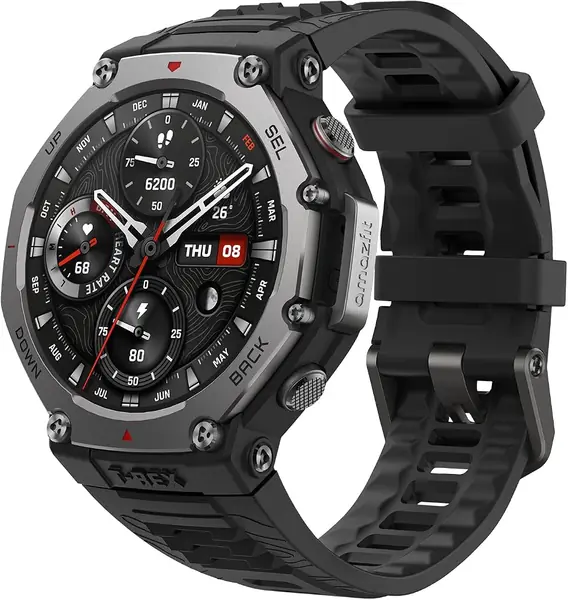
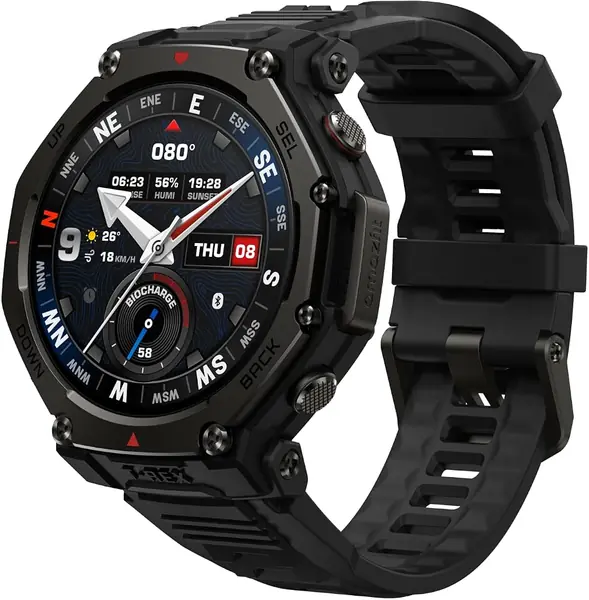
Line the T-Rex 3 up against our top pick and it wins several columns outright: a 1.5-inch AMOLED at 2,000 nits instead of 1.2 inches at 1,000, up to 27 days of typical use instead of 18, and a 316L stainless steel bezel, all for less money. It is rated from -22F to 158F as well, which matters if your winter hikes start below freezing.

What narrows the gap is everything the spec sheet does not show. Navigation is genuinely strong here — dual-band positioning across six satellite systems, with free global maps — but heart-rate readings drift when you push hard, so we read the optical numbers as a trend and check a chest strap for intervals. Bluetooth pairing is the other snag: it usually connects, and occasionally needs a second try.

The maps are the reason to buy this watch and also its clunkiest part, since panning around a route on a small touchscreen takes practice in a way that a simple arrow never does. Glove Mode earns its keep in cold weather. As for the 170-plus sport modes, we counted them once and stopped; the screen, the battery, and the maps are what you are paying for, and that trio is hard to beat.

Pros

  • 1.5-inch, 2,000-nit AMOLED with 27-day battery
  • Free offline maps with dual-band GPS
  • Rated from -22F to 158F with 100-meter water resistance

Cons

  • Heart-rate readings drift during hard efforts
  • Bluetooth pairing takes patience with some phones
Our verdict

If you want the biggest screen, free offline maps, and a 27-day battery for less than the Garmin, the T-Rex 3 is the one we point you to.

Check Latest Price
3

Amazfit T-Rex 3 Pro Best Premium

88 /100
TKZ Score Excellent

Key details

Battery
Up to 27 days
Water Resistance
10 ATM, dive-rated to 45 m
Navigation
Offline maps with rerouting
Glass
Sapphire
View on Amazon

Sapphire glass, a titanium alloy bezel, and a 10 ATM rating that goes as far as dive certification to 45 meters: the T-Rex 3 Pro exists to answer the two things that actually end a rugged watch's life, which are a scratched crystal and water that finds a way in.

We think the sapphire is the upgrade that matters most if you work around abrasives — masonry, rope, rock, a pocket full of keys. The 3,000-nit AMOLED is the brightest panel in this group and stays legible in direct sun, and the two-color flashlight is a real step up from a plain white beam, with a red mode that will not wreck your night vision at 2 a.m.

Navigation goes further than the standard T-Rex 3 as well: offline maps with point-of-interest search, auto rerouting, and round-trip route creation, over dual-band GPS from six satellite systems. Whether that is worth the premium comes down to one question. If you dive, work with your hands, or have already lost a crystal to a door frame, the armor earns its keep. If none of that describes you, the standard T-Rex 3 covers the same ground for less, and the titanium is the only thing you will miss.

Pros

  • Sapphire glass over a 3,000-nit AMOLED
  • 10 ATM with dive certification to 45 m
  • Offline maps with auto rerouting and POI search

Cons

  • Premium price buys armor rather than new capability
Our verdict

We recommend the T-Rex 3 Pro to divers and to anyone who has already scratched a watch crystal; the sapphire and the 10 ATM rating are the reason to pay.

Check Latest Price
4

Garmin Instinct 3 Tactical Best for Field and Expedition

87 /100
TKZ Score Excellent

Key details

Battery
Up to 40 days, plus solar
Water Resistance
100 m
Display
1.1 in. LCD, 500 nits
Case
50 mm, 58 g
View on Amazon

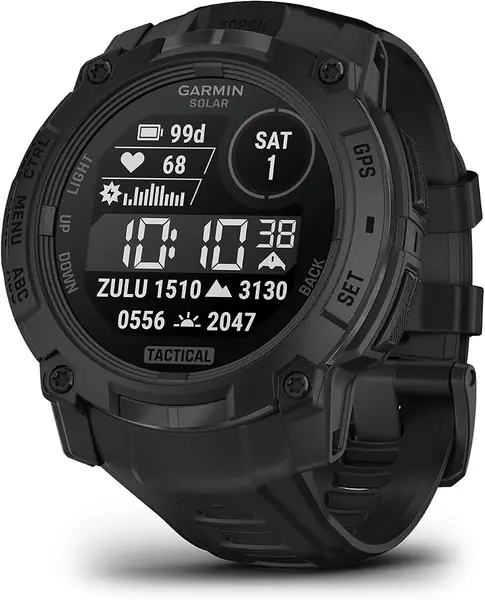
There is a specific person for this watch. If jumpmaster activity, waypoint projection, dual-position GPS format, stealth mode, and a kill switch mean something in your work, the Instinct 3 Tactical is the only pick here that speaks that language. Everyone else should note the 50 mm case and 58 gram weight and walk on.

For that person, the fundamentals hold. The fiber-reinforced polymer case carries the same metal-reinforced bezel and 100-meter water rating as the rest of the Instinct line, and solar charging stretches smartwatch-mode runtime toward unlimited — with the fine print that it assumes all-day wear and about three hours a day outside in 50,000 lux. A full charge alone is rated at 40 days, the longest in this group.

The 1.1-inch, 500-nit LCD is the obvious compromise. It is smaller and dimmer than every AMOLED pick here, and that is rather the point: a low-draw panel under a solar lens is what makes weeks of runtime realistic, and outdoors it reads cleanly in daylight. Indoors it looks like a tool rather than a gadget, which is either the appeal or the problem. It is also hands-down the biggest case on this page, so try one on before you commit.

Pros

  • Solar charging stretches runtime toward unlimited
  • Full tactical toolset: jumpmaster, stealth, kill switch
  • 50 mm case with a 100-meter water rating

Cons

  • Dim 500-nit LCD beside the AMOLED picks
  • Tactical tools most buyers never open
Our verdict

We recommend it to people whose work actually uses jumpmaster, stealth mode, or waypoint projection; everyone else should save the difference and buy the smaller Instinct.

Check Latest Price
5

DEKELIFE C32PRO Best Budget with Built-In GPS

84 /100
TKZ Score Excellent

Key details

Battery
Up to 15 days
Water Resistance
2 ATM (20 m)
Display
2.02 in. AMOLED
Navigation
Built-in GPS
View on Amazon

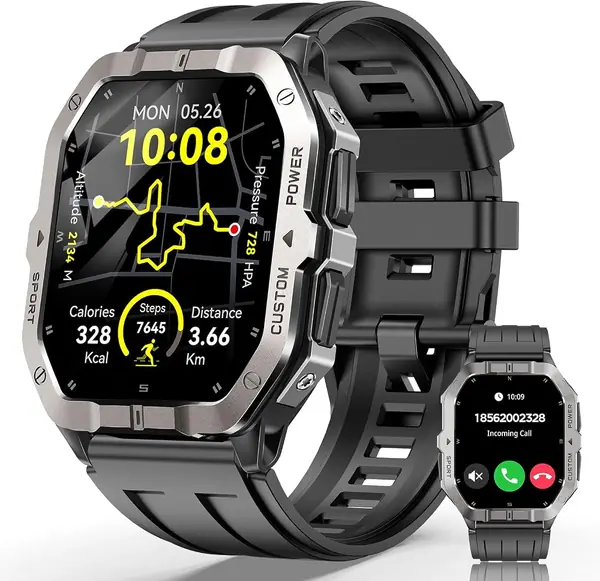
Almost every budget watch on this list borrows your phone's GPS, which means it tracks nothing the moment you leave the phone in the car. The C32PRO is the exception, with a satellite receiver of its own, and that alone earns it a place here — it is the cheapest route into genuine tracking we found.

The rest of the package is built around screen and stamina: a 2.02-inch AMOLED, the largest display in this group, with enlarged fonts and hard contrast that stay easy to read mid-run, plus a compass and altimeter for outdoor routing and Bluetooth calling from the wrist. A Garmin it is not — the interface is busier and the software less polished — but it covers the basics at a fraction of the money.

Two caveats decide it. The first is water: the rating is 2 ATM, roughly 20 meters, which means rain and splashes and not swimming, a real limit on a watch marketed as military-grade. The second is staying power, because this is the pick where a unit can quit within a few months; buy it somewhere with an easy return. Battery is listed at 15 days on average, and a week is the realistic figure with the screen and Bluetooth in constant use.

Pros

  • Built-in GPS, the cheapest route to real tracking
  • 2.02-inch AMOLED, the biggest screen here
  • Compass, altimeter, and Bluetooth calling

Cons

  • 2 ATM rating keeps it out of the water
  • A unit can quit within a few months
Our verdict

We like it as a first GPS watch or a rough-work spare: it is the cheapest way here to get satellite tracking of your own, as long as swimming is not on the list.

Check Latest Price
6

Blackview W50Pro Long Battery Life

83 /100
TKZ Score Excellent

Key details

Battery
960 mAh
Water Resistance
IP68, 10 m
Display
1.45 in. TFT
Navigation
GPS via smartphone
View on Amazon

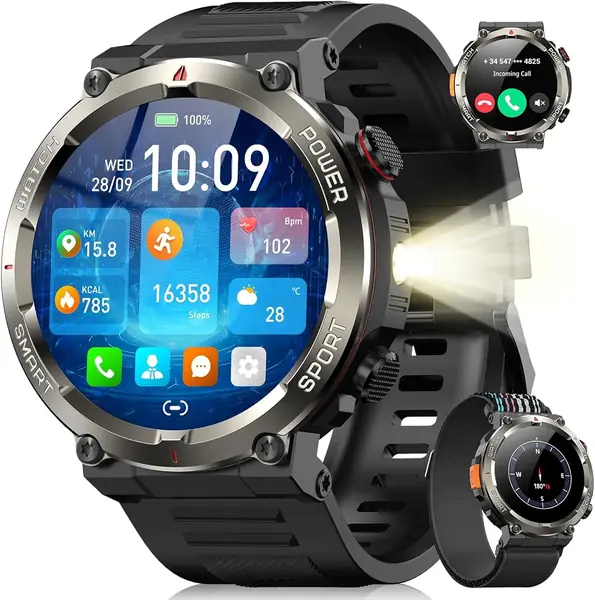
The flashlight is the feature that defines this watch. One button, a bright LED, and you stop reaching for your phone every time the light goes. On a watch this cheap, that is the detail people mention first.

The rest of the sheet is aimed at endurance: a 960 mAh battery with a 100-day claim that assumes you barely touch it, a 1.45-inch TFT display, an aluminum case, a compass, Bluetooth calling, and two straps in the box. The battery is the honest headline — this is a watch you wear for a couple of weeks and forget about the charger.

What it does not carry is a satellite receiver. Position and distance come from your phone over Bluetooth, so the mileage is only as good as the phone in your pocket. Water resistance is IP68 with a depth figure of 10 meters, which covers rain, mud, and a dunking rather than laps in the pool.

Set against the GPS-capable picks, this is a knock-around watch for someone who wants the rugged look, a long battery, and calls on the wrist without paying for navigation they will never use. It belongs on a job site or in a glove box. The backcountry is a job for the watches above it.

Pros

  • 960 mAh battery rated for weeks between charges
  • LED flashlight and compass built in
  • Two straps included

Cons

  • No built-in GPS; distance comes from your phone
  • IP68 rated to 10 meters, so no swimming
Our verdict

We point it at job sites and glove boxes: a big battery, a one-button light, and calls on the wrist, with no pretense of being a backcountry navigator.

Check Latest Price
7

WalkerFit Motion 6 Best for Calls and Workouts

82 /100
TKZ Score Excellent

Key details

Battery
Up to 15 days
Water Resistance
5 ATM (50 m)
Display
1.43 in. AMOLED
Navigation
GPS via smartphone
View on Amazon

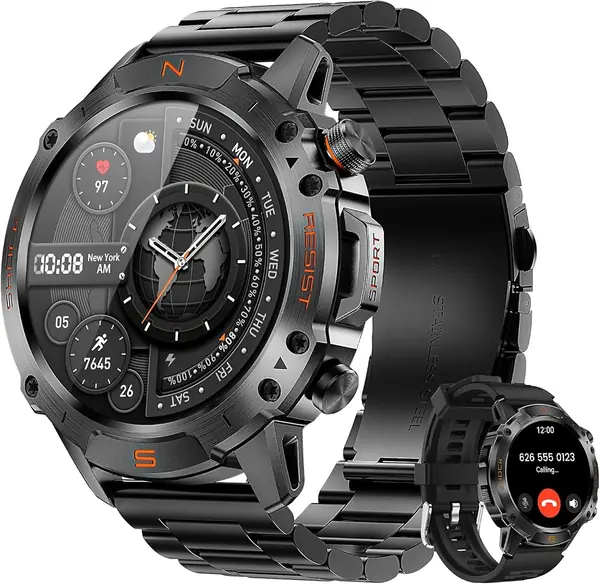
Bluetooth calling is what the Motion 6 sells hardest, and it is the reason to look: a speaker and microphone in the case, notifications on a 1.43-inch AMOLED with an always-on mode, and a 400 mAh battery that charges to full in about two hours.

What we did not expect at this price is the finish. An alloy steel case and a stainless band make it the most office-appropriate watch in this group, while a 5 ATM rating covers swimming and 178 sport modes plus sleep, SpO2, and stress tracking cover the everyday numbers most people actually look at.

Two things to accept going in. There is no satellite receiver, so distance and routes come from your phone. And the health numbers are a rough guide — treat heart rate as a trend rather than a training tool, the same as the other budget picks. For calls, notifications, and a watch that reads more expensive than it is, it is a sound buy.

Pros

  • Bluetooth calling with built-in speaker and mic
  • 5 ATM rating and 178 sport modes
  • 1.43-inch AMOLED with always-on display

Cons

  • No built-in GPS; distance depends on your phone
  • Heart-rate data is a trend, not a training tool
Our verdict

We recommend it to someone who wants calls on the wrist and a watch that passes at the office, not to anyone who needs to navigate off a trail.

Check Latest Price

What We Put These Watches Through

We started with about 30 watches from spec sheets and retail listings, then cut anything that claimed the rugged label without a real GPS chip, a swim-safe water rating, or a battery rated in weeks rather than hours. That left eight, which my team and I wore for seven months.

Each watch went on the same rotation: a five-mile trail loop in rain and heat, twice-weekly pool swims, a long gravel ride, a two-night backpacking trip, and a week of yard work where it got scraped against brick. We dropped each from waist height onto concrete, hosed off the mud, and checked the bezel, glass, and strap for chips and stretch. For battery life we charged to full, ran a GPS activity on the same route, and logged the percentage lost per hour, then repeated the walk in freezing weather to see what cold did to the estimate.

For accuracy, we ran the same measured loop three times per watch and laid the tracks over one another; heart rate went up against a chest strap during intervals, and we compared sleep and overnight readings night to night for consistency. Every watch was paired to both an iPhone and an Android phone, carried until notifications dropped, and used to take a call from a windy corner to hear how the mic handled it; a few looked right on a ridgeline and oversized at a desk.

The last month covered reliability and value: which watches needed a hard reset, which dropped a pairing, which held their charge sitting in a drawer, and how much of the companion app stayed free versus locked behind a subscription. A watch that charges you monthly to see your own sleep data isn't a bargain, whatever the sticker says.

How to Choose a Rugged Smartwatch

Read the water rating before anything else

Two numbers matter, and they are not interchangeable. An IP rating such as IP68 or IP69K describes dust and water ingress in a lab; an ATM or meter rating describes pressure at depth. A watch rated 2 ATM, about 20 meters, handles rain and splashes and should come off before you swim. 5 ATM, or 50 meters, is the sensible minimum for swimming. 10 ATM, or 100 meters, is what to want if you dive, snorkel, or spend whole days soaked.

Our picks split cleanly here: the Instinct 3, Instinct 3 Tactical, T-Rex 3, and T-Rex 3 Pro all carry a 100-meter rating, the Motion 6 has 5 ATM, and the C32PRO's 2 ATM means it stays on the bank.

Built-in GPS or a phone in your pocket

The budget end of this category is full of watches sold as military smart watches that list GPS and mean the GPS in your phone — the watch borrows it over Bluetooth and tracks nothing once you walk away from the car. Look for built-in GPS, GNSS, or a named satellite system in the specifications rather than the title.

Beyond that, multi-band positioning holds a lock better under tree cover and between buildings, and maps are a separate feature from GPS. Both Amazfits draw a map on the wrist; the Instinct line navigates by compass, altimeter, and position.

What a battery claim is actually measuring

Days of battery means smartwatch mode: screen on, notifications, a little GPS. Switch on continuous tracking and that number falls hard — the T-Rex 3 quotes 27 days of typical use but 180 hours in GPS mode, which is under eight days of all-day tracking. Solar charging is real but conditional: Garmin's unlimited-runtime claim assumes all-day wear with about three hours a day outside in 50,000 lux.

If you hike with tracking on, find the GPS-mode hours before you buy. If you mostly wear the watch to work, the smartwatch figure is the one that matters.

Size, weight, and what the bezel is made of

Cases here run from 45 to 50 mm, weights from 53 to 68 grams, and displays from 1.1 to 2.02 inches. That spread decides comfort more than any other specification: a 50 mm case on a narrow wrist catches on cuffs and door frames, and the heaviest watch is the one you take off to sleep.

On materials, stainless steel and titanium resist scuffs, sapphire glass resists scratches, and fiber-reinforced polymer keeps the weight down at the cost of looking plasticky. Pick the material for your worst day rather than your desk.

Sensors, apps, and what the watch does alone

Optical heart rate is the least consistent part of any wrist wearable and the specification least worth trusting on a listing. Read it the way you read a step count — a trend rather than a measurement — and check against a chest strap if you train to zones.

The app matters nearly as much, because it is where your history lives and where a budget watch's rough edges show up. Confirm your phone's operating system meets the watch's minimum before ordering, and decide up front how much the watch needs to do with the phone left at home.

Frequently Asked Questions

Final Verdict

Buy the Garmin Instinct 3 AMOLED if you want one watch that handles weather, distance, and a two-week trip without a charger. It is the most complete package here and the one we recommend first, and the small screen is the only real cost of choosing it.

If a bigger display and on-wrist maps matter more than the case, the Amazfit T-Rex 3 delivers both for less money. If your work actually involves the field tools — solar charging, jumpmaster, stealth mode — the Instinct 3 Tactical is the version to own.