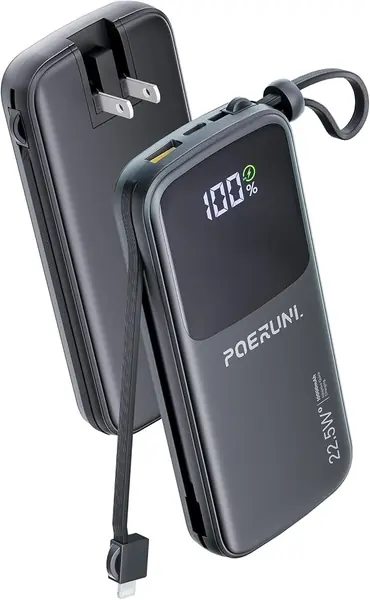
Best Power Banks with Wall Plugs of 2026

The gate agent calls your group, your phone says 9 percent, and the only outlet in sight has a laptop bag parked in front of it. A power bank with a built-in wall plug fixes both halves of that: you plug the battery into the wall to refill it, and you plug your phone into the battery, no separate brick required.

I've had one rattling around my tote for most of a year, and my team has spent the last six months living with 14 of them. The mAh number on the box is the least useful spec going — what actually reaches your phone is always less, and a bigger battery mostly means more weight in your bag. The built-in cable, meanwhile, is the part that tends to fail first.

The keepers all have a plug that folds or at least doesn't hog the socket, real output, and a cable with a little slack. Prices swing wide for what is often the same cell inside, so the picks below run from a bank you'll forget is in your jacket to one built for a weekend off the grid.

The Best Power Banks with Wall Plugs

1

AIFENG 10,000mAh Power Bank Best Overall
92 /100
TKZ Score Outstanding

Key details

Battery Capacity
10,000mAh
Maximum Output
22.5W
Simultaneous Devices
4
Dimensions
3.66 x 2.36 x 1.26 in
View on Amazon

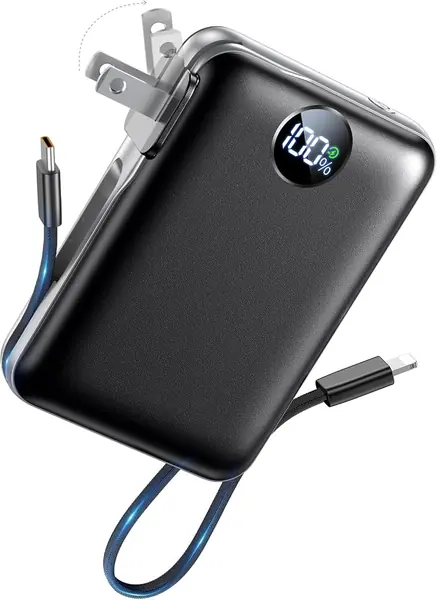
The AIFENG earns the top spot because the all-in-one idea actually fits in a small bag. At 3.66 by 2.36 by 1.26 inches, it is compact enough to live in a jacket pocket or purse, and the built-in cables plus folding AC plug mean there is no separate brick or cord to forget. The 10,000mAh battery and 22.5W output are sensible for a phone-first pack, and four-device charging gives it more flexibility than most pocket rivals. The 1.26-inch depth is the trade-off; this is a dense little block, not a wafer.

We like the way the features work together rather than as a checklist. The wall plug means the pack recharges from an outlet without a USB-C charger, and the built-in cables cover everyday phone top-ups without digging through a bag. A three-year warranty is a real confidence boost at this end of the market, too. The 22.5W output will not trouble a laptop, but for a phone, earbuds, or a tablet it is quick enough to be useful between outlets.

Where it falls short is speed and size at the margins. The INIU is faster and slimmer, and the Anker Prime is the one to choose for a laptop. The AIFENG answers the more common case: one compact pack that can refill several small devices and then refill itself from a wall outlet. Four devices at once is the practical detail we keep coming back to; on a short trip, it can be the only charging accessory in the bag.

Pros

  • Compact all-in-one body with built-in cables and AC plug
  • Charges up to four devices at once
  • Three-year warranty adds confidence

Cons

  • 22.5W output is phone-first, not laptop-class
Our verdict

For a pocketable everyday battery you can recharge from any outlet, the AIFENG is our top pick, with four-device charging and built-in cables at a budget-friendly price.
Check Latest Price
2

Anker Nano 3-in-1 Power Bank Best Premium Compact

91 /100
TKZ Score Outstanding

Key details

Battery Capacity
10,000mAh
Maximum Output
30W
Simultaneous Devices
2
Weight
8.82 oz
View on Amazon

The Anker Nano is the smallest-feeling way to leave the house with both a charger and a battery. The foldable plug and built-in USB-C cable disappear into a 4.25 by 2.01 by 1.22-inch body that weighs 8.82 ounces, and the 30W two-way design means it can charge a phone from the wall or from its own battery. That two-way flexibility is the point: fewer things in the bag, fewer cables to lose.

What we like most is how cleanly it handles a USB-C travel kit. An iPhone 15 or newer, an iPad, or a Samsung phone can use the built-in cable, and the spare USB-C port adds a second device. The 10,000mAh capacity is a day-bag reserve rather than a weekend supply, and 30W is fast enough to make a short layover useful. It is a focused design rather than a universal one, and that focus is why it travels so well.

The catch is the cable mix: there is no Lightning cable built in, so older iPhones need their own cord. Two devices at once is also the ceiling, which is fine for a phone-and-tablet traveler but thin for a family. It will top up a tablet, but not a laptop. That makes it a phone-and-tablet pack, not a computer charger.

Pros

  • 30W two-way charging works from wall or battery
  • Built-in USB-C cable and foldable plug
  • Compact 8.82-ounce body

Cons

  • No built-in Lightning cable
  • 18-month warranty is shorter than rivals
Our verdict

USB-C travelers who want a compact 30W charger and battery in one should put the Anker Nano on their short list; we think two-device charging is the limit to accept.

Check Latest Price
3

INIU 45W Power Bank Best for Fast Charging

90 /100
TKZ Score Outstanding

Key details

Battery Capacity
10,000mAh
Maximum Output
45W
Simultaneous Devices
3
Thickness
0.6 in
View on Amazon

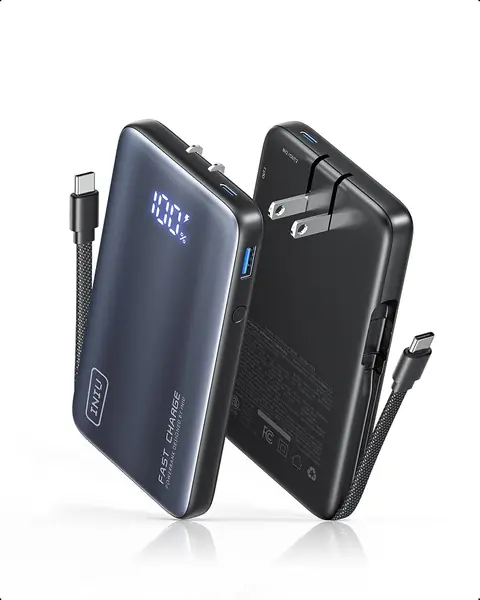
The INIU is the pack we point to when speed matters more than device count. Its 45W output is the highest among the slim 10,000mAh models here, and the 0.6-inch body slides into a pocket or crossbody without the brick-like feel of the high-capacity packs. GaN circuitry is doing the work, and the built-in USB-C cable means there is one less thing to pack. For a USB-C phone or tablet, this is the fastest small option in the group.

The port setup is deliberately simple: the built-in USB-C cable plus two ports for up to three devices. It recharges through the foldable AC plug, and a three-year warranty is one of the longer ones here. At 8.1 ounces and 0.6 inch thick, it disappears into a work bag; that combination of low weight and high output is why we keep it near the top of the list.

The catch is the single built-in cable and the 10,000mAh ceiling. Android phones and USB-C iPhones are covered, but anyone with an older iPhone needs a separate Lightning cable. And 45W can top up a tablet or give a laptop a short reprieve, not carry it through a workday. If you need one cable for everything, the AIFENG is more flexible; if you want the quickest small top-up, the INIU wins.

Pros

  • 45W output is the fastest among the slim 10K picks
  • 0.6-inch body slips into a pocket or bag
  • Three-year warranty

Cons

  • Built-in cable is USB-C only
  • 10,000mAh limits laptop use
Our verdict

The INIU is our pick for USB-C users who want the fastest, slimmest 10,000mAh pack here, as long as one built-in cable is enough.

Check Latest Price
4

citicr 20,000mAh Power Bank Best Mid-Capacity

89 /100
TKZ Score Excellent

Key details

Battery Capacity
20,000mAh
Maximum Output
22.5W
Simultaneous Devices
5
Weight
12.8 oz
View on Amazon

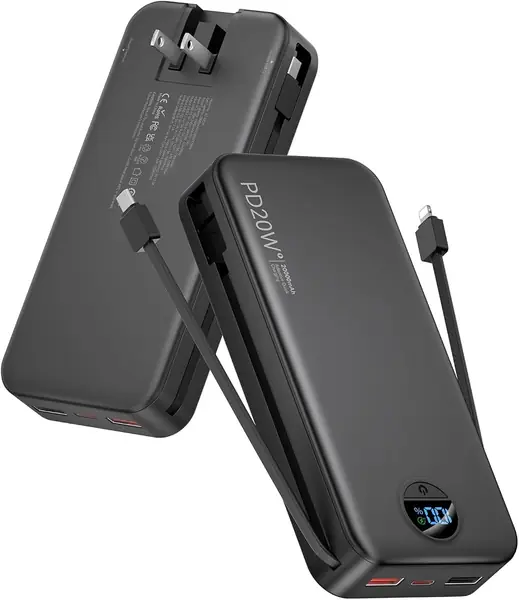
The citicr is what a power bank looks like when it is meant to live in a work bag rather than a pocket. The 20,000mAh battery, 5.9 by 2.6 by 1.17-inch body, and 12.8-ounce weight put it firmly in bag territory, but that size buys five-device charging and a built-in AC plug. The LED display is easy to read at a glance, and the foldable prongs keep the pack from snagging on a tote.

We like it for the family or commuter bag because it solves the outlet problem and the port problem at once. Two phones, earbuds, and a tablet can share the pack, and the 22.5W PD output is quick enough for phones without pretending to be a laptop charger. Pass-through charging is the sleeper feature: plugged into a wall, it can act as a small charging hub instead of making you choose between refilling the battery and charging a phone.

The trade-offs are weight and long-term confidence. At 12.8 ounces it is not something you carry in a jacket pocket, and the durability record is mixed enough that we treat it as a bag pack rather than a buy-it-for-a-decade purchase. The 20,000mAh capacity sits safely under the 100Wh carry-on limit, which makes it the largest straightforward flyer here. For a family trip or a busy work bag, that is a useful set of compromises.

Pros

  • 20,000mAh capacity for multi-day bag use
  • Five-device charging with built-in plug and cables
  • Pass-through charging adds desk-hub use

Cons

  • Heavy at 12.8 ounces
  • Durability record is mixed
Our verdict

We favor the citicr when one bag has to serve several devices; its 20,000mAh capacity and five outputs justify the weight, but a mixed durability record is the risk.

Check Latest Price
5

LHUOED 50,000mAh Power Bank Best High Capacity

88 /100
TKZ Score Excellent

Key details

Battery Capacity
50,000mAh
Maximum Output
22.5W
Simultaneous Devices
4
Dimensions
6.54 x 3.54 x 1.5 in
View on Amazon

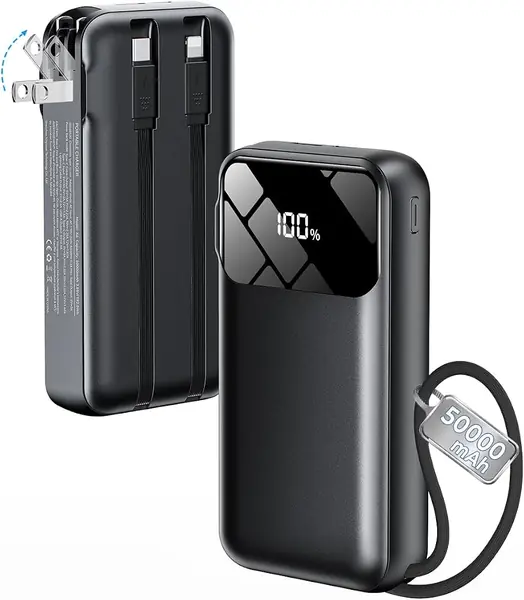
The LHUOED is less a pocket accessory than a reserve fuel tank. Its 50,000mAh battery is rated to recharge an iPhone 17 Pro Max up to 8.5 times, and the built-in USB-C cable, AC plug, digital display, and four-device setup make it a self-contained charging station for a car, cabin, or outage kit. The 6.54 by 3.54 by 1.5-inch body is the honest signal that this is a backpack or cargo-box item.

The 22.5W output is ordinary for the size. It will charge phones and tablets at a useful pace, but it is not a laptop pack, and the four-device ability is more about sharing outlets than about high-speed everything. The three-year warranty is unusually generous, and the foldable plug means you can refill it from a wall without hunting for the right cable.

The flight rule is the part to internalize. At roughly 185Wh, a 50,000mAh pack is over the 100Wh carry-on limit and even above the 160Wh ceiling that requires airline approval, so this is not a pack to buy for a plane trip. Check the Wh printed on the case before any travel; for flights, stay with a 10,000 or 20,000mAh model.

Our recommendation is narrow: the LHUOED earns its place for buyers who need maximum capacity and will keep it in a car, campsite, or home emergency kit. For that job, the capacity and four-device charging are the whole point, and the 22.5W output is a fair trade. The Sucrosey is the smaller, less expensive 50K alternative; neither belongs in a carry-on.

Pros

  • Massive 50,000mAh capacity
  • Four-device charging with built-in USB-C cable and AC plug
  • Three-year warranty

Cons

  • Exceeds the 160Wh flight ceiling
  • Large 6.54 by 3.54 by 1.5-inch body
Our verdict

For road trips and power outages where capacity matters most, we recommend the LHUOED; it is not a pack to buy for air travel.

Check Latest Price
6

Anker Prime Power Bank Best for Laptops

87 /100
TKZ Score Excellent

Key details

Battery Capacity
9,600mAh
Maximum Output
65W
Weight
10.7 oz
Ports
2 USB-C
View on Amazon

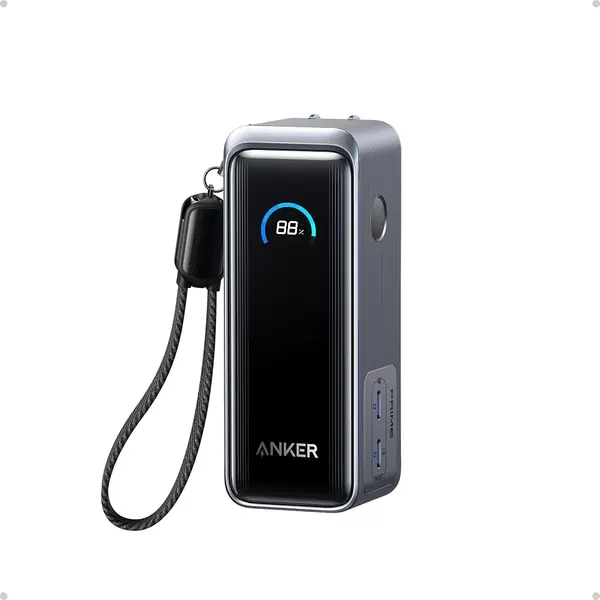
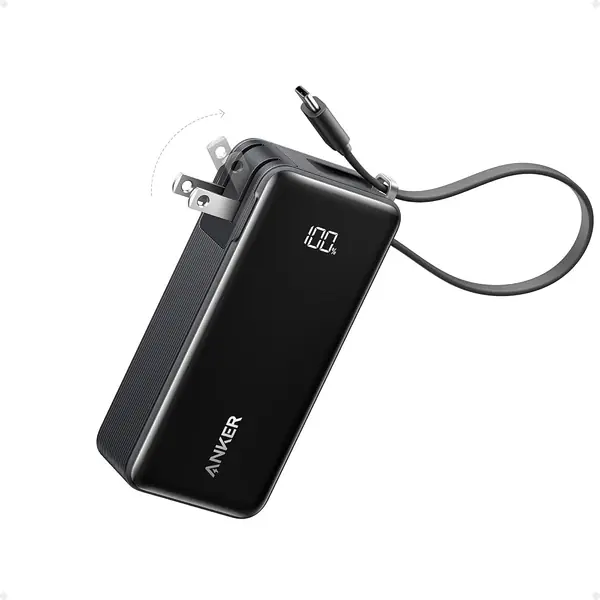
The Anker Prime is the pack for the person who carries a USB-C laptop and resents every extra ounce. It delivers up to 65W from a body that measures 4.53 by 1.65 by 1.71 inches and weighs 10.72 ounces, with a 1.3-inch LCD that shows remaining battery and output. That combination of laptop-class power and pocketable size is rare in this set, and it is the reason the Prime exists.

The 9,600mAh capacity is the catch. It is enough for a phone top-up or a partial laptop charge, not a full day of computer work, and there are only two USB-C ports. The 30W wall recharge is quick for a pack this size, and the included USB-C cable and travel pouch make it feel like a finished travel kit rather than a bare battery.

The Prime is the pick for the traveler who values 65W output and the smart display enough to pay the premium, and who accepts that capacity is the sacrifice. For phone-only days, the AIFENG or Anker Nano are easier to justify. It is at its best when it is the one charger in the bag for a laptop, tablet, and phone, and the LCD takes the guesswork out of sharing it.

Pros

  • 65W USB-C output for laptop-class charging
  • 1.3-inch LCD shows battery and output
  • 30W wall recharge is quick for the size

Cons

  • 9,600mAh capacity is limited for laptops
  • Only two USB-C ports
Our verdict

We recommend the Anker Prime for USB-C laptop charging on the go, with the caveat that its 9,600mAh capacity will not last a full workday.

Check Latest Price
7

Sucrosey 50,000mAh Power Bank High-Capacity Value

86 /100
TKZ Score Excellent

Key details

Battery Capacity
50,000mAh
Maximum Output
22.5W
Weight
0.79 lb
Ports
4
View on Amazon

The Sucrosey is the lower-cost route into 50,000mAh territory. It packs that capacity into a 4.61 by 2.87 by 1.26-inch body, with a foldable AC plug, built-in USB-C and iOS cables, and a digital display. For a 50K pack, the footprint is surprisingly bag-friendly, although 0.79 pound is still enough to remind you it is there.

The feature mix is sensible: 22.5W output, four ports, and enough capacity to last a long weekend of phone charging. The display is a useful touch on a pack this big, because guessing at remaining charge is more annoying when the battery is meant to last for days. The built-in cables also mean the pack can serve an iPhone and a USB-C device without a separate pouch of cords.

The same flight limit applies here. At 50,000mAh, this is roughly 185Wh, over the 100Wh carry-on allowance and above the 160Wh approval ceiling, so it belongs in a car or emergency bag, not a plane. The 12-month warranty is also shorter than the three-year coverage on the LHUOED, which is a meaningful difference for a battery that will be cycled hard.

The Sucrosey makes sense for a road-trip or campsite kit where the lower price and smaller body matter more than the longer warranty. It is not the pack for a flyer, and it is not the pack for someone who wants laptop speed. For pure reserve capacity at a value, it earns its spot.

Pros

  • 50,000mAh capacity for long weekends
  • Compact footprint for a 50K pack
  • Digital display and built-in USB-C/iOS cables

Cons

  • Over the 160Wh flight ceiling
  • 12-month warranty is shorter than rivals
Our verdict

We consider the Sucrosey a budget-minded 50,000mAh reserve for the car or campsite, as long as you will not fly with it.

Check Latest Price
8

POERUNI 10,000mAh Power Bank Budget Carry

85 /100
TKZ Score Excellent

Key details

Battery Capacity
10,000mAh
Simultaneous Devices
4
Dimensions
5.91 x 2.93 x 0.73 in
Built-in Cables
USB-C and Lightning
View on Amazon

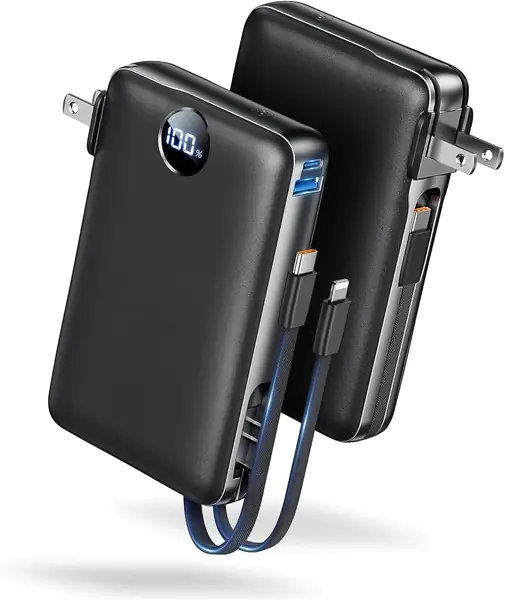
The POERUNI is the low-cost way to get the wall-plug formula: 10,000mAh, a foldable AC plug, and two built-in cables in a 5.91 by 2.93 by 0.73-inch body. It is wider than the pocket-first picks, so a small bag or glovebox is a better home than a front pocket. The LED display is a nice touch at this end of the set.

The twin cables are the reason to consider it. One is USB-C and the other is Lightning, so a recent Android phone and an older iPhone can both charge without extra cords. Up to four devices can share the pack, and the two-year warranty is more generous than the price suggests. For a commuter or a light phone user, that is a lot of convenience in one piece.

The missing specification is output wattage. The listing does not state a number, so do not expect the confirmed fast-charge rates of the AIFENG or INIU. The 10,000mAh capacity is a day-bag reserve, and the 0.73-inch body is slim but not the smallest here. It is a budget pack, not a speed pack.

For a light user who wants the lowest-cost way to carry a wall plug and both cable types, the POERUNI is the budget pack we point to, especially for commute or overnight charging. If charging speed is the priority, the AIFENG or INIU is the better buy; if capacity is, step up to the citicr. Its job is simple, and it does that job without extra accessories.

Pros

  • Budget-friendly all-in-one design
  • USB-C and Lightning cables built in
  • Four-device charging and LED display

Cons

  • No output wattage is stated
Our verdict

The POERUNI is our budget pick for phone charging on the go, as long as you do not need a stated fast-charge rate or laptop power.

Check Latest Price

How We Tested Power Banks With Built-In Plugs and Cables

We started by pulling spec sheets for more than 40 power banks with built-in wall plugs, then narrowed to models that paired the plug with at least one built-in cable, spanned 10,000 to 50,000mAh, and covered a real spread of prices so we could tell whether extra money bought anything beyond capacity. Fourteen made it into testing, and over six months I carried one or another of them through commutes, two long flights, a camping weekend, and plenty of ordinary desk days where the outlet is behind the couch.

Refilling each bank was timed on the same kitchen outlet, from full drain to full. I noted whether the prongs folded, whether the body blocked the second socket, and whether a heavier bank stayed put in a loose hotel outlet or sagged out of the wall halfway through. For output, we ran a dead phone to 50 percent on every unit and wrote down the time, then added a second and third device to see whether the first one's speed visibly dropped.

The built-in cables took the roughest handling, because that is what happens in a bag: bent at the strain relief, jammed next to keys, pulled out by the cord more times than I'd like to admit. We tracked fraying and checked whether the cable had enough slack to reach a phone in your hand while the bank sat in a bag on the floor. We also counted how many full phone charges each one delivered against its label, weighed them and tried each in a jeans pocket and a jacket pocket, and dropped them from waist height onto tile to see what cracked.

How to Choose a Power Bank with a Wall Plug

Match the Plug to How You Recharge

A foldable AC plug is the difference between a one-piece travel kit and another device that needs a cable. Look for prongs that fold flat and a body that leaves room around a crowded outlet; a plug that blocks the second socket is a small annoyance you notice every night. Pass-through charging is worth having if the pack will double as a charger on a desk or hotel outlet. We prioritize a folding plug and pass-through over a slimmer body, because the plug is the reason to choose this category.

Pick Capacity by the Trip

A 10,000mAh pack is the pocketable default: roughly one and a half to two phone charges, depending on the phone. 20,000mAh is the work-bag or family size, and 50,000mAh is a different category. At the usual 3.7 volts, 50,000mAh is about 185Wh, over the 100Wh carry-on limit and above the 160Wh approval ceiling. That makes a 50K pack a car or emergency battery, not a flyer. Check the Wh printed on the case before any flight; 20,000mAh is the largest simple carry-on choice here.

Read Wattage and Ports Together

The headline wattage often applies to one port, not every cable, so pair the number with the port you will actually use. For phones, 20W to 30W is plenty; for tablets, look higher; for USB-C laptops, 45W or 65W makes the difference between a top-up and a stall. Built-in cables also count toward the device total, and a pack with four outputs can still be slow if the shared load is high. The AIFENG's 22.5W is phone-first, while the INIU's 45W and the Anker Prime's 65W are the laptop-leaning picks here.

Trade Size Against Durability

A 10K pack around 8 ounces and under an inch thick disappears into a bag; a 20K or 50K pack is a deliberate carry. Size is easy to compare, but the parts that fail are often the built-in cable and the folding plug, so a longer warranty matters. We put more weight on a three-year warranty and a cable that tucks away than on a millimeter of thickness. If the pack will live in a bag, buy for the outlet and cable mix first, then trim size.

Frequently Asked Questions

Final Verdict

Start with the AIFENG if you want one compact pack for everyday carry. It combines the two things this category is for: refilling from a wall outlet without extra gear and charging several small devices from one battery. The 10,000mAh capacity is enough for a day out, and the four-device setup gives it more flexibility than the slim premium packs.

If a laptop travels with you, the Anker Prime's 65W output is the reason to pay more. If one pack has to serve a family's phones and a tablet from a bag, the citicr's 20,000mAh capacity and five outputs are the better fit. Both are specific upgrades, not reasons to overbuy.