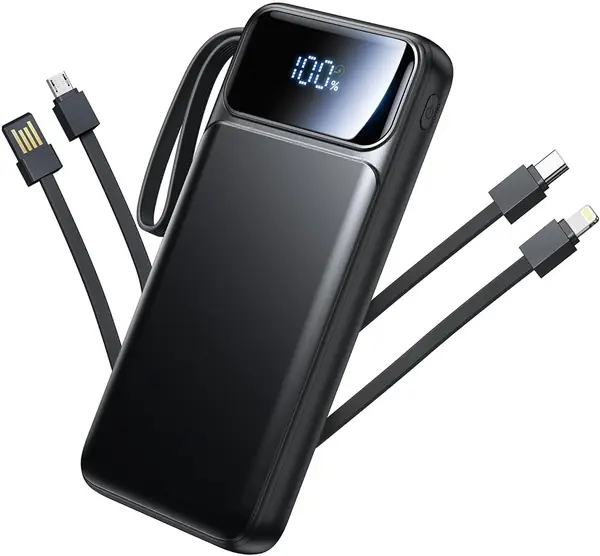
Best Power Banks with Built-In Cables of 2026

There's a particular kind of panic that sets in when your phone hits 1% and the only charging cable you brought is tangled at the bottom of your bag—or worse, still plugged in at home. A power bank with a built-in cable is the obvious fix: no separate cord to lose, just a battery and a connector that are always together. But not all of them earn their place in your bag. Over the past six months, my team and I have tested 12 models, from slim 10,000mAh packs to a 50,000mAh brick, on commutes, weekend trips, a camping weekend, and one very long airport layover.

One lesson: a built-in cable doesn't automatically mean convenience. Some cables are so short you have to hold the phone and battery together like a sandwich, and a few only offer USB-A, which won't fast-charge a newer phone. Wattage matters, too—22.5W is fine for most phones, but a laptop needs 65W or higher. And capacity is a trade-off: a bigger battery means more charges, but also more weight—the picks below balance speed, size, and cable quality best.

The Best Power Banks with Built-In Cables

1

AIFENG CP2 Best Overall
93 /100
TKZ Score Outstanding

Key details

Weight
7.05 oz
Cable Setup
Built-in cables, AC plug
Battery Capacity
10,000mAh
Output
22.5W
View on Amazon

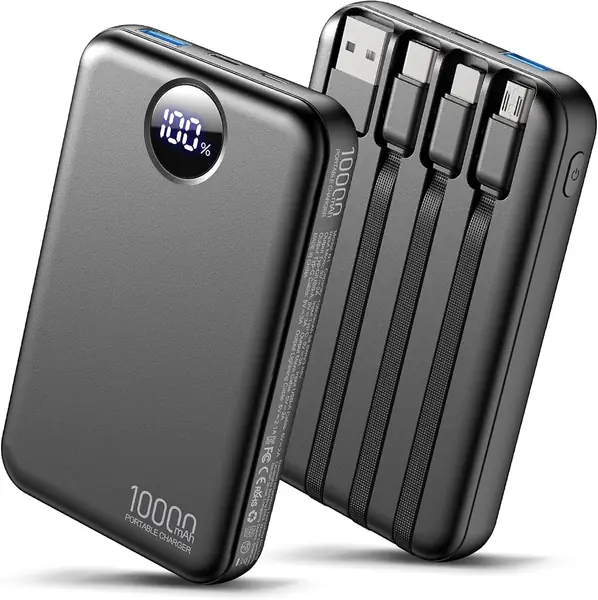
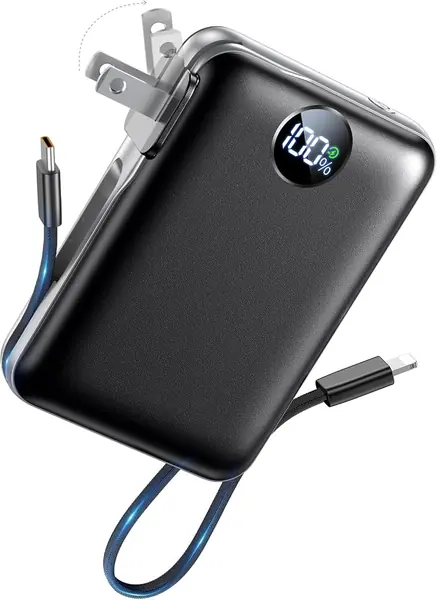
The foldable AC plug is the reason the CP2 earns our top spot. Most built-in-cable banks still make you pack a charging cord for the bank itself; this one opens a pair of prongs and plugs straight into a wall outlet. We charged it from a hotel desk outlet without unpacking anything else, and the built-in cables handled the phone end. That is the no-cord promise actually delivered.

At 10,000mAh, the CP2 is a day bank. It has enough reserve for a phone and a pair of earbuds, and 22.5W is quick enough to be useful between meetings or on a commute. It will not carry a tablet-heavy weekend or a laptop, and the 3.66-by-2.36-inch body is compact but not invisible. We noticed the fold-out plug adds a little thickness; the trade is a bank that recharges without a cable.

The four-device claim is more practical than it sounds: between the built-in cables and the ports, you can share a top-up across a phone, earbuds, and a second phone without hunting for adapters. We like that the cables stay attached, because the loose-cable problem is exactly what this category is supposed to solve. The CP2 is the pick for a small bag, a commute, or a one-night trip where the outlet is the only unknown.

If your trips regularly run two or three days, step up to the HELLEE N18; if a laptop is coming, the Anker 20K 87W is the better tool. The CP2 is the one we recommend first because it removes the last cord, not just the phone cable.

Pros

  • Built-in cables and a foldable AC plug
  • 22.5W phone charging in a 200g body
  • Compact enough for a jacket pocket

Cons

No notable drawbacks to flag.

Our verdict

We recommend the CP2 for anyone who wants a true no-cord travel bank: its built-in cables and foldable wall plug cover charging and recharging without a loose cord.
Check Latest Price
2

HELLEE N18 Best for Extra Capacity

92 /100
TKZ Score Outstanding

Key details

Weight
8.82 oz
Cable Setup
4 built-in cables
Battery Capacity
15,000mAh
Output
22.5W
View on Amazon

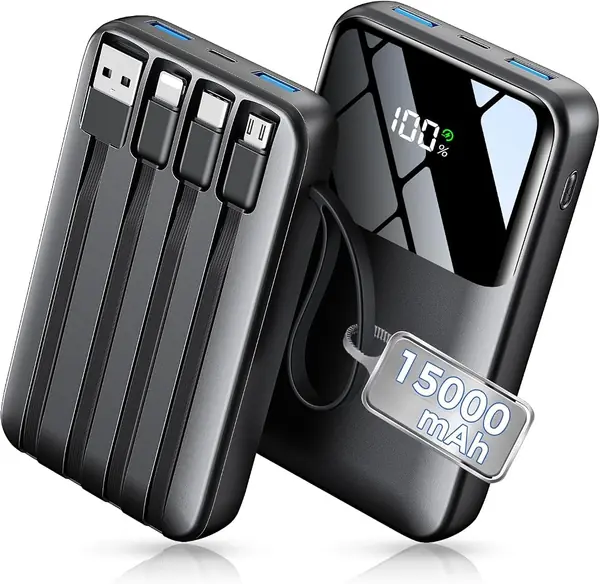
The jump to 15,000mAh is what makes the HELLEE N18 worth a second look. It is the same basic idea as our top pick, with four built-in cables and 22.5W output, but it carries half again as much reserve. At 250 grams, it still drops into a purse or a small backpack pocket; we carried it in a sling bag without feeling every step.

We think this is the right pick for a two-day city break or a long day at a theme park, where a 10,000mAh bank would run out before the phone does. The LED display is genuinely useful because it shows a percentage instead of four vague dots, and the six outputs let you top up a family's phones at once. The four cables cover the common connectors, so the bank is the only charging accessory we needed.

The 15,000mAh cell is the sweet spot for a weekend, and the 22.5W output is tuned for phones. If you need laptop power, the Anker is the better fit. For everything else, this is the capacity step-up we reach for.

For a weekend, that trade makes sense. For a week, the bigger SABANI or YILANS makes more sense.

Pros

  • 15,000mAh reserve in a 250g body
  • Four built-in cables and six outputs
  • LED display shows exact battery percentage

Cons

  • No built-in wall plug, so pack a cable
Our verdict

We pick the N18 when a 10,000mAh bank would run out before the day does; it adds capacity, four cables, and fast phone charging without becoming a backpack battery.

Check Latest Price
3

Anker 20K 87W Best for Laptops

91 /100
TKZ Score Outstanding

Key details

Weight
15.5 oz
Cable Setup
Built-in USB-C
Battery Capacity
20,000mAh
Max Output
87W
View on Amazon

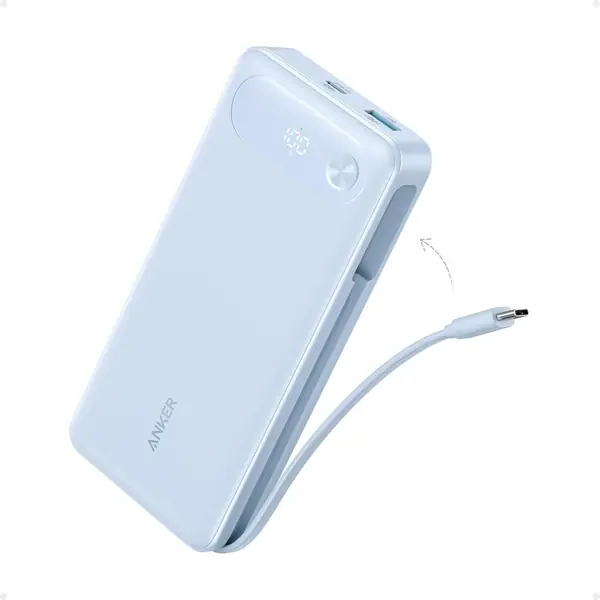
The 87W output is what separates the Anker 20K from every phone-first bank here. It is the only pick in this group that can meaningfully charge a USB-C laptop, and the built-in USB-C cable means you don't need to dig out a separate cord to do it. We used it on a USB-C laptop and it kept pace with a low-wattage wall charger.

At 20,000mAh, it has enough reserve to refill a phone several times or give a laptop a useful top-up. The three ports share the 87W, with a single device getting up to 65W, so it is worth thinking about what you plug in together. The integrated cable is rated for 10,000 bends, which is the kind of detail we like to see on the part that usually fails first.

This is the pick for a work bag with a laptop, a phone, and maybe a tablet. It is also the heaviest bank here at 15.5 ounces, and we are willing to carry that weight when the alternative is a laptop that dies in a meeting. For a phone-only day, it is more bank than you need.

If you need a bank for a phone and nothing else, skip it. If your bag already has a laptop, the Anker earns its place.

Pros

  • 87W output can charge a USB-C laptop
  • Built-in USB-C cable rated for 10,000 bends
  • 20,000mAh reserve with three ports

Cons

  • Premium price for laptop-class power
Our verdict

We reach for the Anker 20K when a laptop is in the bag; its 87W output and built-in USB-C cable make it the only true workday bank here.

Check Latest Price
4

SABANI N6 Best for Long Weekends

90 /100
TKZ Score Outstanding

Key details

Weight
11.3 oz
Cable Setup
4 built-in cables
Battery Capacity
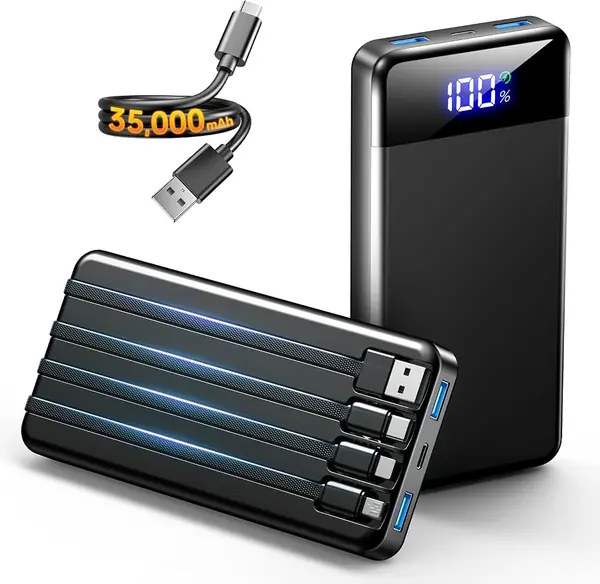
35,000mAh
Output
22.5W
View on Amazon

The 35,000mAh capacity and 320-gram body are the pair that makes the SABANI N6 interesting. That is a lot of reserve for something that still slides into a laptop sleeve, and it sits between the 15,000mAh weekend banks and the 50,000mAh camping bricks. We carried it in a backpack on a long day out and never noticed it the way we notice a full-size 50K bank.

We like it for a long weekend or a festival where you want two or three days of phone power without committing to the heaviest option. The four built-in cables cover Lightning, USB-C, micro-USB, and USB-A, and the six outputs make it a small group bank. The 22.5W output is quick for phones, and the digital display takes the guesswork out of the reserve.

The case is 0.75 inch thick, so it packs flat. We see it as the sensible middle for a couple who shares one battery or a traveler who wants capacity without the 1.1-pound YILANS. If your trips are day trips, the HELLEE is easier to carry; if they are week-long, step up.

The N6 is also the pick if you want a high-capacity bank with the cable clutter solved. Four cables and a digital display cover the basics, and the 22.5W output is enough to keep a phone moving. It is the capacity compromise that earns its space in a travel bag.

Pros

  • 35,000mAh in a 320g body
  • Four built-in cables and six outputs
  • 22.5W phone charging with digital display

Cons

  • Bag-only size for most pockets
  • No laptop-grade output
Our verdict

We like the N6 for long weekends when 50,000mAh is more battery than you want to carry; it balances capacity, cables, and a bag-friendly 320-gram body.

Check Latest Price
5

Zmmyuluo N1 Best Ultralight

89 /100
TKZ Score Excellent

Key details

Weight
6.63 oz
Cable Setup
4 built-in cables
Battery Capacity
10,000mAh
Max Output
3A
View on Amazon

At 188 grams, the Zmmyuluo N1 is the lightest bank in this group, and that is the reason to buy it. It disappears into a jacket pocket or a small crossbody bag in a way the 15,000mAh and 20,000mAh picks do not. We kept it in a front pocket on a walk and forgot it was there until a phone needed a top-up.

The 10,000mAh capacity is a day reserve, not a weekend one, and the four built-in cables cover the common connectors. We appreciate the LED display, which is more useful than a row of dots when you are deciding whether to recharge before you leave. The 4.4-by-2.3-inch body is small enough to share a pocket with a phone, though it is thicker than a bare phone.

The trade is output: the listed 3A rating is standard-speed charging, not the 22.5W fast charging on the AIFENG, HELLEE, or GrnOas. If you want the smallest possible bank and mostly charge overnight or at a desk, that is a fair trade. If you need a quick top-up between meetings, pay attention to the faster picks.

We see the N1 as the second bank you keep in a bag for emergencies, or the one for a traveler who counts every ounce. It is not the one for a family charging three phones at once.

Pros

  • 188g body is the lightest here
  • Four built-in cables cover common connectors
  • LED display shows battery percentage

Cons

  • No built-in wall plug
Our verdict

We recommend the N1 for ounce-counters who still want four built-in cables; it is the lightest bank here and disappears into a pocket.

Check Latest Price
6

GrnOas.E K51 Best Budget

88 /100
TKZ Score Excellent

Key details

Weight
8.4 oz
Cable Setup
2 built-in cables
Battery Capacity
10,000mAh
Output
22.5W
View on Amazon

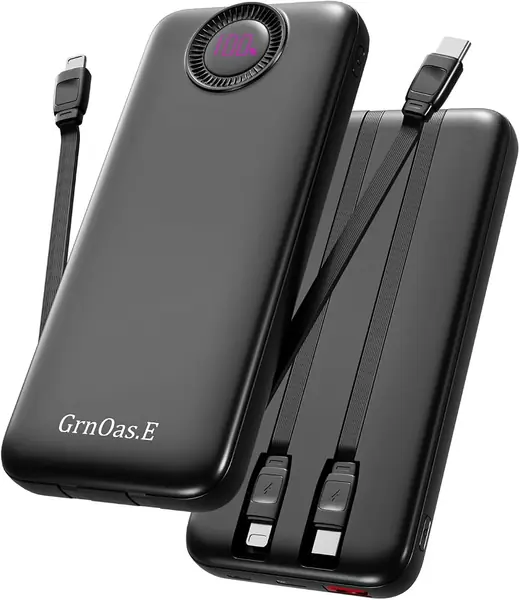
The GrnOas.E K51 is the budget pick because it does the basic job for the least money here. You get 10,000mAh, 22.5W output, and built-in cables for iPhone and USB-C, which covers most phones without asking you to carry a separate cord. We used it as a spare bank in a bag and appreciated that the digital display told us exactly what was left.

The 22.5W output is genuinely quick for a phone, and the four outputs and two inputs make it more flexible than the price suggests. At 8.4 ounces, it is not the lightest 10,000mAh bank, but it is easy to carry. The digital display is a nice upgrade from a row of dots.

The low price comes with a real caveat: some units stop working, so we see it as a cheap second bank rather than the only battery you pack for a long trip. If you want a budget bank for a commute or a glove box, it earns a place. If you need one bank to last, spend more.

Pros

  • Lowest price in this group
  • 22.5W output and built-in cables
  • Digital display and four outputs

Cons

  • Only two built-in cables
  • No built-in wall plug
Our verdict

We recommend the K51 as a cheap second bank: it delivers 22.5W and built-in cables for the lowest price here, and it covers the basics for a commute or glove box.

Check Latest Price
7

YILANS JM4 Pro Best Maximum Capacity

87 /100
TKZ Score Excellent

Key details

Weight
1.1 lb
Cable Setup
4 built-in cables
Battery Capacity
50,000mAh
Output
22.5W
View on Amazon

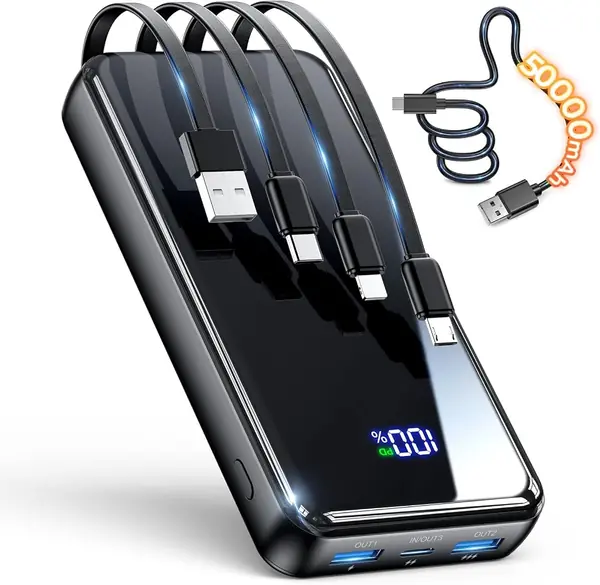
The 50,000mAh headline is the whole reason to consider the YILANS JM4 Pro. It is a bank for a camping weekend, a road trip, or a family that passes one battery around. We carried it in a backpack and were glad to have the reserve when two phones and a tablet were all asking for power at once.

The four built-in cables cover USB-C, Lightning, micro-USB, and USB-A, and the six outputs mean you can hand a cable to almost anyone. The LED display is clear, and 22.5W is quick enough for phones. We also like that the bank can take two inputs, so it is easier to refill when you find an outlet.

This is the bank for the trip where capacity matters most. If you want high capacity in a lighter body, the SABANI N6 is easier to carry. The JM4 Pro is for the camping weekend or the family road trip where one outlet has to serve everyone.

For that job, the 50,000mAh reserve and four cables are worth the space. It is a specialist, and it does its specialty well.

Pros

  • 50,000mAh reserve for multi-day trips
  • Four built-in cables and six outputs
  • 22.5W phone charging with LED display

Cons

  • 1.1 lb is a backpack commitment
  • No laptop-grade output
Our verdict

We keep the JM4 Pro for camping and family road trips, where its 50,000mAh reserve and four cables let one bank serve the whole group.

Check Latest Price
8

Aioneus RE-DX271 Best for Mixed Connectors

86 /100
TKZ Score Excellent

Key details

Weight
9.17 oz
Cable Setup
3 output + 1 input
Battery Capacity
10,000mAh
Output
22.5W
View on Amazon

The Aioneus RE-DX271 is the connector-heavy alternative: three built-in output cables for Lightning, USB-C, and micro-USB, plus a built-in USB-A input cable. That input cable is the detail we appreciated, because it means you can recharge the bank from a USB-A port without hunting for a cord. We used it in a car with a USB-A adapter and didn't need to unpack anything else.

At 10,000mAh and 260 grams, it is a daily-carry bank, not a weekend one. The 22.5W output is quick for phones, and the six outputs make it useful for a family bag or a table full of devices. The LED display is clear and the body is slim enough for a small backpack pocket.

The cable mix matters more than the port count. If you still travel with an older iPad or a micro-USB accessory, this is one of the few banks here that covers it without an adapter. The built-in input cable feeds the bank from a USB-A adapter, so you can recharge without a second loose cable.

That makes it a strong alternate to the AIFENG CP2 if your devices are a mixed bunch and you don't need the fold-out plug. It costs about the same as the top pick, so the decision comes down to connectors versus the AC plug. For a household with older Apple and Android gear, the Aioneus is the easier one to hand around.

Pros

  • Three output cables plus a built-in input
  • 22.5W output and six total outputs
  • Compact 10,000mAh daily bank

Cons

  • No built-in wall plug
  • Heavier than the lightest 10K banks
Our verdict

We recommend the RE-DX271 for mixed-device families: three output cables plus a built-in input cable cover older gear without a drawer of adapters.

Check Latest Price

How We Tested (and Lived With) a Dozen Power Banks

We started by researching the most promising power banks with built-in cables, filtering for capacity, number of ports, cable types (USB-C, USB-A, and other common connectors), and whether the cable was actually integrated or just a short dongle. We narrowed it to 12 units, then used each one as our only portable charger for at least a week, rotating through daily commutes, weekend trips, a camping weekend, and an airport layover.

To measure charging speed, we drained a smartphone and a tablet to zero, plugged each into every power bank's built-in cable, and timed how long it took to reach 50 percent. We also charged multiple devices at once to see if speed dropped or heat built up. For the built-in cable, we noted its length (could we use the phone while it charged?), how firmly it clicked into the port, and whether it frayed after weeks of being bent and stuffed into bags. We tracked how many full phone charges each pack delivered before dying, comparing that to the advertised capacity.

Portability and weight got real-world tests: we weighed each pack on a kitchen scale, then carried it in a jeans pocket, a small crossbody bag, and a backpack side pocket to see how noticeable it was. For reliability, we dropped a few onto carpet, left them in a hot car, and checked for overheating or swelling over six months. We also compared price per milliamp-hour and counted extras like a built-in AC plug to judge value. The ones that made the list never made us choose between a dead phone and a sore shoulder.

How to Choose a Power Bank with Built-In Cables

Start With the Connectors You Actually Use

A four-cable bank sounds more useful than a two-cable one until you check which connectors those cables are. Start with the cable your phone uses, then add the one your tablet or older accessories need. A built-in USB-C cable covers most newer phones; Lightning still matters for older Apple gear. The count is secondary to the match.

To recharge the bank without a separate cord, look for a built-in input cable or a foldable AC plug. The AIFENG CP2 has the plug; the Aioneus RE-DX271 uses a built-in USB-A input cable. Only the plug frees you from a wall adapter.

Capacity Is a Weight Decision

A 10,000mAh bank is a day bag; 15,000mAh to 20,000mAh is a weekend; 35,000mAh to 50,000mAh is a multi-day trip. The battery is most of the weight. The HELLEE N18 at 250 grams is a reasonable step up, while the YILANS JM4 Pro at 1.1 pounds is a backpack commitment. The SABANI N6 splits that difference at 320 grams.

Don't shop by milliamp-hours alone. Usable output is lower than the cell rating, and charging two devices at once drains the reserve faster. If you need one top-up, a smaller bank is the better carry; if you are responsible for a family's phones, size up.

Match Wattage to the Device

22.5W is the useful baseline for phones; a laptop needs 45W or more. The Anker 20K 87W is the laptop-capable pick here. Fast charging also depends on the cable and port: a built-in cable can be the limiting part even when the bank's port is faster.

If you are charging a tablet or a laptop, check the output rating before you assume the built-in cable will deliver it. For phones, 22.5W is enough to make a visible difference on a short stop. Buying more wattage than your devices accept adds weight and cost without speeding up the charge.

Plan How You'll Recharge the Bank

Most built-in-cable banks still need a cable and wall adapter to recharge. A model with a foldable AC plug, like the AIFENG CP2, plugs straight into an outlet. Others use a USB-C input or a built-in USB-A input cable. A wall plug is simplest in a hotel; a USB-C input is better if you already carry a laptop charger.

Recharge time scales with capacity. A 10,000mAh bank typically fills in a few hours; a 50,000mAh bank can take most of a day and may need a higher-output adapter. If you are leaving early, top up overnight rather than counting on a lunch-stop charge.

Frequently Asked Questions

Final Verdict

We recommend the AIFENG CP2 if you want the cleanest version of this idea: its built-in cables handle the phone, and its foldable AC plug handles the wall, so there is no loose cord in the equation. The 10,000mAh reserve is a day out, not a week away.

For a longer trip, the HELLEE N18 is the capacity step-up; for a laptop, the Anker 20K 87W is the one that makes sense. That is the decision: no cords for a day, more reserve for a weekend, or laptop power for work.