Best Power Banks for ROG Ally of 2026

A handheld gaming PC is only as good as its battery, and the ROG Ally's battery is not its strong suit. You notice it about an hour into a flight, when the low-power warning appears and you start scanning the cabin for an outlet. A power bank buys you another session — if it can keep up with the Ally's draw.

Here's what I wish someone had told me sooner: the wattage on the box and the wattage a bank actually sustains are two different numbers. I've watched packs advertise 100W and then sag well below that once they warm up, right when the Ally starts complaining. Capacity matters too, but a 25,000mAh pack weighs about as much as the handheld, so size and weight belong in the decision rather than the fine print.

Fit and finish count for more than I expected. A built-in cable saves you from digging through a bag, but only if the retraction mechanism survives a few months of that abuse. My team and I have spent six months with 12 of these, charging the Ally on couches, trains, and a couple of long flights. The picks below are the ones that held their rated output when it mattered.

The Best Power Banks for ROG Ally

1

UGREEN Nexode 130W Power Bank Best Overall
91 /100
TKZ Score Outstanding

Key details

Capacity
20,000mAh (72Wh)
Total Output
130W
Max Single-Port Output
100W
Recharge Input
65W
View on Amazon

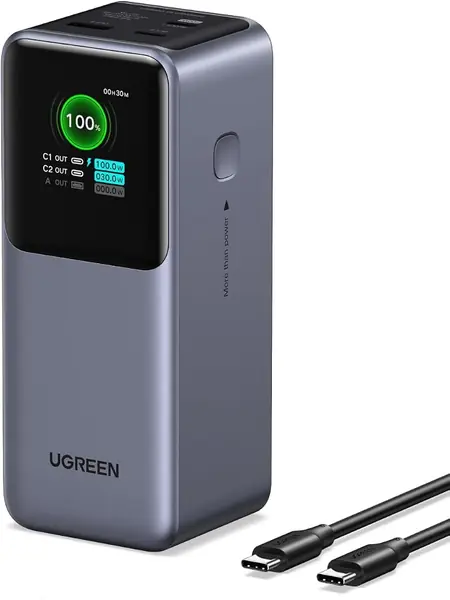
The Ally asks for 65W and keeps asking while you play, so the number that matters on a portable charger isn't the big total printed on the shell. It's what one USB-C port will hold. The Nexode puts 100W on a single port and spreads 130W across three, which is more than the original Ally needs and leaves room for whatever else is in the bag.

That margin is why this is the one we recommend first. Left connected during a session, it keeps the console topped rather than merely slowing the drain, and the color TFT screen reports watts, volts, and time-to-full in real time. Watch that readout and you can see the moment the Ally stops asking for full power and starts sipping, which is the honest answer to whether a bank is keeping up. On the packs here with four blinking dots, you're guessing.

The rest of the package is sized for a bag. The 20,000mAh cell works out to 72Wh, the column body is about two inches square and five tall, and it refills at up to 65W, so an hour on a laptop charger gets you most of the way back. UGREEN names the ROG Ally in its compatibility list alongside MacBooks and Steam Decks.

What you give up is capacity. At 72Wh it holds noticeably less than the 25,000mAh picks further down, so if your sessions run long and outlets are far apart, the INIU or the Anker will hand you more playtime per charge. For a commute, a flight, or a weekend bag, the smaller body is the better trade.

Pros

  • 100W on a single USB-C port
  • Live TFT readout of watts and charge time
  • 72Wh stays under the airline limit

Cons

  • Capacity can fade after a year of daily cycles
Our verdict

We recommend it as the default for ROG Ally owners: 100W on one port, a live wattage readout, and 72Wh that clears airline rules.
Check Latest Price
2

INIU 25,000mAh 100W Power Bank Best for Long Sessions

90 /100
TKZ Score Outstanding

Key details

Capacity
25,000mAh
Ports
3 (2 USB-C, 1 USB-A)
Max Output
100W
Warranty
3 years
View on Amazon

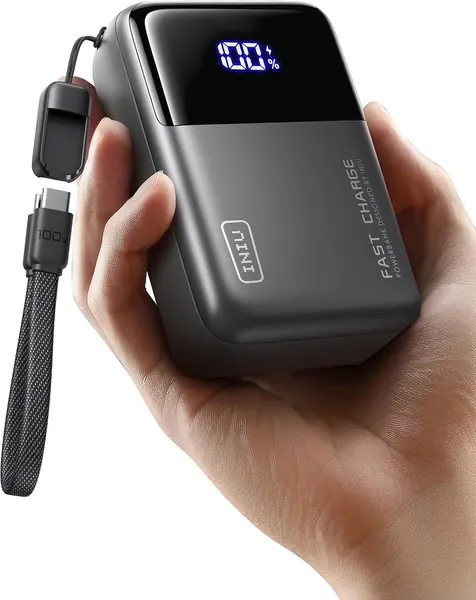
If the UGREEN is the sensible default, the INIU is the one we reach for when the trip is long. It costs less, carries 25,000mAh instead of 20,000, and still delivers a real 100W on a single USB-C port. INIU markets it at four extra hours of play and names the ROG Ally, Steam Deck, and Legion Go directly, which is the most on-the-nose pitch in this group.

The size is the trick. High-density cells get a 25,000mAh pack into a body 4.3 inches tall and 1.4 thick, small enough for a jacket pocket, and the digital display gives you a percentage rather than four dots.

Consistency is the soft spot. Recharge speed comes back less even here than on the UGREEN, and that's one reason the warranty matters: three years is the longest cover in this group by a clear margin, with most of the pack stopping at 18 months to two.

One small annoyance worth planning around: the included USB-C cable is a 4.8-inch stub, fine for topping up a phone inside a bag and awkward for a handheld in your hands. Budget for a longer 100W cable — the detachable design means swapping it costs you nothing else.

Pros

  • 25,000mAh in a 4.3-inch body
  • 100W on a single USB-C port
  • Three-year warranty, longest here

Cons

  • Some units stop taking a charge within months
Our verdict

We reach for it when playtime matters more than size: 25,000mAh, a true 100W port, and the longest warranty here.

Check Latest Price
3

Anker 25,000mAh 165W Power Bank Best Cable-Free Pick

89 /100
TKZ Score Excellent

Key details

Capacity
25,000mAh
Total Output
165W
Max Single-Port Output
100W
Built-in Cables
Two USB-C (2.3 ft and 0.98 ft)
View on Amazon

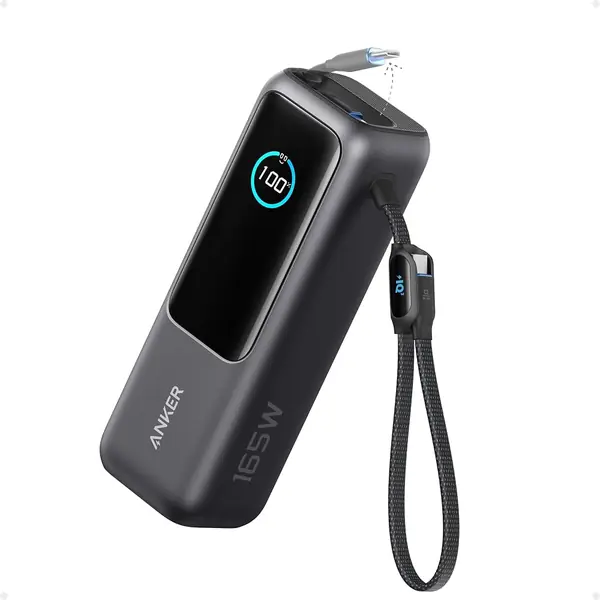
Two cables live inside the Anker. One is a 2.3-foot retractable USB-C that pulls out and winds back, rated by Anker for 20,000 retractions; the other is a 0.98-foot stub that doubles as the carrying strap. Nothing to forget, nothing to untangle, and no third cable to buy after the second one frays.

The rest of the hardware is aimed at the same trip. Three USB-C ports each rated to 100W, 165W shared, enough for the Ally, a phone, and a laptop at once, plus USB-A for older gear. It refills in about two hours on a 100W charger, and it's built to stay on the right side of airline rules.

For a bag that already carries a handheld, a phone, and a laptop, that's hard to argue with, and it's the pick when the cable pouch is the thing you keep losing. Three ports at 100W each also mean the Ally gets its full draw whether or not a phone is plugged in beside it, which isn't true of every bank here.

The clever parts are also the fragile ones. A retractable spool and a strap-mounted cord are two more things that can fail, and if one goes on a trip you lose the bank's main convenience along with the cable. The USB-C port still works, so a spare C-to-C in the bag is cheap insurance — even if it quietly undoes the reason you bought this one.

Pros

  • Two built-in USB-C cables, one retractable
  • Three USB-C ports at 100W each
  • Refills in about two hours

Cons

  • Heavy for its capacity in a pocket
  • The most expensive bank here
Our verdict

We think it's worth the premium if you want to stop carrying cables: two built-in USB-C cords and three 100W ports.

Check Latest Price
4

Ansody 140W Power Bank Best for Maximum Output

88 /100
TKZ Score Excellent

Key details

Capacity
25,000mAh
Total Output
145W
Max Single-Port Output
140W
Warranty
2 years
View on Amazon

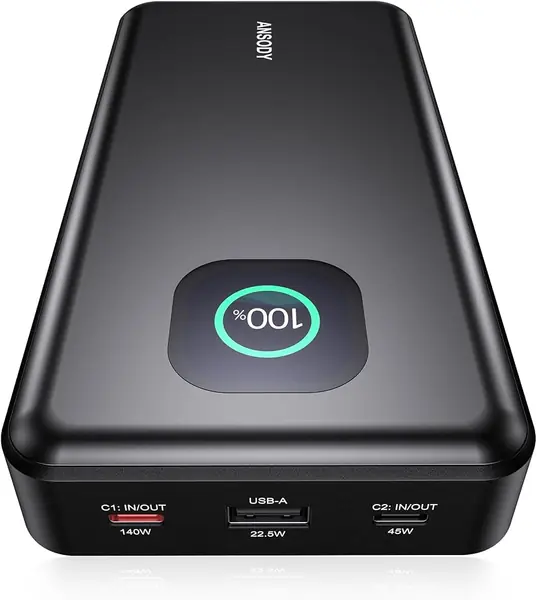
140W on one port is the biggest single-port figure in this group, and it's more than any ROG Ally model asks for. That sounds like overkill until you consider what margin buys: a bank running well inside its limit rather than at its ceiling, and a second USB-C port that can take a phone without the console dropping below the draw it wants.

We like it most for the headroom. Two devices share 145W total here, so the handheld isn't quietly giving up watts to whatever is charging beside it, and a laptop can use the same port on a work day. The catch is that the third port is USB-A, so a second USB-C device waits its turn.

Everything else is unfussy: 25,000mAh, a display with percentage and live wattage, a 100W C-to-C cable in the box, and a two-year warranty longer than Anker's. At 489 grams it's a bag charger rather than a pocket one, and the shell is plain dark gray.

That plainness is the point. It charges the thing, tells you how fast, and takes any 100W cable you own. The gadgetry on other picks — retractable spools, apps, charging bases — is exactly the stuff that breaks or gets left at home, and if you want the highest output here without the extras, this is the straightforward answer.

Pros

  • 140W on a single port, highest here
  • 25,000mAh with two-year cover
  • Display shows percentage and wattage

Cons

  • 489 grams is strictly bag weight
Our verdict

Our pick for anyone who wants output in reserve: 140W on a single port with 25,000mAh and two years of cover behind it.

Check Latest Price
5

JUOVI 65W Power Bank Best Budget

87 /100
TKZ Score Excellent

Key details

Capacity
20,000mAh
Ports
4
Max Output
65W
Display
Digital percentage readout
View on Amazon

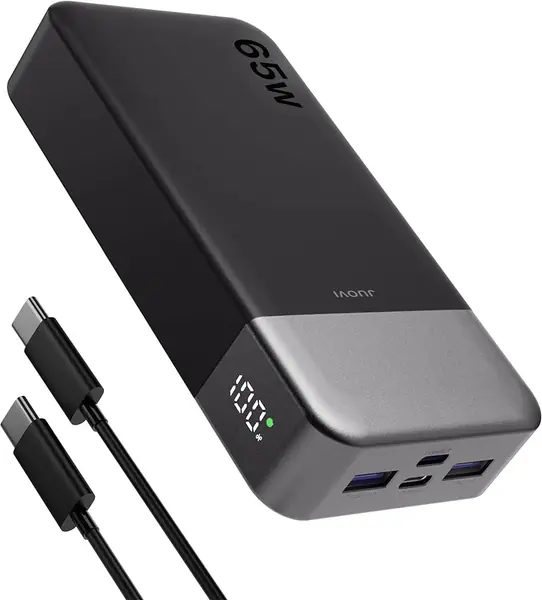
This is the cheapest bank here that still clears the Ally's actual requirement: 65W over USB-C PD 3.0. That's exactly what the original Ally asks for and nothing more, which is all plenty of people need. If you're not also fast-charging a laptop from it, the extra money elsewhere in this list buys capacity and polish rather than compatibility.

The fundamentals hold up. 20,000mAh, four ports, a percentage readout instead of four dots, a trickle mode for earbuds, and a 30cm C-to-C cable in the box. It's a little over an inch thick, so it rides beside the console in a bag pocket rather than dragging at the bottom of it.

Then there's reliability: some units quit within a couple of months, which is why we treat this as a second bank, or a first one for someone who tops it up nightly at a desk. It's a stopgap that happens to be cheap, not a bank you hand down to anyone.

Pros

  • Least expensive bank here to clear 65W
  • Four ports and a percentage display
  • Just over an inch thick

Cons

  • Refills slowly without a 65W charger
  • Adding a second device pulls power from the Ally
Our verdict

For the least money here, it meets the original Ally's 65W draw — we just ask that you charge it overnight.

Check Latest Price
6

Baseus Blade 100W Power Bank Best for Slim Bags

86 /100
TKZ Score Excellent

Key details

Capacity
20,000mAh
Ports
4 (2 USB-C, 2 USB-A)
Max Output
100W
Thickness
0.78 in
View on Amazon

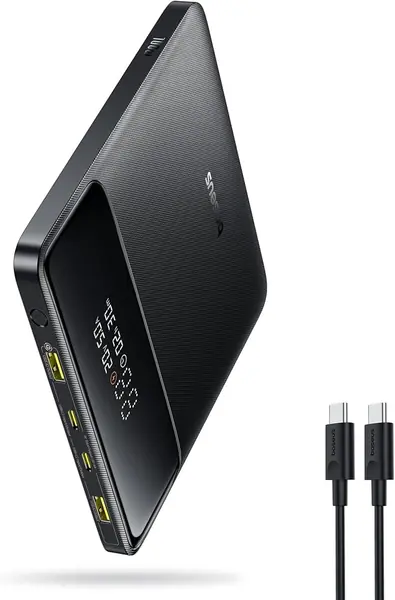
Most banks this capacity are columns. The Blade is a slab: 5.27 inches square and 0.78 thick, sized to slide into a laptop sleeve beside the machine it's meant to charge. If your bag is already full, shape matters more than a watt or two of headroom.

The numbers fit the Ally: 100W over USB-C PD, 20,000mAh, two USB-C and two USB-A ports, a display showing percentage and live wattage, a low-current mode for earbuds, and a 100W C-to-C cable in the box. Baseus backs it for two years.

The 100W rating is the part to verify early. Some units don't reach the advertised figure, and a shortfall like that shows up as a slowly draining handheld rather than an obvious failure — you won't notice it from the lights. Plug the Ally in, watch the number on the display, and use the return window if it sits well under 100.

Even with that caveat, a flat 20,000mAh pack that disappears into a laptop sleeve and still puts 100W on the Ally's port is a genuinely useful thing to own. It just isn't the one we hand a first-time buyer: the UGREEN's faster refill and extra port make it the easier default for a little more money.

Pros

  • Slab shape fits a laptop sleeve
  • 100W USB-C PD with 20,000mAh
  • Two-year warranty and 100W cable included

Cons

  • Some units fall short of the 100W rating
  • Refills at only 60W
Our verdict

We like it for the flat shape: a 20,000mAh slab that fits a laptop sleeve and still puts 100W on the Ally's port.

Check Latest Price
7

EcoFlow Rapid 25,000mAh Power Bank Value Capacity

85 /100
TKZ Score Excellent

Key details

Capacity
25,000mAh
Total Output
170W
Max Single-Port Output
100W
Recharge Input
100W
View on Amazon

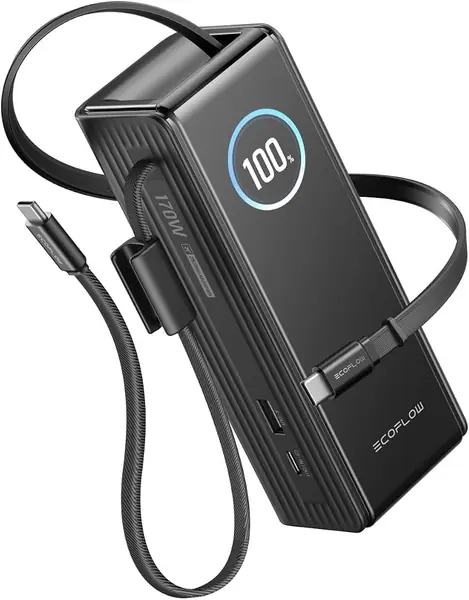
The Rapid is the pack we ended up grabbing on the way out, mostly because there's nothing to grab with it: a 2.2-foot retractable USB-C cable and a short 0.8-foot one are built into the body, and the short one doubles as a handle.

It's the Anker's idea executed for less money — 25,000mAh, 170W total, 100W on a single port, four outputs counting the two cables, and a display that reads out remaining power and live wattage. Refilling is quick: EcoFlow quotes 50% in about 26 minutes on 100W input, and the two-year warranty is longer than the Anker's 18 months.

Size is the price of the capacity. At 20 ounces and 1.9 inches thick it's a bag pack, not a pocket one, and the fixed cables mean a damaged cord benches the bank's best feature. The USB-C port still works when that happens, which is the same escape hatch the Anker offers.

Where it earns its place is the middle of the market: it undercuts the Anker while matching its capacity and beating its warranty, and two attached cables cover a handheld and a phone without a pouch. Against our top pick it's heavier and holds 5,000mAh more, and for a travel bag that's a trade we're happy to make.

Pros

  • Two built-in USB-C cables, one retractable
  • 25,000mAh with 100W on one port
  • Refills to half in about 26 minutes

Cons

  • 20 ounces keeps it out of a pocket
  • Needs a 100W charger for that fast refill
Our verdict

We rate this the value version of the Anker: 25,000mAh, two attached cables, and two-year cover for less money.

Check Latest Price
8

REWONDER 40,000mAh Power Bank Best for Desk and Car

84 /100
TKZ Score Excellent

Key details

Capacity
40,000mAh (154Wh)
Ports
4
Max Output
65W on a single port
Carry-on
Not permitted at 154Wh
View on Amazon

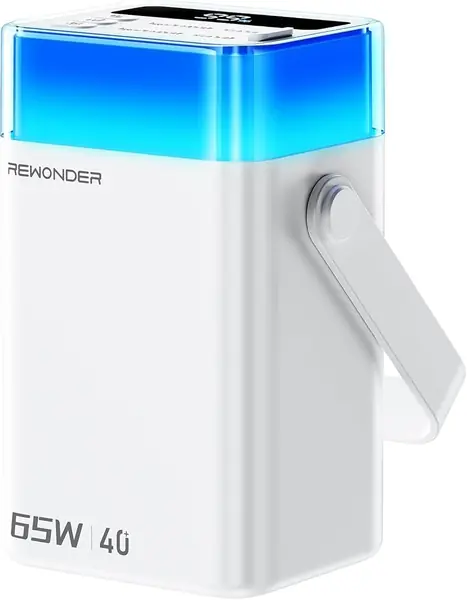
You can't fly with this one. At 40,000mAh it's rated 154Wh, well over the 100Wh ceiling for carry-on lithium batteries, and the company says so plainly. Everything else about the pack follows from that: it's for a desk, a car, a campsite, or an outage, not for the plane.

What the restriction buys is capacity nothing else here approaches. 40,000mAh at 65W means the Ally can run and charge through a long stretch without a wall outlet, and there are four outputs, a silicone cover over the ports, a seven-color light with three brightness levels, and a handle molded into the shell. Peak 65W needs a single port in use — split it across two devices and the budget is shared, so charge the handheld alone when you want full speed.

We like it for the job it does well: sitting by the outlet you use most and keeping the handheld fed through a week of evenings, with enough left over for a phone, a tablet, or a drone battery. It's also the only pick here with a built-in light, which is more useful than it sounds when the power is out.

The trade-offs are real. It's heavier than anything else here, and it's the least-established product on the page, so the long-term picture is the least settled. Give it a shelf by the outlet you use most and it earns the space; treat it as a travel bank and the arithmetic stops working.

Pros

  • 40,000mAh, far beyond anything else here
  • 65W USB-C output for the handheld
  • Built-in light and port cover

Cons

  • Ships with no cable or wall charger
  • Slow to refill without a 65W brick
Our verdict

We keep this one at a desk: 40,000mAh that runs a handheld for days of evenings, provided you never need it on a plane.

Check Latest Price

How We Tested Power Banks for a Handheld Gaming PC

We started with research rather than shopping: we pulled every bank we could find that advertises at least 65W over USB-C, which is roughly the Ally's ceiling, then narrowed the field by capacity, port mix, weight, and price so the shortlist covered budget packs as well as loaded ones with smart displays and built-in cables. We bought 12 units in all and used them for six months.

Most of the testing happened on the couch, in the least convenient way possible: a demanding game at fixed brightness and volume, the Ally drained down to 20 percent, then the bank connected and a stopwatch running until the pack died. We logged how many extra hours of play each one delivered and how quickly the Ally's battery percentage climbed in the first 30 minutes. On a few work trips we repeated the whole thing on a plane tray table and a train seat, where heat builds up differently than it does on a desk.

A USB-C power meter logged actual wattage for the full session, which is how we caught the packs that start strong and fade as they warm. We compared each bank's own readout against that meter, since a display is only useful if it's honest, and felt the case every 20 minutes to see which ones ran hot enough to be unpleasant against a leg.

Every unit got weighed and packed into a sling bag and a backpack pocket next to the handheld, so we could judge how the two carried together. Built-in cables were plugged and unplugged repeatedly, then retracted until we lost count, and each bank took a few knocks off a coffee table onto carpet to check whether the ports still gripped a cable tightly afterward.

How to Choose a Power Bank for a Rog Ally

Read the Port, Not the Total

A bank rated at 130W or 165W is describing everything its ports can do at once. The Ally only ever sees one of them, so the figure to hunt for is the single-port maximum. On the UGREEN that's 100W. On a 65W-total pack like the JUOVI, plugging in a phone leaves the console short and the battery starts falling again, just slowly.

Keep the handheld on the bank's primary USB-C port and check the per-port number before you buy, not the headline. That one habit explains most of the disappointing results people get from otherwise capable packs.

How Much Playtime Capacity Buys

Milliamp-hours are a phone number; watt-hours predict playtime. A 20,000mAh pack is about 72Wh and a 25,000mAh pack is about 90Wh. Divide by what the Ally draws in game — call it 30W at high settings — and 72Wh gives you a little over two hours of play, 90Wh about three.

That arithmetic is why 25,000mAh is the sweet spot for long sessions and 20,000mAh is plenty for a commute. It also means a bigger cell buys time, not speed: a 40,000mAh pack does not charge the Ally any faster than a 20,000mAh one.

Built-In Cables or a Cable You Can Replace

The retractable and fixed cords on the Anker and the EcoFlow are the most convenient thing about either one, and they are also the part that fails first. When a built-in cord dies, the bank's headline feature dies with it, where a detachable design makes the repair a cable swap.

Our compromise: buy the built-in version if losing cables is genuinely your problem, and keep a spare USB-C cord in the bag anyway. The USB-C port on every bank here still works when its built-in cable doesn't.

Weight and Shape, by the Number Rather Than the Class

Two 25,000mAh packs in this guide differ by more than six ounces, so treat weight as a specification to check rather than something capacity tells you. Shape matters as much: a column drops into a bottle pocket, while the Baseus slab is built to lie flat in a laptop sleeve.

The practical test is the one you'll repeat every day — bank, handheld, and cable in the same pocket you actually use. If that pocket is a jacket, 20 ounces is a different proposition than it is in a backpack.

Recharge Speed and the One Useful Display

Refilling the bank is the chore nobody plans for. At 65W input a 20,000mAh pack is back in about two hours; on a 30W phone charger, plan on most of a day. If you're buying one of these, buy a 65W-or-better wall charger with it.

A display that shows live wattage is worth paying a little for on this device in particular. It tells you whether the Ally is pulling its full draw or has tapered off near full, which is the difference between a bank that works and a bank you only think works.

Frequently Asked Questions

Final Verdict

If you want one answer, it's the UGREEN Nexode. It holds 100W on the port the Ally uses, shows you the wattage while it does it, and packs 72Wh into something that drops in a bag and clears airport security. Nothing else here combines those four things as cleanly, which is why it's the one we recommend first.

If your sessions run long, the INIU's 25,000mAh buys more playtime per charge for less money. If a built-in cable is worth the premium to you, take the Anker. The JUOVI is the one to buy as a second bank, not the only one in your bag.