Best Heavy-Duty Backdrop Stands of 2026

A backdrop stand has one job: hold a wall of fabric steady through a whole party, or wobble the second someone brushes past it. I've spent six months with a dozen of these frames, and the gap between one I trust and one I quietly brace with sandbags almost never comes down to the width printed on the box. It's the base plates, the locking collars, and how much the thing actually weighs.

Heavier is better here, counterintuitively — the stand that's a nuisance to drag up from the basement is usually the one still upright at midnight. Assembly matters nearly as much: a frame one person can raise in fifteen minutes without pinching a finger beats a fancier one that needs two. And since these all look alike in photos while prices swing wildly, value comes down to whether the hardware feels built for a fourth event.

The picks below are the frames that stayed up, packed down, and went back up again. They're not the lightest options out there, and that's the point.

The Best Heavy-Duty Backdrop Stands

1

Qoolfoto 10x10 Pipe and Drape Stand Best Overall
90 /100
TKZ Score Outstanding

Key details

Width Range
4ft-10ft / 47in-122in
Height Range
4.8ft-10ft / 58in-122in
Load Capacity
33 lb
Base Weight
10.3 lb each
View on Amazon

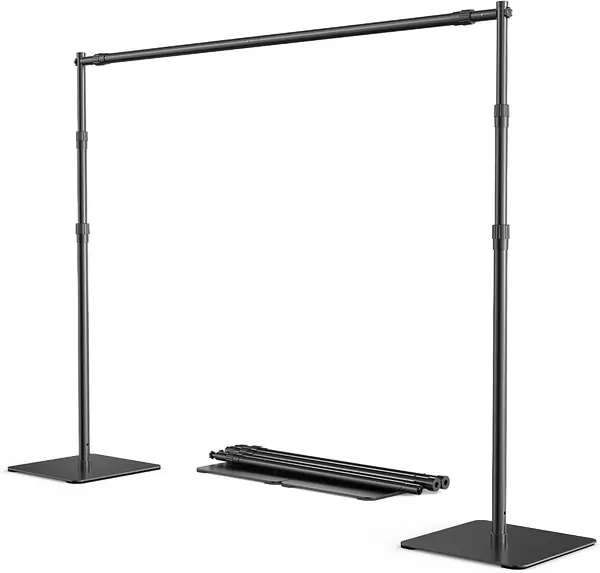
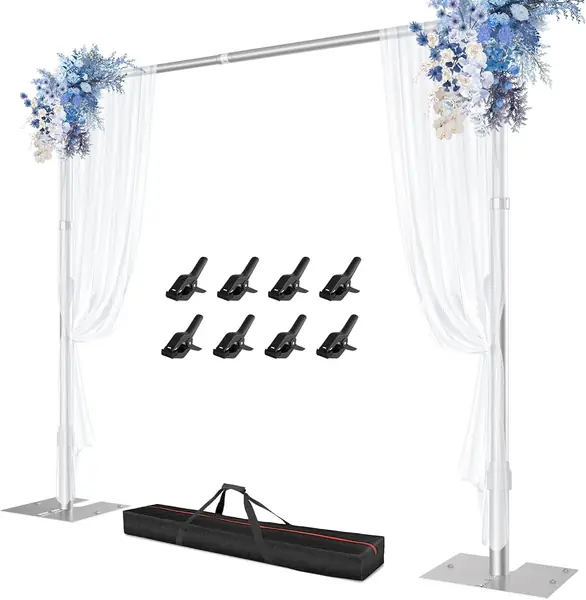
Two 10.3-pound steel bases and a 33-pound load rating are what put the Qoolfoto at the top of this group for us. The bases sit flat on the floor, so the support comes from a broad footprint rather than three tripod legs that can walk or tip. For a wedding backdrop, a photo booth, or a studio shoot with a heavier fabric drop, that is the difference we care about most.

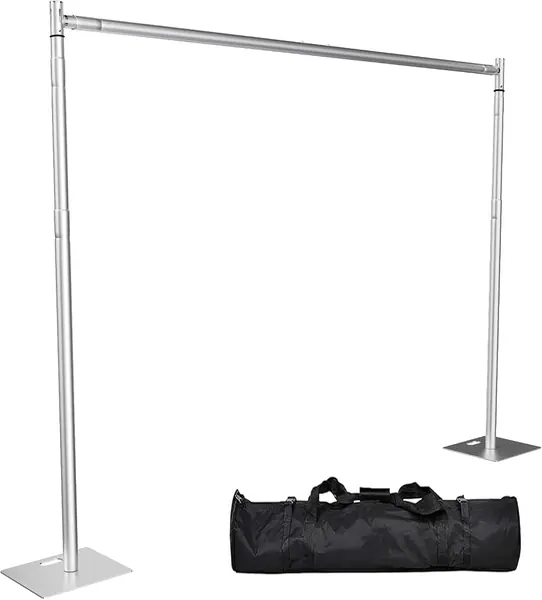
The frame adjusts from 4.8 to 10 feet high and 4 to 10 feet wide, which covers most full-size backdrops without forcing a permanent installation. We appreciate the folding bases and the included bag, because the stand breaks down into a single kit between events. The telescopic poles and locking pins are simple to work with; we paid attention to the collars because that is where cheaper stands start to feel fussy.

One crossbar is the one place the Qoolfoto gives ground to the Fotoumgl. If you routinely hang two backdrop layers, the double-rod design is worth the step up. For a single backdrop that needs to stay where you put it, the flat bases do the work without extra rods to assemble.

Pros

  • 33-pound load rating for heavier backdrops
  • Two 10.3-pound flat bases resist tipping
  • Adjusts to 10 feet high and wide
  • Folding bases and bag simplify storage

Cons

  • Heavy frame needs a deliberate setup
Our verdict

For most buyers, the Qoolfoto is the heavy-duty stand we recommend: its 10.3-pound flat bases and 33-pound rating keep a full-size backdrop secure.
Check Latest Price
2

Fotoumgl Double Crossbar Stand Best for Two Backdrops

89 /100
TKZ Score Excellent

Key details

Width Range
4ft-10ft
Height Range
4.5ft-10ft
Base Weight
10.3 lbs each
Frame Weight
34 lb
View on Amazon

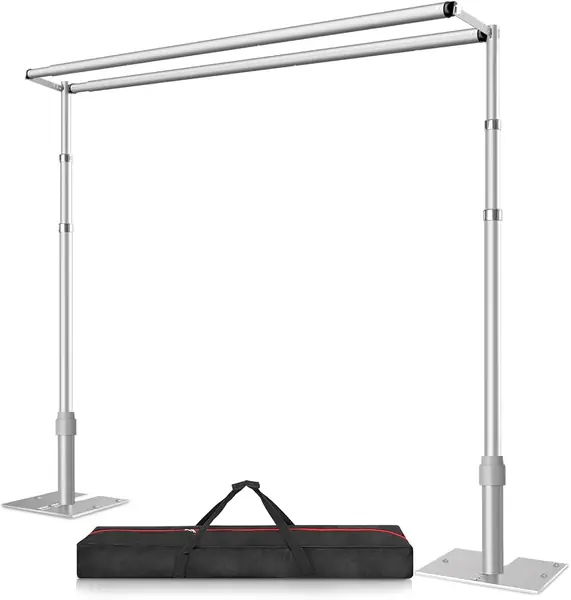
A second crossbar is not a gimmick on a 10-foot frame. It lets you hang two backdrop layers at once, or keep a drape and a flower wall on separate rods, and the Fotoumgl is the only pick here built around that idea. For a photo booth with two-sided branding or a studio that changes looks quickly, it solves a problem the single-rod stands cannot.

We like the simple hardware: the uprights and crossbars twist to lock, each steel base weighs 10.3 pounds, and the expandable holes give you more mounting options without a second frame. The 4.5-to-10-foot height and 4-to-10-foot width leave room for a full backdrop. This is a lot of stand, but the flat bases are the part that keeps it planted.

That weight is doing useful work. The bases hold a tall drape steady, and the double rod means fewer trips back to the gear box when the look changes. If you only ever hang one backdrop, the Qoolfoto does the job with less hardware. If two layers are part of your setup, the Fotoumgl earns its place.

Pros

  • Double crossbar holds two backdrop layers
  • Two 10.3-pound steel bases steady the frame
  • Tool-free twist-lock height and width
  • Adjusts from 4.5 to 10 feet

Cons

  • 34-pound frame requires two-person handling
Our verdict

We choose the Fotoumgl when one event needs two backdrop layers; its double crossbar does a job the single-rod stands here cannot.

Check Latest Price
3

EMART 12x10 Backdrop Stand Best Wide Span

88 /100
TKZ Score Excellent

Key details

Width Range
72 inch/6 ft to 144 inch/12 ft
Load Capacity
35 lb
Frame Weight
13.1 lb
Crossbars
4
View on Amazon

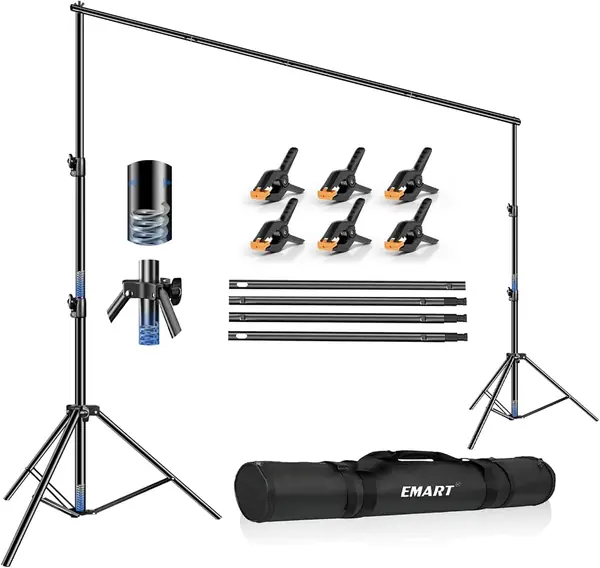
Twelve feet of width is the reason to look at this EMART. Four crossbars connect to stretch from 6 to 12 feet, and the frame carries a 35-pound load rating, so it can hold a wide group-shot backdrop or a long banner that leaves a 10-foot stand looking cramped.

The tripod design is the trade. At 13.1 pounds, the aluminum frame is far easier to carry than the flat-base pipe stands here, and the dual spring cushions are a nice touch for protecting the frame during setup. But tripod feet need weight on a smooth floor or in a breeze, and this kit does not include sandbags. Plan on weight bags if the stand will be near a doorway or outside.

For a wide indoor backdrop in a hall or studio, we think the extra span is worth the fuss. For a tight room or a windy outdoor event, the Qoolfoto's flat bases are the safer call. The EMART is the wide-span specialist, not the all-purpose default.

Pros

  • 35-pound load capacity
  • Extends to 12 feet wide
  • 13.1-pound aluminum frame
  • Four crossbars and six clamps included

Cons

  • Needs 12 feet of clear width
Our verdict

The EMART earns our wide-span pick: 12 feet of width and a 35-pound rating suit long banners, provided you have weights for its tripod feet.

Check Latest Price
4

ShowMaven 8x10 Steel-Base Stand Best for Heavy Stationary Setups

87 /100
TKZ Score Excellent

Key details

Width Range
67 to 120 inches
Height Range
39 to 96 inches
Item Weight
36.6 lb
Base Type
Steel
View on Amazon

At 36.6 pounds, the ShowMaven is the heaviest stand in this group, and that is the point. Its steel base and wide contact area are built to keep an 8x10 backdrop planted in a studio or a fixed event space. We don't see it as a travel stand; we see it as a frame you set up and leave alone, and that makes it the one we choose for a permanent photo corner.

The frame adjusts from 67 to 120 inches wide and 39 to 96 inches high, so it can handle a portrait backdrop or a horizontal banner. Setup is tool-free and quick, and the thicker aluminum pipe is meant to add rigidity. We especially like the weighted-platform feel for balloon arches and solid backdrops, where a lighter tripod can start to creep.

For a fixed studio, the weight is a fair trade. If the stand has to travel to a different venue every weekend, the EMART or the Forlogic will be easier to live with. The ShowMaven is for the buyer who wants the frame to stay put and does not mind giving up portability to get there.

Pros

  • 36.6-pound steel-base build
  • Tool-free setup in about five minutes
  • Adjusts 67 to 120 inches wide
  • Thicker aluminum pipe frame

Cons

  • No stated load rating
  • Adjusting uprights can stick
Our verdict

For a fixed studio, we recommend the ShowMaven; its 36.6-pound steel base is built to keep an 8x10 backdrop planted.

Check Latest Price
5

TOCRETOARE 10x10 Pipe and Drape Kit Best Midrange Kit

84 /100
TKZ Score Excellent

Key details

Width Range
3.9ft-10ft / 67in-120in
Height Range
4.5ft-10ft / 54in-123in
Load Capacity
22 lb
Tube Diameter
1.5 in
View on Amazon

The 1.5-inch aluminum tube is the first thing that separates the TOCRETOARE from the budget tripod stands. It gives the frame a more substantial feel, and the 10x10 coverage is enough for a full fabric backdrop without looking like a scaled-up clothes rack. For a pipe-and-drape kit in the middle of the price range, that is a sensible combination.

We like the telescopic poles and rotary locks: height runs from 4.5 to 10 feet and width from 3.9 to 10 feet, so you can fit a doorway, a photo corner, or a full wall. The four-step setup is tool-free, and the metal bases are easier to trust than folding tripod legs. It is not as heavily built as the Qoolfoto, but it is also easier to move and costs less.

The 22-pound load rating is the number to respect. A dense flower wall or a heavy velvet drape can eat through that margin quickly, and this is not the stand for a two-layer display. For a single fabric backdrop indoors, it is a tidy middle choice between the budget frames and the premium pipe kits.

Pros

  • 1.5-inch aluminum tube frame
  • 22-pound load capacity
  • 10x10 coverage with telescopic poles
  • Tool-free five-minute assembly

Cons

No notable drawbacks to flag.

Our verdict

The TOCRETOARE is our midrange choice for indoor fabric backdrops, with a 10x10 span that costs less and moves easier than the premium kits.

Check Latest Price
6

Fomcet 10x10 Pipe and Drape Stand Best for Budget Indoor Parties

83 /100
TKZ Score Excellent

Key details

Item Weight
17.2 lb
Size
10 ft x 10 ft
Base Type
Rectangular base
Frame Material
Steel
View on Amazon

A 10x10 steel pipe frame at the lower end of this group is the Fomcet's appeal. The rectangular bases and powder-coated finish give it the look of a pipe-and-drape kit rather than a folding tripod, and the frame adjusts down to 6.3 x 6.3 feet for smaller spaces. For an indoor party where the backdrop is fabric and the floor is level, that is a lot of coverage for the money.

We like that it is light enough for one person to move and simple enough to assemble without tools. The 10x10 size is the main event, though: it gives you a full backdrop wall without the footprint of the 12-foot EMART. The flat bases also sit closer to the floor than tripod legs, which makes the frame feel more like part of the room and less like a camera accessory.

This is a budget stand, and we treat it that way. It earns its place at a birthday, shower, or small corporate event where the look matters more than the load. For an indoor fabric backdrop, the Fomcet delivers the pipe-and-drape silhouette without the premium price; that is the whole reason to choose it.

Pros

  • Steel pipe frame with rectangular bases
  • 10x10 coverage adjusts down to 6.3 feet
  • Light enough for one person to move
  • Lower-cost pipe-and-drape option

Cons

  • Center can sag under a heavy drape
  • Less stable outdoors in wind
Our verdict

We recommend the Fomcet for indoor parties on a budget, where its steel frame can hold a fabric backdrop without the premium price.

Check Latest Price
7

Forlogic Wheeled Backdrop Stand Best for Moving Studio Setups

82 /100
TKZ Score Excellent

Key details

Item Weight
11.9 lb
Size
10 x 7.5 ft (WxH)
Included
2 sandbags, 2 tripods, 6 clips, bag
Wheel Type
Rotating, locking
View on Amazon

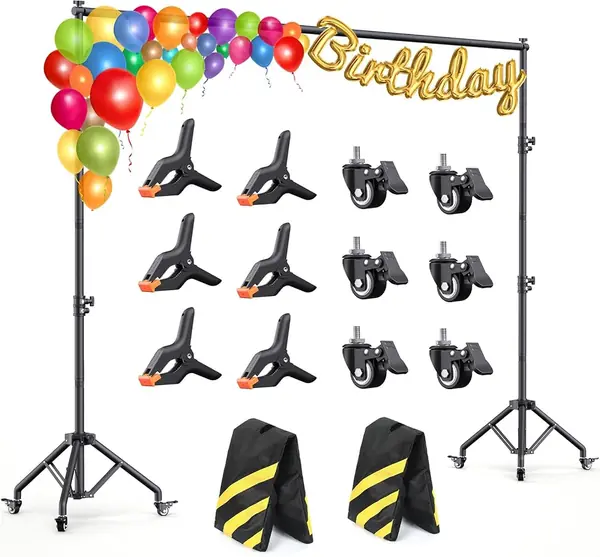
The wheels are the whole reason to consider the Forlogic. A 10x7.5-foot backdrop frame that rolls into place is handy in a studio or a multipurpose room where the backdrop moves between setups. The wheels lock, and the kit includes two sandbags and six spring clips, so it arrives ready to secure a fabric drop.

The frame adjusts from about 46 to 120 inches wide and 35 to 90 inches high, which covers a portrait backdrop and most banner sizes. At 11.92 pounds, it is one of the lighter stands here, which is why it rolls and carries so easily. For a fabric backdrop and a small crew, it is a practical piece.

We like the wheeled tripods for a room that gets rearranged often. The locking casters are the detail that makes the mobility useful; without them, a rolling stand becomes a nuisance during a shoot. The included sandbags give you a way to add stability once the frame is in place, and the storage bag keeps the clips and hardware together.

For a studio that repositions a backdrop several times a week, the Forlogic is our pick. The wheels and locking casters turn a two-person shuffle into a one-person roll, and the included sandbags let you settle the frame once it is in place.

Pros

  • Locking wheels for repositioning
  • 10x7.5 coverage
  • Includes two sandbags and six clips
  • 11.92-pound frame

Cons

  • Lighter frame limits dense backdrops
  • Casters need locking before a shoot
Our verdict

Rolling wheels make the Forlogic our pick for studios that move a backdrop between setups, as long as the backdrop stays light.

Check Latest Price

How We Tested Heavy-Duty Backdrop Stands

I began by narrowing the field to pipe-and-drape frames with flat or square steel bases instead of tripod feet, since tripod legs are the first thing to go in a crowd. From there I filtered by height range, whether the telescoping poles locked at the joints, and whether the crossbar could carry two layers — a fabric panel plus a flower wall, say. That left 12 stands, which we assembled and lived with over six months.

Each one went up in three settings: a backyard birthday with fabric at full height, a rented hall where we built a booth-style backdrop, and my garage, where I raised and struck them repeatedly for photo shoots. I assembled every stand alone with a stopwatch running and noted where a second pair of hands would have been required. I weighed each on a bathroom scale, in the bag and out, and carried them up and down a flight of stairs to feel what that weight meant in practice.

Stability got the most scrutiny. I hung two fabric panels, added a sandbag at the base and a few pounds of clamp weight on the crossbar, then checked an hour later whether the poles had crept or the collars had slipped. I bumped each frame with a hip the way a guest would, set them up on grass and on concrete, and watched the bases under a fan and, one gusty afternoon, actual wind. On the stands with wheels, I checked whether the brakes held.

Last, the metal itself: the welds at the joints, whether pole sections fit snugly or rattled, whether base plates bent under an over-tightened bolt. None of these is cheap enough to replace casually, so value came down to the hardware — the collars, pins, and bolts that decide whether a stand survives a season of events or one summer.

How to Choose a Heavy-Duty Backdrop Stand

Start With the Base and the Load Rating

A flat steel base does two jobs at once: it lowers the center of gravity and spreads the load across a wide contact patch. That is why the Qoolfoto's two 10.3-pound bases and the ShowMaven's 36.6-pound steel-base build feel more planted than a tripod frame, especially when a backdrop catches a draft. A tripod can still work, but it needs weight on the feet and a level floor.

Load ratings are the other half of the decision. The Qoolfoto is rated to 33 pounds, the EMART to 35, and the TOCRETOARE to 22. Match that number to the backdrop, not to the frame: a dense flower wall or a lined velvet drape can weigh far more than a single sheet of muslin. A background stand that names its load rating is easier to match to a heavy drape. If a stand does not publish one, keep the load light and test the frame before the event.

Match the Span to the Room, Not Just the Backdrop

A 10x10 frame needs roughly 10 feet of clear width plus room for the bases, and the same goes for height: check the ceiling, the door height, and any light stands before you set it up. The EMART stretches to 12 feet, which is useful for a long banner or a group shot, but it also needs a bigger room. The ShowMaven's 8x10 footprint suits a smaller studio wall.

The size order is not universal. Some listings give width by height, others height by width. Check the range in both directions before you buy, especially if the frame has to fit under a soffit or between doorframes. If the number is close, choose the smaller span; a backdrop that fits with a few inches to spare is easier to light and less likely to crowd the room.

Check the Adjustment Hardware Before the Event

Telescopic poles and locking collars are where a stand either feels solid or turns into a wrestling match. Twist locks can be quick, but they need a firm hand; pin-and-screw systems are slower but less likely to slip. We check that every joint locks at the height we need before hanging anything, because adjusting a loaded frame is the hard part.

The Fotoumgl's twist-to-lock poles and the TOCRETOARE's rotary locks are both tool-free, while the ShowMaven sets up without tools in about five minutes. That convenience is real, but test the hardware at low height first. A collar that sticks when the frame is empty is easier to fix than one that sticks with a backdrop on it.

Decide How Often the Stand Will Move

Weight is the simplest guide to stability and the biggest annoyance on install day. A 36.6-pound ShowMaven is the right answer for a permanent photo corner, while a wheeled 11.92-pound Forlogic makes more sense in a room that gets rearranged. The Qoolfoto sits between those extremes: substantial enough for a full backdrop, but still a two-person setup.

For a stand that travels, wheels or a compact bag are worth more than an extra pound of steel. For a stand that stays put, accept the heavier base and skip the feature you will never use. That is the trade we make every time: portability for stability, and the other way around.

Frequently Asked Questions

Final Verdict

For most events, we recommend the Qoolfoto 10x10 Pipe and Drape Stand. Its pair of 10.3-pound flat bases and 33-pound load rating give a full-size backdrop the kind of support a lightweight tripod cannot, and it adjusts far enough for weddings, photo booths, and studio work.

If you need two backdrop layers, the Fotoumgl's double crossbar is the better tool. If the stand will live in one spot, the ShowMaven's 36.6-pound steel-base build is the one we choose. Start with the Qoolfoto unless one of those specific needs changes the decision.