Best Fitness Trackers for Seniors of 2026

Most fitness trackers aren't hard to use so much as easy to abandon. A screen you can't read without your glasses, an app demanding a login you'll never remember, a charging cable that disappears into a drawer — and by week three the watch is in there with it. What a tracker actually fixes is smaller and more useful than the packaging suggests: it tells you, with almost no effort on your part, whether you moved today and how you slept last night.

I once watched someone wear a tracker for a full month and never look at it once, which is roughly when I stopped trusting spec sheets in this category. Since then we've spent four months with 14 trackers, worn on daily walks, in the pool, and overnight by people from their late fifties to their mid-eighties, and the split was obvious: the ones that stuck around were readable at arm's length and worked straight out of the box, while the ones that needed a phone and a companion app to show a step count got left on the nightstand.

One thing worth knowing before you shop: the trackers that skip the app entirely trade a little detail for a lot of daily usability, and the blood oxygen and blood pressure numbers on any wrist-worn device are trends, not medical readings — good for spotting a pattern, not for diagnosing anything. What follows is sorted by who each one actually suits.

The Best Fitness Trackers for Seniors

1

Pautios EW1 Pedometer Watch Best Overall
85 /100
TKZ Score Excellent

Key details

Display
Color LCD, touchscreen
Battery Life
10 days
App Required
No
Health Sensors
Heart rate, blood oxygen, sleep
View on Amazon

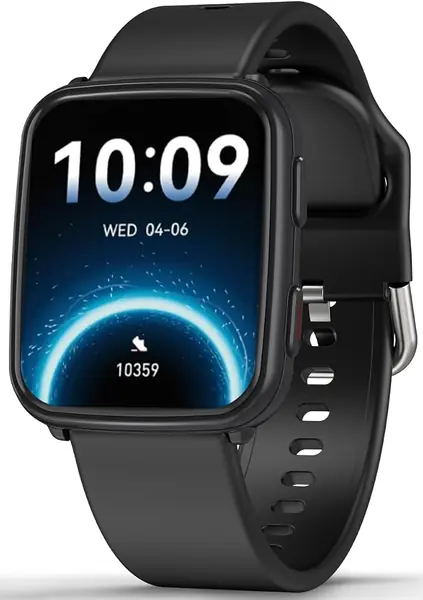
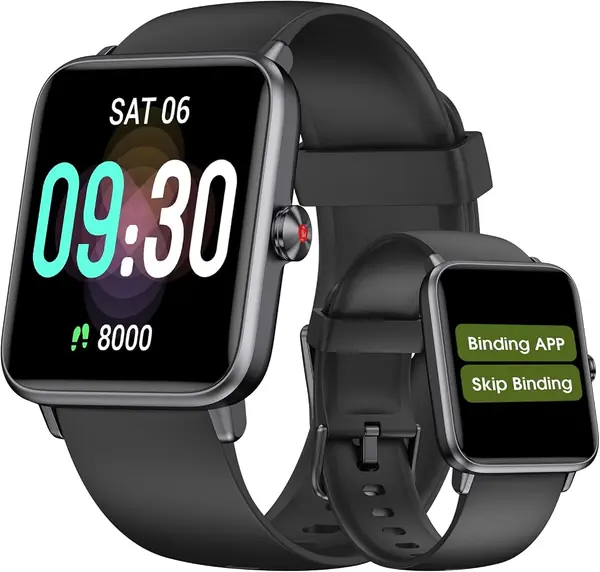
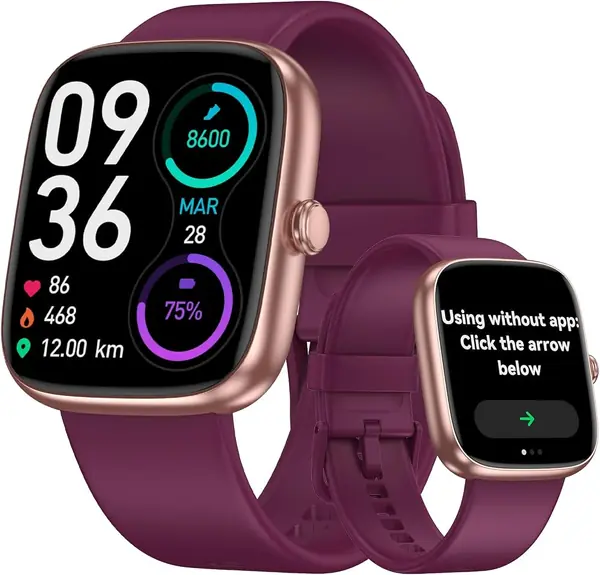
The Pautios EW1 asks nothing of you: no app, no pairing, no account, no phone in the room. Charge it, strap it on, and the numbers are already there. That single design decision is why it is the tracker we point most families to — a pedometer watch that gets worn daily is one that never needs a helper, and this is one of only two picks here that make the phone-free promise at all. The color display is large and bright, and the figures are big enough to read at arm's length without hunting for glasses.

What it tracks is a sensible short list. Steps, distance, calories, and activity time sit on the surface; heart rate and a blood-oxygen reading are a tap or two away; sleep, an alarm, and a stopwatch are waiting in the morning. We like that the blood oxygen is a manual check you start yourself — a spot reading, presented honestly, rather than a monitor the watch pretends to be. The stated ten-day battery is the other quiet luxury: pick a day, charge it while the coffee brews, and stop thinking about it.

It is also among the least expensive trackers here, which makes the whole purchase feel low-risk. Nothing on it is luxurious — the case is plastic, the band is plain silicone, and the display is a generation behind the AMOLED panels on the Bestinn and the FITVII. What you get in exchange is a watch with no dependencies, one that will still be doing its job on a morning when the internet is down, the phone is mislaid, and nobody is around to help.

Pros

  • No app, no pairing, no phone needed
  • Large color display with big readouts
  • Up to ten days between charges

Cons

  • Step counts can run high on arm movement
  • Band runs short and traps moisture
Our verdict

If the person wearing it won't pair a phone, buy this one: steps, heart rate, and sleep on a big color screen, with nothing to set up and no app to open.
Check Latest Price
2

DAVIKO Senior Fitness Tracker Best for Big Numbers

84 /100
TKZ Score Excellent

Key details

Display
1.83-inch LCD
Warranty
1 year
Water Resistance
1.5 meters
Standalone Use
Yes, no app needed
View on Amazon

At 1.83 inches, the DAVIKO's display is the biggest in this group by a clear margin — closer to a small phone screen than to the slim bands most trackers wear. For someone who has given up reading a step count through bifocals, that is not a spec-sheet nicety; it is the entire reason to buy. It runs standalone as well, so the no-app, no-phone idea holds here too, and it is the least expensive tracker in this roundup. One detail worth knowing before you order: the only colorway is purple.

The 320 by 320 resolution spread across that much glass is the visible cost of the size: you get big digits, not crisp ones, and the LCD panel does not have the contrast of the AMOLED screens on the Bestinn or the FITVII. We think that is the right trade for this buyer — a large number in a plain font beats a small number rendered beautifully — and it is why we keep it as the readability-first alternative to our top pick. Just do not expect premium materials: the case is plastic, the band is ordinary silicone, and the watch is happiest as a step counter that tells the time.

Pros

  • Largest screen in this roundup
  • Works standalone without a phone
  • Cheapest tracker in this set

Cons

  • Water resistance stops at 1.5 meters
  • Single-year warranty only
Our verdict

We recommend it when reading the display is the whole problem — the 1.83-inch panel is the largest here, and it still runs without an app or a phone.

Check Latest Price
3

Bestinn H32 Pro Fitness Tracker Best Screen for Phone Users

83 /100
TKZ Score Excellent

Key details

Display
1.58-inch AMOLED
Warranty
3 years
Weight
0.96 oz
Battery Life
Up to 7 days
View on Amazon

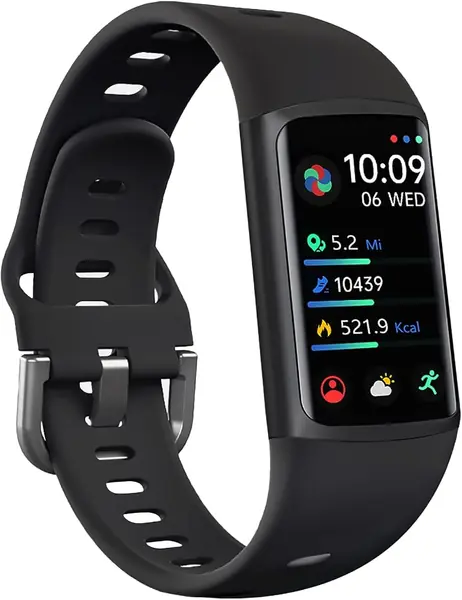
The Bestinn H32 Pro has the sharpest screen in this roundup: 1.58 inches of AMOLED, which is the difference between squinting at a number and simply reading one. At a hair over 27 grams it is among the lightest full-size watches here, and the bands swap without tools, so a fabric strap or a metal bracelet is a two-minute change.

Around that screen sits a complete smartwatch: around-the-clock heart rate, blood pressure and blood oxygen readings, sleep tracking, call and message notifications, and more than 120 exercise modes. The battery is rated at up to seven days, enough that charging becomes a weekly habit rather than a daily chore, and the watch face is fully customizable — which sounds frivolous until you set one with three enormous numbers on it and realize that is all you wanted to see.

What tips it for us is the stated three-year warranty, the longest of any pick here and aimed squarely at the thing that actually goes wrong with wrist trackers: a battery that stops taking a charge. Add swappable bands and the sharpest display in the group, and this is the most watch you get for the money. It is the pick for a senior who already carries a smartphone and wants the clearest possible read of the numbers.

Pros

  • Sharpest, brightest panel in the group
  • Three-year warranty, the longest here
  • Customizable faces with very large numerals

Cons

  • Setup and syncing require the phone app
Our verdict

The pick for a senior who already carries a smartphone and wants the sharpest screen and the longest warranty in this group.

Check Latest Price
4

MorePro Air6 Fitness Tracker Best for Health Tracking

82 /100
TKZ Score Excellent

Key details

Display
1.52-inch LCD
Warranty
2 years
Water Resistance
IP68
Weight
1.12 oz
View on Amazon

At 1.12 ounces, the MorePro Air6 almost disappears on the wrist. The 1.52-inch LCD is bright enough to check mid-walk, the case is IP68 rated, and the band is soft silicone — the whole thing sits low enough in profile to slide under a sleeve, which is what you want from a watch someone will wear from breakfast to bed.

We like it best for the household that wants the widest set of health numbers in one place: heart rate, blood pressure, blood oxygen, sleep, and cycle tracking, all readable on the watch and graphed in the app. The 230 mAh battery settles into a roughly weekly charge, and the two-year warranty is the second-longest here — a real hedge in a category where a dying battery is the usual ending. Setup runs through the MorePro app and takes about ten minutes with a phone in hand; after that, most days need nothing but a glance at the wrist.

The sport-mode list runs past 120 and is far longer than anyone needs. Ignore it and the watch does exactly what you bought it for, logging a walk, a night's sleep, and a resting heart rate while feeling like almost nothing at all.

Pros

  • Barely noticeable on the wrist at 1.12 ounces
  • Widest set of health readouts here
  • Two-year warranty against battery failure

Cons

  • LCD panel is less crisp than the AMOLED picks
Our verdict

Buy it for the health readouts and the two-year warranty, as long as someone in the household is happy to set up the app.

Check Latest Price
5

FITVII FINO2 Fitness Tracker Slim, Light Wrist

81 /100
TKZ Score Excellent

Key details

Display
1.45-inch LCD
Warranty
1 year
Water Resistance
IP68
Compatibility
Android 7 and iOS 13 or above
View on Amazon

The FINO2 is the one that looks like a watch first and a health device second: a slim rectangular case, a 1.45-inch LCD, a plain buckle closure, and none of the bulk of the sportier picks. On a wrist that has never worn a tracker, that is a genuine advantage — nothing about it starts a conversation, and nothing about it announces that someone is being monitored.

It covers the basics well. Steps, distance, calories, sleep, around-the-clock heart rate, blood pressure, and blood oxygen all show on the watch; the longer view lives in the FitCloudPro app, which runs on Android 7 and iOS 13 or newer, and pairing is straightforward on both systems. Multiple sport modes and call and message notifications round it out for someone who keeps a phone nearby.

We keep coming back to it for the senior who texts, carries a phone in a pocket, and wants the numbers without the clinical look. The one-year warranty is standard rather than generous, and this is a comfort-and-discretion pick more than a durability one. For the person it fits, it is the tracker most likely to be worn without complaint — light enough to forget, clear enough to read, and quiet about what it is.

Pros

  • Slim case that reads as an ordinary watch
  • Light and comfortable enough for all-day wear
  • Pairs with both Android and iOS

Cons

  • Smaller display than the top picks
Our verdict

It suits the senior who texts and keeps a phone in a pocket, and prefers a tracker that looks like a watch rather than a medical device.

Check Latest Price
6

Bakoor Fitness Tracker Compact Budget Tracker

80 /100
TKZ Score Excellent

Key details

Display
1.10-inch AMOLED
Warranty
None
Water Resistance
IP68
Sports Modes
25
View on Amazon

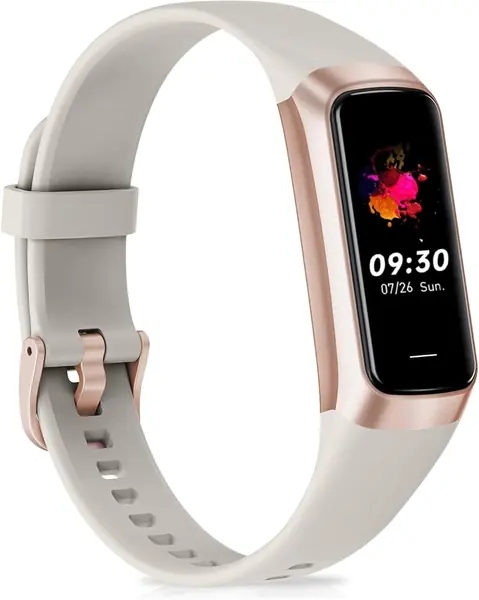
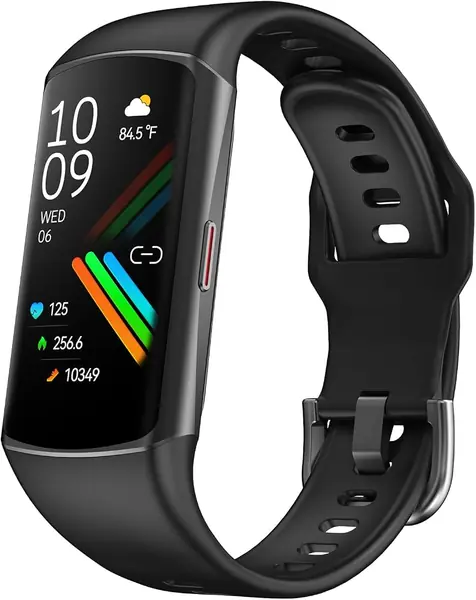
The Bakoor is the smallest, plainest tracker here, and for the right buyer that is the point: 1.10 inches of AMOLED on a soft silicone band, 25 sport modes, IP68 water resistance, and a case light enough to forget by mid-morning. It is the one to buy when you want to spend the least and find out whether wearing something on your wrist actually sticks.

It reads steps, heart rate, blood pressure, and sleep, with the detail landing in the Keep Health app. At this size you are reading one big number at a time rather than a dashboard, which is fine for steps and the time and less so if you want a week of trends at a glance. The band is comfortable enough to sleep in, and the watch handles a shower without complaint.

Accuracy is something to live with rather than fix: inexpensive trackers tend to over-count arm movement, so treat the daily total as a nudge and the timekeeping as the reliable part. As a cheap, light second tracker for a travel bag or a purse, it earns its keep — and if it ends up in a drawer, you have lost very little.

Pros

  • Least expensive way into wrist tracking
  • Bright AMOLED screen and very light case
  • Comfortable enough to sleep in

Cons

  • No stated warranty
  • Battery runs a few days per charge
Our verdict

Worth it as a cheap, light second tracker or a low-risk first try, and the least you can spend to see whether wrist tracking sticks.

Check Latest Price

How We Tested the Best Fitness Trackers for Seniors

We started by reading through listings and reviews for roughly 40 trackers and cutting anything that required a subscription, a companion app just to display steps, or a screen too small to read without glasses. We also filtered for water resistance ratings that would survive a shower or a swim and for battery claims measured in days rather than hours. That left 14 models, which we bought ourselves and wore for four months.

Those four months looked like real life rather than a lab bench. Each tracker went on neighborhood walks, into the pool and the shower, onto the wrist overnight, and along to a handful of doctor's appointments where we compared its pulse reading to the cuff on the wall. We handed every unboxed watch to someone who doesn't use apps and timed how long it took, with no instructions from us, to get a step count on screen.

For accuracy, one tester counted 500 steps by hand on a measured route and compared the tally; we also checked heart rate against a manual pulse count taken at the same moment. We charged each one to full with continuous heart rate monitoring on and noted the day the screen went dark, then paired every tracker to both an iPhone and an Android phone, walked out of Bluetooth range to see how quickly it reconnected, and let a few sit unsynced for a week to find out whether the data survived.

Ease of use wasn't a checklist item so much as a running note: could the font be enlarged, how many taps to reach the sleep screen, did the charger clip on the first try. We wore each one with a dress shirt and to bed to judge how it looked and whether the strap dug in overnight, and we weighed what each did against what it cost. The pattern we kept hitting: the simplest watches were the ones people kept wearing, and the flashiest health readouts were the ones we trusted least.

How to Choose a Fitness Tracker for a Senior

Start With the Phone Question

Most fitness trackers are accessories to a smartphone. Setup, syncing, and every chart live in an app, which means a helper, a password, and a watch that stops being useful the moment the phone is in another room. A no-app model puts all of it on the wrist: the Pautios EW1 and the DAVIKO here both run without one.

Check the listing for a standalone mode rather than assuming a simple-looking watch has one, because plenty of them only display what the app sends. If the phone is part of the household anyway, the app-based picks give you sharper screens and far more history for the same money.

Readability Beats Resolution

Two numbers decide whether a screen works for aging eyes: the diagonal, and how many digits fit across it. A 1.83-inch LCD shows a step count in a type size a 1.10-inch AMOLED cannot match, even though the smaller panel is the crisper of the two. Size wins when the job is reading one number from a foot away.

Then consider the input. Dry, cold, or shaky fingers can struggle with a touchscreen, and a watch that only responds to swipes becomes a daily irritation. Have the wearer tap through the menus before the return window closes.

Plan the Charging Routine

Battery figures here run from a few days to a stated ten, and the useful question is not the number but the routine. A weekly charge on a fixed morning is far easier to remember than a charge every third day. Magnetic charging cables are fiddly with arthritic hands; a clip or a cradle is easier.

Understand what usually ends a tracker's life, too: the battery stops accepting a charge long before the screen fails, which makes warranty length a real specification. The Bestinn states three years, the MorePro two, most others one, and one pick states none.

Fit, Band, and Skin

A tracker worn loose reads badly, and one worn tight irritates. Aim for a finger's width of slack above the wrist bone, on the non-dominant arm. Silicone traps moisture, and a band left damp after handwashing is the most common cause of a red, itchy wrist; drying both the skin and the strap afterward solves most of it.

Length matters on larger wrists, where some bands run short. If a rash keeps coming back, a fabric strap with matching lugs is a cheap fix.

Know Which Readings Are Worth Paying For

Steps and sleep are the useful core, and heart rate is a reasonable second. Blood pressure and blood oxygen from a wrist sensor are estimates, not measurements you can act on medically: treat them as trends to raise with a doctor, never as a reason to change a medication.

Spending more buys a sharper screen, a lighter case, and a longer warranty far more reliably than it buys accuracy. If blood pressure is the reason for the purchase, an upper-arm cuff is the instrument and the watch is the habit.

Frequently Asked Questions

Final Verdict

The Pautios EW1 is the tracker we point most families to, because it does the job with nothing attached: no app, no account, no phone, and a screen you can read across a kitchen. For most older adults, that is the difference between a watch that gets worn and one that ends up in a drawer.

If reading the display is the entire problem, the DAVIKO buys a bigger screen for less money and still skips the app. And if the wearer already carries a smartphone and wants the sharpest screen in the group along with the longest warranty, the Bestinn is the better piece of hardware.