Best 20000mAh Power Banks of 2026

A phone that dies at 4 percent is a small emergency with terrible timing: the boarding pass you can't pull up, the kid's tablet going dark two hours into a drive. A 20,000mAh power bank heads that off — enough juice to refill a phone three or four times, and small enough to live in a tote or a jacket pocket.

The catch is that 20,000mAh on the label tells you less than you'd expect. Some capacity is lost in conversion, and charging speed depends as much on the cable and the port as on the wattage printed on the box. That's why built-in cables and percentage readouts are what I check first now — and why a solar panel is a backup plan, not a charging strategy.

My team and I spent six months living with 14 of these — commuting, flying, camping, and sitting through long days away from an outlet, recharging each until the differences got obvious. A few earned permanent spots in my bag; several never left the drawer after the first week. The picks below gave back close to the capacity they promised.

The Best 20000mAh Power Banks

1

INIU P512 Best Overall
94 /100
TKZ Score Outstanding

Key details

Max Output
22.5W
Ports
3
Warranty
3 years
Size
4.1 x 2.8 x 1.2 in
View on Amazon

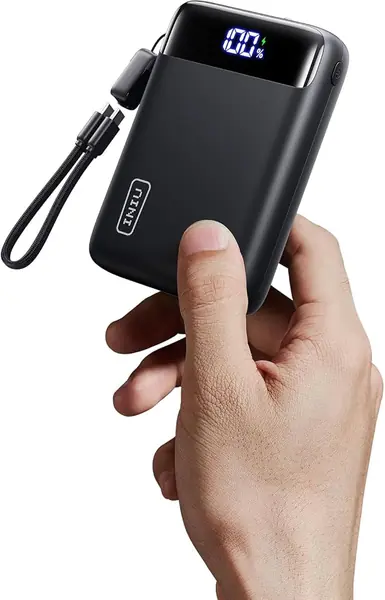
The INIU P512 is the smallest 20,000mAh bank in this group — 4.1 by 2.8 by 1.2 inches — and that single fact is why it tops the list. We judge a portable charger by where it ends up living, and this one fits a coat pocket or a small sling instead of sinking to the bottom of a backpack. It left the house in a jacket pocket on a weekend trip and stayed there until a phone actually needed it, which is more than we can say for the bricks we've carried.

Speed is what you trade for the size. At 22.5W it sits at the slow end of this set, fine for a phone at 40 percent but not the thing to grab when a tablet needs topping up before a flight; the Anker Zolo runs 30W and the UGREEN Nexode 45W. Refilling the bank itself takes about 5.4 hours on the listed spec, so it wants an overnight slot next to your phone rather than a 20-minute stop.

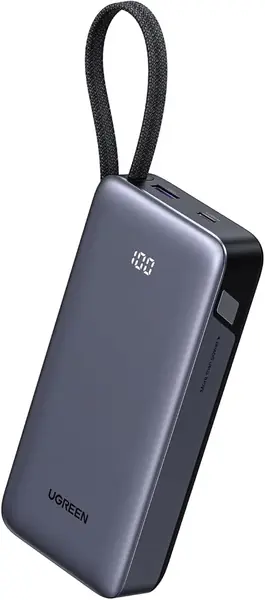
The details hold up. The USB-C cable is built into the body as a nylon lanyard, which gives you a loop to hang onto while the phone charges, and the front readout gives an exact percentage instead of four bars you have to interpret. Three ports cover a phone, earbuds, and one more thing. INIU's three-year warranty is the longest of any pick here, and on a battery that's the spec that outlasts all the others.

Pros

  • Smallest 20,000mAh bank in this group
  • Three-year warranty, longest here
  • Built-in USB-C lanyard cable and a percentage display

Cons

  • 22.5W is the slowest output here
  • About 11 ounces, heavier than pocket-size implies
Our verdict

We recommend the INIU P512 to anyone who wants one bank for daily carry: smallest 20,000mAh unit here, and the three-year warranty is the longest.
Check Latest Price
2

Anker Zolo 20K Best for Most Phones

93 /100
TKZ Score Outstanding

Key details

Max Output
30W
Weight
12.9 oz
Warranty
18 months
Built-in Cable
5.98 in USB-C
View on Amazon

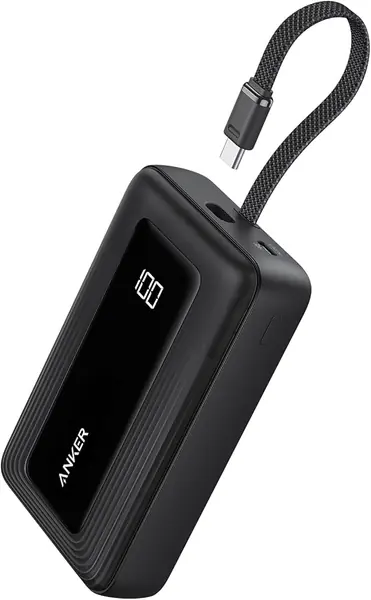
The built-in cable on the Zolo is 5.98 inches of braided USB-C that loops back into the shell, and Anker rates it for 10,000 bends. It looks like a design flourish until the night you realize your only cable is in a hotel room; then it's the reason your phone still gets charged. The loop shape is the part we appreciated most, because it hooks over a finger while the phone sits in your hand at a gate.

Thirty watts is the sensible middle of this group. On the listed rating it takes an iPhone from 0 to 57 percent in half an hour, which is quick enough that a coffee stop is worth something. The pack refills at 20W in about five hours, so it also wants an overnight slot rather than a lunch break.

Weight lands in the middle too: 365 grams is a bag item, not a pocket item, and that's the same story as every other 20,000mAh bank here. The 18-month warranty is the shortest of our top picks, a real gap against the three-year cover on the INIU and the VRURC. The built-in cable is also the piece that wears first on any of these, though the ports keep working if it ever goes.

Where it beats the INIU is habit: you can walk out with the Zolo and nothing else and still charge a phone. Anker's ActiveShield temperature monitoring is the sort of insurance you never notice until a cheap bank gets hot in your hand. If you keep a battery for years rather than seasons, though, three years of cover is the better bet.

Pros

  • 30W output quick-charges most phones
  • Built-in USB-C cable rated for 10,000 bends
  • ActiveShield temperature monitoring

Cons

  • 18-month warranty, shortest of our top picks
  • No Lightning cable built in
Our verdict

For phone-first shoppers, the Zolo is our default: 30W charging, a cable built into the body, and a shape that rides in a bag rather than a pocket.

Check Latest Price
3

Anker 87W 20K Best for Laptops

92 /100
TKZ Score Outstanding

Key details

Max Output
87W total, 65W single
Weight
15.2 oz
Ports
3
Recharge Time
1.5 hours
View on Amazon

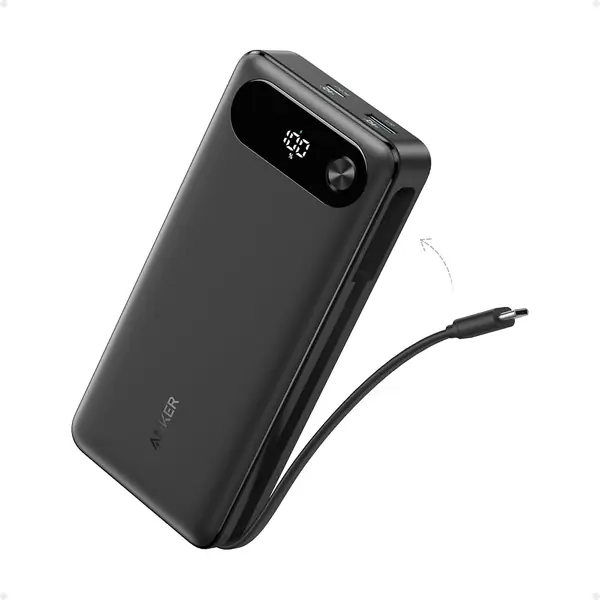
A 20,000mAh bank that can run a laptop is a different purchase from one that tops up a phone, and the Anker 87W is the only pick here built for it: 65W to a single device, 87W split across three, and enough headroom that the listing claims a 14-inch MacBook Pro reaches about half in half an hour.

The built-in USB-C cable does the heavy lifting, and the pack itself refills in roughly 1.5 hours — the fastest here by a wide margin next to the five-hour banks. That refill speed matters more than the output number when you're moving between hotels: a bank that's full again by the time you've showered is a bank you actually travel with.

Fifteen ounces is what you pay for it, and this is the heaviest pick in the group. We noticed it in a backpack alongside an actual laptop, which is the honest version of the trade: on a trip where the laptop comes anyway, one brick replacing a laptop charger and a phone charger is a net loss of weight rather than a gain.

Everything else is Anker's usual fit and finish — a stiff, positive cable, a shell that doesn't flex, 18 months of cover. If everything you carry is a phone, this is more bank than you need, and the 30W Zolo does the same job with less to lug. If a laptop is in the bag, nothing else here handles it as comfortably.

Pros

  • 65W to one device, 87W across three
  • Refills in about 1.5 hours
  • Built-in USB-C cable rated for 10,000 bends

Cons

  • 15.2 ounces, the heaviest bank here
  • Costs the most of anything in this group
Our verdict

Buy the Anker 87W if a laptop travels with you — 65W to one port and a 1.5-hour refill make it the only true laptop bank here.

Check Latest Price
4

UGREEN Nexode 45W Best 45W Pick

91 /100
TKZ Score Outstanding

Key details

Max Output
45W
Weight
13.4 oz
Ports
3
Built-in Cable
USB-C, input and output
View on Amazon

Two of our picks wear their cable on the outside, and the UGREEN Nexode is the one for a bag that carries a tablet. At 45W it sits on the middle rung: enough for a fast-charging Samsung or an iPad, short of what a laptop wants, and more than an iPhone will ever draw from it.

The built-in braided USB-C cable works in both directions, so the same lead tops up the iPad and refills the bank, and the front display gives a percentage instead of guesswork. Three outputs, 20,000mAh rated for about 3.7 charges of an iPhone 16 Pro or two of an iPad Pro, and a body that takes up roughly the space of a small paperback.

Weight is the compromise. At 380 grams and just over an inch thick it's a bag bank rather than a pocket one, and it feels noticeably denser in the hand than the Zolo. What the bulk buys is headroom: 45W keeps an iPad moving at a rate a 22.5W bank can't match, and the extra port means the tablet and the phone can share without a queue.

What keeps it in the bag is the balance of the three. It's lighter and slower than the Anker 87W, meaningfully quicker than the 30W Zolo on anything with a big screen, and the only one here with a cable that wakes up in both directions. That's a narrow slot, but a lot of people are standing in it.

Pros

  • 45W output with a bidirectional built-in cable
  • Percentage display and three outputs
  • Lighter and cheaper than the 87W Anker

Cons

  • 380 g and over an inch thick
  • Charging can stop working after several months
Our verdict

We point tablet owners to the Nexode: 45W, a built-in bidirectional cable, and a percentage display in a 380-gram body.

Check Latest Price
5

Miady 2-Pack Best Two-Pack

90 /100
TKZ Score Outstanding

Key details

Max Output
22.5W
Weight
1.83 lb for the pair
Outputs
3
Pack Count
2
View on Amazon

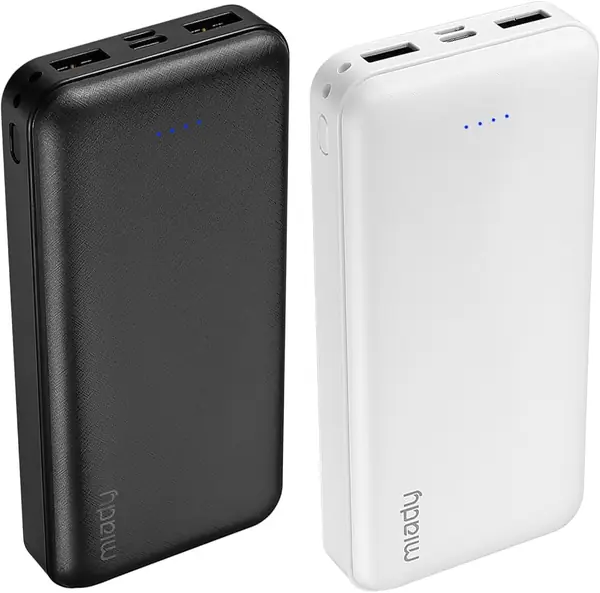
Two 20,000mAh banks for about the price of one of the others is the whole pitch, and for a household it's a good one: one lives in the car, one lives in a backpack, and nobody has to remember which bag the charger went into.

The pair works better than either bank would on its own. Black and white shells make it obvious which is which, and the white one's display is easier to read in daylight, which sounds trivial until you're squinting at it in a parking lot. Each unit runs 22.5W with three outputs and two inputs, so a phone, a tablet, and a pair of earbuds can share one without an argument.

Bulk is the catch. The two together weigh 1.83 pounds, and each is chunky enough that you'll carry one at a time. A USB-C cable comes with each; Lightning users supply their own. A unit that won't hold a charge is the failure to catch early, so open both boxes and run a full charge and discharge before the return window closes — it's a five-minute test that saves a bad surprise in month two.

Twenty-two and a half watts is not the fast end of this group either. Treat the Miady pair as the practical answer rather than the quick one: two honest banks, one permanently in the car, for what a single premium pick costs.

Pros

  • Two banks for roughly the price of one
  • Black and white shells are easy to tell apart
  • Three outputs and two inputs on each

Cons

  • 1.83 lb for the pair; each is bulky
  • 22.5W output, not the fast end
Our verdict

For two people or two bags, the Miady pair is the value call: two 20,000mAh banks for about the price of one of our other picks.

Check Latest Price
6

VRURC 4-Cable 20K Best for Mixed Devices

89 /100
TKZ Score Excellent

Key details

Max Output
22.5W
Warranty
3 years
Built-in Cables
4
Thickness
0.75 in
View on Amazon

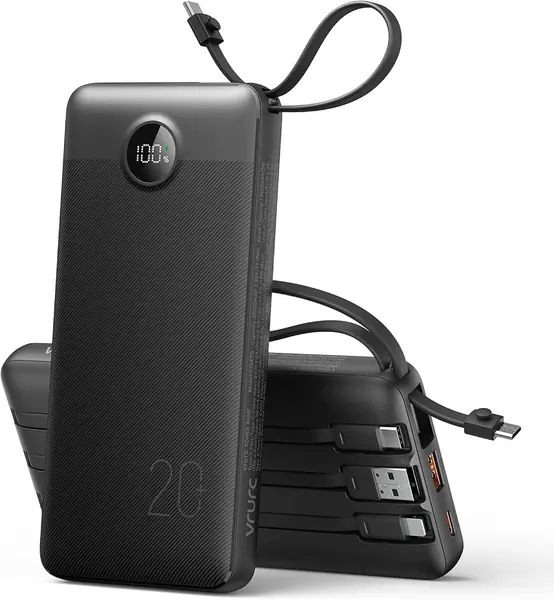
At 0.75 inches thick and just over six inches long, the VRURC is the slimmest way to carry four built-in cables, and that combination is the entire reason it's here. USB-C, Lightning, Micro-USB, and USB-A all live on the body, so a drawer full of mismatched gadgets stops being a cable hunt.

The case for it is a bag holding an iPhone, an older Kindle, and a friend's Android — nothing needs a cable you didn't bring. Output is 22.5W over USB-C, which is the same ballpark as the INIU and the Miady, so you're not giving anything up against the other 22.5W picks; you're simply not gaining on the 45W ones.

Three years of warranty is the longest here alongside INIU, and the percentage display sits on the front where you want it. What you accept is weight: 345 grams in a body this thin means real density, and it feels heavier in the hand than the photos suggest. If every device you own is USB-C, two of those built-in cables are dead weight and a simpler bank serves you better.

Pros

  • Four built-in cables cover old and new devices
  • 0.75 inches thick, the slimmest here
  • Three-year warranty

Cons

  • 345 g, heavier than the slim profile suggests
  • Micro-USB and Lightning cables are dead weight for all-USB-C kits
Our verdict

Buy the VRURC if your devices mix USB-C, Lightning, and Micro-USB — four built-in cables and a three-year warranty at 0.75 inches thick.

Check Latest Price
7

RONEGN 20K Best Budget

88 /100
TKZ Score Excellent

Key details

Max Output
22.5W
Built-in Cables
4
Outputs
5
Inputs
3
View on Amazon

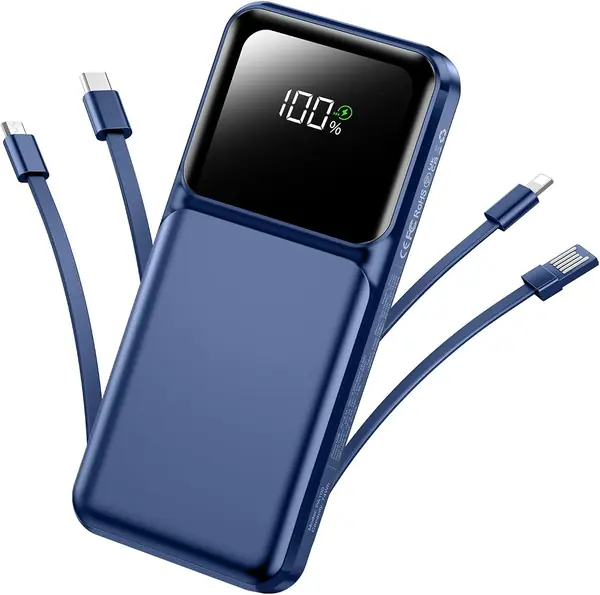
The RONEGN is the least expensive bank here, and it still gives you four built-in cables and five outputs. For keeping a car full of phones alive on a road trip, that is a lot of capability for the outlay.

Five outputs and three inputs is the most flexible port count in this group. The iOS and USB-C leads are built in, the LED display tells you what's left, and the Micro-USB lead is the quiet bonus — it's what charges a Kindle Paperwhite or a decade-old speaker that a USB-C-only bank ignores.

Where it gives ground is staying power. Durability is the weakest of anything we recommend here, so treat it as a second-string bank rather than a daily driver: a glovebox or desk-drawer unit that gets topped up every couple of months instead of the one you rely on in a strange city.

Speed is modest too, at 22.5W, so it won't rescue a dead phone in ten minutes at a rest stop. What it will do is sit in the car for a year and work when a passenger's phone is at 3 percent, which is the job most people actually want a spare bank for.

Pros

  • Least expensive pick here with five outputs
  • Four built-in cables, including Micro-USB
  • LED percentage display

Cons

  • Weakest durability in this group
  • Output tops out at 22.5W
Our verdict

The RONEGN is our cheap second-bank pick: five outputs, four built-in cables, and enough capacity for the glovebox at the lowest price here.

Check Latest Price
8

BLAVOR Solar 20K Best for Camping and Rain

87 /100
TKZ Score Excellent

Key details

Max Output
20W
Built-in Cables
4
Water Resistance
IPX5
Wireless Charging
Qi, phone and watch
View on Amazon

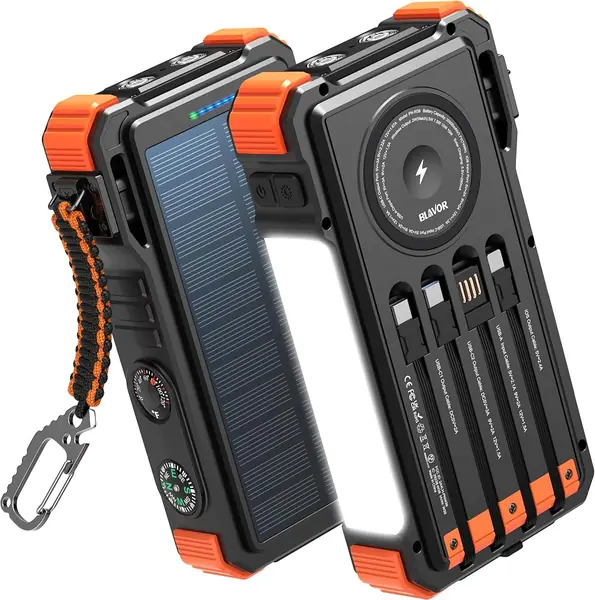
The solar panel is the least useful thing about the BLAVOR, and it's the reason most people pick it. A panel that size trickles: it's an emergency top-up for a bank that's already flat, not a way to keep one charged on a trip, and anyone buying this to live off the sun will be disappointed by the second afternoon.

Everything else is better than the gimmick. Wireless Qi charging for a phone, a charger for an Apple Watch, four built-in cables, an IPX5 shell, and a genuinely bright flashlight — BLAVOR rates it for six devices at once, and for a camping weekend that covers a phone, a watch, and a headlamp with no loose cables in the tent.

It's also built like a tool. A carabiner comes in the box, the shell is chunky enough to survive a truck bed, and the flashlight is bright enough to be the reason you reach for it after dark rather than your phone.

Heft is the tax. At 7.28 inches on its longest side it's the biggest thing here, and heavy enough that it feels like a deliberate addition to a daypack rather than something you forget you packed. Charging failures are the thing to watch for with this one, which is why the three-year warranty matters more here than it does on a cheaper bank.

We recommend it for the outdoors on one condition: buy it for the watch charger, the light, and the tough shell, and treat the solar panel as a last resort. On that basis it's the most useful thing here to leave in a car or a tent — just don't plan a trip around the sun filling it back up.

Pros

  • Wireless phone and Apple Watch charging
  • Four built-in cables plus an IPX5 shell
  • Bright flashlight and three-year warranty

Cons

  • Solar panel only trickles
  • 7.28 in long and heavy for a daypack
Our verdict

For camping and outages, the BLAVOR earns its spot with wireless watch charging, a flashlight, and an IPX5 shell — not for the solar panel.

Check Latest Price

How We Picked and Tested These Power Banks

We started with every 20,000mAh bank we could find from brands people actually buy, then cut the field by price band, port layout, and whether the pack could plausibly ride in a tote or jacket pocket every day. Vague capacity claims and anything that arrived unable to hold a charge got dropped. That left 14 banks, which we used for six months.

Testing happened where these packs actually live: in a commuter bag for a week at a time, through airport security in a carry-on, on a camping weekend where outlets were scarce, and on 12-hour days away from a desk. We drained each bank into the same phone from dead and counted full recharges, timed the first 30 minutes of a charge from a set starting percentage, and timed how long the bank itself took to refill from a wall charger. Every unit got weighed on a kitchen scale and slid into a jacket pocket to see how it sat.

We watched for the things you only notice later. Built-in cables got wound, tugged, and stuffed back into their slots to see if they'd fray or stay put; percentage displays were checked against how much charge actually came out; multiport packs were loaded with a phone, earbuds, and a tablet at once to see whether speeds fell off. Each one went into a bag with keys and loose change, and a few were handled with sandy hands at a campsite. The solar model spent an afternoon in direct sun so we could see how much it genuinely added.

The last measure was cost per full phone charge, which told a different story than the sticker prices did. What separated the top picks was rarely the biggest number on the box — it was delivering close to rated capacity, staying cool under a fast charge, and still feeling reasonable in a bag six hours in.

How to Choose a 20000Mah Power Bank

What 20,000mAh Really Gets You

The 20,000mAh figure is cell capacity at 3.7 volts, or about 74 watt-hours. Converting that up to the 5 or 9 volts your phone wants burns some of it as heat, so plan on roughly two to four full phone charges or one to two tablet charges rather than the six the raw arithmetic suggests. A bank that gives you three phone charges is doing its job, not shortchanging you.

The same 74Wh is why nearly every bank here calls itself flight-safe: it sits under the 100Wh threshold most airlines use for carry-on batteries.

Match the Watts to What You're Charging

Output wattage is where the real differences live. 22.5W is fine for a phone and slow for a tablet; 30W is the sweet spot for most iPhones; 45W buys fast charging on a Samsung flagship or an iPad; 65W and up is laptop territory. Our 45W and 87W picks exist for tablets and laptops, not because they make a phone charge dramatically faster.

The trap is paying for watts your device can't take. An iPhone pulls roughly 25 to 30W whatever you plug into it, so a 45W bank is an investment in the tablet in your bag, not the phone in your hand.

Weight and Shape Decide Whether You Carry It

Physics is unforgiving here: a genuine 20,000mAh bank weighs somewhere between 11 and 15 ounces, because that is what the cells weigh. A listing promising 20,000mAh at six ounces is not telling you the whole story. Choose by where the bank will live — the INIU P512 at 4.1 by 2.8 by 1.2 inches is a coat-pocket object, the Anker 87W at 15.2 ounces is a bag object.

Built-in Cables Cut Both Ways

A built-in cable means one less thing to forget, and it's a large part of why the Anker Zolo and UGREEN Nexode are on this list. It's also a single point of failure: the cable takes the bends and the yanks, and when it goes you fall back to the ports.

Count your connectors before deciding. Four-cable designs like the VRURC cover a drawer of Lightning, Micro-USB, and USB-C gadgets, while an all-USB-C household pays for two cables it will never use.

Recharge Time and Warranty: The Two Specs Shoppers Skip

Input wattage is the number nobody reads. An 18 to 20W input means about five hours to refill; a 45W or higher input gets you there in two hours or less, which is the difference between a bank you top up overnight and one that's ready before dinner. Check the input figure separately from the output figure, because a fast bank can still be a slow one to refill.

Warranty is the other quiet number. Three years from INIU and VRURC against 18 months from Anker is a meaningful gap on something that rides in a bag and gets dropped.

Frequently Asked Questions

Final Verdict

The INIU P512 is the one we tell most people to buy. It's the smallest 20,000mAh bank in this group at 4.1 by 2.8 by 1.2 inches, it carries the longest warranty here at three years, and it's the only pick that genuinely disappears into a coat pocket.

Pay more when the job changes: the Anker 87W 20K is the only bank here that will charge a laptop, and the UGREEN Nexode's 45W is the right middle ground if a tablet shares your bag. On the tightest budget, the RONEGN covers two phones and a glovebox for the least money.