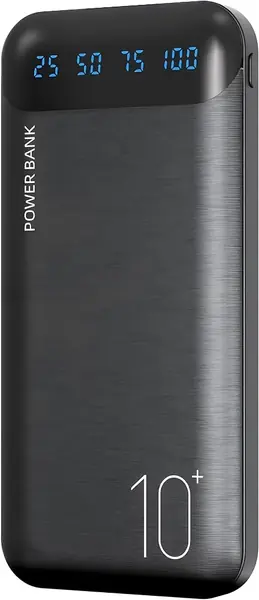
Best 10,000mAh Power Banks of 2026

The number on a power bank box describes the battery inside, not what reaches your phone. Cells hold energy at about 3.7 volts; your phone wants 5 or more, and the conversion eats a real share. A good 10,000mAh pack delivers closer to 6,500mAh — about one solid charge. So the differences worth shopping on are speed, port count, and whether it's small enough that you'll actually carry it.

I learned that at midnight on a dark corner, watching a ride-share app spin at 2 percent. Over the past five months, my team and I have cycled 16 packs through ordinary days: commutes, a camping weekend, a layover that drained two phones. The feature I'd underestimated is the built-in cable — stop hunting for a cord in the bottom of a bag once and you won't go back.

The picks below are sorted by how you'll use them: pocket carry, a bag that covers two people, a pack that can top up a tablet too. None of these will run a laptop all afternoon. All of them will get you home.

The Best 10,000mAh Power Banks

1

Anker Zolo 10K Power Bank Best Overall
92 /100
TKZ Score Outstanding

Key details

Battery Capacity
10,000mAh
Size
4.32 x 2.58 x 0.98 in
Max Output
30W
Built-in Cable
5.4-inch USB-C
View on Amazon

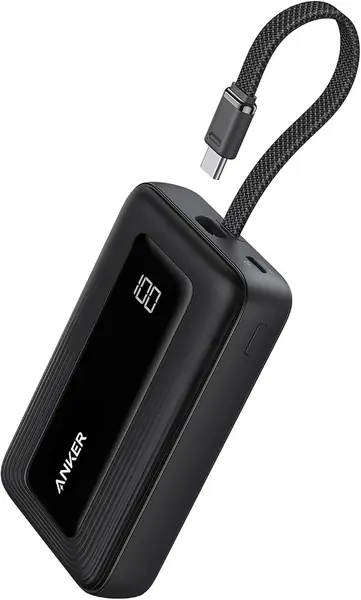
The USB-C cable is built into the Anker Zolo and clips back into the body as a lanyard, and that one detail is why we hand it to most people first. A power bank's real failure mode isn't a dead battery — it's the night you leave the cable in another bag. Anker rates the built-in cord for 10,000 bends, and the case adds one USB-C and one USB-A port for anything else.

At 30W it has the highest stated output of anything we picked, and the numbers suggest that means something: Anker says it takes an iPhone 16 Pro Max to 50% in 27 minutes, and the full 10,000mAh works out to about two charges for an iPhone 15 or 1.94 for a Galaxy S24. A small screen shows the percentage remaining, which we prefer to the four blinking dots most packs at this price give you.

The cost is bulk. At 0.98 inches and 7.9 ounces, this is the chunkiest pack on the page — fine in a tote or a jacket pocket, noticeable in a front one. The built-in cable is USB-C only, so an iPhone 14 or older still needs a Lightning cable along for the ride.

What it gets right is the whole package: fast enough for a genuine top-up, with the cable attached and a number on the screen. Anker covers it for 18 months, which is shorter than the three-year promises on some cheaper packs here, and that's worth knowing before you compare warranties line by line.

Pros

  • 30W output is the highest in this set
  • Built-in USB-C cable doubles as a lanyard
  • Percentage display shows exactly what's left

Cons

  • Thickest pick here at 0.98 inches
  • Built-in cable is USB-C only
Our verdict

Our pick for most people: the fastest charging here, a USB-C cable you can't leave behind, and a display that shows exactly what's left.
Check Latest Price
2

Anker PowerCore Slim 10000 Best for Slim Carry

91 /100
TKZ Score Outstanding

Key details

Battery Capacity
10,000mAh
Weight
8.6 oz
Size
5.99 x 2.81 x 0.61 in
Max Output
15W (5V/3A)
View on Amazon

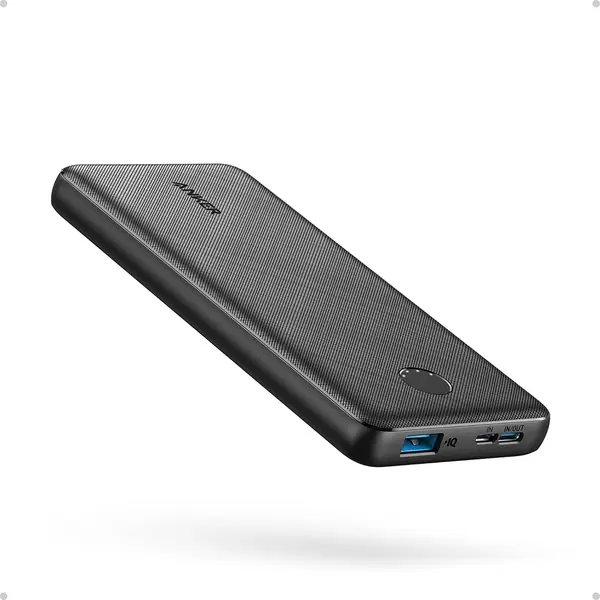
If the Zolo's near-inch thickness is what puts you off, the PowerCore Slim is the same 10,000mAh in a 0.61-inch slab that slides into a back pocket. It's long and flat rather than short and dense, has USB-C in and out plus a USB-A port, and Anker says it survives a 3.2-foot drop.

We kept reaching for this one on days we were carrying a bag anyway, because there's simply nothing to notice about it. The catch is speed: output tops out at 5V/3A, roughly half what the Zolo delivers, so a current phone charges at a steady but unremarkable pace. There's no cable built into the body either, which makes this the pick for someone who already keeps one in their bag.

Refilling the pack itself takes about five hours on USB-C, and Anker backs it for 18 months. Buy it for the profile and the simplicity; if fast charging matters more than thinness, the Zolo or the GrnOas is the better call.

Pros

  • 0.61-inch body slips into a back pocket
  • USB-C in and out plus a USB-A port
  • Rated to survive a 3.2-foot drop

Cons

  • 15W output is half the top pick's
  • No cable built into the pack
Our verdict

We recommend the PowerCore Slim to anyone who wants a pack to vanish into a bag and already carries a cable — just don't expect fast charging.

Check Latest Price
3

GrnOas.E 22.5W Power Bank Best Budget

90 /100
TKZ Score Outstanding

Key details

Battery Capacity
10,000mAh
Max Output
22.5W
Built-in Cables
Lightning and USB-C
Outputs
4
View on Amazon

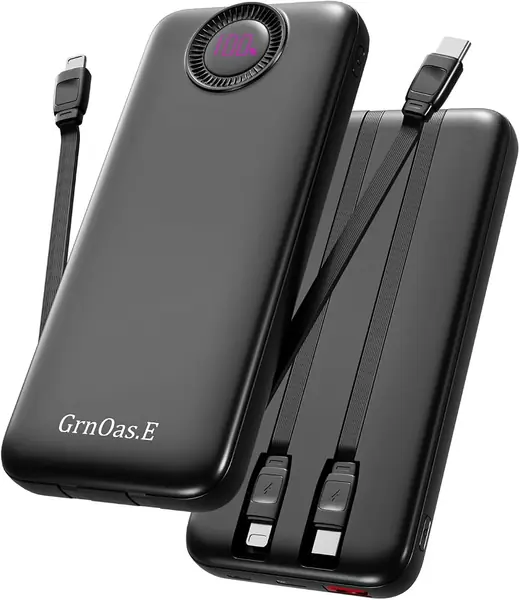
The GrnOas is the least expensive way here to get 22.5W charging and both cable types in one case: a Lightning lead and a USB-C lead are built in, alongside two more outputs, for four outputs and two inputs in total.

That combination is why it earned a place. One pack covers an iPhone and an Android in the same household, and there's nothing to remember on the way out the door. Our reservation is the cables themselves: they're fixed, they take all the wear, and when one goes the pack loses that trick for good. It's the reason we'd treat any built-in lead as the part to be gentle with.

At 0.75 inches and 8.4 ounces it's mid-pack on size, and coverage runs three years — longer than Anker's. The 22.5W rating is a ceiling rather than a promise, so this isn't the pack to buy if the fastest possible top-up is the entire point.

Pros

  • 22.5W charging and two cables at a budget price
  • Lightning and USB-C leads both built in
  • Three-year warranty

Cons

  • Built-in cables are the failure point
Our verdict

We keep this one in the budget slot because it puts 22.5W charging and both cable types into one inexpensive body.

Check Latest Price
4

VRURC 10,000mAh Power Bank Best for Multiple Devices

89 /100
TKZ Score Excellent

Key details

Battery Capacity
10,000mAh
Weight
9.2 oz
Built-in Cables
Four
Outputs
5
View on Amazon

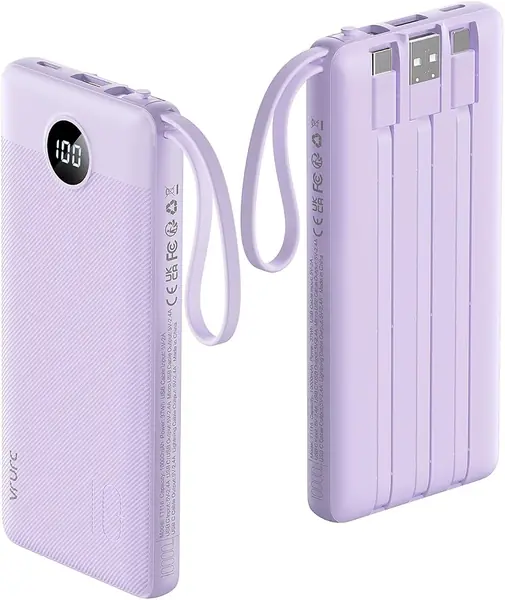
Three phones, a pair of earbuds and a friend's dying Android: the VRURC is built for the moment when everyone's battery is low at once. Three cables are built into the case — USB-C, Lightning and micro-USB — plus a USB-C port and a USB-A port, so it can run five devices simultaneously.

The 37Wh rating keeps it inside airline carry-on limits, a percentage display shows what's left, and it ships with a lanyard and a small travel pouch. It's also the heaviest pack we're recommending at 9.2 ounces, which is the price of carrying all that cable.

The bigger compromise is speed. Output is 5V/2.4A, so there's no PD fast charging — a modern phone charges, just not at the rate the Anker or the GrnOas manages. We think that's a fair trade for a pack that lives in a car or a family bag rather than a pocket; if you want one pack for yourself, this isn't the one.

Pros

  • Four built-in cables cover almost any device
  • Charges up to five devices at once
  • Display, lanyard and travel pouch included

Cons

  • No PD fast charging
  • Heaviest pick here at 9.2 ounces
Our verdict

If the job is keeping other people's phones alive, we think the VRURC's four cables and five outputs earn their extra weight.

Check Latest Price
5

Evopow 2-Pack 10,000mAh Power Bank Best Two-Pack

88 /100
TKZ Score Excellent

Key details

Battery Capacity
10,000mAh each
Weight
7.7 oz each
Size
5.39 x 2.6 x 0.55 in
Pack Count
2
View on Amazon

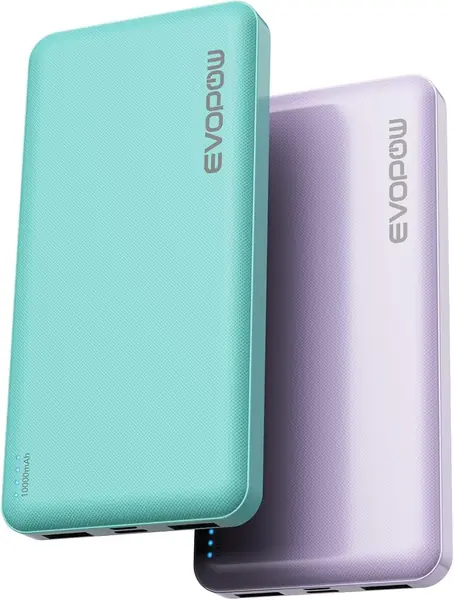
Two 10,000mAh packs for less than a single premium pack costs is the whole pitch, and the Evopow pair is thin enough — 0.55 inches, 7.7 ounces each — that the second one isn't a chore to carry. Each has three outputs, two inputs and a USB-C port that works in both directions, and the green and purple shells settle whose is whose.

Spreading two packs across two bags is the practical win: one stays in the car, one in a backpack, and neither has to be remembered every morning. Evopow quotes about three and a half hours to refill a pack, which is quick for this capacity.

Two things to know before you order. There are no cables in the box, so budget for your own, and output is 5V/2.4A rather than PD, which means a steady trickle into a newer phone rather than a fast top-up. For a glovebox pack or a spare in a suitcase, neither matters much.

Pros

  • Two full packs for less than one premium pack
  • Thin 0.55-inch body at 7.7 ounces each
  • USB-C input and output on each pack

Cons

  • No cables included in the box
  • Output is 2.4A, not PD
Our verdict

We like the Evopow pair for the bag you never unpack: two thin packs for less than one premium pack, as long as you supply the cables.

Check Latest Price
6

Zmmyuluo 4-Cable Power Bank Smallest Cable Kit

87 /100
TKZ Score Excellent

Key details

Battery Capacity
10,000mAh
Weight
6.6 oz
Size
4.4 x 2.3 x 0.77 in
Built-in Cables
Four
View on Amazon

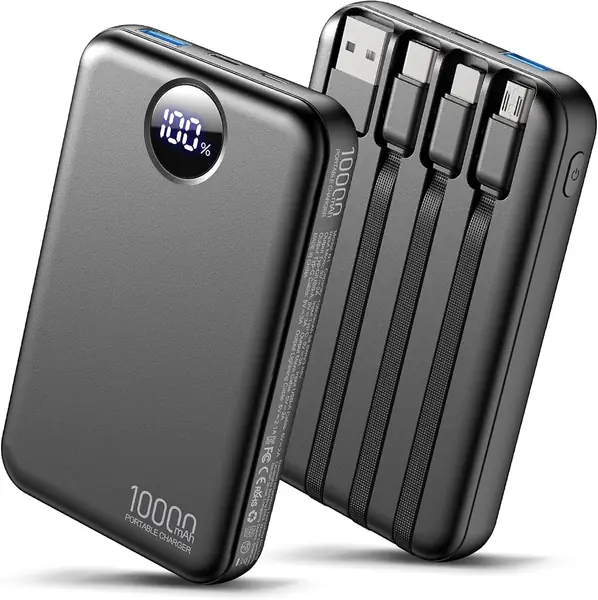
Four cables are built into the Zmmyuluo, and one of them is micro-USB — a connector almost nothing else on this list carries. That's the detail that earns it a slot: if a bag still holds an older Android, an e-reader or a camera, this pack charges it without an adapter or a spare cord.

It's also the smallest and lightest thing we're recommending, at 4.4 by 2.3 by 0.77 inches and 6.6 ounces, with a percentage display and a four-hour refill. The cables plus its ports handle more than one device at a time, so a phone and a pair of earbuds can both be topped up.

What we don't love is that the cables are fixed. A dead Lightning lead retires that function permanently while the battery is still fine. Speed is the other soft spot — no wattage appears on the listing, while the faster packs here put their numbers front and center.

Pros

  • Lightest pack here at 6.6 ounces
  • Four built-in cables, including micro-USB
  • Shows remaining charge as a percentage

Cons

  • Fixed cables can't be replaced individually
Our verdict

We reach for the Zmmyuluo when bag space is tight and the devices are mixed — it's the lightest pack here with four cables attached.

Check Latest Price
7

FancyBean 2-Pack Power Bank Best for Cars and Bags

86 /100
TKZ Score Excellent

Key details

Battery Capacity
10,000mAh each
Built-in Cables
Lightning and USB-C
Outputs
4
Pack Count
2
View on Amazon

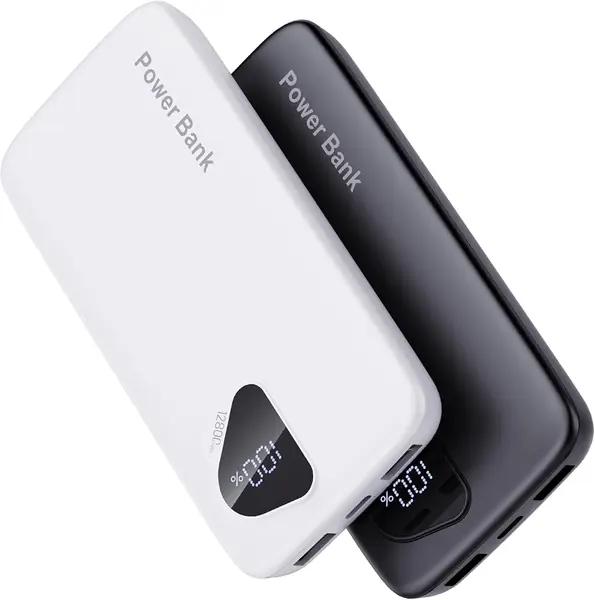
There's no power button on the FancyBean packs: plug a device in and charging starts, and a percentage display shows what's left. It sounds trivial until a two-pack starts moving between people, and nobody has to learn a button sequence or wonder whether the pack is on.

Each unit carries a Lightning cable and a USB-C cable built into the shell plus two USB-A ports, so four devices can charge at once. They're slim at 0.63 inches, and one is black and one white, which ends the which-is-mine argument before it starts.

Charging speed is the compromise here; nothing on the listing promises the fast-charge rates the Anker and the GrnOas quote. Coverage runs three years, as long as anything on this page, which for a pair of budget packs is the reassurance that actually matters.

Set against the Anker, this pair gives up speed and the polish of a premium pack and gains a second unit, two built-in cables and longer coverage. We think that's the right trade for a household rather than a single traveler.

Pros

  • Two packs, both with Lightning and USB-C cables
  • Three-year warranty
  • Nothing to press

Cons

  • Charging speed is the weak point
Our verdict

We think the FancyBean pair is the sensible buy for two people who keep forgetting cables, backed by three years of coverage.

Check Latest Price
8

YOBON Slim 10,000mAh Power Bank Back-Pocket Backup

83 /100
TKZ Score Excellent

Key details

Battery Capacity
10,000mAh
Weight
0.45 lb
Max Output
2.4A
Thickness
0.39 in
View on Amazon

At 0.39 inches this is the only pack here that gets under half an inch, which means it disappears in a back pocket in a way none of the others manage. It weighs 7.2 ounces, has three outputs and two inputs with USB-C working in both directions, and shows the remaining charge as a percentage.

We understand why it sells. It's the least expensive pack on this page, it's the thinnest, and it does the basic job of moving charge from one battery to another. The USB-C port taking input as well as output means you can refill it with the same cable you use on your phone.

The catch is staying power. Battery-life feedback on this pack is the most divided in the group, with units running down far faster than the capacity suggests, and a full refill takes about six hours. That's the trade at the bottom of the price range.

What surprised us is the feel — at this end of the list we expected something flimsy, and it doesn't read that way in the hand. The three-year warranty is longer than Anker's, too.

Pros

  • Thinnest pack here at 0.39 inches
  • Light enough to forget in a pocket
  • USB-C input and output at a budget price

Cons

  • Charge can drop off faster than expected
  • About six hours to refill
Our verdict

We see the YOBON as a cheap backup to keep in a bag, not the pack we trust for a long travel day.

Check Latest Price

How We Tested 16 Power Banks Over Five Months

We started with spec sheets: capacity, port count and type, USB-C input and output, claimed wattage, and stated weight. Anything larger than a deck of cards or without USB-C charging got cut. That left 16 packs, from plain two-port bricks to models with several cables built into the shell, and every one went into daily rotation for five months.

The core test was a full cycle. We drained a phone to zero, plugged in, and timed how long it took to reach 100 percent, then repeated it with a tablet and with two phones at once to see whether the second port stole speed from the first. A USB power meter told us how many milliamp-hours actually left the pack on each run — that's how we separated the ones that hand over close to 6,500 from the ones that quit somewhere past 5,000. We also timed each pack's own recharge from empty, since a slow one is a paperweight on a short trip.

For portability, every pack got weighed on a kitchen scale and then carried in a jeans pocket, a jacket pocket, and a tote for a full day to see whether it disappeared or dug into a hip. Built-in cables were folded and unfolded through commutes, a camping weekend, and one long airport layover, and we watched for loosening nubs and softened strain relief. We flexed each shell, wiggled every port, and dropped each pack from waist height onto a wood floor.

Reliability showed up over time rather than in a single test. We logged every cycle, noted which packs started taking longer to fill or quit earlier than they used to, and compared how much delivered capacity you got per dollar by the end of the five months.

How to Choose a 10,000Mah Power Bank

Output Wattage Is What You're Paying For

Two packs with the same 10,000mAh label can charge a phone at wildly different rates. A 5V/2.4A pack moves power at roughly 12W, while a PD or QC pack rated 22.5W or 30W takes a modern phone from low to half full in well under an hour. The catch is protocol matching: a 30W pack only runs at 30W with a phone that negotiates the same standard, which is why the port and cable matter as much as the number on the box.

Our rule: if your phone is the main thing you charge, buy the fastest output you can reasonably afford, and don't pay for speed your phone can't take. If yours tops out around 15W, a 30W pack buys headroom rather than a faster charge.

Built-In Cables: Convenience With a Fixed Failure Point

A cable inside the case means you never arrive without one, and that is genuinely the difference between a pack that gets used and one that stays in a drawer. It's also the part that wears out first, and on nearly every cable-equipped pack here it isn't replaceable — when a Lightning lead dies, you lose the connector, not the battery.

Choose built-in if you or the person you're buying for forgets things, and check the connector: a USB-C tail does nothing for an iPhone 14. Choose a pack with a detachable cable if you'd rather replace a cord than a whole battery, and favor one whose USB-C port works in both directions so a single cable covers everything.

Size, Weight, and What Pocketable Really Means

Every pack on this page is 10,000mAh, yet they run from 0.39 to 0.98 inches thick and from about 6.6 to 9.2 ounces. Thickness decides whether a pack rides in a front pocket or a tote; weight decides whether you notice it by noon. A thin, wide pack carries better in a back pocket, and a shorter one fits a small purse.

'Slim' in a listing usually means slim next to a 20,000mAh brick, not slim next to your phone. Read the thickness figure instead, and remember that a pack you barely notice is the one that actually travels with you.

Ports, Cables, and How Many Devices Share the Load

Three outputs is typical; the cable-heavy picks go to five. Charging several devices at once splits the available power, so a phone plugged in beside a tablet fills more slowly than either would alone. Count what actually travels with you — phone, earbuds, watch, occasionally a tablet — and match the pack to that list rather than to the biggest number on the page.

For connectors, USB-C PD is the one your phone wants, USB-A still covers older accessories, and micro-USB is worth having only if something in your bag still uses it.

One Pack or Two, and How Long It Lasts

A two-pack sometimes costs less than a single premium pack, which makes sense if the packs live in different bags or get shared around a household. A single, faster pack is the better call if you carry one bag and want the best version of it.

Whichever you pick, check the warranty — coverage here ranges from 18 months to three years — and treat the pack like the consumable it is. Charge it before a trip, not at the airport gate, and retire it if it stops holding a charge or starts running hot.

Frequently Asked Questions

Final Verdict

For most people, the Anker Zolo is the one to buy: 30W output, a USB-C cable that's always attached, and a percentage display that ends the guesswork. Its near-inch thickness is the price of all three, and it's a fair one.

Two situations change the answer. If you want a pack that vanishes into a pocket and you already carry a cable, the PowerCore Slim is the thinner, cheaper Anker. If the pack is for a family or a car full of people, the VRURC's four cables and five outputs do more work than any single-cable design here.