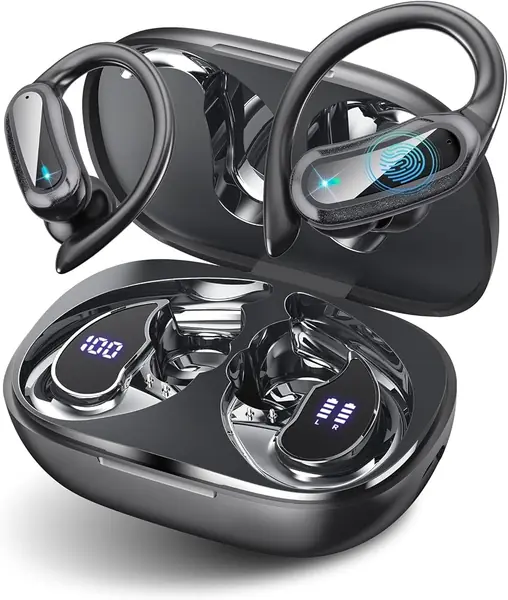
Best Wireless Earbuds with Ear Hooks of 2026

Ear hooks solve one specific problem: earbuds that work their way loose the second you start moving. The tradeoff is that all that extra plastic has to sit somewhere, and the inch of space behind your ear is already crowded if you wear glasses, a helmet, or a hat. I've fished a bud out of a storm drain grate mid-run, so I'll take the bulk — but after four months with 14 pairs, I can tell you the hooks are not created equal, and neither are the numbers printed on the box.

Here's what first-time buyers get wrong: the 80-hour playtime on the packaging is the case's total capacity, not what a single charge gives you, so a pair that claims 80 hours might still die on a two-hour run if you forget to dock it. A sweat rating tells you about water, not about how the rubber coating holds up after a summer of sunscreen and repeated flexing. And any hook design that leaves your ear canal open will let room noise in, so treating noise cancellation as the headline feature is a mistake in this category.

Everything below was picked for staying put through real movement first, sound quality second. The picks that follow are the ones I kept reaching for without thinking about it.

The Best Wireless Earbuds with Ear Hooks

1

bmani T16 Best Overall
90 /100
TKZ Score Outstanding

Key details

Playtime
80 hours with case
Controls
Push button
Water Resistance
Water resistant
Ear Hooks
Adjustable over-ear hooks
View on Amazon

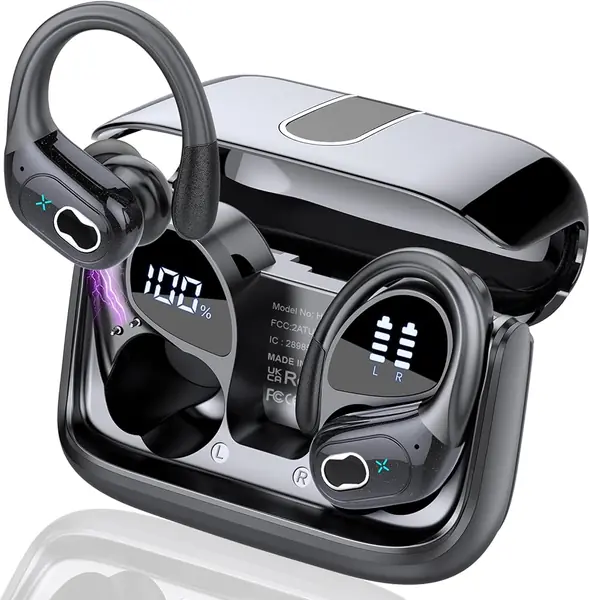
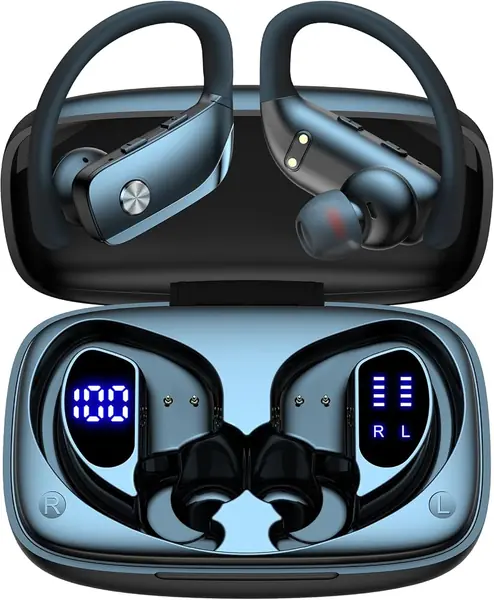
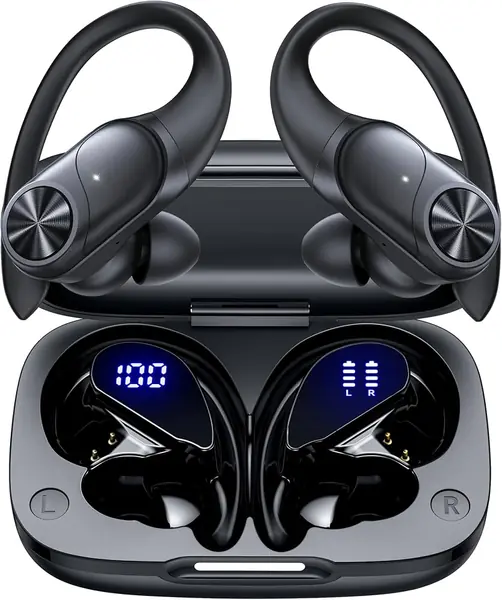
Most ear hooks are molded into a single curve, which is why one pair fits you perfectly and the next digs in behind the ear. bmani's hooks adjust, so you can swing the arm in toward the canal or out away from it and let the bud follow the shape you actually have. Around that sit 10mm dynamic drivers, dual microphones for calls, a digital battery readout on the case, and a listed five-year warranty that is unusually long at this price.

We ended up treating the T16 as the default pair in our testing, and the reason is boring in the best way: nothing about them needed managing. The hooks held through sprints and kettlebell work, the buttons answered on the first press with sweaty fingers, and the buds never needed re-seating between sets. Comfort lasted through a long day of wear, which is where adjustable hooks earn their keep — an arm that clears the pressure point behind the ear stops being something you notice.

The case carries 80 hours of listening, so a week of workouts passes without a wall outlet, and the readout tells you where you stand before you leave the house. One habit worth building: seat each bud squarely on its contacts and glance at the case lights before you walk away, because a bud resting half in will be flat the next time you reach for it.

Pros

  • Adjustable hooks fit a range of ear shapes
  • Physical buttons that work with sweaty hands
  • 80 hours of case power with a battery display
  • Comfortable through long wear

Cons

  • Water resistance has no published IP rating
Our verdict

We recommend the bmani T16 to anyone who wants one pair for runs, gym days, and yard work: adjustable hooks, buttons that work through sweat, and 80 hours in the case.
Check Latest Price
2

Soundcore V20i Best Open-Ear

89 /100
TKZ Score Excellent

Key details

Playtime
8 hours, 36 with case
Water Resistance
IP55
Design
Open ear with rotating hooks
Bluetooth
5.4 with multipoint
View on Amazon

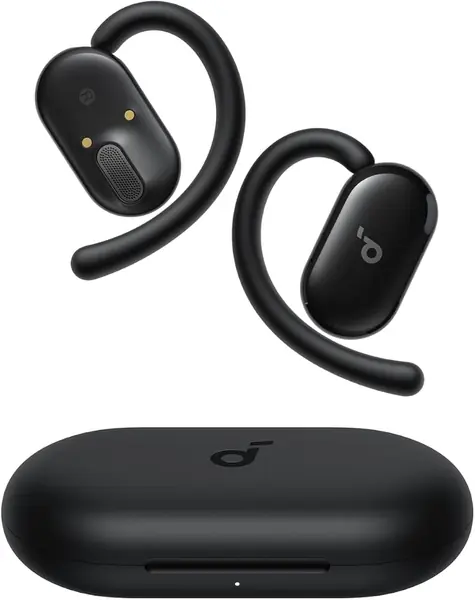
Instead of sealing the canal, the V20i clips over the ear and aims a 16mm titanium-coated driver at it from outside, which is why you can hear the path, the car behind you, and someone calling your name while the music keeps playing. That single decision makes these the best pair here for street running and bike paths, where sealed earbuds are a liability. The rest follows sensibly: four hook positions, IP55, eight hours a charge with 36 in the case, and Bluetooth 5.4 with multipoint so a laptop and a phone both stay connected.

The rotating hook is the part worth dwelling on. Rather than one fixed curve, the arm swings through four positions, and the gap between the wrong one and the right one is the gap between a bud that floats and a bud you forget about. We found the fit settled once we stopped treating the hook as set-and-forget and actually rotated it. Calls run through four mics with AI processing, which is generous at this price.

Bass is what the openness costs you. An open ear leaks low end, so kick drums land politely rather than physically, and a sealed pair like the PocBuds T60 delivers more punch. What you get back is the thing you bought them for: a run where you hear the car coming up the driveway behind you.

Pros

  • Open design keeps traffic and voices audible
  • Four rotating hook positions for fit
  • Bluetooth 5.4 with multipoint pairing
  • IP55 and 36 hours with the case

Cons

  • Hook pressure builds over long listening sessions
Our verdict

We tell runners and cyclists to start with the V20i: it keeps traffic audible, holds the ear securely, and costs less than most pairs here.

Check Latest Price
3

PocBuds T60 Best Charging Case

88 /100
TKZ Score Excellent

Key details

Playtime
8 hours, 80 with case
Controls
One button per bud
Drivers
13mm dynamic
Charging Case
Wireless charging with LED display
View on Amazon

Set the T60's case down on a wireless charging pad and it simply charges — no cable, no flap, no digging through a gym bag for the short cord you swear you packed. That is the feature separating it from everything else here, and it is the kind of small convenience that changes behavior: the case goes back on the pad by the door and the buds are always full. The case holds enough reserve for 80 hours of listening, with a digital readout showing what is left.

The buds run about eight hours a charge, driven by 13mm double-layer diaphragms and held by flexible hooks that curl behind the ear rather than clamping over it. Fit is where this pair quietly wins: it settles on the first try and stays through a sweaty session and a full day at a desk.

What we appreciate most is the lack of drama. Nothing about the T60 asks you to learn an app, remember a gesture, or babysit the case, and at this price that restraint is the feature. If you want the simplest pair here to live with — one that starts charging on contact and sounds full enough for the gym — this is the one.

Keep one habit: set the case flat and check the display before you walk out. The contacts decide whether these are ready, and a bud sitting slightly proud of its slot will read as charged right up until you put it in your ear.

Pros

  • Wireless charging case with a battery display
  • 80 hours total, eight hours per bud
  • Secure, comfortable fit for most ears

Cons

  • One button per bud makes volume slow
Our verdict

We point anyone whose charging cable lives in a drawer to the T60: a wireless charging case, 80 hours of reserve, and a fit that holds through hard workouts.

Check Latest Price
4

Aptkdoe HD65 Best for Long Sessions

87 /100
TKZ Score Excellent

Key details

Playtime
15 hours, 75 with case
Controls
Push button
Water Resistance
IPX7
Drivers
14.2mm dynamic
View on Amazon

Fifteen hours on a single charge is the number that matters here. Where most of these pairs ask for a top-up every six to eight hours, the HD65 keeps going through a double shift or a week of ninety-minute gym sessions with the case still in the bag. The case adds five or six refills for 75 hours total, and 14.2mm drivers handle the audio.

Buttons are the other reason we keep these in rotation. A push button on each bud changes volume and tracks with a click you can feel through a glove, and it does not care whether your fingers are wet — the touch panels on some pairs here do. The TPU hooks are soft enough to forget and grippy enough to hold, and IPX7 means sweat and rain are not a worry.

Where it gives ground is longevity, and the listed two-year warranty is the honest way to think about it: this is a high-value workhorse rather than a buy-once pair. Someone who measures value in listening hours per dollar will be happy; someone who wants the last pair they will ever buy should look at the bmani T16 or the JLab Go Sport+.

Pros

  • 15 hours per charge, 75 with the case
  • IPX7 rated for sweat and rain
  • Push buttons instead of touch panels

Cons

  • Buds can stop charging within a few months
Our verdict

For long shifts, double sessions, or a full day of hiking, we hand people the HD65: 15 hours per charge with buttons that work through sweat.

Check Latest Price
5

JLab Go Sport+ Best for Small Ears

86 /100
TKZ Score Excellent

Key details

Playtime
9+ hours, 35 with case
Water Resistance
IP55
Charging
USB cable built into case
Warranty
2 years
View on Amazon

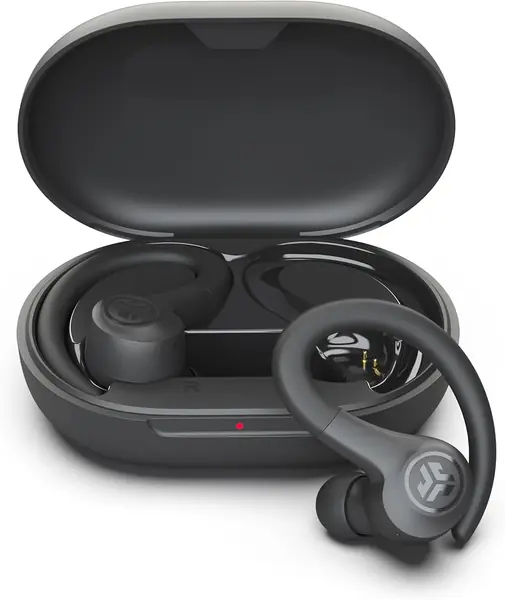
Ear hooks are sized like shoes — most come in one curve, and a narrow ear ends up with an arm that rides up or presses behind the ear until you take it out. JLab builds the Go Sport+ hook for the smallest ears in the room, which is a specific, unglamorous advantage no other pair here offers. A two-year warranty and an app that remaps the touch controls round out the package.

The rest of the design is sensible for training: nine-plus hours per bud with 26 more in the case, IP55 for sweat and dust, and Dual Connect so either bud works alone if you like one ear open. The built-in cable is the detail we did not expect to care about — a USB cord lives in the case, so a dead pair in a gym bag is a non-event. EQ3 presets let you push bass or flatten the response without leaving the app.

Connection stability is the annoyance to plan for. One bud can lag while the other plays, and the fix that usually works is dropping both back in the case for a few seconds to let them re-sync. It is the sort of quirk you learn to live with rather than send a pair back over.

Pros

  • Hook sized for small ears
  • Charging cable built into the case
  • Two-year warranty with app EQ control

Cons

  • Bright tuning with light bass
Our verdict

We point small-eared runners to the Go Sport+: a hook scaled for narrow ears, a cable built into the case, and two years of warranty support.

Check Latest Price
6

kurdene SP9i Best Budget

85 /100
TKZ Score Excellent

Key details

Playtime
12 hours, 60 with case
Controls
Touch
Drivers
16.1mm dynamic
Fit
Rests on top of the ear
View on Amazon

The SP9i is the cheapest pair on this page, and it makes its case with hours rather than polish: 12 hours on a charge, 60 with the case, and 16.1mm drivers pushing a warmer sound than the price suggests. Bluetooth 5.4 handles pairing, and the touch panels run playback and volume.

The shape is a little different from the rest. The bud rests on top of the ear rather than pushing into the canal, with the hook holding it from behind, which is why it can be worn for a long walk without the ache that comes from sealed tips. It stays put through a jog, too.

For a first pair, a spare set for the car, or earbuds for a kid who loses things, we think it earns its place. It will not win a sound comparison against the PocBuds T60, but hours per dollar is where it wins.

The touch panels are the daily annoyance. Rain, a splash from a bottle, or a heavy sweat session can register as a tap and change the volume or pause the track mid-run. You learn to keep a thumb clear of the panel when you wipe your face, but buttons on a set like the Aptkdoe HD65 are the calmer choice in weather.

Pros

  • Least expensive pair here with 60 hours total
  • Rests on the ear instead of pressing into the canal
  • 12 hours per charge, 60 with the case

Cons

  • Touch controls misfire in rain and heavy sweat
  • One side can stop charging within months
Our verdict

We suggest the SP9i as a first or backup pair: it does the basics for the least money here, with 60 hours and a hook that rests instead of pressing.

Check Latest Price
7

HAOYUYAN BX17 Button Fans Who Want Long Battery

84 /100
TKZ Score Excellent

Key details

Playtime
15 hours, 80 with case
Controls
Push button
Water Resistance
IPX7
Noise Control
Active noise cancellation
View on Amazon

Active noise cancellation is the BX17's headline, and it is the part to calibrate before you buy. The sealed in-ear fit and 14.3mm drivers do take the edge off a loud gym — clanging plates, treadmill hum — but this is not the deep hush of a premium noise-cancelling bud. Expect quieter, not silent.

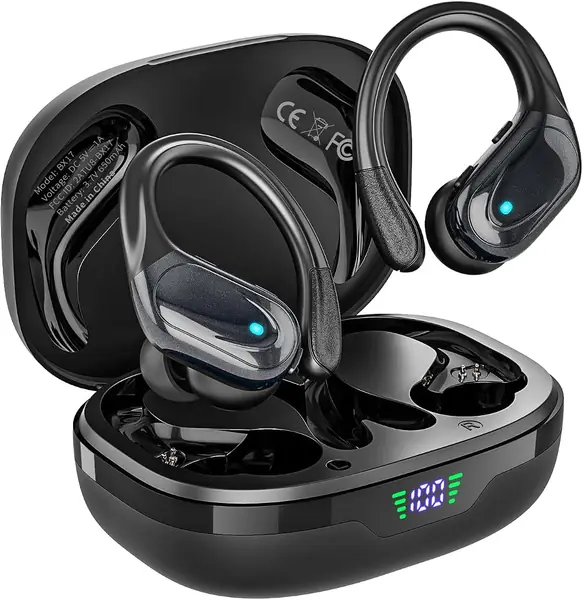
The battery is the more impressive number: 15 hours in each bud, 80 hours with the case, and an LED display that shows the charge without opening your phone. Type-C charging tops it up, and the button on each bud handles playback and volume without a touch panel's guesswork.

Soft elastic hooks hold the buds behind the ear rather than over it, and the shell sits shallow enough that lying back on a bench, or in bed, does not jam the bud deeper. Smaller ears take to it especially well, since there is not much body pressing on the outer ear.

Our honest read is a good pair with an overstated feature. Buy the BX17 for the battery, the buttons, and the comfort, and treat the cancellation as a modest bonus that the sealed fit does most of the work for. If you want true quiet, this is not your pair; if you want a week of workouts on one charge, it is.

Pros

  • 15 hours per bud, 80 with the case
  • Physical buttons instead of touch panels
  • IPX7 rated and comfortable for long wear

Cons

  • Noise cancellation is mild at best
Our verdict

We recommend the BX17 to button people: a real click under a sweaty thumb, 15 hours a charge, and comfort that holds through a long session.

Check Latest Price
8

TRAUSI i27 A Lightweight Second Pair

83 /100
TKZ Score Excellent

Key details

Playtime
6 hours, 54 with case
Controls
Touch
Water Resistance
IPX7
Weight
7g per bud
View on Amazon

Seven grams per bud is light enough that the i27 disappears behind your ear, and that is the whole pitch: a hook pair you forget you are wearing. The soft earhook flexes around the back of the ear rather than clamping, and three sizes of ear tip let you decide how much of the canal you want covered.

Battery is six hours in each bud with 54 hours in the case, and the case tops up over USB-C. Bluetooth 5.4 pairs as soon as the lid opens, and touch panels handle playback and volume.

Fit is where it beats its price. The buds stay put through a run, the low weight keeps them from pressing behind the ear, and a long walk does not turn into an ache. Nothing about the shape needs readjusting mid-session, which is the test that matters for a hook pair.

Six hours a charge is the shortest of these, so we treat the i27 as a second pair — the set that lives in a laptop bag or a glovebox — rather than the one you rely on for a double session. The weight is the reason to make that trade.

Pros

  • 7 grams per bud, barely noticeable
  • 54 hours total with the charging case
  • IPX7 with three ear tip sizes

Cons

  • Six hours per charge is the shortest here
Our verdict

We suggest the i27 as a lightweight second pair: seven grams per bud, three ear tip sizes, and 54 hours in the case.

Check Latest Price

How We Chose and Tested 14 Pairs of Hook-Style Earbuds

To build the shortlist, I went through the specs on more than 40 pairs of hook-style earbuds and kept only the ones that listed a water or sweat rating, at least six hours of single-charge playtime, and hooks that could be adjusted or swapped for a different size. That narrowed it to 14 pairs across a wide price range. Testing ran four months, from late spring into fall, so much of it happened outdoors: three-to-five-mile runs, bike commutes, and yard work with the mower running.

Fit and comfort got the most attention, since that's the entire reason to buy a hook design. I wore each pair for at least one 90-minute session, shook my head hard, and did a set of burpees to see which ones shifted. I also wore them with sunglasses and under a bike helmet, because hooks and frames fight for the same spot behind the ear, and I noted which pairs left a sore spot after an hour and which ones I forgot I had on.

For battery life, I drained each pair to dead on a single charge and timed it with a stopwatch instead of trusting the listed figure, then timed a full case recharge from empty. I watched whether the LED power displays dropped in even steps or jumped from 60 percent to 20, and counted what came in the box — spare tips, a charging cable, a pouch — since some pairs arrive with almost nothing and that changes what you're actually getting for the money.

On connectivity, I left my phone on a gym bench and walked to the far wall to see where the signal broke up, and I paired each set to a laptop and a phone at once to watch how cleanly it handed off. Calls got tested in wind and in a loud weight room. Finally, I treated them badly — stuffed loose in a bag, dropped the cases on pavement, flexed the hooks back and forth for weeks — to see which ones kept their shape and which ones cracked at the hinge.

How to Choose Wireless Earbuds with Ear Hooks

Match the Hook to Your Ear

If a past pair rode up, pressed behind the ear, or needed constant pushing back, the hook was the wrong shape. Most earhook earbuds come with one fixed curve; adjustable designs like the bmani T16's arm or the four rotating positions on the Soundcore V20i cover a much wider range of ears, and the JLab Go Sport+ hook is built smaller from the start for narrow ears.

Test a hook dry, before you sweat. If it presses anywhere while you're sitting still, it will be unbearable at mile three, and no amount of ear tip swapping fixes an arm that is the wrong length.

Choose Buttons if Your Hands Get Wet

Touch panels are sleek and silent until sweat, rain, or a glove gets between your finger and the surface. Physical buttons on the bmani T16, Aptkdoe HD65, and HAOYUYAN BX17 click under a wet thumb and rarely need a second attempt. Touch controls on the kurdene SP9i or TRAUSI i27 are pleasant indoors and less fussy to build into a slim bud.

Match the control to the worst conditions you meet, not the average ones. A hat brim can trigger a touch panel; it cannot press a button by accident.

Read Playtime Per Bud, Not Per Case

The 80-hour headline on several of these cases is a case total, not a session. Per-charge figures run from about six hours on the TRAUSI i27 to fifteen on the Aptkdoe HD65 and HAOYUYAN BX17, and that is the number that decides whether a pair survives a double shift or a long hike.

Case totals matter for travel and for people who forget to charge. Multiply the per-bud figure by your longest session and buy the pair with room left over.

Understand What a Water Rating Covers

IPX7 means a bud survives brief immersion; IP55 means dust plus sprayed water. Neither covers the salt in sweat, which is what corrodes charging contacts over a year. Wipe the buds dry before they go back in the case, and don't swim in a pair rated for splashes.

A plain water-resistant description with no IP number, as on the bmani T16 and kurdene SP9i, is fine against sweat but tells you little about a downpour.

Decide Whether You Want to Hear the Room

Open designs like the Soundcore V20i aim sound at the canal without sealing it, so traffic, voices, and gym announcements stay audible, at the cost of bass weight. Sealed in-ears give isolation and low end but shut the world out.

On roads and bike paths the open pair is the safer buy; on a treadmill, in a crowded gym, or on a noisy train, sealed is better. Know which of those is your usual session.

Frequently Asked Questions

Final Verdict

The bmani T16 is the pair we hand to most people, and the reasoning is plain: adjustable hooks that fit more ears, buttons that work through sweat, 80 hours in the case, and a listed five-year warranty behind it.

If you run or ride near traffic, switch to the Soundcore V20i — you give up bass weight and gain the ability to hear what is coming up behind you. For double shifts and long hikes, the Aptkdoe HD65's fifteen hours a charge is the deciding number, warranty and all.