Best Waterproof Wireless Headphones of 2026

Waterproof is the most casually thrown-around word in the headphone aisle. A pair rated for splashes will survive a rainy walk to the car, then quietly give out three weeks into your swim schedule. The gap between IPX5 and IPX8 is the gap between a splash and a full submerge — and if you sweat hard or swim laps, that difference is the whole purchase.

I've killed more earbuds with sweat than with anything else, usually around month two, right when I'd stopped thinking about them. To find the ones that don't do that, we wore 14 pairs through eight months of pool laps, rainy runs, and long gym sessions. They also had to sound good, stay comfortable past the hour, and be easy to control with wet fingers.

One thing worth knowing: open-ear and bone-conduction models don't seal off the world the way in-ear buds do, and that's the point — you hear traffic, and the sound holds up when your ears are full of water. A few store playlists onboard so you can swim phone-free. The picks below split along those lines.

The Best Waterproof Wireless Headphones

1

TRAUSI i27 Best Overall
92 /100
TKZ Score Outstanding

Key details

Battery
6 hrs, 54 hrs with case
Water Rating
IPX7
Bluetooth
5.4
Weight
7 g per earbud
View on Amazon

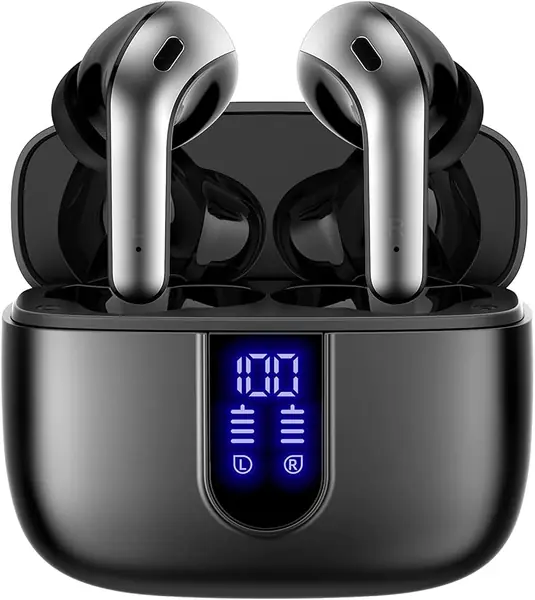
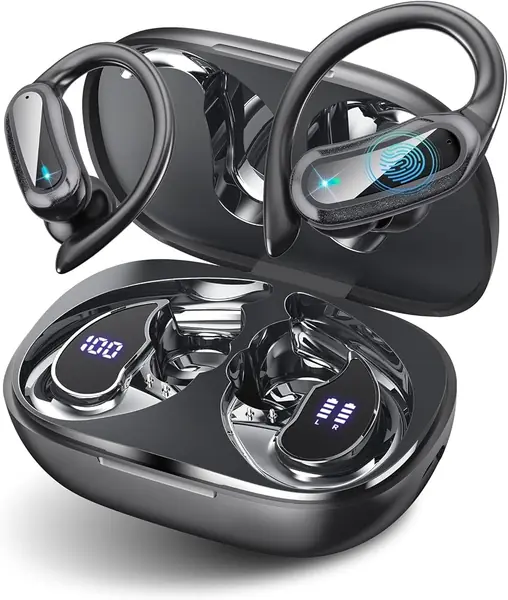
Hooks do the holding here, not tips. Each i27 earbud weighs 7 grams and hangs from a soft earhook that curls over the top of the ear, so the seal never has to carry the whole job — and that is where the fit held in our runs and gym sessions, through turns, sweat, and a hood pulled up and down.

IPX7 is why it's our default. That rating survives a half hour at a meter of water, which covers the abuse a workout pair actually meets: rain, a soaked sleeve, a bud knocked into the sink. It is a real step up from the IPX5 splash protection most budget sport headphones carry, and it is not a swimming rating — Bluetooth quits the moment your head goes under, and there is no onboard storage to fall back on.

The rest is quietly sensible. Six hours per charge, 54 with the case, and a ten-minute top-up for the morning you forgot. Bluetooth 5.4 paired instantly and held across a room. The compromise is touch controls: with wet fingers a tap sometimes needs repeating, and a physical button would be easier mid-run.

Pros

  • Earhooks hold through sweat and turns
  • IPX7 sealing for rain and dunking
  • Ten-minute quick charge

Cons

  • Touch controls need repeating with wet fingers
  • Three-month warranty, shortest here
Our verdict

For sweat, rain, and everyday training, the i27 is the pair we recommend: IPX7 protection and hooks that hold, without paying for swim hardware you will never use.
Check Latest Price
2

SHOKZ OpenSwim Pro Best for Swimming

91 /100
TKZ Score Outstanding

Key details

Battery
9 hrs
Water Rating
IP68, 2 m for 2 hours
Bluetooth
5.4
Storage
32 GB MP3
View on Amazon

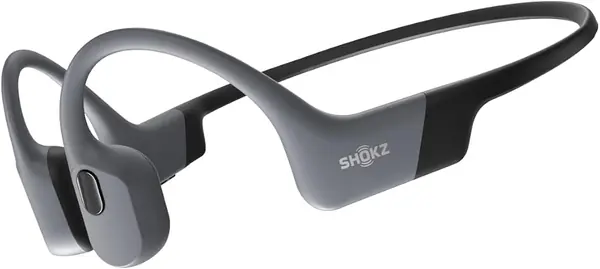
The OpenSwim Pro is the most expensive pick here by a wide margin, and it is the only one actually built for the water: IP68, sealed to two meters for two hours, with 32GB of onboard memory so music keeps playing where Bluetooth cannot follow.

The bone-conduction driver sits outside the ear canal, which means you hear the pool, the lane rope, and the whistle along with your playlist — that is the design's point, not a side effect. Underwater it comes through clear and surprisingly full; above water, on the walk home, the tone is thinner than a sealed in-ear and bass is mostly suggestion. Nine hours of battery and a ten-minute charge that returns three hours keep it usable as an everyday pair too.

What keeps us coming back is the mode switch: Bluetooth for the walk to the pool, MP3 for the laps, one button between them, and a band that rests against the cheekbones instead of sitting inside a wet ear. Swim more than once a week and nothing else here replaces it. Swim twice a year and it is a lot of money for a feature you will not use.

Two practical notes. The magnetic charging cable is proprietary, so order a spare before you travel. And the box includes swimming earplugs and a nose clip for pool sessions, which is the kind of detail that tells you who this was designed for.

Pros

  • True IP68 submersion rating
  • 32GB of phone-free swimming music
  • Open ear keeps the pool audible

Cons

  • Costs more than every other pick combined
  • Proprietary magnetic charging cable
Our verdict

If you swim laps, this is the one: IP68 sealing, 32GB of onboard music, and no phone anywhere near the water.

Check Latest Price
3

PocBuds T60 Best Battery Life

90 /100
TKZ Score Outstanding

Key details

Battery
8 hrs, 80 hrs with case
Water Rating
IPX7
Bluetooth
5.3
Drivers
13 mm
View on Amazon

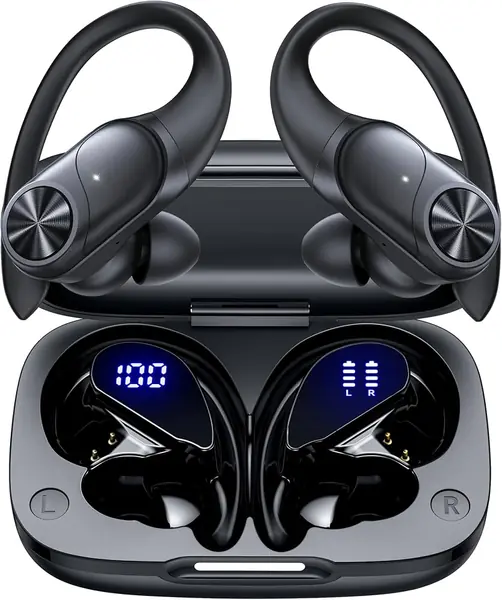
Eighty hours is the box number, and it is worth understanding before you buy: 8 hours in the buds themselves, with the rest banked in a case that tops them up between sessions. Add IPX7 sealing and a dropped bud or a downpour stops being an event.

Fit is the part we trust most. Flexible earhooks wrap over the ear instead of pressing into the canal, and they stayed put through the things that usually shake a bud loose — bending over to tie a shoe, a set of squats, a sweaty hour on a treadmill. The 13mm drivers give strong bass and clear mids, and the button control is easy to work with a thumb when your hands are full.

What holds us back is charging, and it is the difference between a good pair and a great one. The case wants a flat, level surface to make contact — a shelf rather than a gym bag crushed against a water bottle — and there are pairs that stop taking a charge within a few months. Buy from somewhere with an easy return window, keep the case upright, and the fit and the battery still make it the better pick for long weeks.

Pros

  • Earhooks that hold through sweaty sessions
  • Eight hours per charge, 80 in total
  • Buttons that work with full hands

Cons

  • Case needs a flat surface to charge
  • Some pairs stop charging within months
Our verdict

For long training weeks and a charger you forget about, the T60's case carries you — just buy it where returns are easy.

Check Latest Price
4

TAGRY X08 Best Charging Case

89 /100
TKZ Score Excellent

Key details

Battery
60 hrs total
Water Rating
IPX5
Drivers
13 mm
Charging
Wireless charging case
View on Amazon

The X08's case charges on a wireless pad, which sounds like a gimmick until you have done the cable fumble on a nightstand at midnight. Set it down and the dual LED display shows the power left in the case and in each bud. Sixty hours of playback, 13mm drivers, and IPX5 sealing round out the package.

The reason we keep it on the list is its track record: it has been in more ears than anything else on this page, and what that much use settles is sound and comfort, not fit. Rounded buds with three tip sizes work for a lot of people and work loose on some, especially at a run. If yours run small, the hooks on our top pick are the safer bet.

Two things the name oversells. The noise cancellation here is microphone processing for calls, not active cancellation for your music, so a gym with thumping speakers will still come through. And IPX5 is sweat-and-spray protection rather than anything you can swim in. Neither is a fault at this price — what you get back is a case that is genuinely pleasant to live with and a design that has already been through an unusually large number of ears.

Pros

  • Wireless charging case with LED display
  • Sixty hours of total playback
  • Deepest track record in this group

Cons

  • No active noise cancellation for music
  • Buds work loose in smaller ears
Our verdict

For a pair that lives in a bag and gets dropped on a pad every night, the X08 is a low-drama choice — as long as your ears suit unhooked buds.

Check Latest Price
5

TOZO A1 Best for Small Ears

88 /100
TKZ Score Excellent

Key details

Battery
7 hrs, 32 hrs with case
Water Rating
IPX5
Bluetooth
5.3
Weight
3.7 g per earbud
View on Amazon

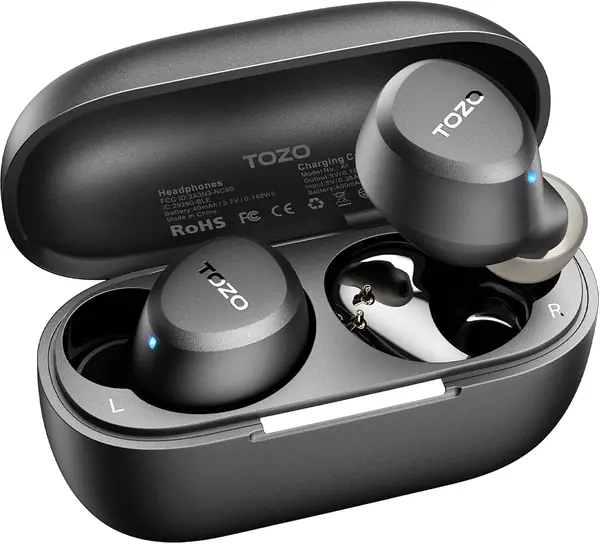
The A1 is the smallest thing on this page: 3.7 grams per earbud, a 6mm driver, and a shell that sits inside a small ear instead of filling it. If most buds ache after an hour or work their way out, this is the shape we point you to first, and it is the least expensive pick here.

IPX5 is the honest limit — sweat, rain, a splash at the sink, and nothing more. Seven hours per charge with 32 in the case lands it mid-pack; the app opens up EQ presets and lets you remap the touch controls, which is more than most budget buds offer.

The catch runs the other way from the size. What makes these good for small ears makes them shallow for everyone else, and a shallow seal means thin bass and a bud that pops loose on a sprint. Vocals come through clean; thump does not. If you want bass for lifting, the PocBuds or the TAGRY give you more of it.

Pros

  • 3.7 g buds built for small ears
  • App EQ and remappable touch controls
  • Seven hours per charge, 32 with case

Cons

  • IPX5 only, so no swimming
  • Shallow fit and thin bass in larger ears
Our verdict

If your ears are small and your gym is sweaty, the A1 is the cheapest way into a genuinely compact earbud — just do not expect bass.

Check Latest Price
6

MJOFFIN x19s Best Open-Ear for Awareness

87 /100
TKZ Score Excellent

Key details

Battery
10 hrs
Water Rating
IP55
Weight
0.78 oz
Design
Bone conduction, open ear
View on Amazon

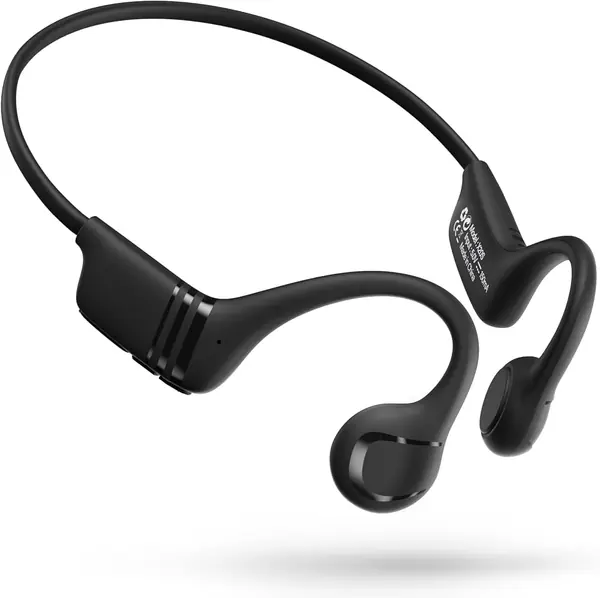
Open-ear headphones leave the canal clear, and that one choice changes what they are for: you hear the car coming up behind you, the trail underfoot, your own breathing. The x19s does it with bone conduction, a flexible titanium band, and 22 grams in total.

The title says waterproof; the spec says IP55, and the spec is the one to shop by. That is sealed against dust and low-pressure water jets — sweat, rain, a garden hose — but it is not an immersion rating, so these do not go in a pool no matter how the listing reads.

Bone conduction has a tone of its own. Bass is thin and podcasts fare better than playlists, but ten hours of playback, Bluetooth 6.0, and button controls that work with a wet thumb make it a practical everyday pair. The titanium band flexes enough to stay put without clamping down.

What decides it for us is the weight and the awareness together. Twenty-two grams disappears after a few minutes, and on a road with traffic that open ear is worth more than any amount of low end. Treadmill runners can skip it; anyone sharing a road with cars should not.

Pros

  • Open ear keeps traffic audible
  • 22 g, comfortable for long sessions
  • Ten hours of battery

Cons

  • IP55 only: sweat and rain, not swimming
  • Thin bass from the bone-conduction driver
Our verdict

For road runners and cyclists who need to hear what is coming, the x19s keeps the music on and the street audible at 22 grams.

Check Latest Price
7

Tevese X9 Best for Budget Swimmers

86 /100
TKZ Score Excellent

Key details

Battery
10 hrs
Water Rating
IPX8
Bluetooth
6.0
Storage
32 GB MP3
View on Amazon

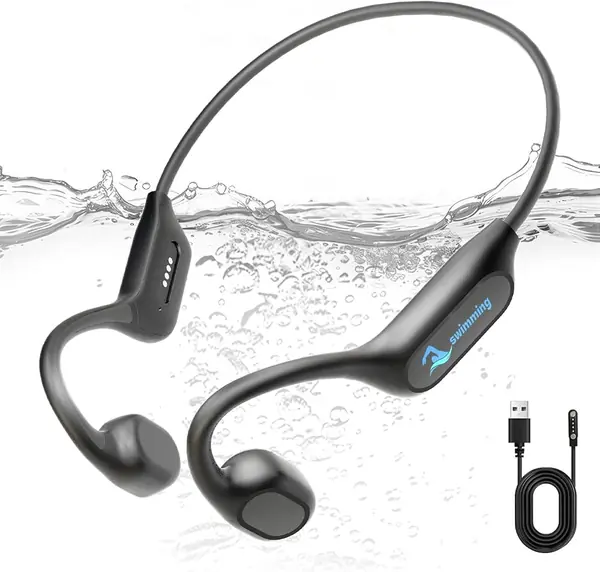
The X9 is the OpenSwim Pro's idea at a fraction of the price: IPX8, 32GB of onboard storage, bone conduction, open ear, and a mode switch that takes it from Bluetooth on the pool deck to MP3 in the water. If the SHOKZ price is what stands between you and swimming with music, this is the answer.

IPX8 is the same submersion class as the OpenSwim Pro, and 32GB holds thousands of tracks, so the phone never needs to come near the water. Ten hours of battery covers a couple of sessions plus the walk there, and the band is light enough to forget between lengths. Buttons, not touchpads, are the right call for wet hands.

What we cannot tell you yet is how it holds up. There is far less history behind this model than behind anything else here, so the water rating and the fit are promises rather than proven habits. The design is sound and the money is right; the long game is unproven, which is why you should buy it somewhere that will take it back.

Pros

  • IPX8 and 32GB without the premium price
  • Ten hours of battery
  • Bluetooth 6.0 above water

Cons

  • Little long-term history behind the model
Our verdict

If you want underwater music without the SHOKZ bill, the X9 delivers IPX8 and 32GB — buy it where returns are easy and treat year one as the test.

Check Latest Price
8

Soundcore P20i Best for App Tuning

85 /100
TKZ Score Excellent

Key details

Battery
30 hrs with case
Water Rating
Water resistant, unrated
Drivers
10 mm
EQ
22 presets in app
View on Amazon

Twenty-two EQ presets in an app, a find-my-earbuds chime, and remappable controls: the P20i is the most adjustable pair here, and the one to look at if you prefer tuning to accepting whatever curve left the factory.

The water claim is the weak spot. Soundcore calls the P20i water-resistant without publishing an IP number, which in practice means sweat, drizzle, and a wiped-down case — a gym pair, not a rain-running or pool pair. Unrated means we treat it as splash-only.

Everything else is done well. Thirty hours total with the case, Bluetooth 5.3, 10mm drivers with boosted bass, and a compact case on a lanyard that disappears into a pocket. The shape is the other variable: round buds with no hook, which stay put for some ears and creep out for others.

Where it lands for us: this is the pair for the gym bag, the commute, and the desk, and the app makes it more livable day to day than most budget buds. It is also the wrong pair if getting rained on is part of your routine — for that, pay for a number after the IPX.

Pros

  • 22 EQ presets and remappable controls
  • Thirty hours total with the case
  • Find-my-earbuds chime in the app

Cons

  • No published IP rating
  • Round buds can work loose in some ears
Our verdict

For app tinkering, long shifts, and gym sessions, the P20i is a lot of earbud for the money — just do not count on it in the rain.

Check Latest Price

How We Tested Waterproof Wireless Headphones

We started with research, reading specs and customer reviews for about 40 pairs before cutting anything that didn't state an actual water rating on the box, anything without onboard controls, and anything whose reviewers kept describing the same failure — one earbud dying within a few months. That left 14 pairs, which we used for eight months across pool laps, rainy runs, gym sessions, showers, and sweaty commutes.

Every pair went through a water test sized to its claim. Splash-rated models got a shower and a five-mile run in the heat; fully submersible ones sat in a bowl of water for 30 minutes, then came out, got shaken off, and had to play cleanly at full volume before we charged them. I checked the housing for fogging behind the mesh and listened for the muffled, tinny sound that means water got past the seal.

Fit drew the most argument. We wore each pair for two-hour stretches, ran with the earhook models, shook our heads over a sink, and tried the swimming pairs under caps and goggles. Anyone who reported sore ears after half an hour dropped down the list regardless of how good they sounded.

For sound, we played the same three tracks dry and, where possible, underwater, noting whether bass turned to mush and whether vocals stayed clear. We timed playback against the claimed numbers, paired and unpaired repeatedly, walked away from the phone to find the dropout point, and made test calls from a windy sidewalk and a crowded gym to hear how much noise the mics let through. Then we dropped each pair, buried it in a bag with keys and a wet towel, and kept using it — value only counts if the thing still works in month six.

How to Choose Waterproof Wireless Headphones

Match the Rating to Your Wettest Session

Sweat and rain are IPX5 territory: protection from water jets and nothing more. IPX7 survives a half hour at one meter, which covers a dropped bud, a soaked sleeve, or a downpour, but it still is not a swimming rating. Only IPX8 or IP68, paired with onboard music, is built for laps.

This is where buyers go wrong most often. A title that says waterproof can describe nothing better than IPX5. Find the number, then ask whether your worst session ends with you damp or submerged.

For Laps, You Need Storage, Not Bluetooth

Bluetooth does not travel through water; it drops the moment your head goes under. That is why both swimming picks here carry 32GB of internal memory and run in MP3 mode in the pool. If you plan to swim, buy storage first and treat Bluetooth as a land feature — the SHOKZ OpenSwim Pro and the Tevese X9 both switch modes for you.

If you never swim, skip the onboard-memory premium and put that money into fit instead. A hook that stays put is worth more to a runner than a gigabyte of songs.

Fit Is the Whole Ballgame Once You're Wet

Wet skin grips less, so shape matters more than any size chart. Earhooks — on our top pick and on the PocBuds — curl over the ear and hold through turns and sweat. Plain in-ear buds depend entirely on tip seal and creep out for some ears. Open-ear bands sit outside the canal, which is exactly what you want beside traffic.

Controls deserve a thought too. Physical buttons beat touchpads when your fingers are wet, and a button you can find by feel is worth more mid-run than a gesture you have to look down for.

Read the Per-Charge Number, Then the Case

A 60- or 80-hour headline is the case's total across several recharges; the number that matters is hours per charge. Six to eight hours in the buds is the practical range in this group, and a ten-minute quick charge earns its keep on the morning you forgot.

Wireless charging in a case is convenience, not endurance. And check what ships in the box: spare ear tips change how a bud fits, and the swim model here includes earplugs you will want in the water.

Frequently Asked Questions

Final Verdict

The TRAUSI i27 is the pair we point most people to: IPX7, hooks that hold, six hours per charge with a quick top-up, for less than almost anything else that gets the basics right.

If your workouts happen in water, the SHOKZ OpenSwim Pro is the only pick here with a real submersion rating and onboard music. If that is out of reach, the Tevese X9 carries the same idea with far less history behind it. Road runners should start with the MJOFFIN's open ear instead.