Best Waterproof Headphones of 2026

Waterproofing and sound quality are usually working against each other: the tighter the seal that keeps the pool out, the more your music sounds like it's coming from inside a bucket. There's a second catch, too — Bluetooth barely travels through water, so a signal that's rock solid on the pool deck will stutter the moment your ears go under. That's why the pairs worth swimming in carry their own music onboard.

I swim three mornings a week, and I've ruined more than one pair by leaving it in a damp towel overnight. Over the past six months, my team and I have put 12 pairs through laps, showers, rainy runs, and a few unpleasant gym sessions — bone conduction models, sealed in-ear buds, and a couple that sit somewhere in between. What separates a pair you keep from one you resent isn't the rating on the box; it's whether the fit holds through a push-off from the wall and whether the battery outlasts the workout. Here's where each one earned its place.

The Best Waterproof Headphones

1

PSIER S18 Best Overall
88 /100
TKZ Score Excellent

Key details

Playtime
Up to 8 hours
Water Rating
IPX8
Onboard Memory
32GB
Modes
Bluetooth and MP3
View on Amazon

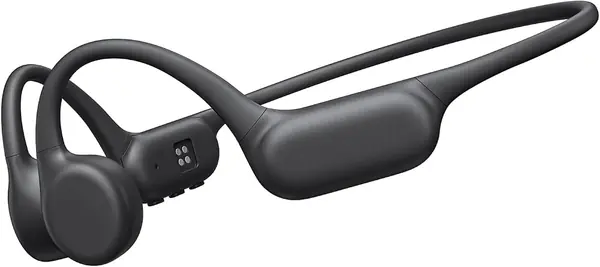
The moment your head goes under, Bluetooth is gone. That's why the sets that actually serve lap swimmers carry their own music, and it's why the PSIER S18 takes the top spot: an IPX8 rating, 32GB of onboard storage, and an open-ear design that leaves your ear canals free for a cap or a pair of earplugs. It solves the pool problem first and the gym problem second, which is the right order here.

We loaded tracks and swam with the S18 in MP3 mode, and what we appreciated was how little there was to fiddle with — no phone on the deck, no reconnecting between sets. Playtime is listed at up to eight hours per charge, and the magnetic charger refills it without an open port to seal. Out of the water it pairs over Bluetooth like any other headset, so it doubles as a running or dog-walking pair.

Bone conduction takes a swim or two to get used to. The sound arrives through your cheekbones instead of your ears, and we found it clearest with earplugs in: the plugs shut out the pool's roar and let the drivers do less work. Nothing seals your ear, so the lifeguard's whistle and the swimmer alongside you still come through.

The band can run large on smaller heads, so try it under a swim cap before deciding it doesn't fit — the cap pulls it snug against your cheekbones, which is how most lap swimmers wear it anyway. Get that right and the S18 disappears for the length of a workout, which is the whole point of paying for a set you only wear in the water.

Pros

  • IPX8 rated with 32GB of onboard music
  • Open-ear band stays put under a swim cap
  • Doubles as a Bluetooth headset on land

Cons

  • Heavy MP3 use can outrun the eight-hour figure
Our verdict

We recommend the S18 to anyone who swims laps: it plays from its own memory underwater, survives the pool, and costs mid-range money.
Check Latest Price
2

SHOKZ OpenSwim Pro Best Premium

87 /100
TKZ Score Excellent

Key details

Playtime
Up to 9 hours
Water Rating
IP68
Onboard Memory
32GB
Quick Charge
10 minutes for 3 hours
View on Amazon

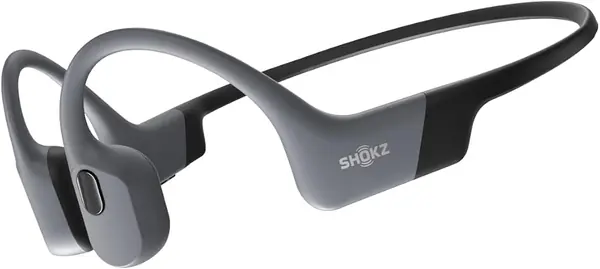
The OpenSwim Pro sits at the top of the price range here, and Shokz is upfront about where the money goes: a two-year warranty, magnetic charging, earplugs and a nose clip in the box, a silicone case, and the most carefully built band of the group. None of that is the reason to buy it.

The swimming job is. IP68 covers submersion to two meters for two hours, there's 32GB for MP3 playback, and the battery runs up to nine hours with a ten-minute top-up that buys three more. We swam with it across several sessions without charging in between, and it never gave us a reason to think about it — which is the highest praise a pool headphone gets.

Bluetooth is land-only here, and that's the honest version of how every set on this page behaves once you submerge. The failure to watch for is at the charging pins: corrosion there is what turns a working set into a dead one, and it usually starts with charging while wet. Rinse in fresh water, dry the contacts, and these last.

The open question is value. The OpenSwim Pro costs several times what our top pick does and doesn't sound several times better underwater. What the extra buys is fit, finish, accessories, and a warranty that runs two years — worth it if this is a five-day-a-week habit rather than a vacation purchase.

Pros

  • IP68 to two meters with 32GB on board
  • Ten-minute charge buys three hours
  • Earplugs, nose clip, and case included

Cons

  • Costs several times our top pick
Our verdict

Buy the OpenSwim Pro if you swim several mornings a week and want the best-built, best-supported set here; casual swimmers get most of it for far less.

Check Latest Price
3

Tevese X9 Best Battery Life

86 /100
TKZ Score Excellent

Key details

Playtime
Up to 10 hours
Water Rating
IPX8
Onboard Memory
32GB
Bluetooth
6.0
View on Amazon

Ten hours is the figure that separates the Tevese X9 from most of this group, and it's the one that matters once the IPX8 rating has been settled. Ten hours covers close to a fortnight of 45-minute swims, so the charger lives in a drawer rather than the swim bag. Add 32GB of storage for MP3 mode and Bluetooth for everything above the waterline, and you have the least fussy set here.

The fit is built around caps and goggles rather than bare heads, and it shows: the band tucks under a cap without pressing on your temples, and the controls are physical buttons instead of touch panels, so a wet thumb works as well as a dry one. We noticed it most while changing volume mid-set, which on a touch-control set is always a gamble.

What the X9 doesn't give you is much beyond the job. The box holds a cable and a manual, and the sound is tuned for water rather than for critical listening. For pool laps that's a fair trade: you're buying battery and memory, and both are strong for the money.

Pros

  • Ten hours per charge
  • 32GB of onboard music
  • Button controls work with wet hands

Cons

  • Ships with only a cable and manual
Our verdict

For long sessions the X9 is our pick: ten hours of playtime, 32GB of music, and buttons that work with wet hands.

Check Latest Price
4

TRAUSI i27 Best Budget

85 /100
TKZ Score Excellent

Key details

Playtime
6 hours per charge
Water Rating
IPX7
Case Charge
54 hours total
Weight
7 g per earbud
View on Amazon

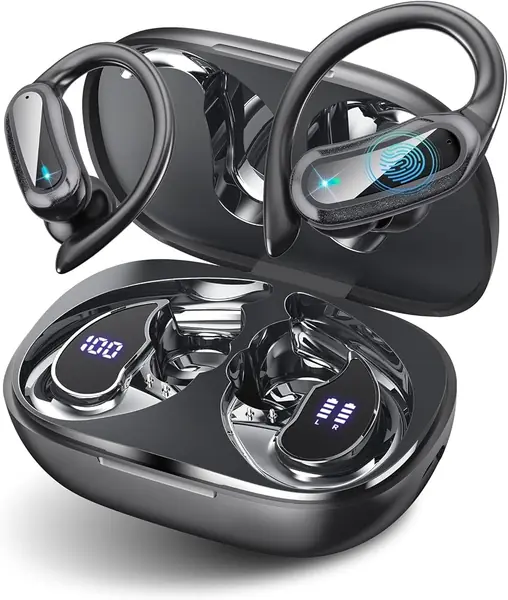
Seven grams per earbud is what makes the TRAUSI i27 comfortable in a way in-ear buds usually aren't: the weight hangs from a soft earhook instead of pressing into the canal, and an hour into a run we stopped noticing them. IPX7 covers sweat, rain, and the occasional dunking, three tip sizes are in the box, and the case carries enough charge for 54 hours of listening with six in the buds themselves.

The pool is where this set stops. IPX7 is an immersion rating for accidents, not a design for lap swimming, and there's no onboard memory — so the i27 is a gym and running pick. Judged on that job it's the cheapest set here that stays put through a sweaty workout, and the only real compromise is sound: clear enough for podcasts and running playlists, a step behind the pricier sets for anything more demanding.

Pros

  • 7 g per earbud stays put on runs
  • 54 hours of listening with the case
  • Lowest price in this group

Cons

  • IPX7 covers sweat and rain, not laps
  • Touch controls rather than buttons
Our verdict

If your water is sweat and rain rather than chlorine, the i27 is the cheapest set here that stays put and keeps playing.

Check Latest Price
5

JBL Endurance Race 2 Best for Gym and Rain

84 /100
TKZ Score Excellent

Key details

Playtime
12 hours per charge
Water Rating
IP68
Case Charge
48 hours total
Noise Control
Active noise cancelling
View on Amazon

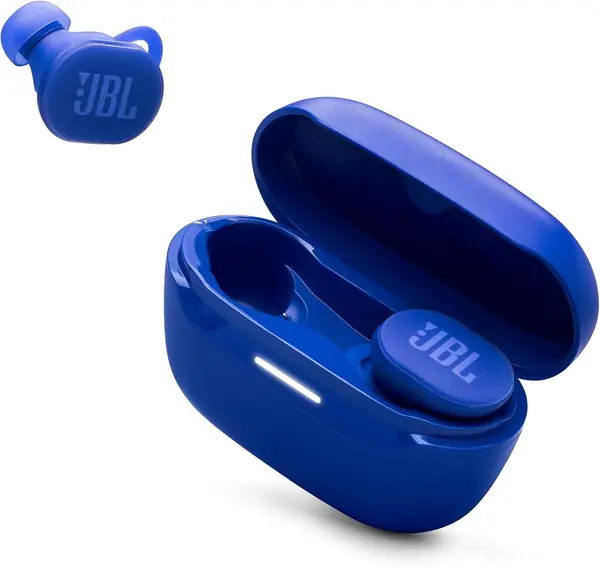
IP68 is the highest water-and-dust rating in this group, and it's tempting to read that as the best swimming pick. It isn't: the Endurance Race 2 is a true wireless earbud, and Bluetooth doesn't travel through water, so the rating buys protection from sweat, rain, and a dunking — not music while you swim.

On dry land it's a serious training bud. The Twistlock wing is the part we trust most, holding the earbud in place through burpees and sprints, and active noise cancelling makes a gym or a train bearable while Smart Ambient lets traffic through when you need it. The numbers are generous too: twelve hours in the buds, another 36 in the case, and speed charging that gets you moving again.

What holds it below the swimming sets is consistency. Connections drop mid-workout on some units, an earbud occasionally stops taking a charge, and the case has to be completely dry before the buds go back in or the contacts complain. Buy it for the gym, the rain, and the run, and keep a set with onboard memory for the pool.

Pros

  • IP68 dust and water protection
  • Active noise cancelling with Smart Ambient
  • 48 hours of playtime with the case

Cons

  • Bluetooth can drop mid-workout
  • Buds and case must be bone dry before charging
Our verdict

The Endurance Race 2 is the gym and rain pick: IP68 protection and noise cancelling, with no pretence of playing music underwater.

Check Latest Price
6

ZOVIMAX X7 MAX Best for Open-Water Swims

83 /100
TKZ Score Excellent

Key details

Playtime
Up to 8 hours
Water Rating
IPX8 to 5 m
Onboard Memory
8GB
Charging
Magnetic, 2 hours
View on Amazon

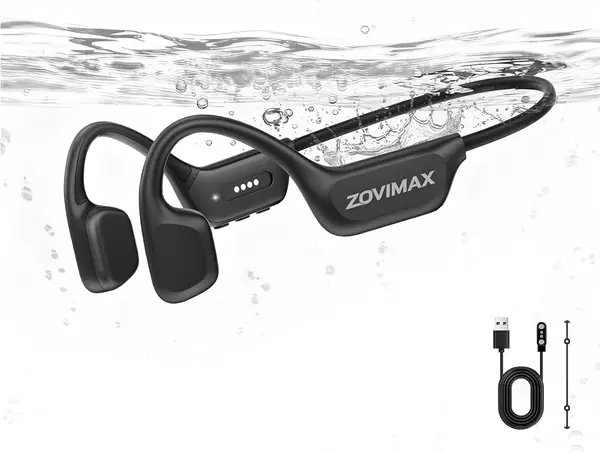
Eight gigabytes is the first thing to weigh with the X7 MAX. That's a couple of thousand compressed tracks — enough for a season of laps, and a quarter of what the 32GB sets here hold. Rotate one playlist and a few podcasts and it never comes up; want your whole library offline and it will.

The water claims are the strongest here on paper: IPX8 with submersion to five meters for up to two and a half hours, which covers open-water swims as well as pool sessions. Magnetic charging means no exposed USB port to leak, a detail that matters more than any single number once a set is a year old.

Open-ear pads sit on the cheekbone, so your hearing stays open, and the silicone is soft enough for a long run. We wore them on road runs as well as in the pool, and the awareness of traffic is the reason we kept reaching for them outdoors.

The battery is the thing to pin down: it's quoted as both eight and twelve hours in different places, so plan on the lower number and treat the rest as a bonus. Get that right and this is the pick for a swimmer who wants depth-rated protection and open ears without paying premium money.

Pros

  • IPX8 rated to 5 m for 2.5 hours
  • Magnetic charging with no exposed port
  • Open-ear pads comfortable for running

Cons

  • Battery quoted as 8 and 12 hours; plan on 8
  • 8GB holds a quarter of the 32GB picks
Our verdict

Choose the X7 MAX for open-water depth ratings and open ears, as long as 8GB holds enough of your library.

Check Latest Price
7

Sanag B60SPRO Best for Salt-Water Swimmers

82 /100
TKZ Score Excellent

Key details

Playtime
Up to 8 hours
Water Rating
IPX8 to 2 m
Onboard Memory
32GB
Charging
Magnetic, 2 hours
View on Amazon

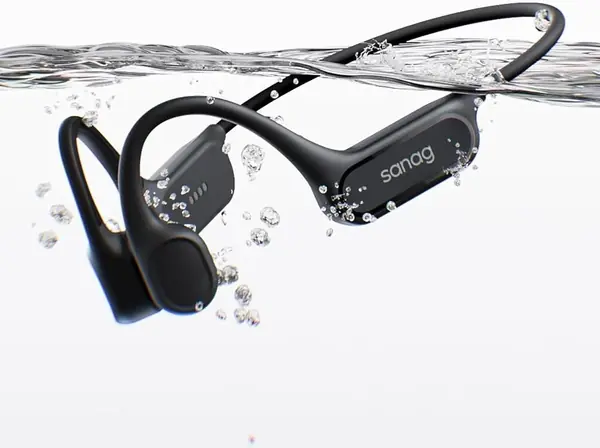
The B60SPRO's one-piece shell is what makes it credible in water: fewer seams means less to seal, and the IPX8 rating covers submersion to two meters for pool training and open-water swims alike. It's the simplest construction here, and simple is what you want in chlorinated water.

The rest of the package is familiar, and we like that it doesn't reinvent anything: 32GB for MP3 playback, up to eight hours on a charge with a two-hour refill, bone conduction that keeps your ears open, and a noise-cancelling mic for calls on the way to the pool. Worth knowing before you buy: MP3 mode is the one that works underwater, and Bluetooth is a land feature.

Where it gives ground is price. It asks more than our top pick without adding storage, playtime, or a capability the PSIER doesn't have, so you're paying for the shell. If the shell is what you want — and for a set that lives in salt water it's a fair thing to want — it's a good buy. Otherwise the S18 is the smarter one.

Pros

  • Seamless shell rated IPX8 to 2 m
  • 32GB of onboard music
  • Noise-cancelling mic for calls

Cons

  • Priced above the top pick without extra features
Our verdict

The B60SPRO is the buy if you want a seamless shell and 32GB, and you're willing to pay more than our top pick for it.

Check Latest Price

How We Chose and Tested the Best Waterproof Headphones

We started with a long list of every pair we could find that claims a waterproof rating of IPX7 or better, then narrowed it by how people actually use them: open-ear bone conduction for pool laps, sealed in-ear buds for the gym and rain, and a couple of hybrids. Anything without onboard storage got flagged for above-water use only, since Bluetooth doesn't carry underwater no matter how good the rating is. From there we bought 12 pairs across price points and rotated them for six months.

Every pair went into a bowl of water for 30 minutes on day one and then straight back on the charger to see whether it survived. In the pool we wore each one through 500-yard sets, tugged goggles and swim caps over the band, and pushed off the wall hard to find out what slipped; we noted which earbuds needed reseating mid-lap and which bands crept up. Showers, rainy runs, and a very sweaty hour on the treadmill covered everything that isn't a lap pool.

Battery life was easy to measure: full charge, then swim and run until each pair died, with a note on how much listening a 10-minute top-up actually bought. For sound, we paid attention to whether the low end vanished underwater, whether volume had to sit at maximum, and whether the seal turned everything into a muddle. Connectivity held up or didn't while we left the phone 30 feet away on the pool deck, behind a towel, and again on a crowded gym floor. Comfort got checked at the one-hour mark, mostly whether the band pressed behind the ears or the tips ached. Finally, we threw every pair into a wet gym bag, dried them on a towel bar, and watched the buttons and seams over the months for stiffness or cracking — and asked, for each one, whether the extra money bought features we actually used or just a nicer box.

How to Choose Waterproof Headphones

Read the IP Rating, Not the Word Waterproof

IPX7 means the set survives 30 minutes at one meter. IPX8 is whatever depth the maker specifies, so the number alone doesn't tell you how deep — look for the depth and duration stated beside it. IP68 adds dust protection to the same idea. None of them promise sound underwater, because the rating covers survival, not transmission.

Titles are looser than ratings. We've seen open-ear sets sold as waterproof that carry only IP55, which is splash and sweat resistance. If swimming is the plan, insist on IPX7 or better plus a stated depth, and treat the word waterproof on its own as marketing.

Underwater Music Needs Onboard Memory

Bluetooth does not travel through water, and every set on this page behaves the same way: submerge the headphones and the stream stops. The workaround is a player built into the headphones, with its own storage, loaded over a cable before you swim.

Eight gigabytes holds a couple of thousand compressed tracks; 32GB holds several times that. If lap swimming with music is the point, storage capacity matters more than the Bluetooth version printed on the box.

Fit Changes With a Cap and Goggles

Open-ear and bone conduction sets rest on the cheekbone and are held steady by a swim cap pulled over the top. In-ear buds rely on a tip seal that water and ear canals both work against. Swim with earplugs and an open-ear set is the better match, since the plugs block water and pool noise while the drivers work through bone.

Try the combination in a pool before a long swim. A set that shifts every length will ruin a session faster than any sound-quality compromise.

Charging Is Where They Fail

A magnetic charging puck or cable removes the most vulnerable part of a waterproof design: the open USB-C port. Even so, the contacts are where trouble starts. Rinse the set in fresh water after every chlorinated or salt-water swim, shake it out, and let it dry completely before it goes back on the charger.

A set that stops charging after a few weeks has usually been charged wet, and that kind of damage tends not to be covered by the warranty.

What Swimming Costs

Sweat and rain are cheap to solve: a budget IPX7 earbud handles a gym session and a downpour for very little. Swimming costs more, because you're paying for onboard memory, a sealed shell, and enough battery for a long session.

Our mid-range picks do all three; the premium set adds fit, finish, accessories, and a longer warranty rather than better underwater sound. Swim laps twice a week or more and the mid-range money is worth it.

Frequently Asked Questions

Final Verdict

The PSIER S18 is the set we point most swimmers to: IPX8, 32GB of onboard music, an open-ear band that a swim cap holds steady, and Bluetooth for everything on land.

Step up to the SHOKZ OpenSwim Pro only if you're in the water several times a week and want the fit, the accessories, and the two-year warranty that come with the price. On a tight budget, the TRAUSI i27 handles sweat and rain well — just don't expect it to play underwater.