Best Sony Earbuds of 2026

Earbuds are one of those purchases you don't think about until they go wrong: a bud that works loose on mile three, a battery that dies mid-call, a connection that drops when you walk past a microwave. Sony's catalog makes the choice harder than it should be, because format matters more than model number. A true wireless set disappears in a pocket; a neckband survives a whole workday; a corded pair never asks for a charger.

My team and I have spent six months wearing a dozen pairs across all three formats — commuting, running, and sitting through back-to-back video calls — and the spec sheets turned out to be a lousy guide to which ones we actually reached for. Fit decided more than anything printed on the box.

Here's what first-time buyers get wrong: the battery figure on the packaging usually counts the charging case, not the buds, so a pair rated at 20-plus hours might give you five or six before it needs a top-up. Call clarity and water resistance also vary more within Sony's own line than you'd expect. What follows is sorted by how you'll actually wear them.

The Best Sony Earbuds

1

Sony WF-C510 Best Overall
88 /100
TKZ Score Excellent

Key details

Weight
1.09 oz
Battery
Up to 22 hrs with case
Water Resistance
IPX4
Multipoint
Two devices
View on Amazon

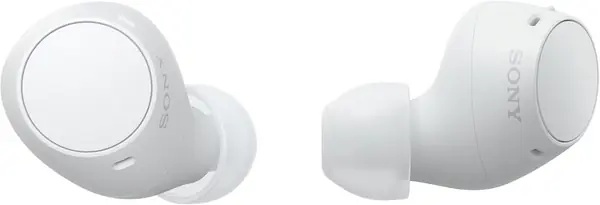
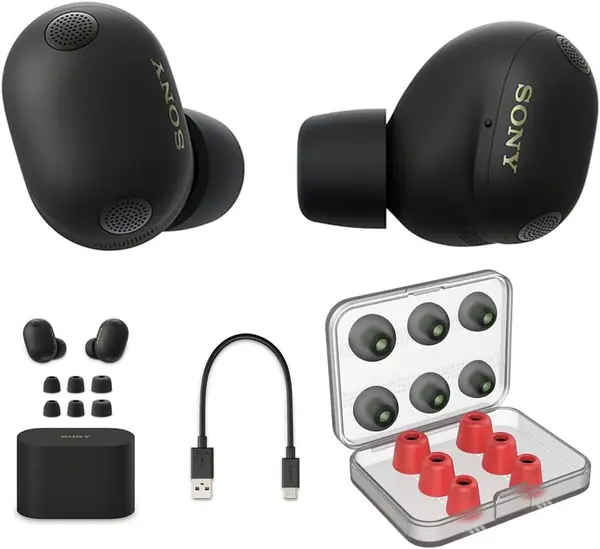
The flagship in this group cancels noise better, processes audio faster, and charges more for the privilege — and it still isn't the pair we hand most people. That's the WF-C510. At 31 grams it vanishes in a pocket, and in our ears it stayed put through a rainy walk and a long workday without the pressure point cheaper buds develop behind the ear. The 6 mm driver won't rattle your chest, but voices stay clear and the tuning is even enough to leave alone.

Battery is the quiet argument for it: eleven hours in the buds and twenty-two with the case, plus a five-minute top-up that returns an hour of playback. That top-up got more use from us than any other feature — five minutes on a laptop while you answer one email and the ride home is covered. Multipoint is the other everyday win, holding a phone and a laptop at once so an incoming call lands without repairing anything.

Ambient mode is the only listening mode on offer, and on a bike path it does exactly what it should: you hear the car before you see it. Bluetooth is where to be careful. Dropouts turn up on some units, so pair both your devices and take a call in the first week, while a return or exchange is still simple.

Pros

  • 31 g build stays comfortable for hours
  • Up to 22 hours total with the case
  • Multipoint keeps a phone and laptop connected

Cons

  • Bluetooth dropouts affect some units
  • No active noise cancelling, ambient mode only
Our verdict

We point most people here: the WF-C510 is light enough to forget, holds two devices at once, and asks for a fraction of what the flagship costs.
Check Latest Price
2

Sony WF-1000XM6 Best Noise Cancelling

87 /100
TKZ Score Excellent

Key details

Driver
8.4 mm
Battery
8 hrs, 24 hrs with case
Bluetooth
5.3
Noise Cancelling
Active
View on Amazon

Noise cancelling is the entire reason to spend flagship money, and the WF-1000XM6 makes its case within a minute of a loud room. Sony quotes the QN3e processor as three times faster than the chip in the previous generation, and the practical result is the one you want: steady low-frequency noise — engines, ventilation, the hum of a train — drops away rather than thinning out. Calls get the same treatment, with dual beamforming microphones and a bone conduction sensor picking your voice out of the background.

We were ready to dismiss the studio-clarity language as marketing, and the 8.4 mm driver mostly backs it up: there's more air around strings and vocals than the cheaper Sonys here manage, and the app leaves room to pull the bass back. The trade is battery. Eight hours in the buds and twenty-four with the case is the shortest per-charge run of the wireless picks, so a heavy day ends with a case stop.

Fit deserves a weekend of experimenting rather than a snap judgment. Sony ships four tip sizes and the bundle adds six more pairs, which is the practical answer if the seal feels shallow at first: work through them before deciding these aren't for your ears. The price is the honest obstacle — this is the most expensive pick here by a wide margin, and what the extra buys is quiet and call clarity rather than hours.

Pros

  • Strongest noise cancelling in this group
  • Up to 24 hours total with the case
  • Beamforming mics and bone conduction for calls
  • Extra tip pairs included in the bundle

Cons

  • Most expensive pick in this group
  • 8 hours per charge, shortest of the wireless picks
Our verdict

For flights, transit, and calls in loud rooms, we send you to the XM6: its noise cancelling is in a different league from everything else on this page.

Check Latest Price
3

Sony WI-XB400 Best for Bass

86 /100
TKZ Score Excellent

Key details

Driver
12 mm
Weight
0.74 oz
Battery
Up to 15 hrs
Quick Charge
10 min for 60 min playback
View on Amazon

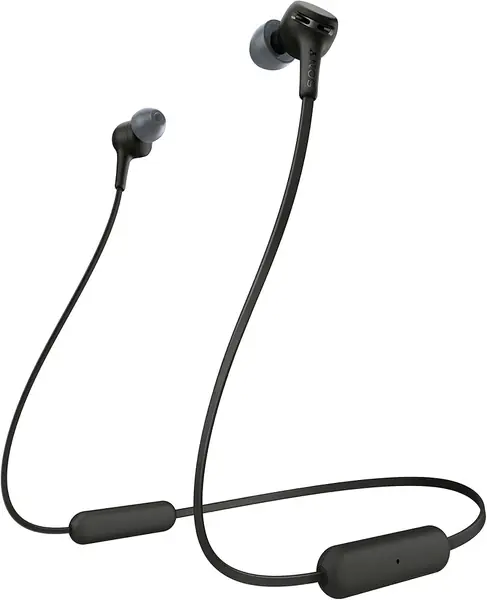
Twelve millimeters is the biggest driver among the wireless picks, and Sony points it at bass rather than balance. Kick drums and basslines sit forward, the low end holds its shape at low volume instead of vanishing, and hip-hop and electronic music sound like someone turned the sub up. We think that's the right trade at this price — the alternative is a flatter, more polite sound with a little more detail up top.

Fifteen hours on a charge is a week of commuting, and the ten-minute quick charge buys an hour, which is the number to remember when you're heading out the door with a dead pair. Isolation is passive: the silicone tips do the blocking, and on a train you'll still hear the carriage. Bluetooth holds fine in a quiet room, though dropouts turn up for some, so take a walk around the block early and see how yours behaves.

Retention is the weak point, and it's worth being honest about it. The buds work loose over an hour, the weight in the cable tugs when you turn your head, and running or lifting will have you pushing them back in. These are desk, workshop, and walking buds. For intervals, the WF-C510 holds its seal far better.

Pros

  • 12 mm drivers deliver the deepest bass here
  • Up to 15 hours on a single charge
  • 10-minute top-up returns an hour of playback

Cons

  • Buds work loose, especially during exercise
  • Bluetooth disconnects affect some units
Our verdict

We rate these the bass pick of the group — 12 mm drivers that hit harder than anything else here, in a neckband that's hard to lose.

Check Latest Price
4

Sony MDR-EX155AP Best Wired

85 /100
TKZ Score Excellent

Key details

Driver
9 mm
Cord
3.94 ft
Connection
3.5 mm wired
Microphone
Integrated
View on Amazon

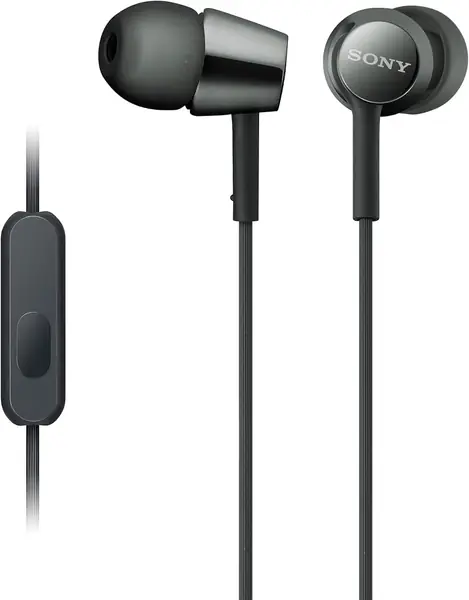
A cord is the whole proposition here: nothing to charge, nothing to pair, and no single bud to lose because both are tethered to the same wire. The 3.94-foot Y-cord reaches from a laptop to the seat pocket in front of you, and at 3.13 grams the buds are light enough that a two-hour call doesn't leave your ears sore.

Small ears are where this pair earns its keep. The silicone tips run small and the buds sit shallow instead of plugging the canal, which makes them comfortable for long stretches and less isolating than a deep-seated design — you'll hear the office around you. The integrated microphone and playback control sit on the cord where your fingers find them without looking, and for calls from a laptop or a phone with a jack, this is the pair we keep coming back to.

The plug is where these usually end rather than the driver: the cord takes the strain and a channel eventually drops out. Treat them as a wear item and buy two. The other catch is the jack itself — if your phone shipped without a headphone jack, budget for an adapter and check which port you have before ordering.

Pros

  • Never needs charging or pairing
  • Small tips suit narrow ear canals
  • Integrated mic handles calls

Cons

  • Plug and cord are the first parts to fail
  • Needs a 3.5 mm jack or an adapter
Our verdict

For calls from a laptop or a phone that still has a jack, we reach for these: no battery, no pairing, and a secure fit in small ears.

Check Latest Price
5

Sony WI-C100 Long Battery Life

84 /100
TKZ Score Excellent

Key details

Weight
0.71 oz
Battery
Up to 25 hrs
Water Resistance
IPX4
Controls
Push button
View on Amazon

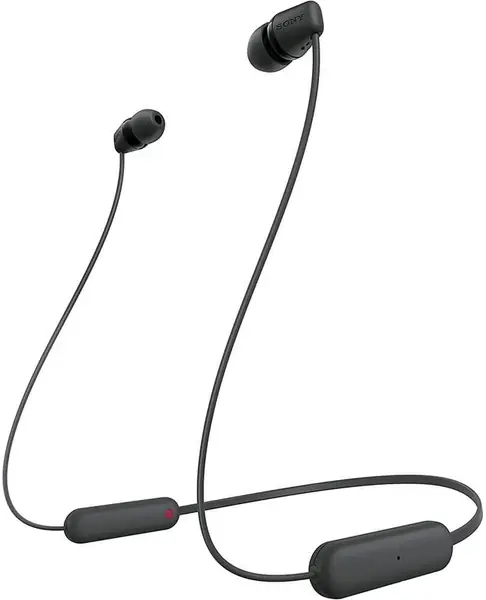
Twenty-five hours is the longest single-charge figure in this group, and it changes how you own a pair: charge it on Sunday night and stop thinking about it until the weekend. We appreciated that more than any feature on the box. There's no case to carry — the band loops around your neck and the buds hang at your collarbone when you pull them out, which is the whole appeal of a neckband on a commute.

Fit is where it asks the most of you. The smallest tips run large, the band flexes enough to slide when you tip your head back, and narrow ears will feel the buds working their way out on the first few wears. Try every tip in the box before you decide, and treat these as a desk, commute, and walking pair rather than gym equipment. If your ears are on the small side, the MDR-EX155AP is the safer fit.

The controls are the underrated part: real buttons for pause, volume, and calls, which you can work one-handed with a glove on. DSEE is there to restore the high frequencies compression strips out, and it's most noticeable on a weak stream. Twenty grams around the neck is light enough to forget by mid-morning.

Pros

  • Up to 25 hours on a single charge
  • Physical buttons work through gloves
  • Only 20 g around the neck

Cons

  • Tips run large for narrow ears
  • Band and cable can fail inside a year
Our verdict

We send forgetful chargers here: 25 hours on a charge, buttons that work through gloves, and a band that stays around your neck.

Check Latest Price
6

Sony MDR-E9LP Best for Backup and Spares

83 /100
TKZ Score Excellent

Key details

Driver
13.5 mm
Weight
0.21 oz
Cord
3.94 ft
Connection
3.5 mm wired
View on Amazon

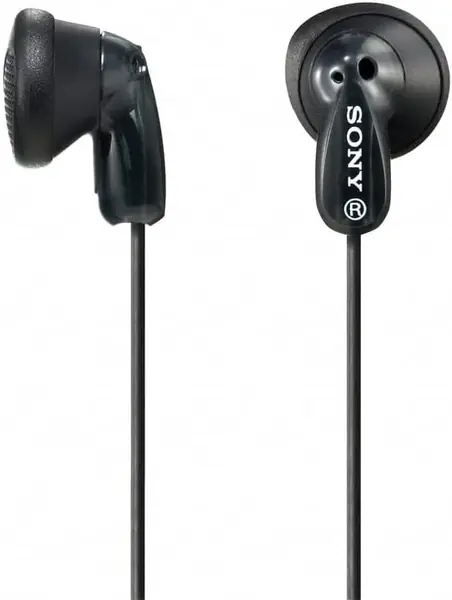
This is the pair you buy in multiples — one at the desk, one in the gym bag, one in the glovebox — for the morning the good earbuds are charging or missing. At 6 grams it's the lightest thing in this group, the 3.94-foot cord is long enough to reach across a desk, and the 13.5 mm driver is larger than the one in either wireless pair.

Sound is the compromise, and it isn't a small one: bass is thin, cymbals get splashy, and anything with a low end sounds like it's playing through a wall. We treat ours as talk-radio buds that happen to play music, and for podcasts, audiobooks, and video from a laptop they're perfectly pleasant. Fit is closer to a coin flip — the rounded buds sit loose in wider ears, and the spare covers in the box only help a little.

The plug and cord are the weak points, and a channel dropping out is how these usually end. That's an acceptable deal at the bottom of the lineup, as long as you're buying a consumable rather than a keeper. A pair in the glovebox and a pair in the desk drawer is how these make sense.

Pros

  • Only 6 g, the lightest here
  • 13.5 mm driver in a tiny earbud
  • Inexpensive enough to keep spares

Cons

  • Thin, bass-light sound
  • One channel can drop out within months
Our verdict

Keep a pair in every bag: the MDR-E9LP is light, fine for podcasts, and the least painful thing to lose in this group.

Check Latest Price

How We Picked and Tested These Sony Earbuds

We started by pulling every current Sony earbud we could buy at retail — true wireless, neckband, and corded — then filtered by what a shopper actually needs: a built-in mic for calls, a price that made sense next to its neighbors in the line, and a format we hadn't already covered three times over. Anything that couldn't take a phone call got cut. Twelve pairs made it through.

Every pair lived the same six months we did. Each one got a full workday of back-to-back calls paired to a laptop, a three-mile run, and a week of commuting, with pairings cycled between an iPhone, an Android phone, and a work laptop. To check connectivity we walked a full floor away from the source and noted exactly where the signal broke up, and we recorded a voice memo through each mic while a hand was cupped over one ear to mimic a windy street.

Comfort got the most attention, since it's the thing that quietly ruins an otherwise good pair. We cycled through every included tip size, shook our heads hard, ate lunch in them, and logged where soreness showed up after two hours. Durability meant dropping them on pavement, burying them loose in a bag, and wearing them through drizzle. On the noise-cancelling model we stood beside a leaf blower and sat in a loud café to hear what got through. Battery was measured rather than trusted: full to dead at a set volume, with a stopwatch, then compared against the box.

The pattern that held across all twelve had less to do with driver specs than with whether the thing stayed put and stayed connected.

How to Choose Sony Earbuds

Start with the shape: wireless, neckband, or corded

Truly wireless buds are the pair you'll actually carry, and the WF-C510 shows why: a case small enough to forget in a jacket pocket, nothing hanging off your ears, and a full day of listening with the case. A neckband trades pocketability for security — the band keeps the buds on your neck and leaves room for a bigger battery, which is how the WI-C100 reaches twenty-five hours. Corded in-ear headphones skip charging and pairing entirely but tie you to a jack.

Decide which of those three irritations you can live with and the list narrows fast. Commuters and gym-goers get the most from truly wireless. Anyone who loses things should look at a band. Anyone whose listening happens at a desk should seriously consider a cord.

What noise cancelling actually buys you

Only one pair here, the WF-1000XM6, actively cancels noise. Everything else relies on the seal of the tip plus, on the wireless models, an ambient mode that pipes the outside world in rather than shutting it out. That's the right choice if you listen mostly at a desk or on quiet streets: you get better battery and a lower price instead of a feature you weren't using.

Buy for the noise you actually meet — engines and rail rumble for active cancelling, awareness for city cycling. And read the listing closely: a noise-cancelling bullet sometimes describes a transparency mode rather than cancellation, which are opposite jobs.

Read battery figures the way they're measured

Every wireless figure here comes in two parts: hours in the buds and hours with the case. The XM6's twenty-four-hour headline is eight hours before you're back in the case; the WF-C510's twenty-two is eleven. The smaller number is the one that decides whether a long flight ends with a dead bud.

Neckbands skip the case entirely, so the WI-C100's twenty-five hours is twenty-five hours in your ears. Quick-charge claims matter as much as the total: five or ten minutes at a socket can rescue a commute, and that's the feature you'll use most.

Fit is the specification that isn't printed on the box

Two people can put the same pair in and get different bass, different comfort, and different results on a run. Tips do most of the work. Start with the smallest tip that seals, and if the buds loosen when you talk or chew, size down rather than pushing them deeper.

Shallow, rounded buds like the MDR-EX155AP suit narrow canals and long calls; deep-seated tips isolate more but get sore faster. If you run or lift, put retention ahead of every other feature — the WF-C510 held its seal for us where the neckbands didn't.

Water resistance and where you'll wear them

IPX4 is the rating on the wireless picks here, and it covers sweat and light rain — not a pool, not a shower, not a soaked pocket. The corded pairs carry no water rating at all, which matters if they live in a gym bag next to a damp towel.

If your listening happens indoors, spend the difference on fit and battery instead. If you ride or run in the weather, the rating is the first thing to check before anything else on the page.

Frequently Asked Questions

Final Verdict

For most people the WF-C510 is the pair to buy: 31 grams, a seal that survives a walk in the rain, two devices connected at once, and enough battery with the case to cover a working day. The exceptions are specific. If engine noise is the problem you're solving, the WF-1000XM6 is worth its premium.

If you want a pair that never asks for a charger, the MDR-EX155AP is the one — provided your phone still has a jack to plug it into.