Best Power Banks for Travel of 2026

The number on a power bank's label is a useful half-truth. A 10,000mAh pack doesn't put 10,000mAh into your phone — conversion loss takes a bite, so you get roughly two-thirds of the promise. Once that clicked, shopping got simpler. What a good one buys you is unglamorous and total: no dead phone at the gate, in the cab, or at midnight with the map on your screen.

My team and I spent six months carrying 14 of them through flights, commuter trains, hotel rooms, and one long layover. The differences come down to what listings bury: charging speed, weight in a jacket pocket, whether the cable is built in, and how many real charges you get for the money.

Two things worth knowing. Built-in cables sound like a gimmick until your only cord is in a checked bag. And the FAA's 100-watt-hour ceiling means nearly every pack here flies in a carry-on — check watt-hours, not milliamp-hours. These picks are for people who are actually moving.

The Best Power Banks for Travel

1

Anker Zolo 10,000mAh 30W Best Overall
93 /100
TKZ Score Outstanding

Key details

Capacity
10,000mAh
Weight
7.9 oz
Max Output
30W
Built-in Cable
5.4 in USB-C
View on Amazon

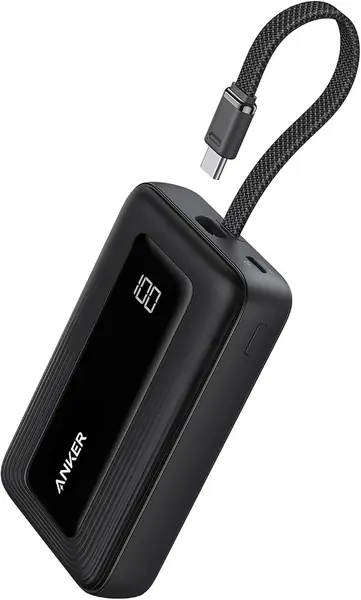
The cable is attached, and that is most of the argument. Anker builds a 5.4-inch USB-C cable into the side of this pack, rates it for 10,000 bends, and shapes it so it doubles as a loop you can hang off a finger while your phone charges. In an airport seat with one hand free, that is the difference between charging and rummaging through a bag.

The rest of the spec sheet is sensible rather than spectacular: 10,000mAh, 30W out with 20W back in, and a body measuring 4.32 by 2.58 by 0.98 inches. Anker rates it for about two full charges of an iPhone 15 and half a battery on an iPhone 16 Pro Max in 27 minutes. Against the budget 10,000mAh packs here, that 30W is the number that matters, because it turns a coffee stop into a real top-up instead of a trickle.

This is the pack we keep in the day bag, because it hits the balance most trips actually need: enough for a full day of maps and photos, small enough to forget, and quick enough that a 20-minute wait at a gate is worth plugging in for. The 18-month warranty matters more than it sounds in a category where early failure is the common complaint, and Anker's record across this group is the steadiest of the budget-adjacent brands.

At just under eight ounces it is not the lightest ten-thousand here; the Zmmyuluo is about an ounce and a half lighter. That difference disappears in a jacket pocket, and the Zolo is the one we trust when the pack is the only backup between you and a dead phone at a foreign train station.

Pros

  • Cable is built in, so nothing gets left behind
  • 30W output makes a short top-up worthwhile
  • Pocketable at 7.9 oz and under an inch thick

Cons

  • Built-in cable is USB-C only
Our verdict

Our pick for most travelers: two phone charges, a 30W top-up, and a cable you cannot leave on the nightstand.
Check Latest Price
2

Anker 25,000mAh 165W Best for Laptops

92 /100
TKZ Score Outstanding

Key details

Capacity
25,000mAh
Built-in Cables
Two, one retractable
Ports
3 USB-C + 1 USB-A
Total Output
165W
View on Amazon

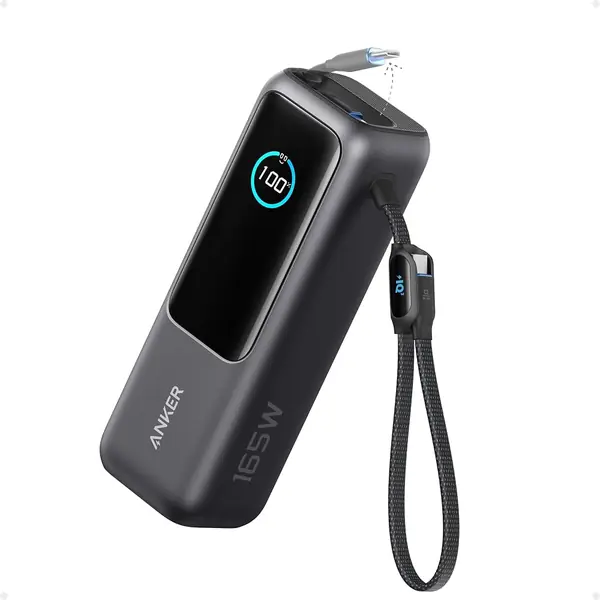
If a laptop is coming on the trip, this is the pick and the Zolo is not close to it. Three USB-C ports that each deliver up to 100W, 165W in total, and a 25,000mAh reserve: enough to run a MacBook Air, a phone, and earbuds off one brick, then do it again the next day. It is a 1.92-inch-thick slab and it feels like one in a jacket pocket, but nothing else on this page asks a laptop to charge at that speed.

The retractable cable is the detail we did not expect to care about and now do. It pulls out to 2.3 feet and is rated for 20,000 retractions, so there is no cable loose in your bag and none dangling across a cafe table; a second 0.98-foot cable doubles as the carry loop. Four devices at once is realistic here rather than theoretical, because the total output is high enough to feed them. Refilling is quick too, about two hours with a 100W charger, which matters when you are changing hotels every night.

The reservation is longevity. Some units stop accepting a charge after a few months, and losing a pack at this price stings; the 18-month warranty is the backstop, and it is the reason this stays a recommendation rather than a warning. It is also the only premium-priced pack here, and you are paying for laptop-class output, not for looks.

Pros

  • Charges a laptop, phone, and earbuds at once
  • Retractable cable ends cable hunting
  • 25,000mAh covers multi-day trips

Cons

  • Thick and heavy in a jacket pocket
  • Some units quit within months
Our verdict

The travel pack we point laptop carriers to: 165W, 25,000mAh, and two built-in cables, paid for in bulk.

Check Latest Price
3

INIU P512 20,000mAh Best High-Capacity Value

91 /100
TKZ Score Outstanding

Key details

Capacity
20,000mAh
Size
4.1 × 2.8 × 1.1 in
Max Output
22.5W
Recharge Time
5.4 hours
View on Amazon

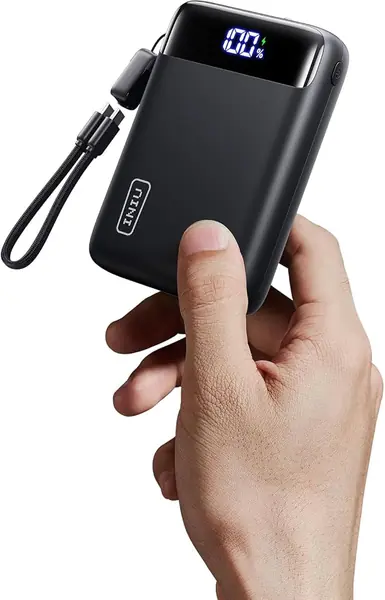
The numbers on the side are what sold us: INIU puts the remaining charge on a small screen in percentages, so you know whether you have 40% or 4% before you commit a phone to it. Four dots or a row of lights cannot tell you that, and at an airport it is the only readout we actually use.

This is the pack we take when the day is long and there is no outlet in sight: a flight, a festival, a theme park. Twenty thousand milliamp-hours is the cheapest way here to get that much reserve, it measures 4.1 by 2.8 by 1.1 inches, and the 22.5W output is plenty for a phone or a tablet. The built-in USB-C cable doubles as a lanyard, there is a flashlight on the side, and the three-year warranty is the longest coverage in this roundup. Of the two 20,000mAh packs here, this is the one we reach for first.

Two things to plan around. It is a two-hand pack, not a pocket one, and that bulk is simply how 20,000mAh gets made. And it needs 5.4 hours to refill, so it goes straight onto the charger when you walk into the room rather than at bedtime, when a late start leaves you carrying a half-empty brick the next morning.

Pros

  • Percentage display removes the guessing
  • 20,000mAh at the lowest price of any high-capacity pick
  • Three-year warranty, the longest here

Cons

  • 22.5W is too little for a USB-C laptop
Our verdict

The most charge per dollar here, with a percentage readout and the longest warranty of any pick.

Check Latest Price
4

HELLEE 15,000mAh Power Bank Best for Sharing

90 /100
TKZ Score Outstanding

Key details

Capacity
15,000mAh
Built-in Cables
4
Outputs
6
Weight
8.8 oz
View on Amazon

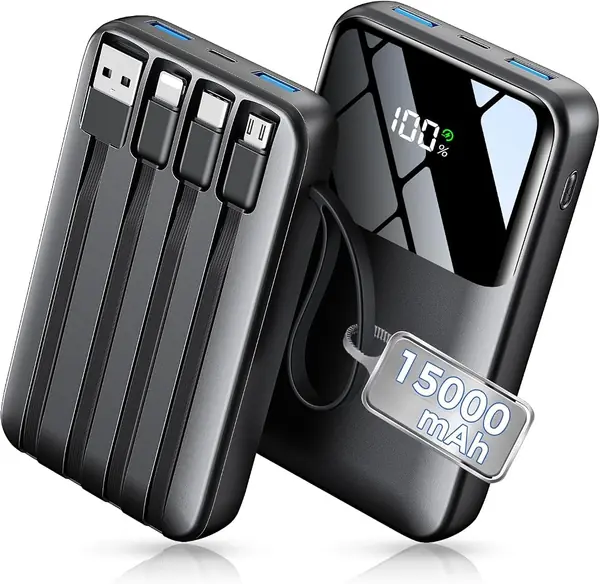
Hand this to a kid with an iPad and a friend with a Galaxy at the same time and both keep moving. Six outputs and four built-in cables is more than anyone traveling alone needs, and exactly right for a family day at a park or a beach, where the phone that dies is rarely yours.

What we like most is the middle capacity. Fifteen thousand is 50% more than the 10,000mAh packs here and meaningfully lighter than the 20,000mAh ones, so it covers a full day for two phones without the brick feel. The digital display shows the exact percentage, and a three-hour refill is the second-fastest here after the Anker 25K, which means an afternoon back at the hotel resets it completely.

It is a bag pack rather than a pocket one, and the four cables are the only ones you get, so treat the Lightning one kindly. Nothing else in this roundup gives you six ports for the money, and the built-in cables are the reason to choose this over a plain 15,000mAh brick with two ports and a prayer.

Pros

  • Six outputs keep a group charged
  • Four built-in cables cover most phones
  • Three-hour refill is quick for the capacity

Cons

  • Bulky in a pocket at 1.1 inches thick
Our verdict

The pick for two or three people charging at once, with the fastest refill of any mid-size pack here.

Check Latest Price
5

Zmmyuluo 10,000mAh Power Bank Pocket Carry

89 /100
TKZ Score Excellent

Key details

Capacity
10,000mAh
Built-in Cables
4
Size
4.4 × 2.3 × 0.77 in
Weight
6.6 oz
View on Amazon

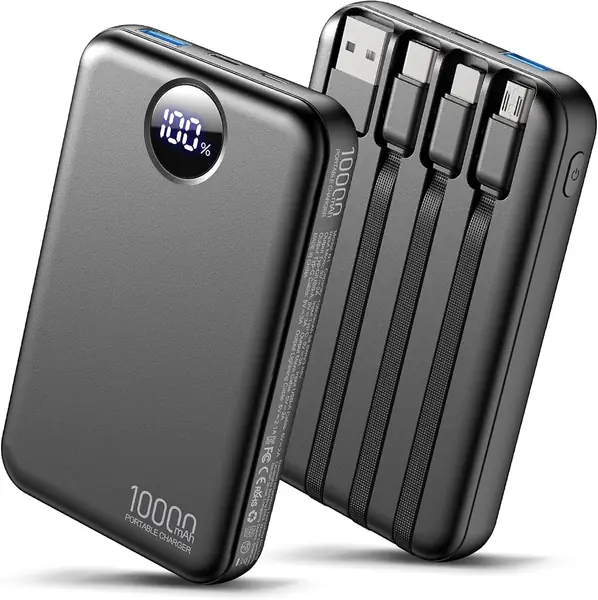
At 4.4 by 2.3 by 0.77 inches and 6.6 ounces, this is the smallest and lightest pack in the roundup, short enough to sit alongside a phone in a jacket pocket and light enough that you stop noticing it. It still carries 10,000mAh, four built-in cables and an LED percentage display, which is a lot of hardware for the size.

We treat it as the second pack rather than the only one. It is what goes in a small bag for a concert, a day hike, or a long museum afternoon, where the goal is one dependable top-up instead of three days of independence. The four cables mean it can rescue someone else's phone too, which in practice is most of what a pocket pack gets used for.

Speed is the compromise. The listing gives 3A output and no fast-charge wattage figure, and it behaves accordingly: steady rather than quick, so budget an hour for a serious top-up. The warranty is also the shortest here at a year. Neither matters much for the job it is doing, and neither makes it a substitute for the Anker if one pack has to carry a whole trip.

Pros

  • Smallest and lightest pack here at 6.6 oz
  • Four built-in cables cover most devices
  • LED display shows the exact percentage

Cons

  • Charging is steady rather than fast
  • One-year warranty is the shortest here
Our verdict

The one to slip into a small bag: 6.6 ounces, four cables, and enough for a single solid top-up.

Check Latest Price
6

VRURC 10,000mAh Power Bank Best for Mixed-Device Groups

88 /100
TKZ Score Excellent

Key details

Capacity
10,000mAh
Built-in Cables
4
Outputs
5
Recharge Time
6 hours
View on Amazon

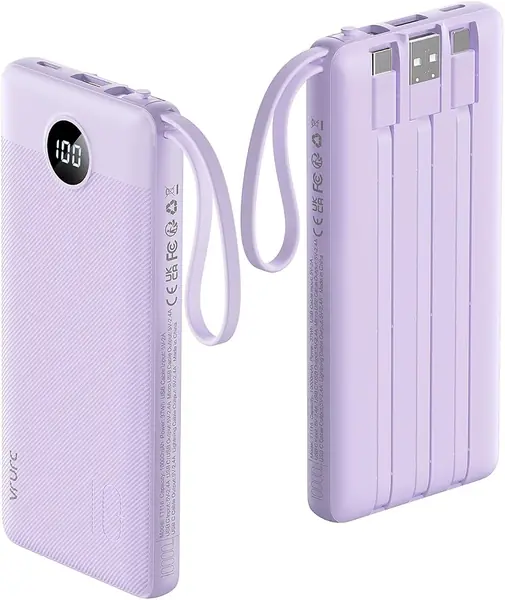
Micro-USB is the giveaway. This pack carries four built-in cables, USB-C, Lightning, micro-USB and USB-A, which is one more connector than anything else on this page and the reason it ends up in a shared bag. Old earbuds, a kid's tablet, a friend's aging Android: there is a plug for all of them.

Otherwise it is a well-sorted 10,000mAh pack: five outputs, an LED percentage display, a lanyard built into the body, a travel pouch in the box, and a 37Wh rating that clears the carry-on rule with room to spare. At 9.2 ounces it is heavier than the Anker Zolo at the same capacity, which is what four cables cost you in the hand.

The cost is pace. This has the lowest output and the longest refill in the roundup, and neither is a rounding error when you are topping up a dead phone before a train. It is the pack we pass around a table rather than the one we rely on through a whole day of navigation, and that is the honest boundary of what it is for: buy it for the connectors, not the speed.

Pros

  • Four built-in cables cover nearly any phone
  • Five outputs charge several devices at once
  • 37Wh rating clears airline carry-on limits

Cons

  • 2.4A output is the slowest here
  • About six hours to refill
Our verdict

The group pack: four built-in connectors and five outputs, if you can live with the slowest charging here.

Check Latest Price
7

Orfeika 20,000mAh Power Bank Best for Two-Device Travel

87 /100
TKZ Score Excellent

Key details

Capacity
20,000mAh
Built-in Cables
4
Outputs
6
Max Output
20W
View on Amazon

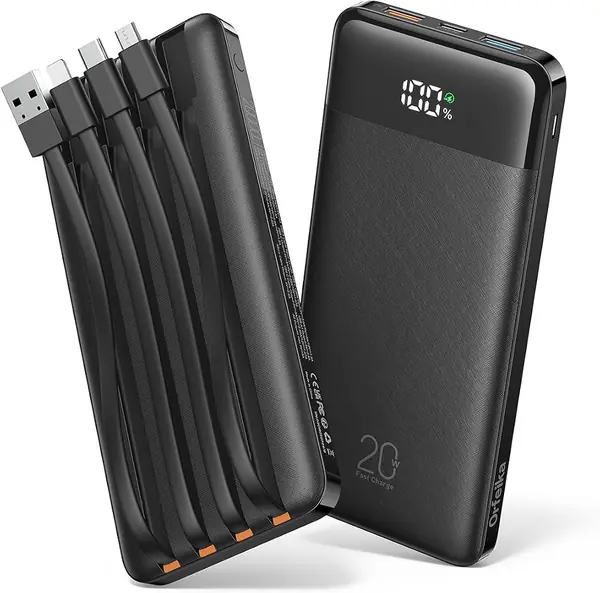
Against the other 20,000mAh pack here, this one trades a little speed for a lot of cable. Orfeika builds in four cables, three outputs plus an input, and pairs them with six outputs total, so a family of four can plug in and still leave ports free. The LED display reads in percentages and the body is 0.74 inches thick.

The capacity claim is the interesting part: Orfeika says you get three charges for an iPhone 16 out of it while weighing only 35% more than a standard pack. At 0.73 pounds it lands in the same territory as the INIU, so the practical difference between them is cable count and port count, not weight.

The gap to the INIU is small and mostly about pace. Slightly less output, a slightly longer body, and one extra built-in cable instead of one. If you are charging two phones and a tablet on a trip and would rather not pack cords at all, that trade goes Orfeika's way; if you want the fastest top-up of the two, it does not.

Our advice is to give it a full discharge and recharge at home before you pack it, because the units that fail tend to fail early, and a power bank that dies on day two of a trip is worse than none at all. Do that, and the two-year warranty covers a sensible, well-priced high-capacity pack.

Pros

  • Six outputs with four cables built in
  • 20,000mAh at 0.73 lb
  • Two-year warranty

Cons

  • 20W is the slower of the two 20,000mAh picks
  • Some units fail within weeks
Our verdict

A 20,000mAh pack with four cables and six outputs, for two-device travelers who want capacity without a laptop brick.

Check Latest Price
8

FancyBean 2-Pack 10,000mAh Best for Two Travelers

86 /100
TKZ Score Excellent

Key details

Capacity
10,000mAh per pack
Built-in Cables
Lightning and USB-C
Outputs
4 per pack
Size
5.83 × 2.68 × 0.63 in
View on Amazon

Two packs for roughly the price of one mid-range pick here is the whole pitch, and it holds up for a specific kind of trip. Each unit is a 10,000mAh portable charger with a Lightning cable and a USB-C cable built into the body, plus two USB-A ports and a percentage display. One stays in the room, one comes with you.

The built-in cables are the practical part. Lightning covers older iPhones and iPads without a dongle, USB-C covers everything current, so a household with mixed hardware travels without anyone packing a cord. They are slim, too, at 0.63 inches, which slides into a purse or a seat-back pocket without a fight.

There is no power button, and that is the detail that annoys us. The display lights up when you plug something in, so you cannot check the level in your bag without committing a device to it first. Charging speed is also the least predictable number on the page, with some units moving a phone along briskly and others taking their time.

Buy it as a pair for two travelers or as a glovebox and desk-drawer spare, and the three-year warranty, matching the longest here, is real comfort at this price. It is not the pack to carry alone through a photo-heavy week in a new city; it is the one you own two of so you stop thinking about charging entirely.

Pros

  • Two packs for about the price of one mid-range pick
  • Lightning and USB-C cables built in
  • Slim 0.63-inch body fits a seat pocket

Cons

  • No power button to check the level
  • Charging speed varies between units
Our verdict

The two-pack for couples and mixed hardware: built-in Lightning and USB-C, with a spare always charged at the hotel.

Check Latest Price

How We Tested 14 Power Banks on the Road

We started by gathering every power bank sold as a travel pack and cutting the list by capacity, port count, and claimed footprint. From there we bought 14, skipping anything that couldn't legally fly in a carry-on. Testing ran six months, mostly on the move: red-eye flights, a commuter train, hotel rooms with one outlet hidden behind the nightstand, and long walking days with a bag on one shoulder.

Capacity and charging speed we measured the boring way. We drained a phone to zero, plugged in, and timed how long it took to hit 50 percent and then full, noting whether the pack got warm enough to feel through a pocket. Then we kept going until the pack died and counted full phone charges — which is where labels and reality part ways.

Portability got handled literally: each pack went into a jacket pocket and a sling bag, and we weighed it against the phone in the other hand. Built-in cables were bent at the connector and yanked — once because I stood up with the phone still attached. Durability came from living with them: tossed in a tote with keys, dropped on tile, and recharged on a loop to see if ports loosened or a display flickered.

For value, we compared what each one delivered per dollar rather than what the box promised, and noted the small things: a display readable in daylight, labeled ports, whether a pack could top itself up while I showered. That's how the list below got sorted.

How to Choose a Power Bank for Travel

Start With the Airline Limit

Spare lithium batteries fly in the cabin, not in checked bags, and most airlines cap a carry-on pack at 100Wh, which works out to about 27,000mAh. Every pack here clears that line comfortably, from the 37Wh VRURC to the 25,000mAh Anker at roughly 90Wh. Above 27,000mAh you are into paperwork and gate-agent judgment, and no traveler's problem is solved by that.

So shop capacity against the trip rather than against the biggest number on the page. A week of city days wants 10,000mAh. A long-haul flight with a tablet and a second phone wants 20,000mAh. A laptop changes the question entirely, which is the next section.

Watts Decide What You Can Charge

A phone draws only what it accepts, so a 165W pack does not fill a phone any faster than a 30W one; the extra power shows up with a laptop. If a MacBook or a USB-C Windows machine is coming with you, look for 45W and up on a single port with USB-C Power Delivery. The Anker 25K's three 100W ports are the only ones here built for that job.

For phones and tablets, 20 to 30W is the useful range and most of this group clears it. A pack that advertises amps rather than watts is usually the slower sort, and 2.4A is the number to recognize as slow.

Cables Are Where Trips Go Wrong

A built-in cable is the biggest convenience upgrade in this category: nothing to forget, nothing to untangle in a middle seat. The catch is that it is soldered in. When the Lightning connector on a four-cable pack frays, that output is gone for good, so treat the cable you use most with some care.

Two checks before you buy. The built-in connector has to match your phone, which rules out an iOS-only cable for a USB-C household. And the pack has to be refillable through a connector your wall charger already has; a USB-C cable that works in and out does both jobs. A portable charger with one good USB-C cable is more useful than four you cannot use.

Weight Decides Whether It Comes With You

Ten thousand milliamp-hours lands around 7 to 9 ounces and disappears into a jacket pocket. Twenty thousand runs 11 to 12 ounces and belongs in a personal item, not a pocket. The 25,000mAh Anker is a bag-only proposition, and it earns that only if a laptop is in the bag too.

If the pack travels every day, buy the light one and recharge it nightly. If it only leaves the house on trips, the extra capacity of a 20,000mAh pack costs you an ounce or two and nothing else.

Feeding the Pack Takes Longer Than You Think

Refilling is the overlooked half of the spec sheet. Times here run from about two hours on the Anker 25K with a 100W charger to six on the VRURC; the INIU P512 wants 5.4 and the HELLEE three. A pack that is still at 40% when you check out is dead weight for the rest of the day.

Match the pack to your charger and start it the moment you reach the room. A 30W USB-C wall charger refills everything here except the big Anker, and it is worth packing deliberately, because most of these ship without one.

Frequently Asked Questions

Final Verdict

Most travelers should buy the Anker Zolo. It fits a jacket pocket, refills a phone twice, and comes with the cable attached, which is the detail that decides whether a power bank actually travels with you. At 30W a short wait is worth it, and the 18-month warranty gives you somewhere to go if it fails.

Two requirements change the answer. If a laptop is in the bag, the Anker 25,000mAh is the only pack here that will run it at speed, and the extra bulk is the price. If you want the most charge for your money and do not mind charging it for an evening, the INIU P512 delivers 20,000mAh and a percentage readout for less than the rest of the high-capacity group.