Best Power Banks for iPhone of 2026

The gate agent calls your boarding group, and your phone reads 6 percent. That's the moment a power bank stops being an accessory and becomes the thing standing between you and a boarding pass you can't pull up on screen. A good one hands you a full charge in about the time it takes to drink a coffee, without turning your jacket pocket into a brick. The catch is that the number on the box is optimistic: capacity is measured at the battery's internal voltage, so a slim pack rated at 10,000mAh will not push a full 10,000mAh into your iPhone once conversion losses are factored in. Expect roughly two-thirds of the advertised figure and you'll shop much more accurately.

Over the past seven months, my team and I have been living with 11 of these — clipping them to bags, forgetting them in coat pockets, and topping up phones on commutes, flights, and a very long weekend of camping. The differences that mattered weren't the ones I expected. Built-in cables saved me constantly, magnetic pads turned out to be either magic or useless depending on the phone case, and the packs that ran cool through a full charge were the ones I kept reaching for.

The Best Power Banks for iPhone

1

INIU P512 20000mAh Best Overall
94 /100
TKZ Score Outstanding

Key details

Battery Capacity
20000mAh
Max Output
22.5W
Self-recharge Time
5.4 hours
Built-in Cable
USB-C lanyard cable
View on Amazon

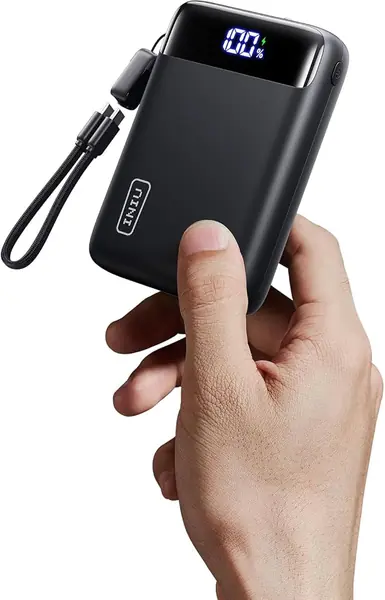
A 20,000mAh pack usually arrives as a brick, and this INIU is the one that doesn't feel like one. At about 4.1 by 2.8 by 1.2 inches it slips into a jacket pocket or a small purse, and it still holds enough for roughly three full iPhone charges. That balance is why it sits first: other picks here beat it on size or on output, but none gives you this much capacity in a body you'll actually carry.

The details are what kept it in our bag. The readout gives a real percentage rather than four unhelpful dots, so you know whether you're leaving with half a charge or a tenth. The built-in USB-C cable doubles as a lanyard, which sounds like a gimmick until you're the person at a concert with the charger hanging off your wrist, and the 22.5W output is enough to hit an iPhone's fast-charging ceiling, which sits near 20W. There's a flashlight built in too, a small thing that earns its keep in a parking garage or a tent.

Weight is the honest trade. This is a dense block, and a full day in a jeans pocket is a stretch — it's a jacket-and-backpack battery, not a front-pocket one. What that buys you is a pack that flies without a second thought at roughly 74Wh, and the longest warranty in this group at three years.

Pros

  • Three-plus iPhone charges from one pack
  • Built-in USB-C cable doubles as a lanyard
  • Percentage readout instead of guesswork dots
  • Three-year warranty, the longest here

Cons

  • Older iPhones need their own Lightning cable
  • Slow self-recharge at about 5.4 hours
Our verdict

For most iPhone owners this is the one to buy: three-plus charges in a body small enough to live in a bag, with the longest warranty here.
Check Latest Price
2

Anker 20000mAh 87W Best for Travel

93 /100
TKZ Score Outstanding

Key details

Battery Capacity
20000mAh
Max Output
87W across 3 ports
Self-recharge Time
1.5 hours
Built-in Cable
USB-C
View on Amazon

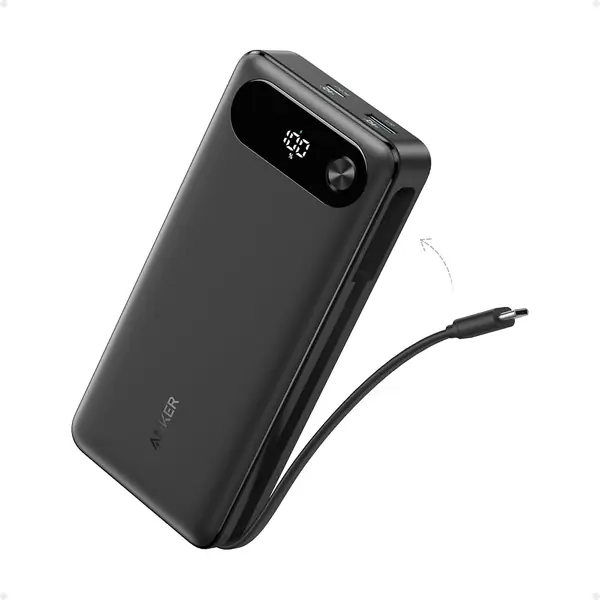
What separates this Anker from our top pick is wattage: 87W shared across three ports, with up to 65W to a single device, against 22.5W for the INIU. That's the difference between a phone charger that can rescue a 14-inch MacBook Pro and one that can't, and it's the reason this one travels with us on work trips.

Our take is that it's the right bank for a bag with a laptop in it and overkill for anything else. On a phone-only trip you're paying for output you'll never use, and the 20,000mAh INIU does the same phone duty for a lot less. But when one brick tops up an iPad, a Switch and a phone on a single charge, and the built-in USB-C cable means there's nothing to forget on the hotel desk, the premium starts to make sense.

The number we keep coming back to is 1.5 hours — how long the pack itself takes to refill from a 65W charger, far and away the fastest here, so an overnight stop leaves you full rather than hopeful. The integrated cable is rated for 10,000 bends, a figure that matters the first time a cable fails at the strain relief.

Pros

  • 87W output charges a laptop and a phone
  • Refills in about 1.5 hours
  • Built-in USB-C cable rated for 10,000 bends

Cons

  • Heavy at 15.2 ounces
  • Some units stop holding charge within 18 months
Our verdict

Buy it when a laptop shares your bag: it replaces two chargers, refills in about 90 minutes, and still carries a phone for days.

Check Latest Price
3

Anker MagGo 10K Best MagSafe

92 /100
TKZ Score Outstanding

Key details

Battery Capacity
10000mAh
Thickness
0.58 in
Wireless Charging
15W Qi2
Wired Output
30W USB-C
View on Amazon

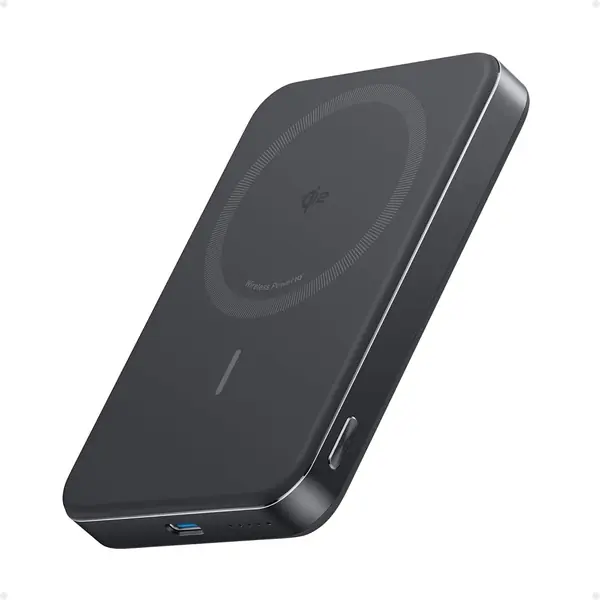
Snap it on and it stays. The magnet ring grabs an iPhone hard enough that you can lift the phone by the pack, and it self-centers every time, so there's no hunting for the sweet spot the way there is with cheaper magnetic discs. For cable-free charging that's the whole appeal: the phone tops up in a pocket, on a train table, or on a nightstand where a cord would be in the way.

This is the magnetic pack we recommend if you're going to own one. The 15W Qi2 charging is the fastest an iPhone takes wirelessly, the matte metal body is 0.58 inches thick and feels better made than anything else in this group, and a 30W USB-C port covers you when you want speed over convenience. Ten thousand milliamp-hours works out to about 1.8 iPhone charges, so it's a long day out rather than a weekend.

Where it earns its keep is the small stuff. The phone charges while you're walking, the pack still works as a wired bank when the phone is low and you're late, and the 24-month warranty is the longest of the magnetic picks. Two things to know: wireless charging generates heat here, and at 215.9 grams this is heavier than a magnetic pack looks like it should be.

Pros

  • Magnet holds and self-centers reliably
  • 15W Qi2, the fastest iPhone wireless rate
  • Slim metal body at 0.58 inches

Cons

  • Can run hot enough that an iPhone pauses charging
  • Heavy for a magnetic pack at 215.9 grams
Our verdict

This is the magnetic bank we recommend if you want the good version — it holds hard, charges at the fastest wireless rate, and costs accordingly.

Check Latest Price
4

HELLEE 15000mAh Best Built-In Cables

91 /100
TKZ Score Outstanding

Key details

Battery Capacity
15000mAh
Max Output
22.5W
Self-recharge Time
3 hours
Built-in Cables
4 built-in leads
View on Amazon

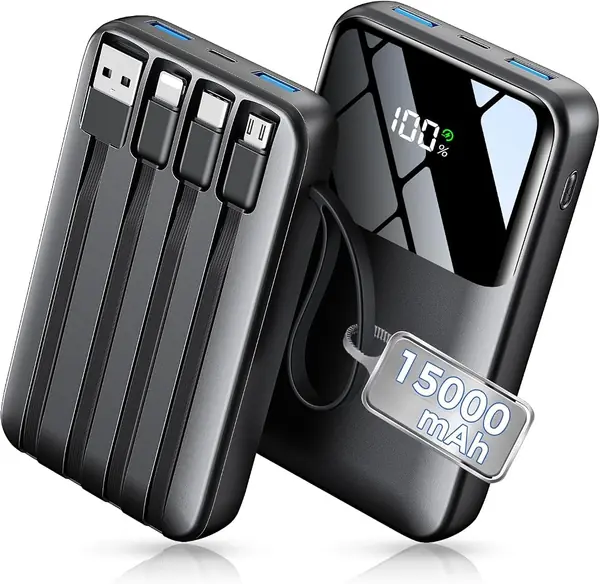
Four built-in leads — USB-C, iOS, micro-USB and USB-A — are the reason this one earns a place. Nothing else here lets you hand a cable to a friend with an Android phone and then charge your own iPhone without opening a bag. As a portable charger for a group, that beats another 5,000mAh of capacity nobody can reach.

Fifteen thousand milliamp-hours is the sweet spot of this lineup: about three and a half iPhone charges, which is a full day of photos, maps and hotspot for two people, without the brick feeling of the 20,000mAh-and-up packs. The display gives a percentage instead of a guess, 22.5W maxes an iPhone's fast charge, and six outputs mean everyone can plug in at once.

It's still a bag item. At six inches long, 1.1 inches thick and 250 grams, plan on a backpack or a tote rather than a pocket, and expect about three hours to refill it — quicker than several smaller packs here. The price sits near the bottom of this group without feeling like a corner was cut.

Pros

  • Four built-in leads cover iPhone and Android
  • About three and a half iPhone charges
  • Percentage display and six outputs

Cons

  • Warranty terms are left vague
Our verdict

Built for the household or car full of mixed phones: four leads, three-plus charges, and nothing extra to pack.

Check Latest Price
5

IAPOS 60000mAh Best for Off-Grid Weekends

90 /100
TKZ Score Outstanding

Key details

Battery Capacity
60000mAh
Max Output
22.5W
Weight
15.5 oz
Built-in Cable
3-in-1 cable
View on Amazon

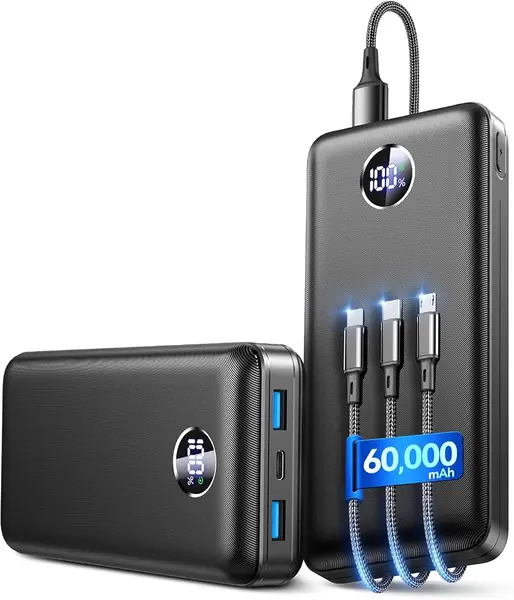
Sixty thousand milliamp-hours is a different category of thing. This is the pack you take when there's no outlet for three days — a camping weekend, a festival, the week the power keeps going out — and it keeps several phones alive without breaking a sweat.

The hardware is built for that job. A 3-in-1 cable covers USB-C, iOS and micro-USB, two USB-A ports and a USB-C port take the rest, so five devices can be plugged in at once, and the digital display tells you what's left before you commit it to a tent full of people. Output is 22.5W, which still fast-charges an iPhone rather than trickling into it.

Size follows capacity: roughly six by three by an inch and a bit, 15.5 ounces, a two-hands object that lives at the bottom of a backpack and comes out once a day. That's how it should be used — this is a pack you plan around, not one you keep in a jacket.

What it's for is the long trip. On reserve alone nothing else here is close, and the three-year warranty suits the slow, occasional way a pack like this gets used. We treat it as a car-camping and outage battery, and on that job it has no competition in this group.

Pros

  • Enough reserve for a multi-day trip
  • Charges five devices at once
  • Three-year manufacturer warranty

Cons

  • Over the 100Wh carry-on limit
Our verdict

For off-grid weekends and storm weeks this is the reserve to own, as long as you understand it's a backpack battery and not a pocket one.

Check Latest Price
6

TRKOY W5 Best for Lightweight Top-Ups

89 /100
TKZ Score Excellent

Key details

Battery Capacity
5000mAh
Weight
4.23 oz
Thickness
0.46 in
Wireless Charging
15W magnetic
View on Amazon

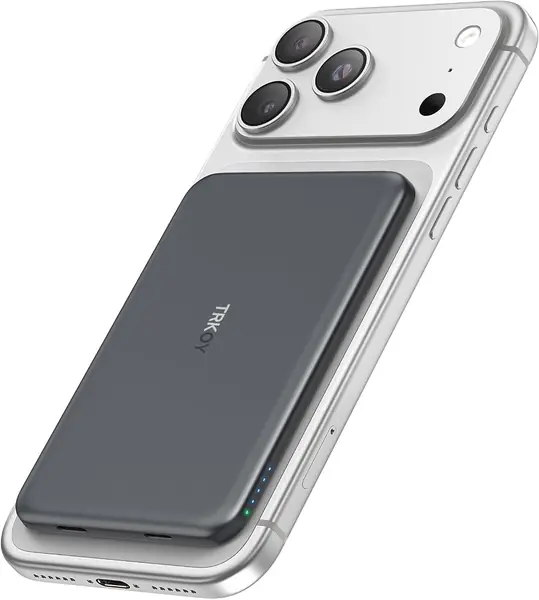
At 120 grams and 0.46 inches thick, this is the lightest thing in our lineup — noticeably lighter than the Anker magnetic pack, and thin enough that a phone with it attached still slides into a coat pocket. That's the whole reason to choose it: you forget it's there until you need it.

The trade is capacity, and it's a fair one: 5,000mAh is about one full iPhone charge, which is a night out or a long travel day rather than a weekend. The magnet centers itself and holds, there's a USB-C port when you want a wired top-up instead, and three years of warranty is generous at this price.

We think of it as the emergency pack — the one in the glovebox or the jacket pocket that gets checked now and then. If your phone is near an outlet at some point most days, that's a better use of weight than a 20,000mAh brick you resent carrying. If you're regularly two days from power, it isn't enough, and the top pick is.

Pros

  • 120 grams, the lightest pick here
  • Strong magnet plus a wired fallback
  • Three-year warranty at a budget price

Cons

  • Magnetic charging needs iPhone 12 or later
Our verdict

The pick for a charger you forget you're carrying: one full iPhone charge, almost no weight, and a price near the bottom of this group.

Check Latest Price
7

Zmmyuluo 10000mAh Budget Everyday Carry

88 /100
TKZ Score Excellent

Key details

Battery Capacity
10000mAh
Self-recharge Time
4 hours
Weight
6.63 oz
Built-in Cables
4 built-in leads
View on Amazon

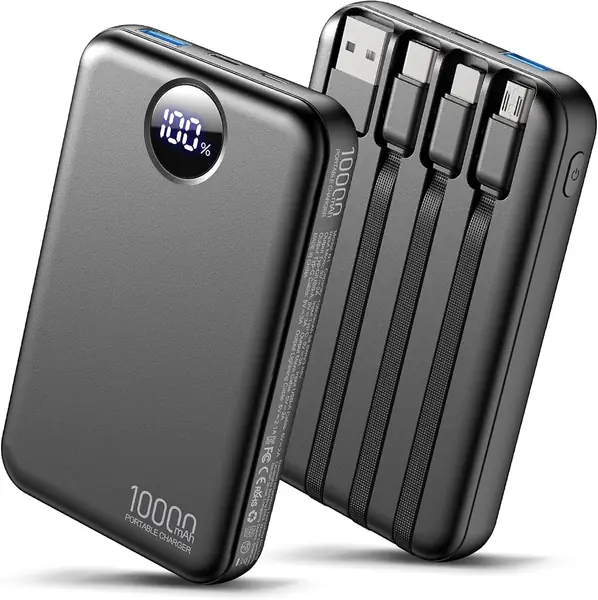
Nothing here costs less, and nothing here feels like a penalty box. At 188 grams it's about the heft of a phone in a case, and at 4.4 by 2.3 inches it disappears into a coat pocket or a small bag, which is more than several bigger packs in this group can claim.

Four built-in leads do the work — USB-C, iOS, micro-USB and USB-A — so it charges an iPhone and a friend's Android without a single loose cable, and the LED display shows what's left as a percentage rather than a blinking light. Ten thousand milliamp-hours is good for about two full iPhone charges, and refilling it from empty takes roughly four hours.

What we like most is that nothing here feels like a compromise on the basics: the cables are always attached, the display means you're never guessing, and the whole thing weighs about as much as the phone it's charging. It's the pack we hand over without a second thought — a theme-park day, a fishing trip, a bag that gets tossed in a trunk — which is what a budget battery should be.

Pros

  • Four built-in leads need no extra cable
  • 188 grams, about the weight of a phone
  • LED display shows exact percentage

Cons

  • One-year warranty is the shortest here
Our verdict

The budget pack that gets the basics right — four leads, an honest display, and phone-like weight — with the shortest warranty here.

Check Latest Price

How We Tested the Best Power Banks for iPhone

We started by pulling every power bank we could find that charged over USB-C, held at least 5,000mAh, and landed in a price range most people would actually pay for a battery they carry daily. That cut a long list down to a shortlist of 11 units spanning slim magnetic packs, pocket-size bricks with molded-in cables, and one genuinely enormous multi-device model. Before any charging happened, I weighed each one on a kitchen scale and measured how it sat in a jeans front pocket and a jacket interior pocket, since a pack you resent carrying is a pack you leave at home.

Then we used them the way people actually do. Each pack went through a week of commutes, and we timed how long it took to push a dead iPhone to 50 percent, then to full, recording the percentage the phone displayed every five minutes. Two came on a cross-country flight, where we also checked each unit's printed watt-hour rating against airline carry-on limits. One went camping for three nights and had to keep two phones and a headlamp alive. The magnetic models lived on the back of a phone during calls, navigation, and a full day at a theme park, because that's where wireless charging gets hot and slow.

We ran each pack from full to empty repeatedly and counted how many complete phone charges it actually delivered rather than trusting the box. A pack sat on a shelf for a month, then we checked how much of that stored charge survived. To test durability, we dropped each one from counter height onto tile and let it rattle around a tote bag with keys for a few weeks, watching for cracked housings and frayed built-in cables. Heat got a hand check every 15 minutes during fast charging — the packs that grew uncomfortably warm got flagged, because a hot battery is a battery losing energy it should be sending to your phone.

How to Choose a Power Bank for Your Iphone

Start With Usable Charge, Not the Label

Capacity is quoted at the cell, not at your phone. Conversion losses take a bite out of every pack, so budget for roughly two-thirds of the number on the label. The 10,000mAh models here are rated for about two iPhone charges, 15,000mAh for about three and a half, and 20,000mAh for three to four. A 5,000mAh magnetic pack is one charge, which is the right size for an evening out and the wrong one for a weekend.

Pick by the longest stretch you'll be away from an outlet rather than by the biggest number you can afford, then weigh what that capacity costs you in ounces. A pack you leave in a drawer because it's too heavy charges nothing.

Wattage: Match It to the Phone, Not the Billboard

An iPhone's fast charging tops out near 20W over USB-C, so the 22.5W packs here already max it. A 45W or 87W bank doesn't fill the phone faster; it buys headroom for an iPad or a laptop and, just as usefully, a much quicker refill of the bank itself — about 90 minutes on the 87W Anker versus more than five hours on our 20,000mAh top pick.

Watch the marketing wattage. Large numbers on cheap packs often describe a proprietary Android fast-charge protocol an iPhone ignores. Wireless has its own ceiling too: 15W on a Qi2 pack is the fastest an iPhone accepts without a cable, and it is still slower.

Cables, Magnets, and What You Carry

Three designs, three habits. A built-in cable is the one you can't leave at home, and the packs with three or four leads can rescue a friend's phone or a pair of earbuds without a pouch of adapters. A magnetic pack snaps onto the back of a compatible iPhone and charges through the case: the most convenient thing here for a crowded train or a pocket, and the slowest.

Decide by where the pack lives. In a pocket, low weight and a magnet win. In a backpack, you'll get more out of built-in leads than out of a slim profile.

Weight, Size, and the Carry-On Rule

Expect roughly 6 to 9 ounces for 10,000mAh, 11 to 15 ounces for 20,000mAh, and a pound or more for the 50,000 and 60,000mAh packs. Compact in a listing usually means it fits a bag, not a jeans pocket, so picture where it will actually live before you buy.

The flight rule is hard: U.S. carry-on limits allow batteries up to 100Wh without airline approval, which works out to about 27,000mAh. The 20,000mAh packs here sit around 74Wh and clear it easily. The 50,000 and 60,000mAh models don't, so plan those for road trips, camping, and storms.

Frequently Asked Questions

Final Verdict

In a category full of inflated numbers, the INIU P512 is the pack we hand to most people: 20,000mAh in a body that still fits a coat pocket, a percentage readout instead of dots, a cable that works as a lanyard, and three years of coverage. It flies, it covers a long weekend, and it sits in the middle of this set on price.

Two picks answer narrower needs. If you charge without cables, the Anker MagGo's 15W magnet is the version worth paying for. If a laptop shares your bag, the 87W Anker replaces two chargers and refills in about 90 minutes. Everything else here is a budget, capacity, or weight special case — which is exactly how a roundup should end.