Best Power Banks for Backpacking of 2026

A dead phone on the third day of a backpacking trip is more than an inconvenience—it's a navigation and safety problem. A power bank that can't handle rain, a drop off a rock, or the weight penalty of your pack is dead weight, and I've carried a few. The right one keeps your phone, headlamp, and GPS alive without adding a brick to your base weight.

Over the past seven months, my team and I put 14 power banks through mud, rain, and long days on the trail, from ultralight models to rugged bricks with built-in cables. The spec sheet won't tell you how much a bank weighs after a week in a damp pack, or whether its ports still work after a drop on granite. Capacity numbers are optimistic, too—expect roughly two-thirds of the printed mAh in real charging.

We ranked these on how they performed when the sun went down and the phone was at 4 percent, not on how they looked on a desk. Some suit weeklong trips, others weekend missions. Here's what survived.

The Best Power Banks for Backpacking

1

NESTOUT Rugged 15000 Best Overall
92 /100
TKZ Score Outstanding

Key details

Weight
12.8 oz
Capacity
15,000mAh
USB-C Output
32W PD
Water And Dust Rating
IP67
View on Amazon

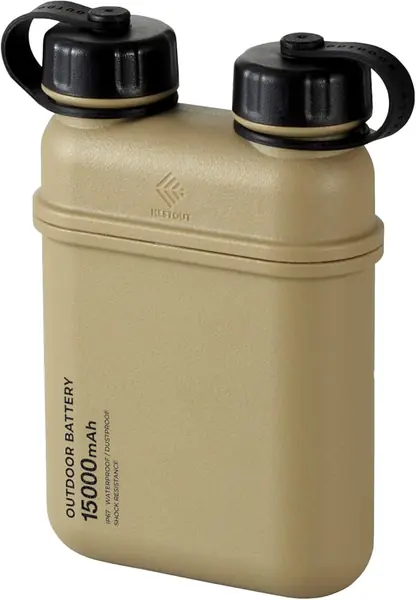
Most backpacking trips turn wet at least once, and the NESTOUT Rugged 15000 is the pack here that doesn't need to be babied when they do. The shell is a hard body with the cells wrapped in a silicone cushion and rated IP67 for dust and water. That's the reason it's our top pick: on a trip where a dead phone means no navigation, a pack that shrugs off a rainstorm and a fall onto rock is worth more than a lighter one that doesn't.

The capacity backs that up. At 15,000mAh it covers a long weekend of phone, headlamp, watch, and camera-battery top-ups with something left over, and the USB-C PD port pushes 32W, so a lunch-stop refill is genuinely quick. Three ports mean a phone and a watch charge at the same time without unplugging anything, and it holds its charge between trips rather than draining itself in a gear bin, so a pack charged in spring still has something in it in June.

Weight is what it asks in return. At 12.8 ounces it's roughly two and a half times the ultralight picks in this group, and on a fast trip where every item has to justify itself, that's a real argument against it. The way we see it, the extra ounces buy a weekend of power and a shell that survives the trip. If you're moving fast and light and your electronics already live in a dry bag, one of the lighter picks earns its place instead.

One detail worth knowing: the ports are sealed with O-rings under tethered caps, which is what makes the IP67 number believable in the first place. Check both caps are seated before the pack goes into a wet lid pocket. A cap left open is the one thing that undoes the rating.

Pros

  • IP67 shell survives rain, dust, and drops
  • 15,000mAh with 32W USB-C PD output
  • Three ports charge several devices at once

Cons

  • About 3.6 hours to refill from empty
Our verdict

We recommend the NESTOUT Rugged 15000 to backpackers willing to carry a few extra ounces in exchange for a phone that still works in bad weather.
Check Latest Price
2

Nitecore NB10000 Gen4 Best for Ultralight Backpacking

91 /100
TKZ Score Outstanding

Key details

Weight
4.94 oz
Capacity
10,000mAh
USB-C Output
22.5W, dual ports
Water Rating
IPX7
View on Amazon

At 4.94 ounces, the Nitecore NB10000 Gen4 is the lightest pack in this group, and the gap isn't cosmetic: it's roughly eight ounces lighter than our top pick. For a thru-hiker, or anyone who weighs gear by the gram, that single number settles most of the argument before you read another specification.

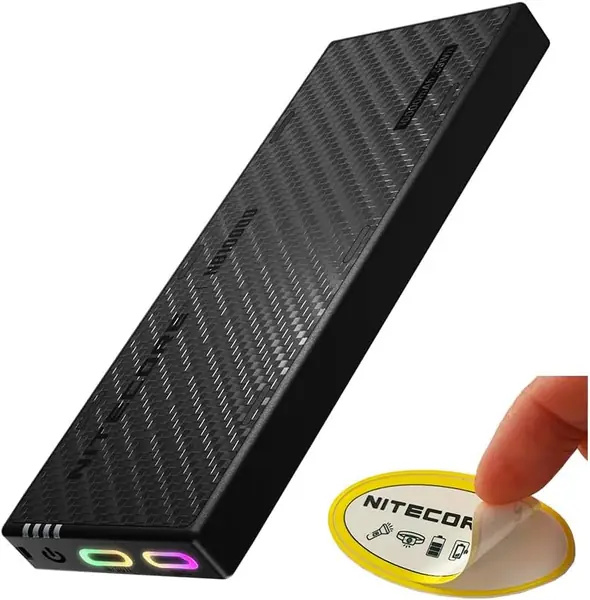
We like the rest of the design nearly as much. Both ports are USB-C and both deliver 22.5W, so it doesn't matter which one you grab, and small indicator lights sit right at the ports where you need them after dark. Pass-through charging lets it refill from a wall outlet while it tops up a phone, the exact sequence of a trail-town stop, and the lanyard is itself a USB-C cable. That trick is clever right up until the cable is the thing you lose, so keep a spare in the pack.

IPX7 sealing is the other reason it holds a place here: it can ride in an outside pocket through a rainstorm without a dry bag. The 4.57 by 1.84 by 0.81-inch body slides into a hipbelt pocket or a running vest, and 10,000mAh is still around two full phone charges. With the phone in airplane mode and the camera doing the work, that's a weekend.

Pros

  • Lightest pack here at 4.94 ounces
  • Dual 22.5W USB-C ports with pass-through
  • IPX7 sealed against rain and splashes
  • Lanyard doubles as a USB-C cable

Cons

  • The highest price here for 10,000mAh
Our verdict

For fast, light trips where every ounce shows up on a spreadsheet, the NB10000 Gen4 is the pack we reach for: under five ounces, sealed, and dual USB-C.

Check Latest Price
3

INIU Rugged 10000 Best Rugged Pick for Day Hikes

90 /100
TKZ Score Outstanding

Key details

Weight
6.9 oz
Capacity
10,000mAh
USB-C Output
45W
Water And Dust Rating
IP67
View on Amazon

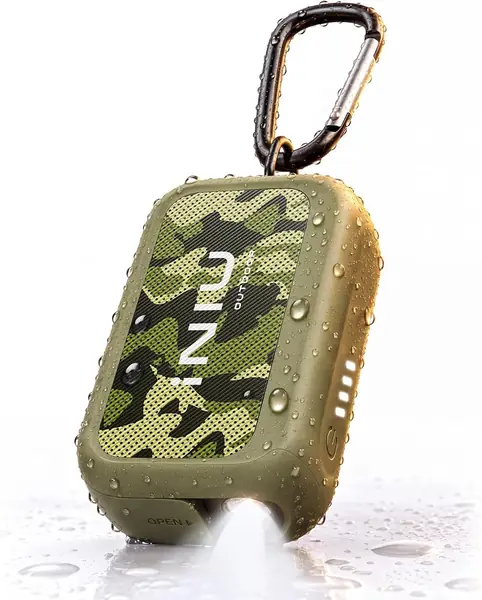
The INIU Rugged 10000 is sized for a day pack: 6.9 ounces, 3.6 by 2.3 by 1.1 inches, IP67, and a carabiner in the box. It's the shape you set down in wet gravel without thinking about it, hang off a pack loop, and forget about until the phone is at 8 percent.

Forty-five watts over USB-C is the number we didn't expect at this weight. That's more than most phones will pull and enough to give a tablet or a mirrorless camera a real boost during a twenty-minute stop. There are two USB-C outputs, a flashlight built in, and a quarter-inch thread on the body so the whole thing can hang from a tripod or a bike mount while it charges something else.

Where it wins for us is the balance. It gives up about two ounces to the ultralight pick and costs less, and in exchange you get a genuinely sealed body, a faster port, and the longest warranty in this group at five years. For wet, rocky country and a pack that lives outside the tent, that's the trade we take.

Pros

  • IP67 at just 6.9 ounces
  • 45W USB-C output for fast top-ups
  • Five-year warranty, the longest here
  • Carabiner and tripod thread built in

Cons

  • 10,000mAh is about two phone charges per fill
Our verdict

The Rugged 10000 is the pick for wet, rocky country: sealed to IP67, quick at 45W, and light enough to forget in a lid pocket.

Check Latest Price
4

HELLEE 15000 Best for Charging Several Devices

89 /100
TKZ Score Excellent

Key details

Weight
8.8 oz
Capacity
15,000mAh
Max Output
22.5W
Outputs
Six, four built-in cables
View on Amazon

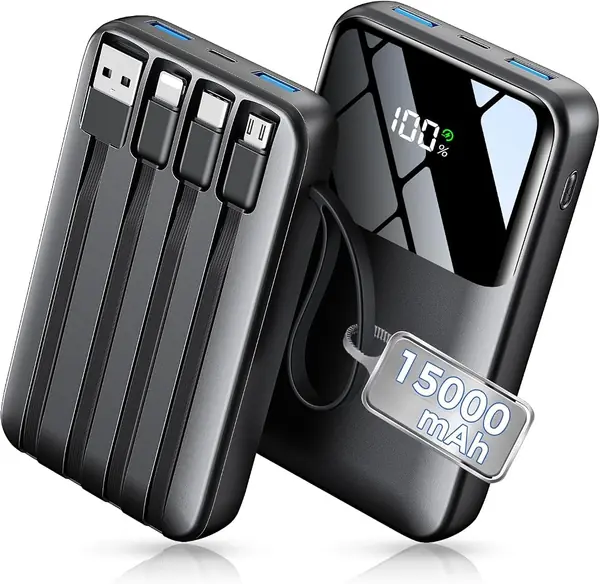
Six outputs and four built-in cables sounds excessive until you're the person at camp everyone hands a phone to. The HELLEE 15000 is built for that job: the cables are part of the body, so nobody digs through a stuff sack hunting for the right connector, and 15,000mAh tops up several devices before anyone starts rationing.

We like it most for group trips and for travelers carrying a tablet, a watch, and earbuds that all take different plugs. The digital display reads out the actual percentage remaining rather than four vague dots, which matters at the moment you're deciding whether to spend the last of it on a headlamp or a phone.

The built-in tails are the part to treat gently, since a yanked cable is a single point of failure you can't replace in the field. At 8.8 ounces the pack sits mid-weight for 15,000mAh, a long way from ultralight but easy enough to carry in a day pack or a carry-on.

Pros

  • Four built-in cables and six outputs
  • Digital percentage display
  • 15,000mAh at 8.8 ounces

Cons

  • 22.5W ceiling slows tablets and camera charging
Our verdict

For a family trip or a shared camp, the HELLEE is the easiest buy on this page: 15,000mAh, six outputs, and cables that stay attached.

Check Latest Price
5

Anker PowerCore Slim 10000 Best Budget Pick

88 /100
TKZ Score Excellent

Key details

Weight
8.5 oz
Capacity
10,000mAh
USB-C Output
5V/3A
Recharge Time
About 5 hours
View on Amazon

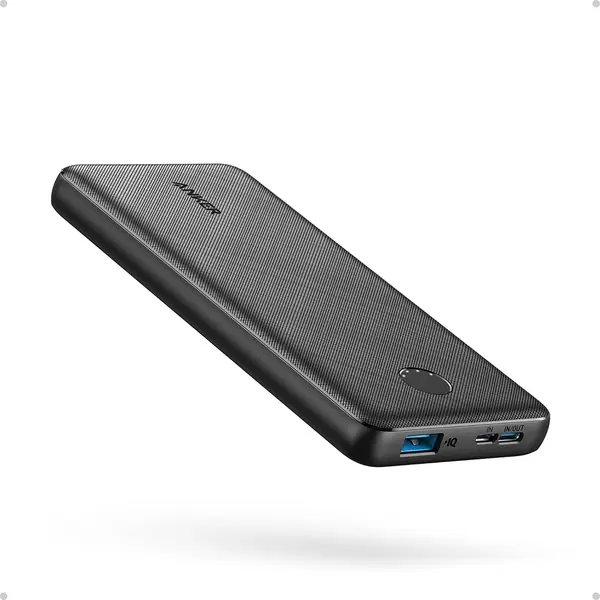
There's no USB-C PD on the PowerCore Slim 10000; it tops out at 5V/3A, and we're recommending it anyway. A phone that sits on a charger overnight in a tent doesn't care about fast charging. This pack does the slow, boring job without drama: plug in at dusk, wake up to a full battery.

What we appreciate is how little there is to go wrong. One USB-C port that both takes and gives a charge, one USB-A, a scratch-resistant shell rated for a 3.2-foot drop, and an 18-month warranty. The 10,000mAh capacity gives about two charges of a modern phone, at 8.5 ounces.

That 8.5 ounces is the trade. It's roughly three and a half ounces heavier than the ultralight packs here for the same capacity, and it makes up for that with a slim shape that slides into a pack lid and a price that leaves room for a spare. Think of it as the portable charger that lives in your pack all season and never asks for attention.

Pros

  • Drop-tested shell and 18-month warranty
  • About two phone charges at 8.5 ounces
  • Two-way USB-C, nothing to configure

Cons

  • Roughly five hours to refill from empty
Our verdict

If your phone only needs to come back to full overnight, the PowerCore Slim does it for the least money in this group without cutting into reliability.

Check Latest Price
6

Anker 20000 87W Best for Laptops and Camera Gear

87 /100
TKZ Score Excellent

Key details

Weight
15.2 oz
Capacity
20,000mAh
Max Output
87W total
Built-in Cable
USB-C
View on Amazon

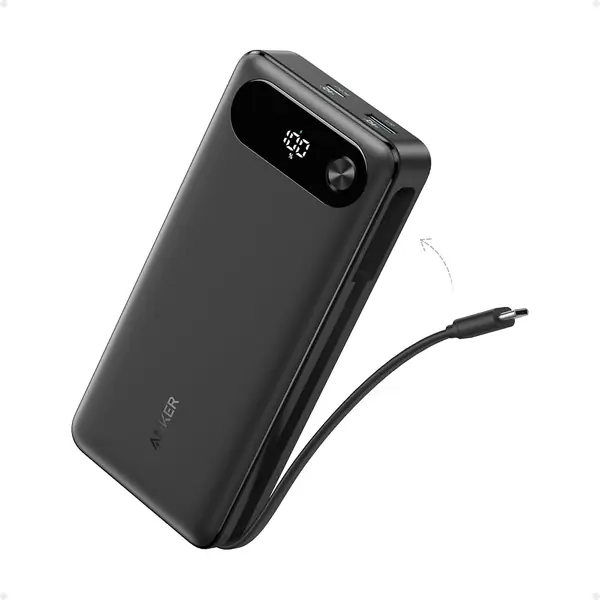
The Anker 20000 87W is the only pack here that will run a laptop, and if your trip involves editing photos or flying a drone, that fact reorganizes everything else in your kit. It distributes 87W across three devices, and the USB-C cable is built into the body, so there's no way to arrive at camp with the power and no way to use it.

We're fond of that cable for a specific reason: it's rated for more than 10,000 bends and folds flat against the pack, which is the difference between a cable that survives a season in a lid pocket and one that doesn't. The pack itself refills in about an hour and a half on a capable adapter, fast enough that a plug socket is worth stopping for.

Fifteen ounces is what all this costs. It's the heaviest thing on this list, and it's more than a phone-and-headlamp trip needs. Carry it when the devices justify it, a 14-inch laptop or a camera workflow, and leave it home when they don't.

Pros

  • 87W across three devices, laptop-capable
  • Built-in USB-C cable rated for 10,000 bends
  • Refills in about 1.5 hours

Cons

  • 65W ceiling for any single device
Our verdict

The Anker 20000 87W is the pick when the trip has to keep a laptop alive; that is the requirement it meets and nothing lighter here does.

Check Latest Price
7

FLEXTAILGEAR 10000 Best for Dry-Climate Hiking

82 /100
TKZ Score Excellent

Key details

Weight
5.1 oz
Capacity
10,000mAh
Water Rating
IPX4
Thickness
0.39 in
View on Amazon

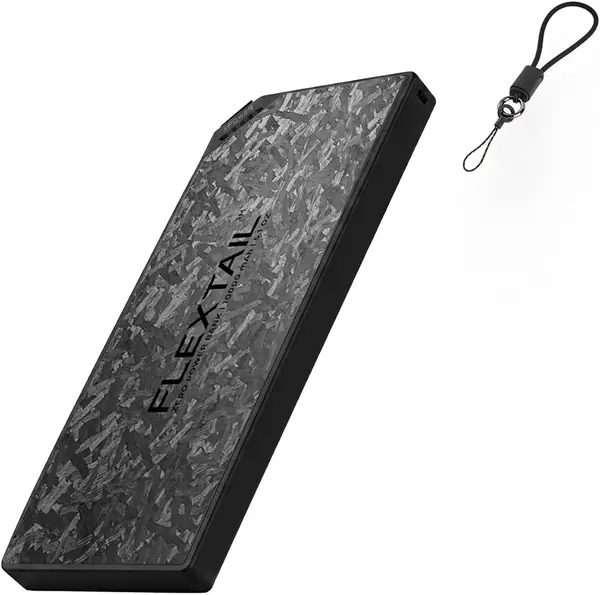
A carbon-fiber shell and a 0.39-inch body make the FLEXTAILGEAR 10000 the flattest pack in this group, thin enough to disappear into a chest pocket or the map sleeve of a pack, which isn't something you can say about most 10,000mAh batteries.

At 5.1 ounces it's within a rounding error of the Nitecore on weight and costs noticeably less, and it does one thing the Nitecore doesn't: the built-in USB-C cable doubles as the lanyard, so the cable is part of the pack rather than a second item to keep track of.

Sealing is where it gives ground. This one turns away rain and splashes but not a dunk in a creek, and that's the clearest line between it and our top pick. If your electronics ride in a dry bag, and in a wet climate they should, the difference rarely comes up.

The detail we didn't expect to care about is the 10% emergency lock, which stops the pack draining itself below a reserve. Pull it out of the bottom of a bag a month later and there's still a charge in it. For dry-climate hiking and three-season trips, that plus the profile makes it a strong alternative to the pricier ultralight option.

Pros

  • Flattest body here at 0.39 inches
  • 5.1 ounces with a lanyard cable built in
  • 10% reserve lock keeps emergency power

Cons

  • Just a one-year warranty
Our verdict

If your electronics already live in a dry bag, the FLEXTAILGEAR gives you near-ultralight weight, a 0.39-inch body, and a cable you can't forget, for less than the premium picks.

Check Latest Price
8

aswayke P20 20000 Base Camp

81 /100
TKZ Score Excellent

Key details

Weight
1 lb
Capacity
20,000mAh
Water And Dust Rating
IP68
Built-in Light
420 lumens
View on Amazon

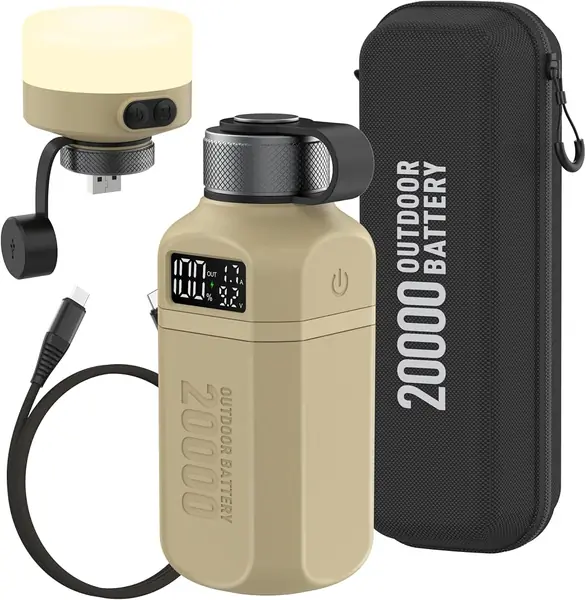
A 420-lumen lantern bolted to a 20,000mAh battery is either clutter or the most useful object in camp, and after a few nights out it's the second. The aswayke P20 runs five light modes, high, soft, SOS, strobe, and warm, off the same body as the charging ports, and the base has a quarter-inch thread so it can hang from a tripod or a tent loop.

The rest of the specification sheet is built for base camp rather than a summit push: 20,000mAh, a 3.2mm ABS and PC shell rated IP68, and a display showing battery percentage plus the current going in and out. That last part is more useful than it sounds, because you can see whether a cable or a device is actually drawing power before you write off a dead port.

The lamp is also the piece to check before you leave. Cycle all five modes at home rather than discovering a dead one at dusk, and use the warm setting for tent light instead of the 420-lumen blast that turns your shelter into a searchlight.

It earns its place when light and power are the same job: a hut trip, a festival, a car camp where the pack stays in one spot for three nights. For anything measured in base weight, it's the wrong tool, and the lantern that makes it useful is the reason.

Pros

  • 420-lumen lantern with five modes
  • 20,000mAh and IP68 in one body
  • Display shows battery percentage and current
  • Tripod thread for hands-free light

Cons

  • A pound of weight keeps it at camp
Our verdict

The P20 is for camp rather than miles: a 20,000mAh pack and a bright lantern in one body that earns its pound whenever you're staying put.

Check Latest Price

How We Tested Backpacking Power Banks

To build the shortlist, I started with a spreadsheet of more than 40 power banks, then narrowed it by weight, capacity, IP rating, and whether they had built-in cables or extra ports—features that matter when you're packing light. We bought 14 models at retail and tested them for seven months, on weekend backpacking trips, a weeklong section hike, and a few soggy car-camping mornings where the rain never let up.

We weighed each bank on a kitchen scale and noted how it felt in a hip-belt pocket versus the bottom of a pack. We timed how long it took to charge a dead phone to 50 percent and how many full charges we got before the bank died, using the same phone and cable for every test. We also left each bank in a pack for two weeks to see how much charge it lost just sitting there, and compared what each delivered for its price.

For ruggedness, we dropped each one from waist height onto rock, stuffed it in a pack with keys and a camp stove, and ran waterproof models under a faucet for five minutes and, when the rating allowed, dunked them in a creek. We tugged on built-in cables, checked whether they charged a phone without an extra cord, and noted any ports that got gritty or loose. A few banks looked tough but quit after a rainy weekend, and one built-in cable frayed within a month. We also kept an eye on size—whether a bank slipped into a chest pocket or hogged space next to a sleeping bag.

How to Choose a Power Bank for Backpacking

Size capacity to nights, not to the biggest number

A 10,000mAh rating is not 10,000mAh of phone charging. Conversion losses and the gap between cell voltage and the 5V your phone accepts mean roughly two-thirds of the rated figure reaches the device, which is why a 10,000mAh portable charger gives most phones about two charges and a 20,000mAh pack about four. Count the refills instead: a phone once a day, a watch or GPS every other day, a camera battery every third.

Three nights with one phone lands at 10,000mAh. Add a second device, a cold forecast, or a lot of screen time for maps, and 15,000 is the safer number. Buying 20,000mAh for a two-night trip is mostly buying weight you'll carry up a hill.

Weight is the specification you feel every mile

Among the 10,000mAh packs here there's a spread of more than three ounces, and the gap between the lightest 10,000mAh pack and a 15,000mAh one runs to nearly eight. The ultralight models save that weight with thinner shells and denser cells; the rugged ones spend it on cushioning and sealed port covers. Decide which you're buying before you compare anything else.

If your electronics ride in a dry bag and the pack never gets dropped, five ounces is the better carry. If it lives in an outside pocket and gets set down on rock, pay the ounces and stop thinking about it.

IPX4 is a splash; IP67 is a rainstorm

Water ratings get read as a badge, but the number tells you what the port covers are doing. IPX4 shrugs off rain and splashes. IP67 survives a dunk and seals out dust, which matters when the pack sits in a wet lid pocket or gets set down in sand.

Sealed ports are also the part that fails first: an open cover or a lost cap undoes the rating entirely. Check that the caps are tethered when the pack arrives and seat them every time. That habit is worth more than the number printed on the shell.

Fast output is only half the charging story

A 45W port can refill a phone during a snack stop, but the figure that decides a trip is how fast the pack refills itself. Input wattage varies widely here: one 10,000mAh pack needs about five hours on the wall, while a 20,000mAh pack refills in roughly an hour and a half. On a trip with town stops, that's the difference between charging over lunch and carrying a dead battery for two days.

Pack a 30W-or-higher wall adapter to hit the faster number, and read the input specification, not just the output.

Don't plan on a solar panel

The panel on a solar power bank is about the size of a phone, and at that size it produces a trickle: a small fraction of what the pack needs, and only in direct sun with the panel angled at it. Treat any built-in panel as an emergency top-up for a device, never as a way to refill a 10,000mAh pack on the move.

A folding panel big enough to matter weighs more than the second power bank it replaces. If off-grid power is the real requirement, carry the capacity instead.

Frequently Asked Questions

Final Verdict

The NESTOUT Rugged 15000 is the pack we recommend to most backpackers. IP67 sealing, 15,000mAh, and 32W over USB-C cover a long weekend and keep working after a rainstorm or a drop onto rock; the extra ounces are the only real cost.

If weight is the number you care about, the Nitecore NB10000 Gen4 does the same job at under five ounces with IPX7 sealing, for a great deal more money. Anyone on a tight budget who only needs a phone alive by morning should take the Anker PowerCore Slim 10000.