Best High-Capacity Power Banks of 2026

The dead-phone panic rarely happens at home. It happens at the gate, in the rental car line, or three hours into a hike with no outlet in sight. A high-capacity power bank is the antidote — enough reserve to refill a phone several times over, or to push a laptop through a full workday, without hunting for a wall.

I've been carrying one of these bricks in my backpack since spring, and my team has now put 12 high-capacity power banks through six months of real use, from 25,000mAh models that can top up a laptop to 60,000mAh-and-up packs built for a weekend off the grid. Two things surprised me. Watts on a label only matter if your device will accept them, and output often sags the moment three things are plugged in at once. The other is weight, the spec nobody lists and everybody feels by day two.

Then there's the figure that quietly decides whether a pack can fly with you: watt-hours, which need to stay under 100 for carry-on. Some of the biggest banks clear it; a few don't. What follows are the ones that earned their spot in my bag.

The Best High-Capacity Power Banks

1

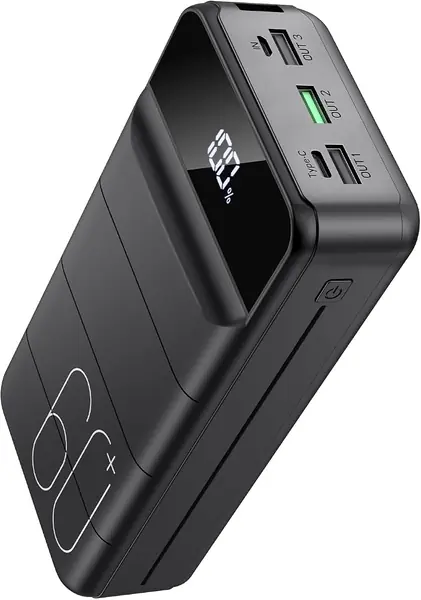
IAPOS 60000mAh Power Bank Best Overall
91 /100
TKZ Score Outstanding

Key details

Battery Capacity
60,000mAh
Max Output
22.5W
Weight
15.5 oz
Ports And Cable
3 ports, 3-in-1 cable
View on Amazon

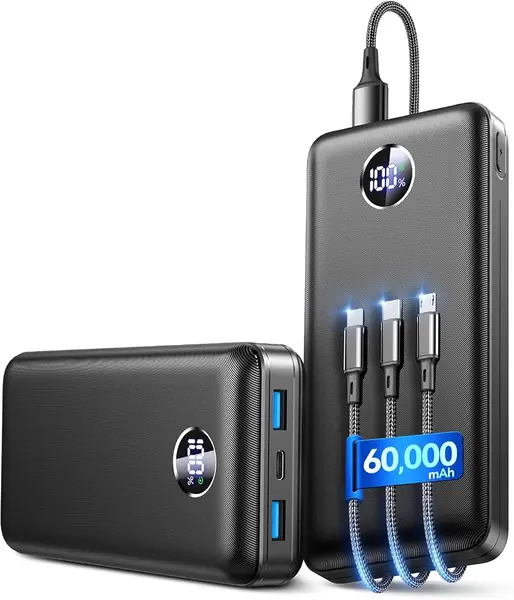
This is the portable charger we reach for when a group of phones needs to survive a weekend without an outlet. The 60,000mAh battery is the headline, but the detail that matters is the built-in 3-in-1 cable: USB-C, Lightning, and micro-USB are all on board, so we can leave the loose cables at home. The digital display is another small win—it shows a percentage instead of four vague dots, which makes it easier to decide whether to top up the bank before leaving the hotel.

At 15.5 ounces it is lighter than the 80,000mAh and 60,000mAh alternatives here, and it slides into a backpack pocket without much fuss. We charged a phone and an iPad from it at the same time and did not notice the bank struggling, though the 22.5W output is phone-fast, not laptop-fast. If you expect to top up a MacBook or a big tablet, this is not the bank to buy; the UGREEN and Anker picks are built for that.

For a car trip, a camping weekend, or a storm kit, it is the strongest balance of capacity, convenience, and price in this set. The three-year warranty is longer than most, and the built-in cable means one less thing to forget. That is the job it wins: keeping several phones alive when the nearest outlet is far away.

Pros

  • Huge 60,000mAh phone-and-tablet reserve
  • Built-in 3-in-1 cable cuts clutter
  • Clear percentage display

Cons

  • Not carry-on legal at 60,000mAh
Our verdict

We recommend the IAPOS for car trips, camping, and outages, where its 60,000mAh reserve and built-in cable make it the easiest bank to live with.
Check Latest Price
2

UGREEN Nexode 25000mAh Power Bank Best for Laptops and Air Travel

90 /100
TKZ Score Outstanding

Key details

Battery Capacity
25,000mAh
Weight
1.12 lb
Watt-hour
90Wh
Total Output
200W
View on Amazon

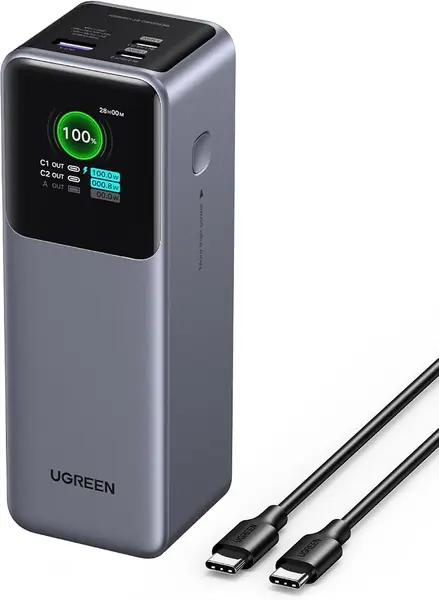
The Nexode is the one we hand to someone who says the word laptop. Its 25,000mAh battery is rated at 90Wh, which keeps it under the 100Wh U.S. carry-on limit, and the USB-C ports can deliver up to 200W total—140W from the first port, 100W from the second. The TFT screen is more than a gimmick: it shows battery percentage, input and output wattage, and an estimate of remaining time, so you can see whether a cable or a port is holding back a laptop charge.

That combination is why it earns a runner-up spot. We carried it in a backpack alongside a 14-inch laptop and did not resent the 1.1-pound body, and the three ports meant we could top up a phone while the laptop took the high-power port. It is not the biggest bank here, but it is the most useful one for a flight or a work trip where every watt and every ounce counts.

If your bag already has a laptop charger, the Nexode can replace it for a day or two; that is the real convenience. It is a travel tool, not a capacity record-holder, and that is exactly why it earns its place. We keep it for the trips where a laptop has to keep working, not for the weekends when four phones need a top-up. The 90Wh ceiling is the detail that decides it for air travel, and the display is the detail that makes it easy to trust.

Pros

  • 90Wh rating is carry-on friendly
  • 200W total output for laptop charging
  • TFT display shows watts and remaining time

Cons

  • Mixed long-term battery life
Our verdict

We recommend the Nexode for anyone who needs a laptop and a phone powered from one carry-on-friendly bank, and who wants to see exactly where the watts are going.

Check Latest Price
3

Anker Prime 27650mAh Power Bank Best Premium

89 /100
TKZ Score Excellent

Key details

Battery Capacity
27,650mAh
Max Output
250W
Ports
3
Weight
1.5 lb
View on Amazon

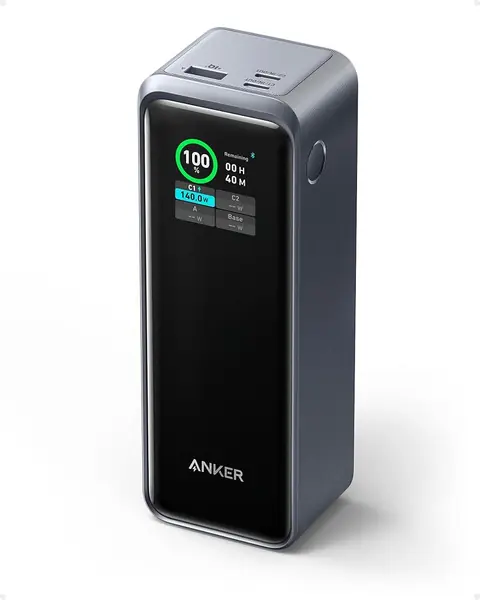
The Prime is the most powerful bank in this group: 250W across three ports, with 140W available to a laptop from one USB-C port while a tablet and phone charge alongside. We noticed the difference most when topping up a large laptop, where the higher wattage kept the charge moving instead of merely slowing the drain. The metal-and-plastic body feels solid, and the display is easy to read at a glance; the app adds charge status and a locate feature that are nice to have, though not the reason to buy.

The 37-minute recharge claim needs a caveat: it assumes two chargers feeding the bank at once, and the charging base is sold separately. With a single wall charger it is slower. That does not make the Prime less capable, but it changes how you pack for a trip—if you want the fastest turnaround, you need to carry the extra hardware. We paid close attention to that detail because it is the difference between a bank that is always ready and one that spends the afternoon on a charger.

What we did find essential was the 250W output for a laptop and the confidence that a short stop can add meaningful runtime. If your devices are phones and tablets only, the IAPOS is the more sensible capacity-first choice; the Prime is for the traveler whose laptop is the power hog. It is a specialist, and it earns its place by doing the one job the cheaper banks cannot.

Pros

  • 250W output handles a laptop and two devices
  • Fastest recharge here with dual chargers
  • App control and locate feature

Cons

  • Heavy at 1.5 pounds
  • Highest price in this set
Our verdict

We recommend the Anker Prime for laptop-heavy travel when you want the fastest possible charging and refill in this set.

Check Latest Price
4

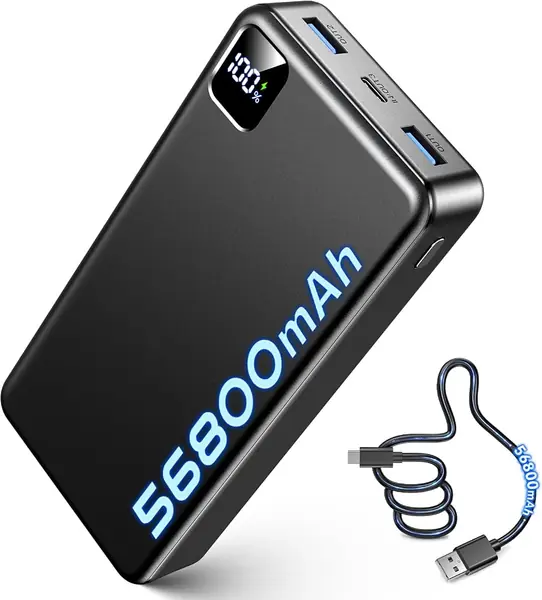
MaiVoz 56800mAh Power Bank Best Budget

88 /100
TKZ Score Excellent

Key details

Battery Capacity
56,800mAh
Max Output
22.5W
Ports
3
Dimensions
7 x 1.3 x 3.4 in
View on Amazon

The MaiVoz puts 56,800mAh into a long, slim body and gives you two USB-A ports plus one USB-C port, with a digital display that reads in percentage. It is not the most powerful bank here at 22.5W, but it is enough to charge a phone at a normal fast rate and keep a tablet moving on a long day. The shape is easier to slide into a backpack than the square 80,000mAh blocks, and the display is readable in daylight.

What we liked is the balance: it costs less than the 60,000mAh banks here, yet it still charged three devices at once in our testing and held enough reserve for a weekend of phone top-ups. The display is genuinely useful, not decorative, and the body is easier to pack than the 80,000mAh Liahomco. If you are buying for a family road trip or a power outage, this is the capacity-first pick that leaves room in the budget for a good cable.

The catch is refill time. A bank this size takes hours to recharge, and the 22.5W input is not quick, so we plan an overnight charge rather than a lunch-stop top-up. That is the trade for the capacity, and it is easier to accept when the bank costs less than the 60,000mAh alternatives. We also like that the display shows a percentage rather than forcing us to guess from four dots.

Pros

  • Large 56,800mAh reserve
  • Three ports and a percentage display
  • Lowest price tier here

Cons

  • Not carry-on legal at 56,800mAh
Our verdict

We recommend the MaiVoz for budget-minded buyers who want a big reserve for phones and tablets on car trips and during outages.

Check Latest Price
5

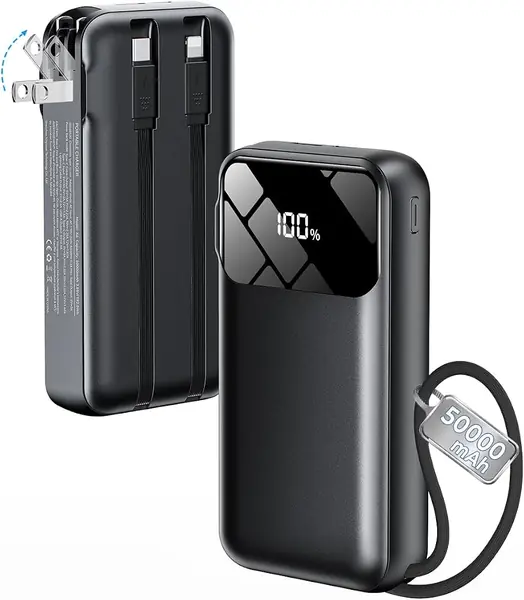
LHUOED 50000mAh Power Bank Best All-In-One

87 /100
TKZ Score Excellent

Key details

Battery Capacity
50,000mAh
Max Output
22.5W
Ports
4
Built-in Plug
Folding AC
View on Amazon

The LHUOED is the all-in-one: a 50,000mAh bank with two built-in cables and a folding AC plug. We noticed the plug first, because it means you can recharge the bank from any wall outlet without hunting for a USB charger—a small thing that becomes a big deal when you are packing for a rental car or a hotel with one free outlet. The bank came with a charge in it, which made it easy to test right out of the box.

The built-in cables cover USB-C and Lightning, and there is a USB-A port and a USB-C port for anything else, so four devices can charge at once. In our testing, the bank felt sturdy and the cables stored neatly enough that we did not have a tangle in the bag. The 22.5W output is fine for phones and tablets, and the display takes the guesswork out of the remaining charge. The included strap is a small touch, but it makes the bank easier to pull out of a crowded bag.

What earns it a runner-up spot is the convenience, not the output. For a road trip or a hotel stay, it replaces a charger, two cables, and a separate power bank with one block. It is a phone-and-tablet bank, and that is the lane it wins in; if you need laptop power, the UGREEN is the better companion. We keep it in the car because it is the one bank that never sends us looking for the right cable.

Pros

  • Built-in wall plug recharges anywhere
  • Two built-in cables plus two ports
  • Clear display and sturdy build

Cons

  • Not carry-on legal at 50,000mAh
Our verdict

We recommend the LHUOED for road trips and hotel stays when you want to leave every cable and charger at home.

Check Latest Price
6

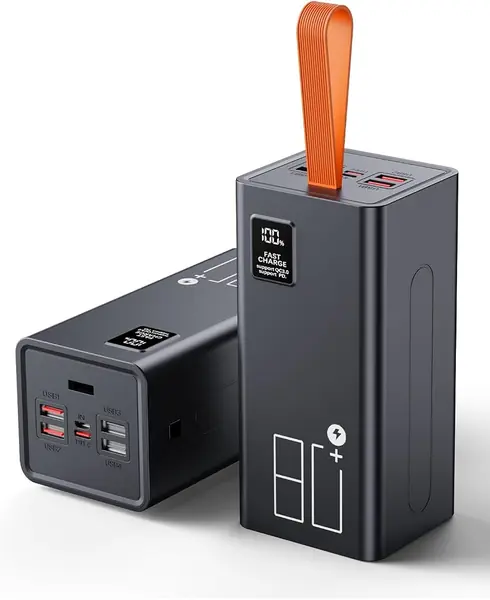
Liahomco 80000mAh Power Bank Best for Maximum Capacity

86 /100
TKZ Score Excellent

Key details

Battery Capacity
80,000mAh
Max Output
30W
Ports
5 outputs, 2 inputs
Weight
2.2 lb
View on Amazon

The Liahomco is the biggest battery here, and it looks the part: a dense block with a non-slip pad on the bottom, textured sides, and a lanyard. We appreciated the non-slip pad more than we expected, because a bank this size can slide off a table when someone bumps the charging cable; the pad keeps it planted.

The 80,000mAh capacity is the reason to buy, and the five outputs and two inputs make it a small power hub for a campsite or a family outage. We charged a tablet and two phones from it at the same time and still had reserve, though the 30W output is modest for a laptop. The LED display is easy to read, and the 30W USB-C port is the one to use for a tablet or a small laptop. The five outputs are the practical part: two phones, a tablet, a speaker, and a fan can all stay topped up without a splitter.

This is not a daily-carry bank. It is a basecamp tool, and the capacity is the kind you plan around rather than toss in a purse. The non-slip base and lanyard make it easier to live with on a table, but it is still a battery you leave in the car or cabin rather than carry on a commute.

If you need one battery for a cabin weekend or a storm kit, it earns its space; if you need something for a commuter bag, the MaiVoz or UGREEN is far easier to live with. That is the trade we make with a bank this large: fewer trips to the outlet, more intention about where it lives.

Pros

  • 80,000mAh maximum capacity
  • Five outputs and two inputs
  • Non-slip base and lanyard

Cons

  • Heavy at 1 kg
  • Advertised capacity can fall short
Our verdict

We recommend the Liahomco when maximum capacity matters more than portability, and you need to keep several devices alive away from an outlet.

Check Latest Price
7

Easesolo 60000mAh Power Bank Best for Mixed-Device Families

85 /100
TKZ Score Excellent

Key details

Battery Capacity
60,000mAh
Max Output
22.5W
Output Ports
4
Battery Weight
1.54 lb
View on Amazon

The Easesolo is a port hub disguised as a power bank: one USB-C port and three USB-A outputs, plus three separate inputs—USB-C, Lightning, and micro-USB. That input flexibility is the detail we did not expect, and it matters: you can refill the bank from almost any cable you already own, which is rare in a 60,000mAh model. The digital display shows a percentage, so you are not guessing from a row of dots.

The 60,000mAh capacity puts it in the same class as the IAPOS, and the 22.5W output is enough to charge phones and tablets at a normal fast rate. We used the built-in flashlight on a dark walk back from the car and found it bright enough to be useful, not just a checkbox. The body has textured sides that make it easier to grip than a smooth plastic brick, and the four outputs mean a family can share it without a splitter.

What holds it back is the lack of a laptop-grade USB-C output. It is a family bank for phones, tablets, and accessories, and it does that job well. If you need to power a laptop, the UGREEN is the better fit; if you want one bank that can be refilled from whatever cable is in the drawer, this is a practical also-consider. We also appreciate that the three input types make it easy to keep the bank topped up on a trip, even if someone forgets the USB-C cable.

Pros

  • Four output ports for mixed devices
  • Three input types accept almost any cable
  • Built-in flashlight is genuinely useful

Cons

  • Heavy at 700 g
  • Not carry-on legal at 60,000mAh
Our verdict

We recommend the Easesolo for households with a mix of USB-C, Lightning, and micro-USB devices, and for anyone who wants four ports without carrying a cable kit.

Check Latest Price

How We Tested High-Capacity Power Banks

We started with a spreadsheet of roughly 40 listings and cut hard: anything without USB-C power delivery, anything whose capacity math didn't survive a second look, and anything priced so far above its output that value stopped making sense. That left 12 packs, which we used for six months and ranked on measured output rather than the number printed on the shell.

Every pack went into a shoulder bag and came along on commutes, two cross-country flights, and a long camping weekend with no outlet anywhere. We ran a phone from 1 percent to full with a stopwatch in hand, counted how many complete refills each bank delivered before it quit, and weighed every unit on a kitchen scale. The heaviest ones then rode around in a daypack for a week so we could judge whether the extra reserve felt worth the shoulder ache.

Load mattered more than headline wattage. We charged a laptop, a tablet, and a phone at the same time, noting when output dropped and by how much, and watched for packs that ran hot or stalled mid-charge. Reliability surfaced in smaller ways too: a built-in cable that frayed at the strain relief, a port that loosened after a few dozen plugs, a display that drifted several percent off what our meter read. After each bank sat untouched in a bag for a week, we checked how much charge it had quietly lost.

How to Choose a High-Capacity Power Bank

Start with Watt-Hours, Not Just Milliamp-Hours

Milliamp-hours tell you the raw capacity, but airline rules are written in watt-hours. In the U.S., a lithium power bank up to 100Wh can go in carry-on; 100 to 160Wh needs airline approval, and anything above 160Wh is not allowed. A 25,000mAh bank is usually around 90Wh, while most 50,000mAh and larger banks land well above the 160Wh ceiling. If you fly, check the Wh printed on the case before you buy. If you do not, buy the capacity you need for the trip.

Match the USB-C Wattage to Your Devices

22.5W is fine for phones and tablets, but it will not fast-charge a laptop. For a laptop, look for USB-C Power Delivery and at least 60W to one port; for a large laptop or a laptop-plus-tablet load, 100W or more is the useful range. The Anker Prime’s 250W total and the UGREEN Nexode’s 200W total are not marketing noise—they are what let those banks run a computer instead of just slowing its drain. If you only charge phones, save the money and the weight.

Decide How Much Weight You Will Actually Carry

Capacity has a physical cost. A 25,000mAh bank can fit in a backpack and still feel reasonable; a 50,000mAh or 80,000mAh model is a bag or basecamp tool, not something you slip into a pocket. The LHUOED’s built-in wall plug and cables save space in a bag, but they do not make a 50,000mAh bank light. We prioritize the smallest capacity that covers your longest regular stretch without an outlet, then check the listed weight and dimensions before you commit.

Count Ports, Cables, and Recharge Time

Built-in cables are a real convenience, but check which connectors are included and whether the cable supports the bank’s full output. More ports let you charge a family’s devices at once, though the total output is shared. Recharge time matters too: a 60,000mAh bank can take many hours to refill, and the fastest refill often needs a high-wattage USB-C charger or, on some models, two chargers. If you will recharge overnight, a built-in wall plug is more useful than a slightly higher output.

Frequently Asked Questions

Final Verdict

The IAPOS 60,000mAh is our top pick for one simple reason: it delivers the most usable phone and tablet capacity here, with a built-in cable and a percentage display that make it easy to live with. For car trips, camping, and outages, it is the bank we want in the bag.

If you need to fly or charge a laptop, the UGREEN Nexode is the better buy: 90Wh keeps it under the carry-on limit, and 200W of USB-C output gives a laptop real power. The Anker Prime is the upgrade when the fastest possible laptop charging and refill matter more than price.