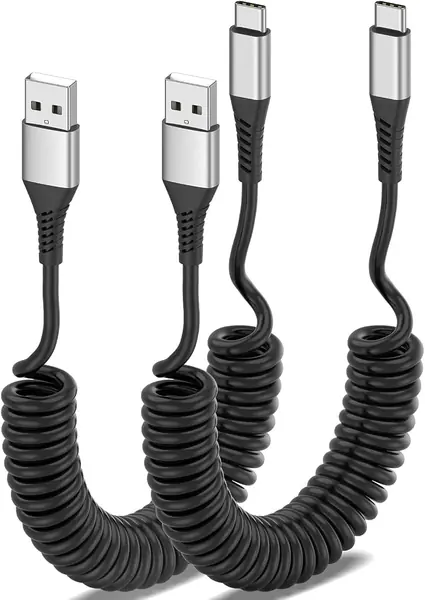
Best Coiled USB-C Cables of 2026

Halfway through a four-hour drive, my phone hit 8 percent and the only cable in the car had slid off the passenger seat, wedged itself under the parking brake, and come back out with a permanent kink. That was the week I switched to coiled cables and stopped thinking about cords. A good one keeps a short working length out in the open and gathers the rest into a tight spring that lives in a cup holder without turning into a nest. The catch is that the spring is always pulling: a sloppy coil stays stretched out after a week, and a stiff one yanks your phone off the mount every time you lift it.

We've spent the past four months living with 14 coiled USB-C cables — in dash ports, laptop bags, and on nightstands — and the field narrowed quickly. Before you buy, check whether your car hands CarPlay or Android Auto over the connector type you're considering, because USB-A to USB-C and USB-C to USB-C are not interchangeable in every vehicle. And treat the biggest wattage number on the box as a ceiling, not a promise, until you know what your phone will actually pull. Below are the ones that stayed coiled, held their connection over every bump, and never got more than lukewarm.

The Best Coiled USB-C Cables

1

Bkduice Coiled USB-C to USB-C Cable 2-Pack Best Overall
93 /100
TKZ Score Outstanding

Key details

Connector
USB-C to USB-C
Coil Reach
1 to 3 ft
Pack
2 cables
Max Power
60W
View on Amazon

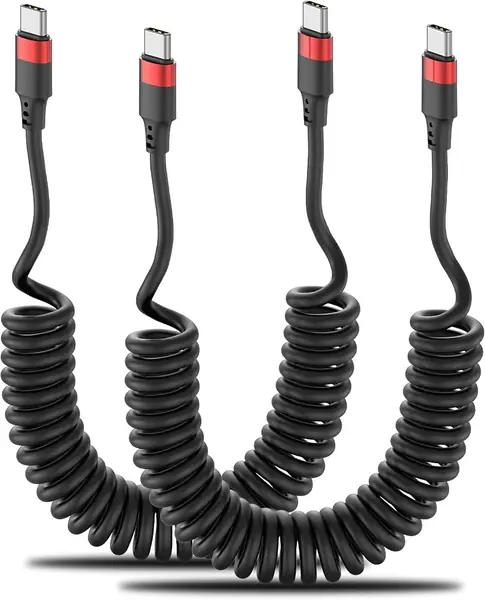
Two 60W USB-C to USB-C cables for less than any other C-to-C pair here is the whole argument, and the cables back it up. We ran one in a center console for CarPlay and kept the second in a bag for laptop top-ups and hotel sockets, and neither has needed a second thought. The 60W rating covers phones and tablets comfortably, and 480Mbps is exactly what CarPlay and Android Auto ask for.

The coil is the part we ended up appreciating most. It sits at about a foot when relaxed and gives a comfortable 2 to 2.5 feet before you feel the spring, with 3 feet as the ceiling. In a console that's ideal: the cable gathers itself instead of pooling in the cup holder, and the tension keeps the plug seated while the phone rides in a mount. Across a wide dash it's a stretch, so measure the gap before you commit.

Where it stops is bigger laptops. 60W will keep an ultraportable alive but won't drive a full-size machine at speed, and there's no data headroom if you also want to shuttle files between drives. For a car-and-bag cable, which is what most people are shopping for, neither matters. Both cables also carry a two-year manufacturer warranty, which is unusual at this end of the shelf.

Pros

  • Two 60W C-to-C cables in one pack
  • Tight coil keeps the console clear
  • Plug stays seated on rough roads

Cons

  • Reach tops out around 3 ft
  • 60W won't fully power a large laptop
Our verdict

Our default pick: two 60W USB-C to USB-C cables for the lowest price of any C-to-C pair here, with a coil that keeps a console clear and a plug that stays seated.
Check Latest Price
2

LISEN USB-C to C Chubby Coiled Cable 2-Pack Best Silicone Build

92 /100
TKZ Score Outstanding

Key details

Connector
USB-C to USB-C
Coil Reach
1 to 3.5 ft
Max Power
60W
Jacket
Silicone
View on Amazon

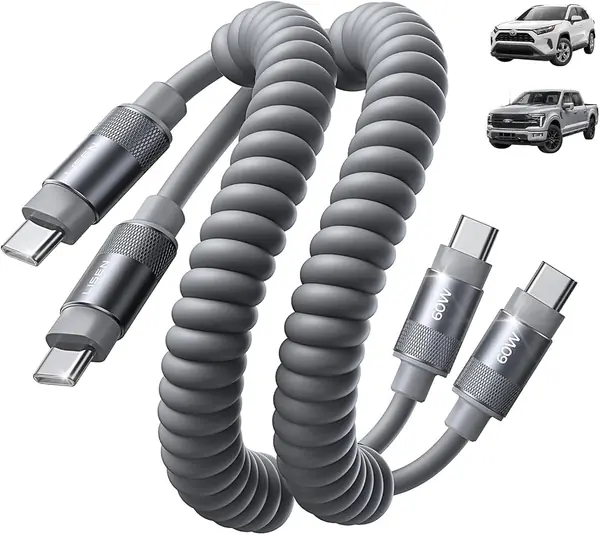
The jacket is the first difference you feel. LISEN wraps this pair in thick silicone with a matte, faintly grippy finish, so it sits where you drop it instead of skating across a console lid, and the connector shells are metal rather than molded plastic. It reads as the better-made cable in the hand, and the pair still fits a glovebox.

Tension is what convinced us. The coil opens at a light pull and closes on its own, which sounds minor until you've used a tight spring that tries to drag the plug out of the socket every time you lift the phone. Here the plug stays put and the cable takes up the slack. It's the same 60W and 480Mbps package as the budget pair, just dressed better and gentler at both ends.

One number needs reading carefully: 3.5 feet is a maximum, and LISEN labels that stretch occasional use, so plan on 2 to 3 feet for daily driving. In a car where the mount sits close to the port, that's the right trade — a coil that never fights you, with a spare in the box.

Pros

  • Soft silicone jacket resists kinks
  • Coil extends without pulling the plug
  • Two 60W cables in the box

Cons

  • Costs more than the budget pairs here
Our verdict

The coiled cable we reach for when the console is cramped: soft silicone, a light pull that doesn't fight the plug, and 60W charging in a two-pack.

Check Latest Price
3

chubbycable Silicone Coiled USB-C Cable 2-Pack Best for Laptop Power

91 /100
TKZ Score Outstanding

Key details

Connector
USB-C to USB-C
Coil Reach
1.5 to 6 ft
Pack
2 cables
Max Power
240W
View on Amazon

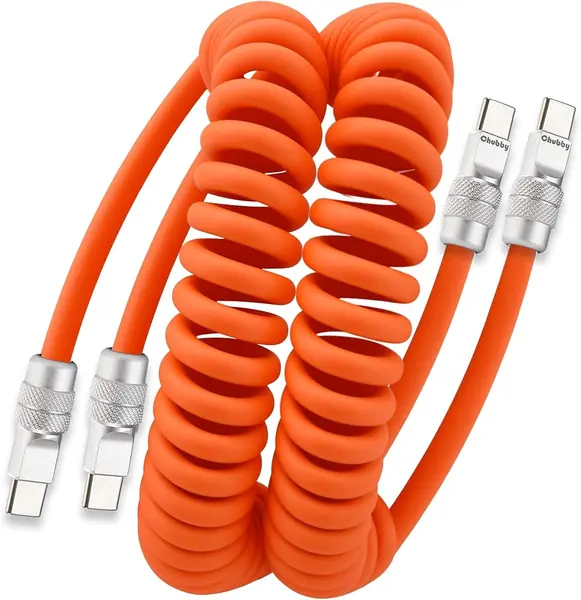
240W is a different class of cable. PD 3.1 at that rating reaches full-size laptops, and the coil stretches from 1.5 feet out to 6 feet, which is roughly twice the working reach of most of the cables here. If you've been treating a car cable and a laptop cable as two separate purchases, this one collapses them into a single orange cord.

The build is the chubbycable house style: thick, velvety silicone over zinc alloy plugs, with a finish that wipes clean and a color that's easy to find at the bottom of a bag. We liked the silicone for the same reason we liked it on the LISEN pair — no tangling, no kinking — and the extra thickness gives the coil enough body to spring back after a long stretch.

What it earns the premium with is reach. From a console port it gets to a rear-seat passenger, and from a desk it gets across to a chair, all while charging at laptop speed. What it costs you is space: six feet of coil takes up more room in a small cubby than a three-foot spring, so this is the cable for the long run, not the tight compartment.

Pros

  • 240W PD 3.1 charges full-size laptops
  • Stretches to 6 ft for back-seat reach
  • Soft silicone jacket and zinc alloy plugs

Cons

  • The priciest pick in this guide
Our verdict

The one to buy if a single cable has to charge a laptop and still reach the back seat: 240W over a six-foot silicone coil, at a premium price.

Check Latest Price
4

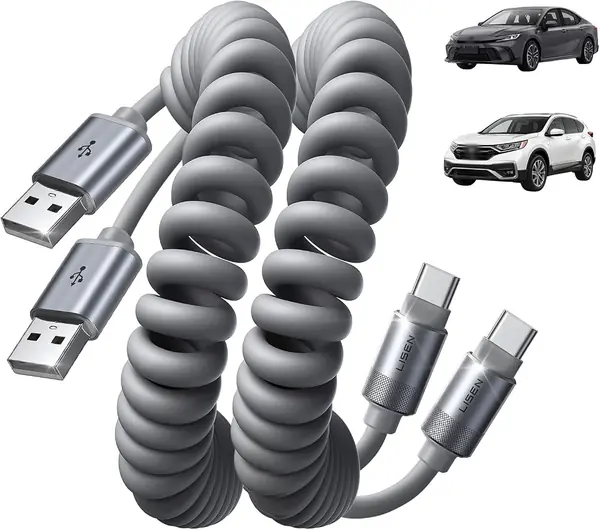
LISEN USB-A to USB-C Coiled Cable 2-Pack Best for USB-A Ports

90 /100
TKZ Score Outstanding

Key details

Connector
USB-A to USB-C
Coil Reach
1 to 4 ft
Max Power
15W
Jacket
Silicone
View on Amazon

If the port in your console is the old rectangular USB-A, the ceiling is set for you: USB-A tops out around 15W here whatever you plug into it. This LISEN pair is built for that socket — silicone jacket, metal-shelled plugs, and a coil that runs from about a foot to 4 feet, with the comfortable range sitting at 2 to 3.

In use it's the least fussy cable of the group. The coil is soft enough to pull out one-handed while you're parked at a light, and it gathers back without a tangle. Charging is the honest limitation: 15W holds a phone steady while CarPlay runs navigation but won't top up a modern battery quickly, and it's nowhere near what the C-to-C picks deliver.

Dropped connections can happen too. Reseat the plug at both ends and try the second cable in the pack before you blame the head unit — a two-minute test that saves a return, and the reason a two-pack is worth having.

So: the right cable if your car only offers USB-A and you want the console to stay neat. Wrong cable if your car has a USB-C port, where the Bkduice pair gives you four times the wattage and a tighter coil for less.

Pros

  • Fits cars with only a USB-A port
  • Soft silicone coil stretches to 4 ft
  • Two cables, so one can live in a second car

Cons

  • 15W ceiling means slow phone charging
Our verdict

The tidy answer for a car with an older USB-A port: silicone, four feet of stretch, and a 15W ceiling that's fine for navigation but slow for charging.

Check Latest Price
5

SMALLRIG 4792 Coiled USB-C Data Cable Best for Data and Tight Spaces

89 /100
TKZ Score Excellent

Key details

Connector
USB-C to USB-C, straight to 90°
Pack
1 cable
Max Power
100W
Data Speed
20Gbps
View on Amazon

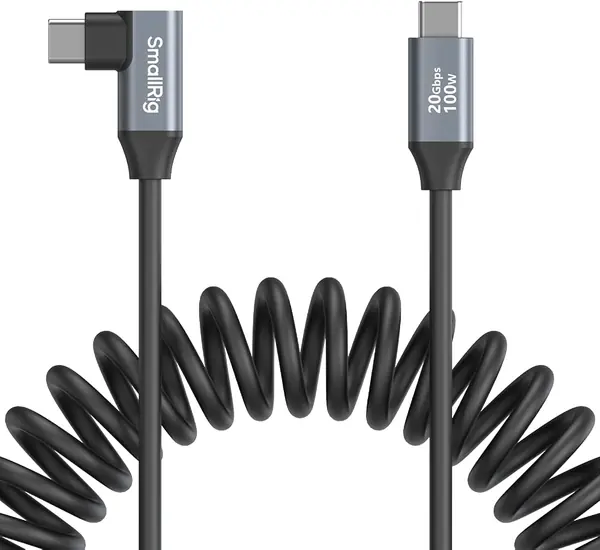
One plug is straight, the other turns 90 degrees, and the cable between them is rated for 20Gbps — far beyond the 480Mbps the rest of this group manages. That combination is aimed at camera rigs and monitor setups, but it solves a car problem too: the angled end tucks under a console lip instead of standing straight up in the way of a lid.

The coil is short, roughly 14 inches, which is right for a camera cage or a monitor arm and wrong for a laptop across a desk. It charges at up to 100W, enough for a tablet or an ultraportable, and the aluminum connectors seat with a more precise click than the molded plugs on the budget cables.

Where it justifies itself is data. If you offload cards from a camera or run a portable SSD, nothing else here comes close, and the angled plug is genuinely useful in a shallow console. If you only need charging, you're paying for bandwidth you'll never use — the Bkduice or LISEN pairs cover that for less.

Pros

  • 20Gbps transfers, far beyond the rest here
  • 90-degree end clears tight spaces
  • 100W PD charging with aluminum plugs

Cons

  • Only one cable in the box
  • Short 14-inch coil limits reach
Our verdict

A specialist that earns its place: the only 20Gbps cable here, with a 90-degree end that fits where a straight plug won't, sold one to a pack.

Check Latest Price
6

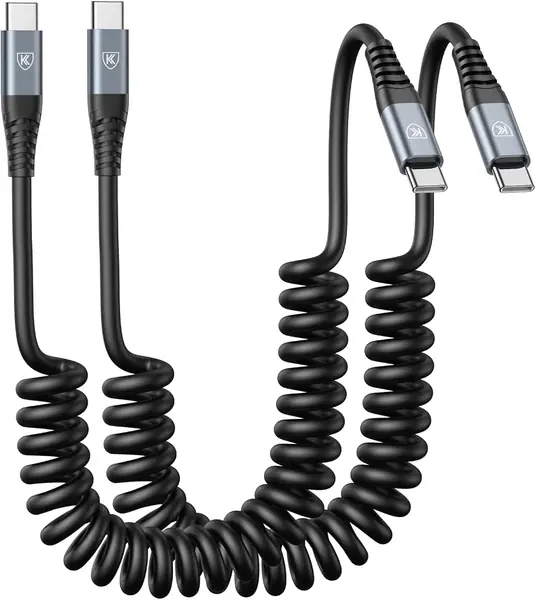
KIYODA Coiled USB-C to USB-C Cable 2-Pack Best for Longer Stretch to a Dash or Windshield Mount

88 /100
TKZ Score Excellent

Key details

Connector
USB-C to USB-C
Coil Reach
1.5 to 4 ft
Pack
2 cables
Max Power
60W
View on Amazon

Connection is where this pair gets uneven. The KIYODA cables charge happily and hold Android Auto well enough, but CarPlay is the sticking point — a session can cut out after a couple of minutes, and reseating the plug is what brings it back. If CarPlay is the only reason you're shopping, that is the detail that decides it.

Everything else is solid. The coil runs from 1.5 feet out to 4 feet, the longest C-to-C stretch here short of the premium chubbycable, and the build is heavier than the budget pair, with connector shells that feel reinforced rather than molded on. Charging lands at 60W, so phones and tablets fill quickly.

It costs the same as the LISEN silicone pair, and that's the comparison that matters: same wattage, more reach, less predictable handshake. For a passenger seat or a mount that sits well away from the port, the extra foot earns its keep. For a CarPlay-first setup, it's a gamble.

Our take: buy it as a charging cable with a bonus stretch, and park the second one in the house. If the console is where it lives and CarPlay runs every trip, spend the same money on the LISEN pair and give up half a foot.

Pros

  • Four-foot stretch beats the budget pairs
  • 60W charging for phones and tablets
  • Heavier build with reinforced connector shells

Cons

  • CarPlay can drop mid-drive
Our verdict

Buy it as a charging cable with a bonus stretch: 60W and four feet of coil, as long as you accept that CarPlay can cut out mid-drive.

Check Latest Price
7

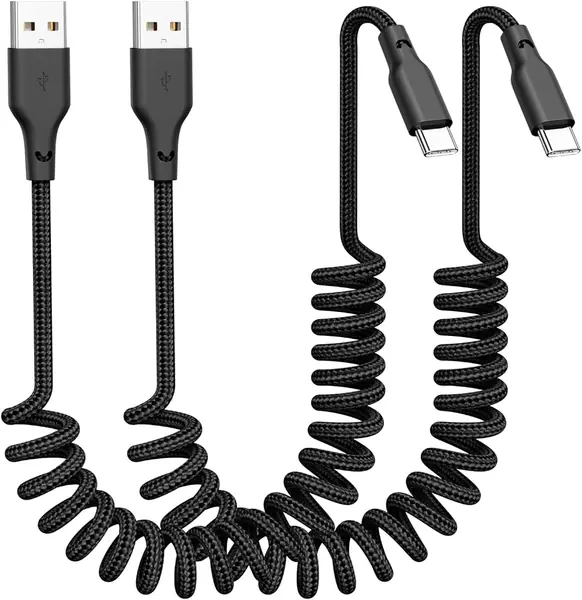
Quickeep Coiled USB-A to USB-C Cable 2-Pack Shallow Consoles Where Plugs Must Lie Flat

87 /100
TKZ Score Excellent

Key details

Connector
USB-A to USB-C, 90° both ends
Coil Reach
1.15 to 3.28 ft
Pack
2 cables
Max Current
3A
View on Amazon

Both plugs turn 90 degrees, and that's the reason to choose these over the other A-to-C pairs: the cable lies flat along a console or a dash instead of standing up and kinking where it meets the phone. In a shallow cubby, or under a lid that has to close, that's the difference between a cable that fits and one that doesn't.

The coil runs from about 1.15 feet to 3.28 feet, and it's tight — tighter than the LISEN pair. Pull past the comfortable middle and it starts tugging at the plug, which is hard on both the connector and the socket. Charge speed is mid-pack at 3A: fine for navigation and a slow top-up, not a fast charge.

Where it lands: a good second cable for a passenger's phone or a car where the port sits sideways, as long as the phone stays close to it. If you need four relaxed feet, the LISEN A-to-C pair is the calmer choice — you give up the angled plugs and gain a coil that doesn't pull back.

Pros

  • 90-degree plugs at both ends
  • Lies flat under a console lid
  • 3.28-ft stretch for close mounts

Cons

  • Tight coil tugs at the plug
  • Charging is average, not fast
Our verdict

The pair to pick when plugs have to lie flat: 90-degree ends at both connectors, a tight coil for close mounts, and charging that's steady rather than fast.

Check Latest Price
8

Acevien Coiled USB-A to USB-C Cable 2-Pack A Spare Cable for a Very Short Run to the Port

85 /100
TKZ Score Excellent

Key details

Connector
USB-A to USB-C
Coil Reach
1 to 3 ft
Pack
2 cables
Max Current
3A
View on Amazon

The coil sits at about a foot and gives 1.5 to 2.3 feet of comfortable working length, with 3 feet as a hard maximum. That makes it a cable for a phone holder bolted right next to the port: a passenger seat, a handlebar mount, a second car where the run is short and a long cable was always in the way.

At the smallest outlay in this guide it's a fair deal, and the parts that usually give out first on an inexpensive cable get attention here: an aluminum alloy shell, a strain-relief boot at each end, and a coil that stays tidy between uses. Charging is 3A with no wattage claim beyond that, which is enough for a phone and not much else.

Pros

  • Lowest-cost pair in this guide
  • Aluminum shells and strain-relief boots
  • Coil stays tidy between uses

Cons

  • Short 1- to 2.3-ft working range
Our verdict

The cheapest coiled pair here, and a sensible spare for a short run — provided your phone sits within about two feet of the port.

Check Latest Price

How We Tested Coiled USB-C Cables

We started with about 40 coiled cables pulled from retail listings and reader suggestions, then cut anything with a vague wattage claim, a coil that looked like it would give out, or reviews that kept mentioning CarPlay dropping mid-drive. That left 14, each of which we used for four months — on daily commutes and two long road trips, on desk hubs, and plugged into nightstand bricks.

Most of the work happened in the driver's seat. I noted how much cable actually reaches from the port to a windshield mount and how much stays gathered, then watched whether the phone reconnected to CarPlay or Android Auto after the engine cycled. On a stretch of patched asphalt, we watched for dropouts, and we judged the tug factor by whether lifting the phone pulled it off the mount or just stretched the coil. In the same seat, we timed how much charge a phone sitting at 20 percent picked up in 30 minutes, then felt each connector for heat afterward.

Back home, we stretched every cable to full extension and left it there overnight to see whether the coil sprang back or sagged. We bent each one right at the strain relief 50 times by hand, wrapped it tight around a phone, and yanked it out by the cord the way everyone does eventually. We checked compatibility both directions, since a USB-A to C and a C to C did not behave the same in every vehicle we tried, and we sized up flexibility — whether the jacket stayed soft in a cold car and whether the coil tangled in a bag or held its shape.

How to Choose a Coiled Usb-C Cable

Match the Cable to Your Car's Port

A coiled cable can only deliver what the socket behind it allows. If your console has the older rectangular USB-A port, an A-to-C cable is the only thing that fits, and the practical ceiling is around 15W: enough to hold a charge while CarPlay runs navigation, not enough to fill a phone quickly. A USB-C port changes the math, which is why the C-to-C cables here charge so much faster.

Look at the port before you look at anything else. It decides the connector, the wattage you can realistically get, and whether the fast-charging claims on a box apply to you at all.

Measure the Run, Then Discount the Max Stretch

Every coiled cable quotes two numbers: a resting length and a maximum stretch. The maximum is a ceiling you reach with a firm pull, and holding a coil under tension is what wears it out. Plan on the comfortable middle, usually 2 to 3 feet, and measure from the port to your phone mount before ordering.

Sellers call these retractable USB-C cables, but nothing retracts into a housing; the spring is the whole mechanism. A cable that has to strain across a dash is tugging at the plug constantly, and a plug under tension is a connection waiting to drop.

Pick Wattage by What You're Charging

Phones are satisfied at 20 to 30W, so a 60W cable like the Bkduice or LISEN pair leaves headroom for a tablet as well. A laptop resets the requirement: 100W is the practical floor for a 14-inch machine, and 240W like the chubbycable pair covers the bigger ones.

Don't buy wattage you'll never use, but don't talk yourself into a 15W cable for a device that wants 45. The coil and the plugs matter more day to day than the top-end number, right up until the moment they don't.

Jacket and Plug Shape Matter More Than the Label

Silicone jackets feel soft, resist kinks, and sit where you drop them; braided jackets shrug off abrasion but can be stiff enough to fight the coil. Both work, and the choice is mostly about how the cable behaves in your hand and in a small compartment.

Plug shape is the underrated one. A 90-degree end tucks under a console lid or behind a camera cage where a straight plug physically won't go, and a straight end is easier to seat one-handed at a light. If you've ever closed a lid on a cable, you already know which you need.

Data Speed: When 480Mbps Isn't Enough

CarPlay and Android Auto run on a trickle of data, so nearly every cable here is rated at 480Mbps and that is plenty. Pay attention only if the same cable moves files: the SMALLRIG 4792 handles 20Gbps, which is what you want between a camera and a laptop or a portable SSD.

If the cable's job is charging and navigation, ignore the number entirely and spend the difference on a better coil.

Frequently Asked Questions

Final Verdict

For most people the Bkduice two-pack is the answer: 60W, two cables, the lowest price of any C-to-C pair here, and a coil tight enough to keep a console clear. If you want a softer jacket and a gentler pull, the LISEN silicone pair is the upgrade; if the same cable has to reach the back seat and charge a laptop, the chubbycable 240W pair is worth the premium.

And if your car only offers a USB-A port, stop looking at wattage you can't have and take the LISEN A-to-C pair, which makes the most of that socket.