Best Clip-On Earbuds of 2026

An open-ear clip bud asks for a small leap of faith: you hook it over the curve of your ear, walk out the door, and hope it stays. I've logged miles, bike commutes, and a lot of tedious video calls in them, and the good ones genuinely disappear — you forget they're on, you still hear the car coming up behind you, and the podcast keeps playing. The bad ones pinch after twenty minutes, leak your call to the entire train car, and pop off the second you pull a hoodie over your head. Our team has spent the past six months living with 13 pairs to sort out which is which.

Here's the thing nobody tells a first-time buyer: because nothing seals your ear canal, bass comes from how the driver is angled and how close the bud sits to your ear opening, not from how far you crank the volume. Two pairs with nearly identical spec sheets can sound like completely different products. And if you wear glasses, the arm of your frames and the arm of the clip are competing for the same half inch behind your ear — that's usually where comfort is won or lost.

There's no single pair that wins on every count. Some are built for sweaty workouts, some for all-day office wear, some for people who just want to spend less. The picks below are grouped by what each one is actually good at, so start with the way you plan to use them.

The Best Clip-On Earbuds

1

Baseus Bowie MC2 Best Overall
89 /100
TKZ Score Excellent

Key details

Bluetooth
6.0
Water Resistance
IP67
Battery (buds/case)
11.5 hours / 55 hours
Weight
5.1 g per earbud
View on Amazon

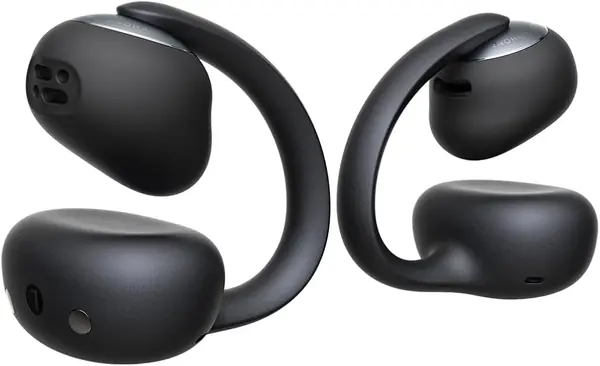
The Bowie MC2 leads with a 55-hour case, 11.5 hours in the buds themselves, and an IP67 rating that covers sweat, rain, and a quick rinse. The clip uses a memory titanium C-ring, and each bud weighs 5.1 grams. Add LDAC, Bluetooth 6.0, and 11 mm drivers, and the spec sheet is unusually complete for the middle of this group.

That completeness is why it earns our top spot. We wore the MC2 for workouts, errands, and long stretches at a desk, and the air-cushion clip stayed comfortable without feeling loose. The light weight matters more than the feature list: it is the difference between a pair you tolerate for an hour and one you forget about until dinner.

Sound is the pleasant surprise. The 11 mm driver gives voices and percussion enough body that open-ear listening does not feel thin, and LDAC adds detail if your phone supports it. The four-mic array also kept our calls usable outdoors, though wind is still wind. The open design lets traffic and conversation in, which is the point, not a flaw.

The practical clincher is the IP67 rating. Sweat, rain, and a rinse at the sink are not events you have to manage. If you want one clip-on pair to cover the most situations, this is the one we hand to most people.

Pros

  • 11.5 hours per charge, 55 with case
  • IP67 protection for sweat and rain
  • 5.1-gram buds with flexible C-ring
  • Four-mic calls that stay clear outdoors

Cons

  • Bass still trails sealed in-ear designs
Our verdict

We recommend the Baseus Bowie MC2 as the best all-around clip-on for most people, thanks to its long battery, IP67 protection, light fit, and clear calls.
Check Latest Price
2

TOZO OpenEarRing Best Value

88 /100
TKZ Score Excellent

Key details

Bluetooth
5.4
Water Resistance
Water resistant
Battery (buds/case)
10 hours / 40 hours
Driver Size
10 mm
View on Amazon

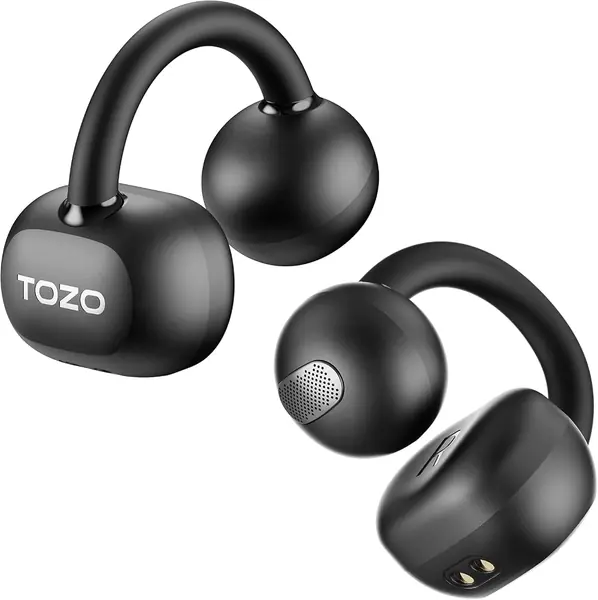
At the low end of this group's price range, the TOZO OpenEarRing is the pair we point to when someone wants to try clip-ons without a big commitment. It brings a 40-hour case, 10 hours per charge, Bluetooth 5.4, 10 mm drivers, and a digital display that makes the case easy to read. The clip is comfortable, and the open fit stays put for most everyday movement.

Sound is loud and clear, and the app's 32 EQ modes let you tune the balance more than the price suggests. Small ears are the fit question: the fixed ring has less give than a memory-wire clip, so try the return policy before committing. The LED display is a small convenience we ended up using more than expected, and it makes the case feel less like a budget afterthought.

The catch is consistency. Bluetooth can drop in crowded spaces, and we don't treat this as the most reliable pair for a full workday of calls. If you want a cheap second pair for podcasts and errands, those risks are easier to accept than they are on a primary pair.

Pros

  • Low price for a first clip-on pair
  • 40-hour case with digital display
  • Comfortable clip and secure open fit
  • 32 EQ modes in the app

Cons

  • Battery can drain unevenly between buds
  • A bud can stop charging
Our verdict

We recommend the TOZO OpenEarRing as a low-cost first pair, provided you can accept uneven battery life and occasional Bluetooth drops.

Check Latest Price
3

Soundcore C50i Best for Running

87 /100
TKZ Score Excellent

Key details

Bluetooth
6.0
Water Resistance
IP55
Battery (buds/case)
7 hours / 28 hours
Driver Size
12 mm
View on Amazon

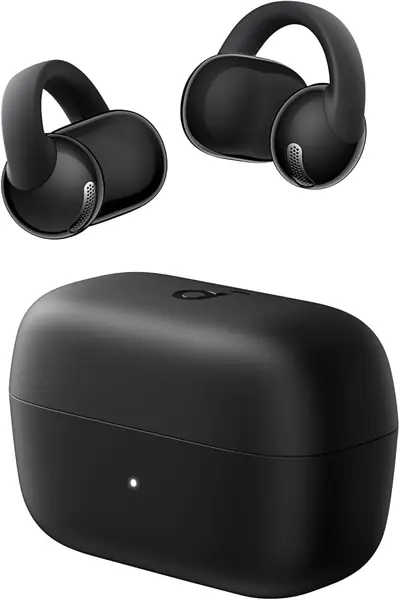
The C50i is the value alternative to our top pick. It uses the same open-ear clip idea, adds a memory titanium FlexiClip, and wraps it in a package that costs noticeably less. You get 7 hours per charge, 28 hours with the case, IP55 protection, Bluetooth 6.0, and 12 mm drivers.

We reached for these on runs because the clip stays put without clamping hard. The open design lets you hear cars and conversation, and IP55 is enough for sweat and light rain. The button controls are easier to find with sweaty fingers than touch panels.

We think the C50i is the right running pick for anyone who wants to spend less and does not need the Bowie MC2's all-day reserve. The tiny case disappears in a pocket, and the FlexiClip adapts without a pressure point. For a workout-first pair, that is a sensible trade.

Pros

  • Secure FlexiClip for runs and gym
  • IP55 sweat and rain protection
  • 12 mm drivers add usable bass
  • Tiny case fits in a pocket

Cons

  • Battery life trails the top pick
  • Bluetooth can stutter in crowds
Our verdict

We recommend the Soundcore C50i for runners and gym-goers who want a secure, sweat-ready clip-on and can live with shorter battery life.

Check Latest Price
4

Raycon Everyday Clip Best for All-Day Comfort

86 /100
TKZ Score Excellent

Key details

Bluetooth
6.0
Water Resistance
IPX5
Weight
6.17 g per earbud
Battery Life
30 hours
View on Amazon

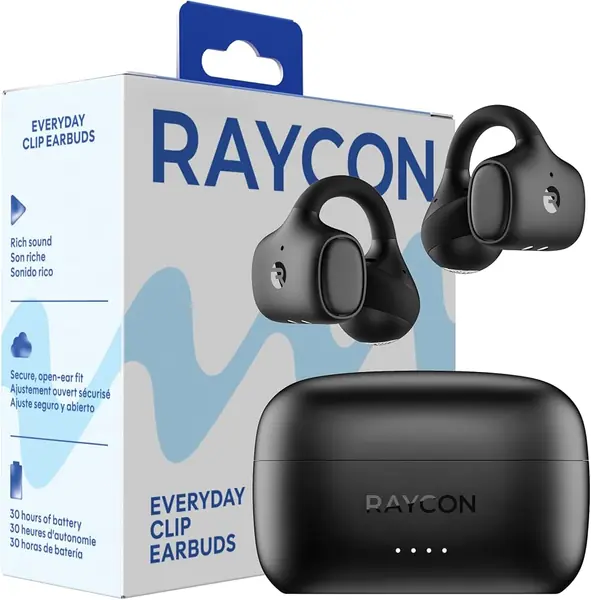
The first thing we noticed about the Raycon Everyday Clip is the weight: 6.17 grams per bud, with a nickel-titanium memory-metal clip that bends to your ear and stays there. That combination is why it owns the all-day comfort slot in this group. You also get 30 hours of battery, IPX5 water resistance, Bluetooth 6.0, and real push buttons.

We appreciated the buttons more than we expected. They are positive and easy to find without looking, which is a better fit for workouts and gloves than a touch panel. The clip has enough tension to feel secure without pinching, and the buds sit outside the canal the way an open-ear design should.

The sound is clear and balanced, not bass-heavy. For the premium end of this group, the Raycon earns its place on comfort and controls; the numbers on the box are not the reason to choose it.

Pros

  • 6.17-gram buds for all-day comfort
  • Memory-metal clip holds its shape
  • Physical buttons are easy to find
  • 30 hours of total battery

Cons

  • 30-hour total trails longer cases
  • IPX5 does not handle a rinse
Our verdict

We recommend the Raycon Everyday Clip to anyone who wants the most comfortable all-day wear and physical controls, even if battery life trails the leaders.

Check Latest Price
5

Baseus Inspire XC1 Best Sound

85 /100
TKZ Score Excellent

Key details

Bluetooth
6.1
Water Resistance
IP66
Battery (buds/case)
8 hours / 40 hours
Driver Type
Hybrid 2-way
View on Amazon

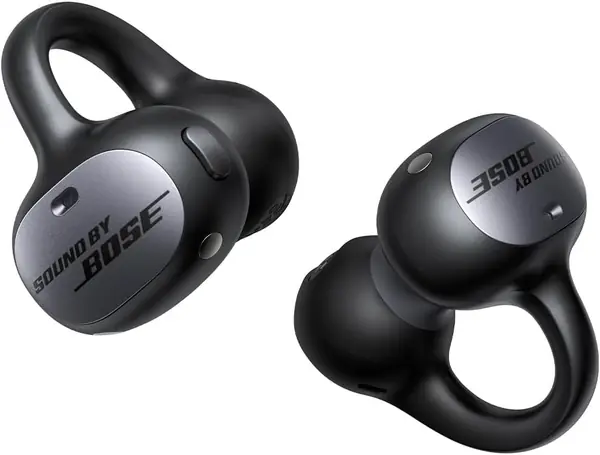
For the listener who cares most about sound, the Baseus Inspire XC1 is the step up. It uses a hybrid two-way driver with a dynamic woofer and a Knowles balanced-armature tweeter, tuned with Sound by Bose, plus Dolby Audio, Bluetooth 6.1, IP66 protection, and 40 hours with the case.

We think it is the best-sounding pair here for open-ear listening. The hybrid setup gives vocals and cymbals more texture than the single-driver picks, and the four-mic array makes calls sound clearer than the price-sensitive models. The air-cushion clip is comfortable.

IP66 covers sweat and heavy rain, and the 40-hour case gives you room to recharge. The ring takes a little more fiddling to seat than the Bowie MC2, but it settles once you find the angle. If sound quality is the reason you are buying clip-ons, this is the pair that makes the extra spend feel purposeful.

Pros

  • Bose-tuned hybrid driver sound
  • Clear four-mic calls
  • IP66 sweat and rain protection
  • 40-hour charging case

Cons

  • 8-hour single charge trails top pick
Our verdict

We recommend the Baseus Inspire XC1 to sound-first buyers who want the richest open-ear audio and clear calls, accepting less single-charge runtime than our top pick.

Check Latest Price
6

Bose Ultra Open Earbuds (2nd Gen) Best Premium

84 /100
TKZ Score Excellent

Key details

Bluetooth
5.4
Battery (buds/case)
9 hours / 28 hours
Driver Size
12 mm
Charging Case
Wireless charging
View on Amazon

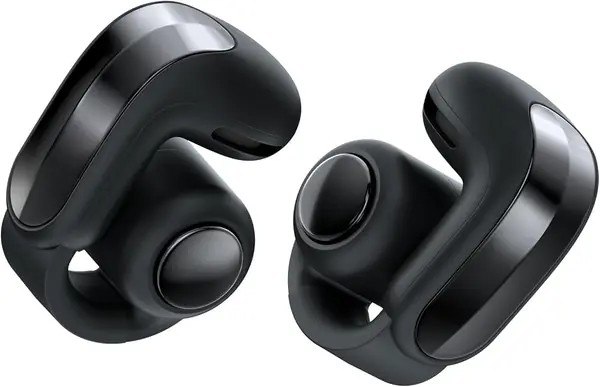
The Bose Ultra Open Earbuds (2nd Gen) sit at the highest price in this group, and they are the only pair here with spatial audio and head tracking. The 12 mm drivers, OpenAudio cuff, 9 hours per charge, 28 hours with the case, Bluetooth 5.4, and wireless charging case make a clear luxury argument.

The spatial effect is the reason to look. It widens the stage in a way the other clip-ons do not, and the flexible silicone joint is genuinely comfortable. The metallic finish and more robust case also make these feel like a small piece of fashion rather than a gadget.

Fit is the risk. The cuff can feel loose on smaller ears, and a secure seal is not guaranteed for every shape, so try them before committing. We still think the Bose is the premium choice for travelers and office listeners who want the most immersive open-ear sound and will pay for it.

Pros

  • Spatial audio with head tracking
  • Comfortable flexible ear cuff
  • 9 hours per charge, 28 total
  • Premium finish and wireless case

Cons

  • Highest price in this group
  • 28-hour total trails cheaper picks
Our verdict

We recommend the Bose Ultra Open Earbuds (2nd Gen) to buyers who want spatial audio and premium comfort and will accept the highest price and a fit that can feel loose.

Check Latest Price
7

Kinglucky Clip-On Earbuds Gen 3 Best Battery on a Budget

83 /100
TKZ Score Excellent

Key details

Bluetooth
6.0
Water Resistance
IPX5
Battery (buds/case)
7 hours / 50 hours
Driver Size
13 mm
View on Amazon

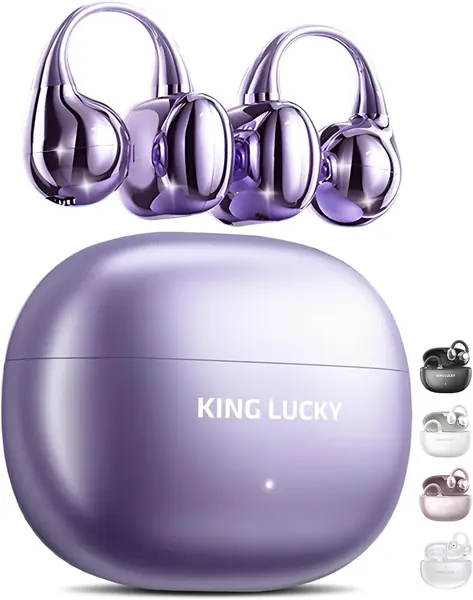
Seven hours per charge is only half the story with the Kinglucky Clip-On Earbuds Gen 3; the case stretches total playtime to 50 hours. That is a lot of runtime for the budget end of this group. You also get Bluetooth 6.0, 13 mm drivers, IPX5 water resistance, and extended slim ear hooks that are designed to sit more securely than a basic clip.

Comfort is a real strength. The hooks are long and thin enough to wrap around the ear without a hard pressure point, and the light build makes them easy to forget during a workday. Small ears and glasses are still worth checking, because the hook shape is fixed.

Sound is lively and louder than the price suggests, with pop and podcasts carrying some weight. The touch panel sits behind the ear, where it is easy to trigger when you adjust the hook, so practice the controls before a run.

We think the 13 mm driver gives it more low-end than the price suggests, though the open fit still keeps bass polite. For long days away from an outlet, the Kinglucky is the one that keeps going.

Pros

  • 50-hour case for long trips
  • 7 hours per charge
  • Slim hooks stay secure
  • 13 mm drivers add low end

Cons

  • A bud can stop charging
Our verdict

We recommend the Kinglucky Clip-On Earbuds Gen 3 to budget shoppers who want a very long battery and can live with touch controls that need a light touch.

Check Latest Price
8

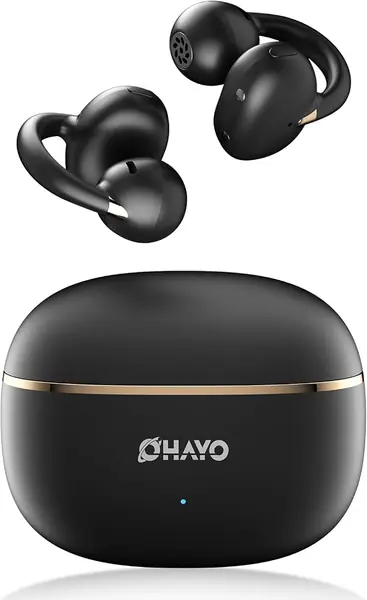
OHAYO A7 Best for Glasses Wearers

82 /100
TKZ Score Excellent

Key details

Bluetooth
5.4
Water Resistance
IPX6
Battery (buds/case)
10 hours / 40 hours
Weight
4.7 g per earbud
View on Amazon

If you wear glasses, the OHAYO A7 is built around that constraint. The soft-touch clip is designed to sit around the ear without pressing on frames, and the package includes Bluetooth 5.4, 12 mm drivers, and IPX6 protection.

The light build is the number that matters. At 4.7 grams per bud, the A7 puts less weight on the ear than most of the group, and the clip shape is easier to live with when glasses are already competing for space. We liked that the controls are physical buttons rather than a touch panel behind the ear.

You get 10 hours per charge, 40 hours with the case, and ENC call processing, which is a practical package for commutes and office use. The 12 mm driver delivers clear vocals, and IPX6 covers sweat and rain.

We think the A7 is the glasses-wearer pick rather than the all-around champion. Its light clip and button controls solve a specific daily annoyance, and the battery is generous for the size. If glasses are part of your day, those details matter more than a little extra bass.

Pros

  • Designed for glasses wearers
  • 4.7-gram buds feel light
  • 10 hours per charge, 40 total
  • IPX6 sweat and rain protection

Cons

  • Bass stays modest for open-ear sound
Our verdict

We recommend the OHAYO A7 to glasses wearers who want a light, secure clip and long battery without paying premium prices.

Check Latest Price

How We Tested Clip-On Earbuds

We started by pulling every clip-on model we could find that was actually in stock and had a real return policy, then read through spec sheets and cut anything with a fixed, non-adjustable clip or no water-resistance rating at all. Thirteen pairs made the final cut, from budget options to premium ones, and each spent six months in rotation rather than a single afternoon on a desk.

In practice that meant a 5K park loop three mornings a week, a bike commute in traffic, a gym session, a full workday of video calls, and a few long drives with one bud in. I deliberately pulled a beanie and a hoodie over my head with each pair on, shook my head hard, and wore glasses the entire time to see whether the frames and the clip could share space without one pressing the other into my skull.

For battery life, we ran each pair at a fixed volume and logged actual hours against the claimed number, checking whether the case display matched what was left. For call quality, we recorded voice memos and took real calls from a windy street corner and a noisy kitchen, then listened back for how much of the room came through. Since open-ear designs don't seal, we noted what each pair let in rather than pretending anything was canceled, and held each bud at arm's length in a quiet room to hear how badly it leaked.

Fit and durability got the least glamorous treatment: every pair was dropped on a sidewalk, tossed loose into a bag with keys, and worn through weeks of sweaty sessions to see whether the clip loosened. We also walked two rooms away from the phone and noted where the signal finally dropped.

How to Choose Clip-On Earbuds

Start With the Clip, Not the Driver

A clip-on lives or dies by tension. Too much and it pinches after an hour; too little and it slides when you run. Look for a flexible memory-wire or memory-metal cuff, and compare weight per earbud rather than the weight of the case. The Baseus Bowie MC2 at 5.1 grams and the Raycon Everyday Clip at 6.17 grams are both light enough for long wear, but they feel different around glasses. Put your glasses on first, then clip the earbud around the ear, and check that the speaker still aims at the canal opening. If you have small ears, treat a fixed ring as a try-before-you-buy design.

Read Battery as Two Numbers

Total playtime with the case is the travel number; single-charge runtime is the number that gets you through a workday. A 50-hour case sounds enormous, but it may hide a 7-hour bud. The Baseus Bowie MC2 gives 11.5 hours in the buds and 55 with the case, while the Kinglucky is closer to 7 and 50. If you listen for eight hours straight, prioritize the first number. If you mostly commute and recharge weekly, the total is the better guide. Quick-charge claims help, but only if you remember to put the buds back.

Expect Open Sound, Not Silence

Open-ear earbuds do not seal the canal, so they cannot deliver the bass or isolation of an in-ear pair. That is the trade for hearing traffic, coworkers, and announcements. An angled driver and a good fit can improve bass, and codecs such as LDAC add detail, but physics still wins. The Baseus Inspire XC1's hybrid driver and the Bose Ultra Open's spatial processing are the most ambitious attempts here. If your priority is a quiet flight or a loud gym, buy in-ears with noise cancellation instead. If your priority is awareness, accept the lighter low end.

Check the Call and Control Details

Call quality depends on microphone count, wind handling, and how the buds sit. Four-mic arrays on the Baseus models and Bose are the most ambitious here, but open-ear calls still pick up street noise. Controls matter just as much: physical buttons are easier with sweaty fingers or gloves, while touch panels can be triggered when you adjust the clip. The Kinglucky's rear touch panel is a case in point. Multipoint pairing is worth having if you move between a phone and a laptop, but do not pay for it if you mostly use one device.

Match Water Resistance to Your Sweat

IPX4 gets you through light sweat; IP55 adds dust and stronger spray; IP67 survives a rinse and heavy rain. If you run hot or live somewhere humid, do not settle for an unrated pair. The Soundcore C50i's IP55 is enough for most workouts, while the Baseus Bowie MC2's IP67 is the most forgiving here. Wipe the charging contacts dry before they go back in the case, and keep the case itself away from water. A high rating protects the buds, not a swim.

Frequently Asked Questions

Final Verdict

We recommend the Baseus Bowie MC2 as the default because it covers the most ground: 11.5 hours in the buds, 55 with the case, IP67 protection, a 5.1-gram fit, and clear four-mic calls. If the budget is tighter, the TOZO OpenEarRing is the value alternative, with the caveat that battery and connection consistency are less predictable. If sound is the priority, the Baseus Inspire XC1 is the upgrade worth making; its hybrid driver and Bose tuning are the best open-ear listening here. Start with the MC2 unless one of those specific needs pulls you elsewhere.