Best Android Smartwatches for Seniors of 2026

The hard part of buying a smartwatch for an older wrist isn't the watch itself — it's everything that happens after the box opens. If the screen demands reading glasses, the band requires a jeweler, or the charge dies before dinner, the thing ends up in a drawer by week two. I've watched that arc play out twice in my own family. What a good one actually fixes is narrower than the ads suggest: calls, reminders, heart rate, sleep, and steps you can read without squinting, on a strap that's comfortable from day one, with a battery that forgives a forgotten charger.

We've spent the past six months wearing 10 of these, from budget trackers that ship with a spare band to premium models with sleep coaching and a voice assistant built in. What I keep noticing is that sensor count barely matters at this size. What separates the good from the frustrating is a screen you can read in daylight, text you can actually enlarge, and a charger that seats on the first try. Our picks lean on those three things — plus battery life and fit you won't have to think about.

The Best Android Smartwatches for Seniors

1

Fitpolo GTX20 Best Overall
88 /100
TKZ Score Excellent

Key details

Display
1.85 in AMOLED, 1800 nits
Battery Life
Up to 10 days
Water Resistance
3ATM (30 m)
Calling
Bluetooth calls and texts
View on Amazon

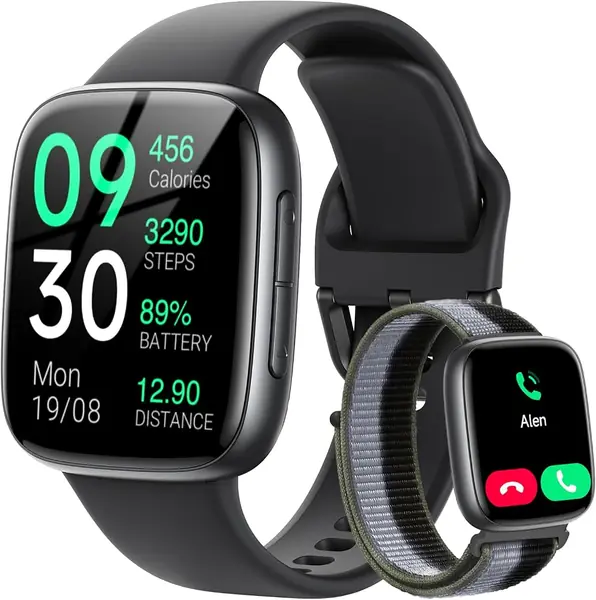
A 1.85-inch AMOLED panel rated at 1800 nits is what puts the Fitpolo GTX20 at the top of this list. Brightness sounds like a spec-sheet detail until you are standing in the driveway at noon: this is roughly three times the peak brightness of the Galaxy Watch 8, and it keeps the time, the step count and a caller's name legible without a hand cupped over the screen. Choose a face with three big lines on it rather than eight small ones and the squinting stops.

Setup is mostly a phone job. Install the companion app, pair over Bluetooth, then grant notification access — the step people skip, and the reason texts sometimes never show up. Calls run through a built-in speaker and microphone that handle a short check-in better than a long conversation. The touchscreen menus are the usual swipe-and-tap, and the 120-plus exercise modes go unused by most people who buy it, which is fine.

Battery is where it earns its place for an older wearer. The listing promises up to 10 days; with calling and all-day heart rate running, plan on something closer to a week, which turns charging into a Sunday habit instead of a nightly chore. Heart rate, blood oxygen, sleep and stress are all tracked, and the 3ATM rating covers handwashing, rain and a knocked-over glass of water.

At 26.5 grams it disappears on the wrist, and the 20 mm band is a standard size, so swapping to a magnetic clasp or a metal bracelet takes minutes if a buckle gets fiddly. Fitpolo's five-year warranty is the longest coverage in this group by a wide margin, and for a device that lives on a wet wrist, we think that is worth more than another watch face.

Pros

  • Brightest screen here at 1800 nits
  • Up to 10 days of listed battery life
  • Bluetooth calling and texts on the wrist

Cons

  • No built-in GPS; workouts use the phone's
  • Extra watch faces cost money in the app
Our verdict

We recommend the Fitpolo GTX20 to most families: the 1800-nit AMOLED screen is the easiest to read here, calls come through clearly, and a week per charge makes it forgettable in the best way.
Check Latest Price
2

Samsung Galaxy Watch 8 Best Full-Featured

87 /100
TKZ Score Excellent

Key details

Display
1.3 in AMOLED, 500 nits
Battery Capacity
325 mAh
Case Size
40 mm
Compatibility
Android phones only
View on Amazon

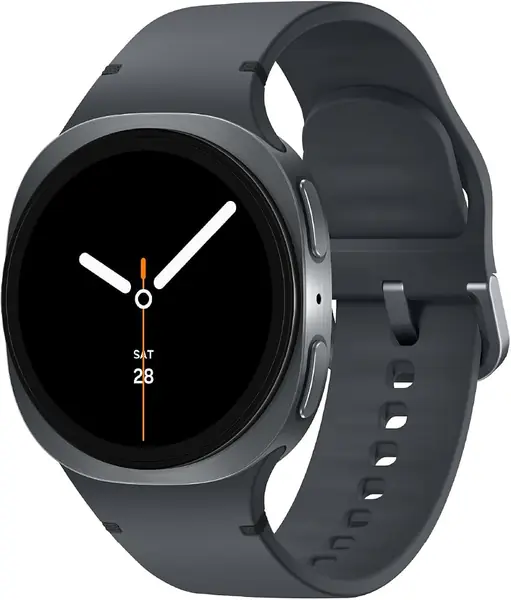
Compared with the inexpensive picks here, the Galaxy Watch 8 spends its money on depth instead of convenience. Advanced sleep coaching, an energy score, a running coach and an on-wrist AI assistant are things the budget watches never attempt, and the health side is the real reason to consider it. It is also one of the lightest watches in this group at 30 grams in a 40 mm case, so it sits still through a night's sleep instead of pressing into the mattress.

The first week is a project, and that is the honest trade. There is a Google account, the Wear app, notification permissions, and then a sleep score that only becomes meaningful after several nights of data. We rate it the choice for a household where someone will actually read the reports with the wearer — a daughter who checks the sleep trend, a spouse who notices the resting heart rate creeping up. Bought for someone who wants to strap something on and forget it, the cheaper picks are the kinder gift.

The 1.3-inch AMOLED is crisp and comfortable indoors; at 500 nits it gives away brightness to the Fitpolo's panel the moment you step outside, which matters for a gardener or a daily walker. Beyond that it is the most complete watch here: real apps, reliable step and heart-rate tracking, and the two-year warranty Samsung includes with this version. It pairs with Android phones, which is the point of this guide.

Pros

  • Deepest sleep and heart-health coaching here
  • Light 30-gram case on a 40 mm body
  • Two-year warranty included

Cons

  • Battery needs charging most nights
  • Band runs short on larger wrists
Our verdict

Buy the Galaxy Watch 8 when the health data is the point and someone will help read it; it is the most capable watch here, and it wants a nightly charge in exchange.

Check Latest Price
3

Motorola Moto 40 Best for Simple Daily Use

86 /100
TKZ Score Excellent

Key details

Display
1.5 in LCD
Battery Life
Up to 10 days
Water Resistance
IP67
Fitness App
Google Fit integration
View on Amazon

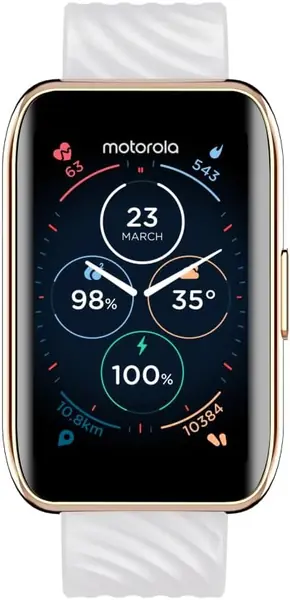
Some shoppers want a watch that does four things — time, steps, pulse, sleep — and then leaves them alone. The Moto 40 is aimed at that person. There is no app store to wander into and no coaching program to dismiss, and the metal case in rose gold reads as a watch rather than a fitness gadget, which matters if it is going to be worn to church, a doctor's appointment or lunch with the family.

Google Fit is the quiet advantage. If the family already checks Fit on an Android phone, steps and sleep land where everyone already looks instead of in a separate app nobody opens. Battery is listed at 10 days and lands nearer three or four with notifications on; charging is quick enough to finish in the time it takes to shower and dress.

Living with it is where the Moto 40 wins us over. The menu is short, the notification card tells you who is calling or texting, and there is nothing to configure twice — the wearer learns it in an afternoon and then never thinks about it again. Where the Fitpolo rewards a little exploring, this one never asks.

Pros

  • Up to 10 days of listed battery life
  • Syncs with Google Fit on Android
  • Simple menu a first-timer can run alone

Cons

  • Notifications only, no calls on the wrist
  • 1.5-inch screen keeps text smaller
Our verdict

Our pick for anyone who wants time, steps, pulse and sleep without a learning curve: the Moto 40 is the least demanding watch in this guide.

Check Latest Price
4

Samsung Galaxy Watch 5 Pro Renewed Best Big-Screen Value

85 /100
TKZ Score Excellent

Key details

Display
1.4 in AMOLED, 1000 nits
Battery Capacity
590 mAh
Case
45 mm titanium
Condition
Renewed, 90-day warranty
View on Amazon

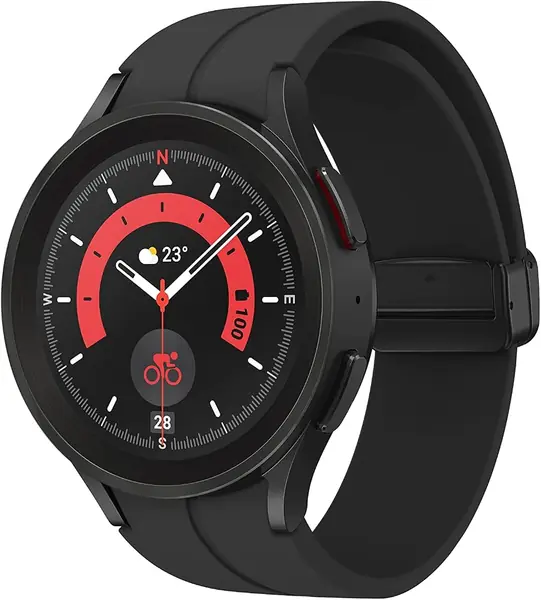
Renewed is the first thing to understand here: this is a Galaxy Watch 5 Pro — 45 mm titanium, 1.4-inch AMOLED rated at 1000 nits — that comes back through Samsung's refurbishment program with 90 days of warranty rather than two years. We rate it the best big-screen value in this group. That panel is the brightest Samsung display here and easier to read outdoors than the Watch 8's, and the refurbished route puts a premium watch within reach of a midrange budget.

The 590 mAh cell is the largest of the Samsungs, and it buys two to three days of ordinary use rather than one, which matters on a weekend away when nobody remembers the charger. Wear OS brings real apps and full notifications instead of a stripped-back menu, and the health side covers sleep, heart rate and workouts without asking for a subscription.

Titanium at 46.5 grams is the heaviest watch here, so on a narrow wrist it sits like a tool rather than jewelry — the 40 mm Watch 8 is the alternative for smaller arms. What the weight buys is a 50-meter water rating, the deepest in this group, and built-in GPS, so a walk gets logged without a phone along for the ride.

Pros

  • 1.4-inch AMOLED at 1000 nits
  • 590 mAh cell, the largest Samsung battery here
  • 50-meter water resistance and built-in GPS

Cons

  • Refurbished stock can arrive scuffed
Our verdict

Big-screen shoppers should start here: the brightest display in the group for midrange money, if a heavier wrist and a refurbished unit are acceptable.

Check Latest Price
5

Cillso IDW26 Best Budget

84 /100
TKZ Score Excellent

Key details

Display
1.83 in LCD
Battery Life
Up to 7 days
Calling
Bluetooth calls and texts
Voice Assistant
Amazon Alexa built in
View on Amazon

Alexa, Bluetooth calling and a 1.83-inch screen for noticeably less money than our top pick is the pitch, and the Cillso IDW26 delivers it. Ask the watch to set a timer or check the weather and it answers; take a call at the kitchen table and the voice coming through the speaker is clear enough for a two-minute conversation. As a first smartwatch, or a second one that lives in a purse, that is a lot of function for the money.

We like it as a low-risk way to find out whether an older wearer wants a smartwatch at all. The features that stick are the ones you would guess — calls, texts, weather, the timer — and the app is simple enough that setup does not need a house call. Give it a fortnight and you will know whether to spend more on the next one.

The caution is longevity. Display and charging faults can turn up within the first couple of months on watches in this class, so buy where returns are simple and put the first two weeks to work: pair it, take a call, run the battery down once. If it is still behaving after a month, it is the cheapest genuinely useful watch in this guide.

Pros

  • Amazon Alexa built in for hands-free basics
  • Bluetooth calling at the lowest price here
  • 1.83-inch screen with 320 x 385 resolution

Cons

  • Step and distance counts run approximate
  • Battery lands at two to three days, not a week
Our verdict

For a fixed budget, we point to the Cillso: Alexa, Bluetooth calling and a readable 1.83-inch screen for less money than anything else here.

Check Latest Price
6

RUXINGX G62 Battery-First Basics

83 /100
TKZ Score Excellent

Key details

Display
1.85 in LCD
Battery Life
Up to 30 days
Battery Capacity
1000 mAh
Water Resistance
3ATM (30 m)
View on Amazon

One number stands out on the G62: a 1000 mAh battery, roughly three times the cell inside the Fitpolo and the largest in this group. The listing pairs it with a 30-day figure, and that figure assumes light use — treat it as headroom rather than an expectation, because calls and all-day heart-rate monitoring eat into any watch's runtime.

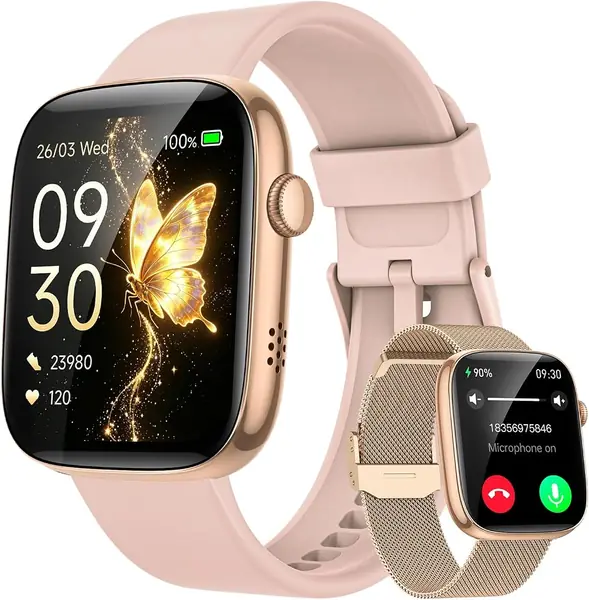
The rest of the package suits someone who wants a capable watch that looks less like gym equipment. A 1.85-inch screen, more than 200 watch faces to tinker with, Bluetooth calling, 120 sport modes and a 3ATM rating that matches the Fitpolo's — plus two bands in the box, so the rose-gold square case can go from errands to dinner without anyone noticing the switch.

Our hesitation is experience, not design. This is a newer model from a smaller brand, so there is less of a track record to lean on than the Fitpolo or the Samsungs have. That is not a reason to skip it — the oversized cell, the water rating and the styling all make sense for an older wearer — just buy it somewhere returning is easy and spend the first week on calls, texts and charging.

Pros

  • 1000 mAh cell, the largest battery here
  • 3ATM water resistance rated to 30 meters
  • Two bands included with the watch

Cons

  • No built-in GPS; workouts use the phone's
  • LCD screen shows less contrast than AMOLED rivals
Our verdict

We like the G62 for the buyer who wants the biggest battery here and a dressier case, with 3ATM water resistance as a bonus.

Check Latest Price

How We Picked and Tested These Smartwatches

We started with more than 40 listings and filtered hard: Android pairing listed as a real feature, a display roughly 1.8 inches across or larger, a multi-day battery claim, Bluetooth calling, and a price that made sense for a first smartwatch. That left 10 units, which my team and two relatives — ages 58, 66, and 72 — wore for six months on wrists measuring 5.5 to 7 inches.

Each watch was paired to an Android phone by the wearer alone, without help from me, and I timed it. We noted whether the phone found the watch on the first attempt and whether the connection held when the phone was left in a purse two rooms away. Then came the ordinary stuff: reading a caller's name at the kitchen table without glasses, stepping outside at noon to see if the screen washed out, enlarging the font, and swapping to the second band in the box to check how the case sat on a thinner wrist.

Durability and accuracy got less gentle treatment. We carried keys in the same pocket, washed dishes, showered, and did yard work with each watch on, then looked for scuffs on the glass and fog under the lens. Heart rate went up against a chest strap during walks and stair climbs, step counts against a manual tally on the same route, and sleep tracking against how the wearers actually felt the next morning. I logged every charge cycle to see how many days each one truly ran, and we bought one renewed unit to judge whether that route is worth the savings. At the end, we tallied which features got used past week three — calling and reminders earned their keep; sport modes mostly didn't.

How to Choose an Android Smartwatch for Seniors

Start With the Screen, Not the Case

Case size is what listings shout about, and it is the least useful number here. A 45 mm watch with small watch-face text still squints, while a 1.5-inch screen set to three big lines beats a larger display crowded with eight. What actually changes readability is brightness and contrast: the Fitpolo GTX20's 1800-nit AMOLED is the most legible panel in this group, and the 500-nit Galaxy Watch 8 is the one to think twice about for someone who sits on a porch all afternoon.

Then simplify the watch itself. Delete the tiles nobody uses so each remaining one fills more of the screen, and pick a face that shows two or three items large rather than a dozen small.

Plan the Setup Before You Wrap It

Every watch here pairs with Android phones, but the real work happens on the phone: install the companion app, pair over Bluetooth, and grant notification access, which is the step that decides whether texts ever arrive. The Galaxy watches ask for a Google account and the Wear app; the budget models run their own lighter apps, and the Moto 40 feeds Google Fit.

Do the pairing yourself and send a test text before handing it over. A watch that needs a helper every time it disconnects ends up in a drawer.

Halve the Battery Claim

Thirty days, 10 days, 7 days — every figure on the box assumes light use, and calling, notifications and all-day heart rate are what cost you. Our rule is to halve the claim: a 10-day watch lands around a week, a 7-day watch around three days. The Galaxy Watch 8 is the other pattern entirely, wanting a puck most nights.

Choose the charging moment in advance — Sunday breakfast, or the morning shower — and put the charger where the watch comes off. A routine works; good intentions do not.

Read the Health Numbers as Trends

Steps, heart rate and sleep are useful for spotting a change across weeks, not for judging a single reading. Blood oxygen is wellness data on these watches rather than a medical measurement — Fitpolo says as much about its own sensor — and the blood-pressure figure listed on some budget models is the one to trust least.

Keep the cuff and the oximeter for decisions and use the watch for the pattern: fewer steps than last month, sleep breaking up more often, a resting pulse creeping up.

What Calling Actually Gets You

Bluetooth calling borrows the phone's connection, so the phone has to be within range — the house and the yard, not a walk around the block. Sound quality varies too: the Fitpolo and the Cillso handle a short check-in, while a long conversation belongs on the phone.

Test a call from the far end of the yard before anyone relies on it, and turn the speaker volume up. A quiet speaker is the usual reason someone decides the watch does not work.

Frequently Asked Questions

Final Verdict

The Fitpolo GTX20 is the recommendation we stand behind for most older Android users: an 1800-nit AMOLED screen that stays readable outdoors, calling that works, and about a week between charges. Set the notifications up properly and it becomes a watch nobody has to think about.

Change the requirement and the answer changes. If the family wants real sleep and heart data and will handle a nightly charge, the Galaxy Watch 8 is the more capable watch. If setup help is scarce and Google Fit is already home base, the Moto 40 is the easier gift.