Best Wireless Headphones for TV of 2026

Every household has one volume setting that suits exactly one person. Mine surfaced at 11 p.m. on a Tuesday: loud enough to follow the dialogue, quiet enough that I flinched through the car chase. Wireless TV headphones solve that problem — the soundtrack goes to your ears and the room stays silent.

What keeps people from holding on to a pair isn't the sound so much as everything around it. Half a second of delay puts mouths out of sync, an optical cable that won't seat turns setup into a chore, and a battery that dies mid-movie ends the experiment. Over six months my team has lived with 12 sets, and the gap between a good one and the rest shows up in a single evening.

The part first-time buyers underestimate is the transmitter. A charging dock means the battery is full when you sit down, real dialogue boost matters more than any spec sheet, and price is a rough guide at best. Below are the sets worth keeping — for late-night viewers, hard-of-hearing parents, and anyone tired of asking what a character just said.

The Best Wireless Headphones for TV

1

Avantree HT5009 Plus Best Overall
87 /100
TKZ Score Excellent

Key details

Charging
Wireless charging dock
Battery Life
50 hours
TV Connection
Optical, AUX, or Bluetooth
Dialogue Mode
Clear Voice with volume boost
View on Amazon

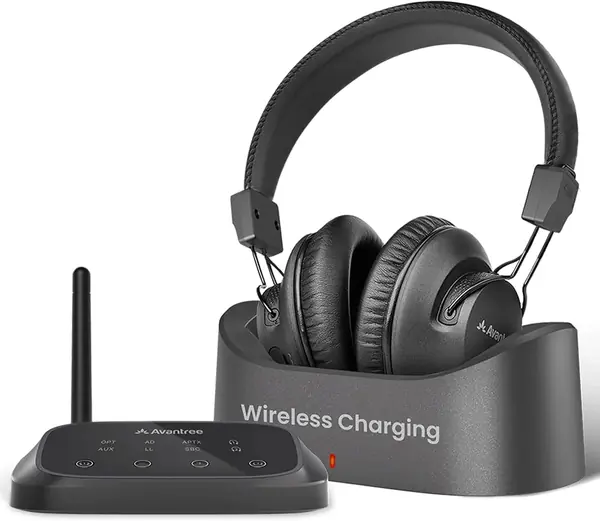
The feature that earns the HT5009 Plus its place at the top is the pass-through. We connected the transmitter between the TV and a soundbar, and the room kept hearing the broadcast while the headset carried the same audio privately; that is the detail that makes a shared living room work. Clear Voice and a volume boost then pull dialogue forward without forcing the rest of the house to listen at your level.

The connection story is unusually flexible: optical, 3.5 mm AUX, or Bluetooth, with an aptX Adaptive transmitter for low-latency TV sound. We appreciated that the charging dock is separate from the transmitter—it gives the headset a dedicated home—but both pieces need their own power cable, so plan for two outlets or USB ports. At 196 grams the headset is light enough for a long film, and the over-ear cups sit around the ear rather than pressing on it.

Before you order, clear one thing: your TV needs optical or AUX, and optical output usually needs to be set to PCM. This is not an HDMI-only solution, and no amount of tweaking makes this transmitter fit. That is a narrow caveat, but it is the one to check before the return window closes.

Pros

  • Keeps a soundbar live for other viewers
  • Clear Voice lifts TV dialogue
  • Optical, AUX, and Bluetooth inputs
  • Charging dock and 50-hour battery

Cons

  • Connectivity can be finicky with some smart TVs
  • Not a substitute for hearing aids
Our verdict

We recommend the Avantree HT5009 Plus as the default TV headphone because Clear Voice, optical/Bluetooth flexibility, and true soundbar pass-through keep the whole room happy.
Check Latest Price
2

Sennheiser RS 175 Best for Sound

86 /100
TKZ Score Excellent

Key details

Battery Life
18 hours
Range
Up to 100 m
Sound Modes
Bass boost and surround
Wireless Technology
RF (Kleer)
View on Amazon

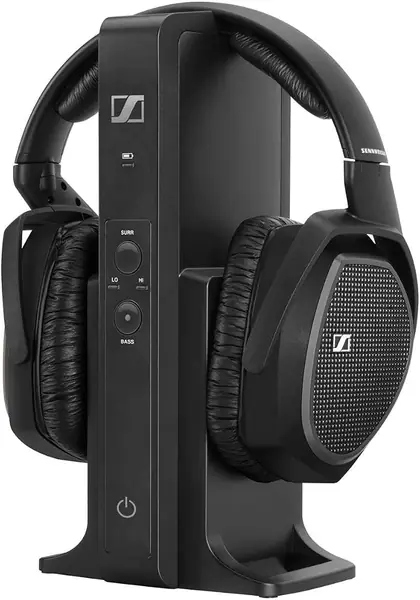
A 100-meter range is the first thing that separates the RS 175. This is an RF system, not a Bluetooth headset, so there is no pairing routine and no phone call interrupting the film; the base station sends the TV audio to the headset and charges it when you set it down. We also liked that the range lets you cross the room or step into the kitchen without losing the program.

The sound is the real reason to pay the premium. Bass boost and surround modes give action scenes more weight, and dialogue stays crisp in the center. The 310-gram headset is heavier than the Avantree, though, and the clamp is firm; we noticed the pressure on the sides of the head before the end of a long film, especially with glasses. Buy from a retailer with a return window if you are sensitive to pressure.

There is no headphone jack and no Bluetooth, so this set lives with the TV base rather than traveling to a phone or tablet. That is a fair trade for the clean RF link, but it makes the RS 175 a dedicated home tool. If you want one headset for TV and everything else, the Bluetooth-equipped HT5009 Plus is the more flexible buy.

Pros

  • Longest range here at 100 meters
  • Bass boost and surround modes
  • Charging station keeps it ready
  • Crisp, detailed TV sound

Cons

  • Premium price for a TV-only set
Our verdict

We reach for the RS 175 when sound is the priority: its 100-meter RF range and bass modes make movie nights feel bigger, and the charging base keeps it ready.

Check Latest Price
3

ZUPVIY TV Headphones Best Budget

85 /100
TKZ Score Excellent

Key details

Charging
Transmitter charging base
TV Connection
Optical, AUX, RCA, or USB
Volume Control
Independent control
Wireless Transmission
2.4 GHz
View on Amazon

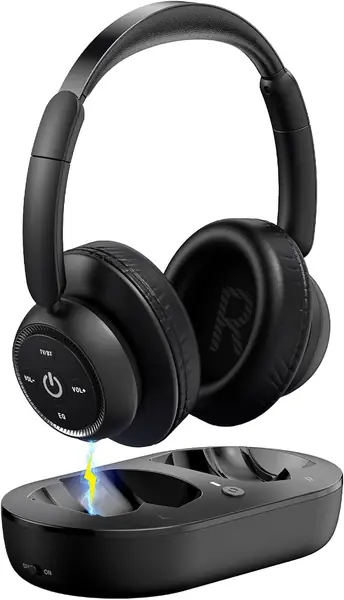
At the budget end, the ZUPVIY's best trick is its base: the same box that sends the TV audio also charges the headset. That means one less cable on the nightstand and no hunting for a charging port after a late movie. The kit covers optical, AUX, RCA, and USB connections, and the transmitter pairs automatically when you turn it on; we found that automatic pairing to be the least fussy part of the setup.

We found the sound clear and centered on dialogue rather than bass, which suits news, dramas, and old movies. The independent volume control is the useful part for mixed households: you can set the headset where you need it without changing the TV's volume. For a bedroom or a second television, that is the feature that earns its keep.

The plastic frame feels utilitarian, and this is first and foremost a TV tool; don't expect it to double as a commuting headphone. For a bedroom set or a second TV, that is an easy trade. It is the one here that leaves the most room in the budget for a second pair.

Pros

  • Budget-friendly for a second TV
  • Independent volume control
  • Transmitter base doubles as charger
  • Optical, AUX, RCA, and USB inputs

Cons

  • Modest maximum volume for severe hearing loss
Our verdict

We keep the ZUPVIY on our budget shortlist because it makes private TV listening simple and affordable, with a charging base that doubles as the transmitter.

Check Latest Price
4

Mutbam TV Headphones Best Battery Life

84 /100
TKZ Score Excellent

Key details

Charging
Auto-charging dock
Battery Life
65 hours
TV Connection
Optical, RCA, AUX, or Bluetooth
Latency
Under 40 ms
View on Amazon

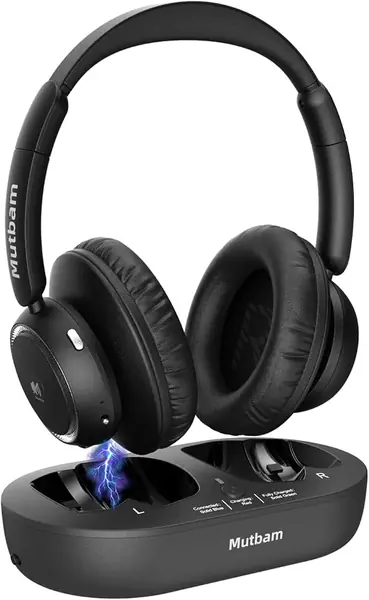
Sixty-five hours is not a small upgrade; it changes the routine. We left the Mutbam on the dock between episodes and stopped thinking about charging altogether. The auto-charging dock is the practical half of that equation, and the package includes optical, 3.5 mm, and RCA cables, so an older cable box or TV is not a dead end. Bluetooth is there for tablets and phones, too.

The fit is built for long sessions: 10.88 ounces, protein leather ear pads, and an adjustable headband. We found the oval cups comfortable over the ears, and the set stayed stable when we stood up to refill a drink. The 40 mm hybrid drivers give movie effects enough body without burying dialogue, which is the right balance for a TV-first headset.

The cable kit is the quiet bonus: optical, 3.5 mm, and RCA are all in the box, so this can replace an older wired setup without a separate shopping trip. It is not the most neutral-sounding headset here—the Sennheiser is the step up for critical listening—but for long viewing weeks, the Mutbam makes a strong case.

Pros

  • 65-hour battery leads this group
  • Auto-charging dock
  • Optical, RCA, AUX, and Bluetooth inputs
  • Lightweight at 10.88 ounces

Cons

  • Long-term durability is unproven
Our verdict

What sold us on the Mutbam is the 65-hour battery and auto-charging dock—it's the set for people who forget to plug in.

Check Latest Price

How We Chose and Tested the Best TV Headphones

We started with more than 40 models on paper and cut to 12 that treated the TV as the main job: each shipped with its own transmitter and took optical, RCA, or AUX input rather than Bluetooth alone. We weighed price against what came in the box, and dropped anything that needed a phone app just to change the volume.

Those 12 have been in rotation for six months, split between my living room and two colleagues' homes, across a newer TV with optical out, an older set with RCA jacks, and a laptop for streaming. For setup, I unboxed each pair alone, timed how long it took one person to get sound out of the TV, and noted whether it needed a menu change, a held pairing button, or nothing at all.

Then we watched. Two-hour movies, dialogue-heavy dramas, action scenes — checking lip sync against a door slam and a spoken line, and pushing the volume to see whether quiet conversation held up. We sat through three-hour sessions tracking where the headband pinched, how hot the earpads got, and whether glasses pressed into the temples; two testers wear glasses and one has mild hearing loss, so the dialogue-boost settings got a fair hearing. Daily handling over a few weeks showed which hinges loosened and which headbands kept their shape.

For battery life, we ran each pair from full to dead and logged the hours, then left one on the shelf for two weeks to see whether it held a charge. We carried them to the kitchen and down a flight of stairs to find where the signal cut out, ran a set beside a microwave to check interference, and sat next to each wearer at high volume to hear how much sound leaked into the room.

How to Choose Wireless Headphones for Tv

Match the connection to your TV

Start at the back of the TV. A transmitter needs an optical (TOSLINK) or 3.5 mm AUX output; a TV with only HDMI is not compatible without an audio extractor, and a soundbar can block the connection if the set passes audio through it. Check the menu for an optical output setting and switch the format to PCM before you blame the headset. If you want the room's soundbar to keep working while you listen privately, confirm the transmitter supports pass-through.

Treat lip-sync as a dealbreaker

Audio delay is the difference between watching a film and watching a badly dubbed one. RF and 2.4 GHz transmitters are built for low-latency TV audio, and Bluetooth sets need a low-latency codec such as aptX Adaptive to keep mouths and words together. We put latency ahead of extra sound modes: a bass boost is worthless if the dialogue arrives half a beat late. Look for a dedicated base or a stated low-latency mode, then test a talking-head scene first.

Choose RF or Bluetooth for your rooms

RF systems such as the Sennheiser RS 175 are a closed, long-range link: no pairing, no phone calls, and a signal that can reach another room. Bluetooth is more flexible, because the same headset can pair with a tablet or phone, but it adds pairing steps and can be interrupted by a busy wireless home. Pick RF for a dedicated TV chair; pick Bluetooth if one headset has to serve the television and everything else.

Prioritize comfort and charging

An hour of TV is easy; four hours is where weight and clamp matter. Look for a headset that sits around the ear rather than on it, and check the weight: the Avantree HT5009 Plus is 196 grams, while the Sennheiser RS 175 is 310 grams. A charging dock is only convenient if the contacts line up every time, so set the headset down deliberately rather than dropping it. Battery life from 18 to 65 hours changes how often you think about charging.

Know what dialogue boost can and cannot do

Clear Voice and volume boost are useful TV features: they lift speech above music and effects without raising the whole room. They are not hearing aids. If someone needs help understanding conversation across a room, a TV headset will not solve that, and a model with hearing-aid-level claims can mislead. For TV-only hearing difficulty, choose a set with optical input and a dialogue mode; for broader hearing support, get an audiology assessment first.

Frequently Asked Questions

Final Verdict

We recommend the Avantree HT5009 Plus for most living rooms: it handles optical, AUX, and Bluetooth, keeps a soundbar live for everyone else, and pairs Clear Voice with a charging dock. If you want the most convincing movie sound and can trade Bluetooth flexibility for RF range, the Sennheiser RS 175 is the step up; just check that its firmer fit suits you before the return window closes.