Best Wireless Headphones for Kids of 2026

The moment I became a believer in kids' headphones was a six-hour drive when my daughter borrowed my earbuds and cranked them to full volume — she had no idea what too loud felt like. A pair made for kids fixes that first, capping the volume before little fingers can, then handles the rest: a headband that fits a kindergartner this year and a fourth grader next, a battery that outlasts a flight, plastic that survives a backpack.

I've spent four months with 14 pairs — school drop-offs, airplanes, the back seat on weekend trips — and the differences are bigger than the spec sheets suggest. A volume limiter only helps if a kid can reach it: some are a switch on the ear cup, others hide in an app. Battery estimates run optimistic, and cheap noise cancellation adds a hiss kids notice before you do.

The ones below all make sense to a child the first time they put them on, which is the bar I kept coming back to.

The Best Wireless Headphones for Kids

1

EarFun K2 Best Overall
94 /100
TKZ Score Outstanding

Key details

Battery
60 hours
Volume Limits
74/85/94 dB
Weight
6.17 oz
Design
Foldable
View on Amazon

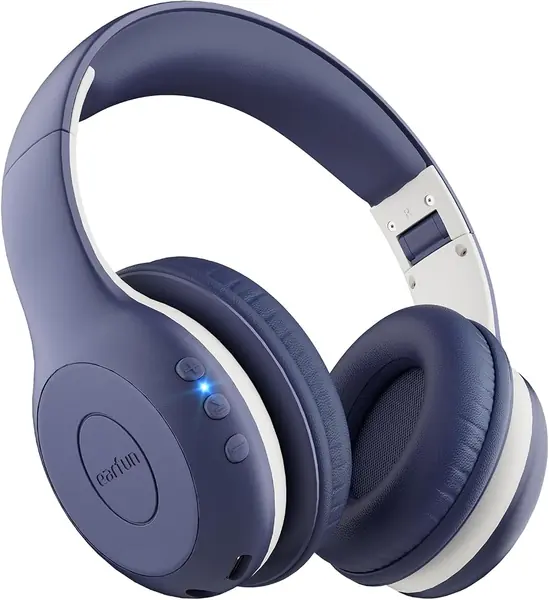
The EarFun K2 earns our top pick because it gets the safety basics right without making a child feel like they are wearing a hearing protector. The volume switch gives you 74, 85, and 94 dB modes; we keep the 74 dB setting for quiet rooms and the 85 dB setting for most school and car use. The 94 dB mode is there for a noisy plane or back seat, not all-day listening. That three-step range is more flexible than the two-step limits on several pairs here, and the K2 is also CPC-certified, which is the paperwork we want behind a kids product.

The 60-hour battery rating and 175-gram build make it easy to live with. We carried it in a backpack, folded the cups flat, and did not think about charging for a school week. The ear cushions are soft enough for a movie, and the controls are simple enough for a child to learn without a parent hovering. The K2 is not the lightest pair here—the iClever BTH22 is 149 grams—but it is easy to forget in a bag.

The 18-month warranty gives us some cover for the part that takes the most abuse, and it is longer than most here. If your child is especially hard on hinges, the iClever BTH12's 24-month coverage is the alternative. For most families, though, the K2's balance of safe volume, battery, and folded size is the reason it stays at the top.

Pros

  • Three volume modes, including a 74 dB setting
  • 60-hour battery rating
  • Folds flat and weighs 175 g

Cons

  • Headband can crack with rough handling
Our verdict

We recommend the EarFun K2 as the best all-around pair for school and travel: three volume limits, 60 hours, and a foldable fit, backed by an 18-month warranty.
Check Latest Price
2

JoySpark T5 Best for Toddlers

93 /100
TKZ Score Outstanding

Key details

Battery
40 hours
Volume Limits
85/94 dB
Weight
6 oz
Bluetooth
5.3
View on Amazon

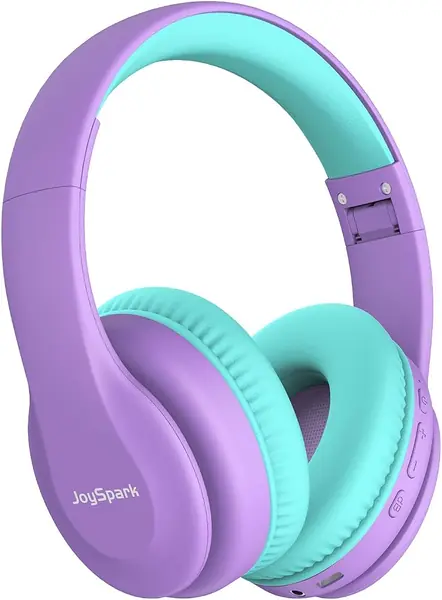
The first thing we noticed about the JoySpark T5 is how small it can go. The adjustable headband and soft memory-foam cushions settled onto a preschool head without the usual gap at the top, and the 170-gram build did not pull the cups down. That fit is why this is our toddler pick: a pair that stays put is more useful than a pair with an extra feature a 3-year-old cannot reach.

The volume switch is a simpler two-step design, 85 dB for daily use and 94 dB for noisy places. We like the one-button pairing and the built-in mic for video calls, and the 40 mm drivers are clear enough for shows and songs. The battery figure needs a second look: the title promises 60 hours, but the spec sheet lists 40. We plan around 40 and treat the bigger number as a best case.

That lower figure is still enough for a week of school use, and the T5's comfort is the reason we keep it in the toddler slot. It is not the pair for a child who needs a 74 dB quiet mode or the longest warranty—the EarFun K2 covers both. But for a small head and a soft fit, the JoySpark is the one we hand over first.

Pros

  • Fits toddlers and small heads
  • Soft memory-foam cushions
  • 40-hour battery

Cons

  • Can stop holding a charge
Our verdict

We recommend the JoySpark T5 for toddlers and small heads: the soft fit and light build are the draw, as long as you accept a simpler two-step volume limit.

Check Latest Price
3

JBL Junior 470NC Best Parental Controls

92 /100
TKZ Score Outstanding

Key details

Battery
50 hours
Weight
6.91 oz
Noise Control
Active noise cancellation
Volume Limit
85 dB max
View on Amazon

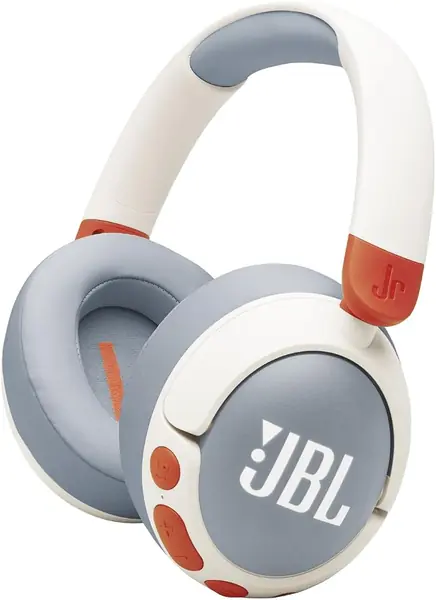
The JBL Junior 470NC is the only pair here with app-based parental controls. A parent can set a lower maximum volume than the 85 dB cap and put a daily listening-time limit on the headphones, which is a different kind of control from a simple switch on the ear cup. That is the feature you are paying for, and for a family that worries about a child quietly nudging the volume up, it is a meaningful one.

The rest of the package is built for travel: 50 hours of battery, a 196-gram frame that fit a smaller-to-medium head, and active noise cancellation for a plane or bus. The sound is fine for shows and music, not a reason to choose this over a cheaper pair. We treat the ANC as a travel extra rather than a guarantee of quiet.

What we appreciate most is that the safety controls do not depend on a child leaving a button alone. The trade-off is the app setup and the fact that the ANC drops out in wired mode, so the JBL is for families who will use the app and the travel features. If you just need a safe, light school pair, the EarFun K2 covers the basics.

Pros

  • App controls volume and daily time
  • 50-hour battery
  • Active noise cancellation

Cons

  • Premium price relative to the rest
Our verdict

We recommend the JBL Junior 470NC for families who want app-level control over volume and listening time, and who will use the ANC mostly as a travel extra.

Check Latest Price
4

iClever BTH12 Best Warranty Coverage

91 /100
TKZ Score Outstanding

Key details

Volume Limits
74/85/94 dB
Weight
7.04 oz
Bluetooth
5.2
Warranty
24 months
View on Amazon

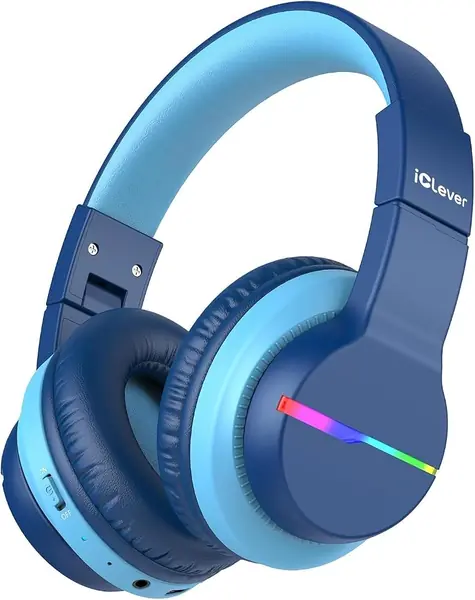
The iClever BTH12 comes with the longest warranty in this group: 24 months. That is the number we care about most, because kids headphones tend to fail at the headband, hinge, or charging port long before the drivers give out. The BTH12 also has a 40 mm driver, a built-in mic, and a simple button layout that a child can learn quickly. It is a school-first pair rather than the lightest or the prettiest.

The model name advertises 85 hours of playtime, but the spec sheet lists a 7-hour average. That is a big gap, and we treat the larger figure as a best-case claim. We plan to charge the BTH12 every few days; a week between charges is not something we count on. That discrepancy is worth knowing before you buy it for a long trip, even though the battery itself is not the reason to choose this pair.

What we like is the combination of that long warranty and a comfortable over-ear fit that worked for school-age kids. The LED lights are fun, but they are not why it earns a place. We keep the BTH12 for families who want a longer safety net and do not mind a slightly heavier pair; the BTH22 is the lighter, cheaper alternative.

Pros

  • 24-month warranty
  • Clear 40 mm drivers
  • LED lights kids like

Cons

  • Plastic headband can crack
Our verdict

We recommend the iClever BTH12 when warranty coverage matters most: 24 months is the longest here, and the 85-hour name is best treated as a claim rather than a promise.

Check Latest Price
5

iClever BTH22 Best Budget

90 /100
TKZ Score Outstanding

Key details

Battery
60 hours
Volume Limits
74/85 dB
Weight
5.26 oz
Charge Time
1.8 hours
View on Amazon

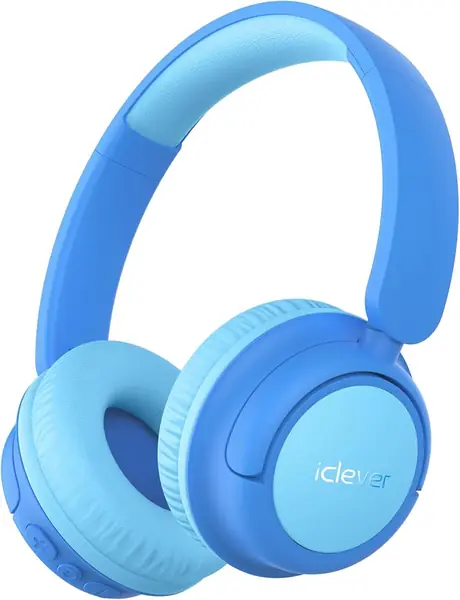
At 149 grams, the iClever BTH22 is the lightest pair we recommend. That matters for a 4- or 5-year-old who is still building neck strength, and it makes the BTH22 easy to drop into a backpack. The rotating ear cups and 10-level headband help it sit flat on a small head instead of clamping at the temples. It is the pair we hand to a child who complains that everything else feels too big.

The BTH22 is our budget pick because it covers the essentials without feeling stripped: 74 and 85 dB volume modes, a 60-hour battery claim, USB-C charging, and a 1.8-hour charge time. We like the 74 dB mode for quiet car rides and the 85 dB setting for school. The 12-month warranty is shorter than the BTH12's 24 months, which is the trade-off for the lower price.

The 1.8-hour charge time is the practical detail we appreciate on a school night: plug it in after dinner and it is ready by bedtime. If you need a longer warranty, the BTH12 is the step up; if you need the softest fit for a toddler, the JoySpark T5 is the better hand-off. The BTH22 is the light, simple pair we keep for everyday school use.

Pros

  • 149 g, the lightest here
  • 74 and 85 dB volume modes
  • 60-hour battery and 1.8-hour charge

Cons

  • Headband can crack with rough handling
Our verdict

We recommend the iClever BTH22 as the budget pick for small heads and school bags: it is the lightest pair here, with a 74 dB mode and 60-hour claim.

Check Latest Price
6

MIDOLA B-07 Best Budget Noise Cancelling

88 /100
TKZ Score Excellent

Key details

Battery
68 hours
Volume Limits
85/94 dB
Bluetooth
5.4
Noise Control
Active noise cancellation
View on Amazon

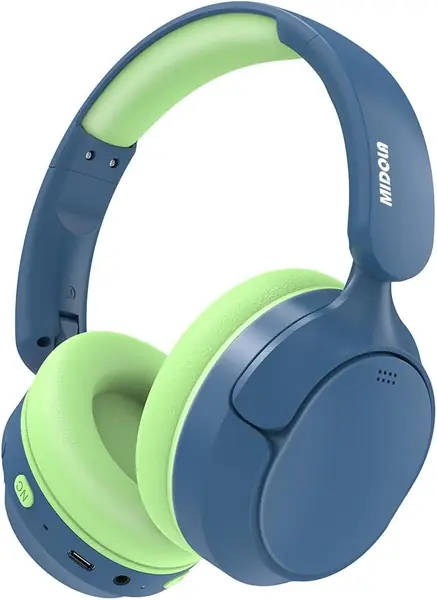
Compared with the JBL, the MIDOLA B-07 gives up the app controls and the brand polish but keeps the one travel feature that costs the most to add: active noise cancellation. It is the budget way to get a quieter plane or bus ride, and the 4-level headband stretches far enough to fit a range of kids.

The rest of the spec sheet is sensible for travel: 68 hours of battery, 85 and 94 dB volume modes, a 40 mm driver, and USB-C charging. The ANC is a one-button affair, which is easy for a child to work, though we treat it as a hush rather than a silence button. It is most useful on engine noise, not a noisy classroom.

The 85 dB mode is the one for daily use; 94 dB is for the noisy settings where a child cannot hear otherwise. We like that the headband has four steps, because a pair that grows with a child is easier to justify than one that fits for a single school year.

The B-07 is our budget travel pick, not our everyday default. We keep it for trips and as a backup, not as the only pair in a rough school bag. For a family that flies a few times a year, that is a useful role at a low price.

Pros

  • Active noise cancellation at a budget price
  • 68-hour battery
  • Four-step headband

Cons

  • Battery can stop charging within months
Our verdict

We recommend the MIDOLA B-07 for budget air travel: active noise cancellation and a 68-hour battery for a fraction of the premium pick, with battery reliability the risk.

Check Latest Price
7

Botesty BS01 Best for Long Trips

87 /100
TKZ Score Excellent

Key details

Battery
85 hours
Volume Limits
85/94 dB
Bluetooth
5.4
Frame
Metal frame
View on Amazon

The Botesty BS01 is the metal-framed outlier in this group, and that frame is the reason it earns a place. It is built to take a bend without snapping, and the 85-hour battery claim makes it a sensible long-trip backup. The 85 and 94 dB volume modes cover daily use and noisy travel, and Bluetooth 5.4 is current enough to pair easily with a tablet.

We like the fold-flat design and the BPA-free materials, and the controls are simple enough for a child to use without help. The 40 mm drivers are clear for shows and school videos, and the included AUX cable gives you a wired fallback when the battery runs down. This is not the pair with the most polished sound or the softest cushions; it is the one we keep in the car or a travel bag.

The BS01 is a value travel pair rather than the main school pair. If you want a metal frame and a long battery claim for occasional use, it is a smart buy; if you want a longer warranty, the iClever BTH12 is the safer call. We just do not expect it to be the pair a child wears every day for a whole school year.

Pros

  • Metal frame
  • 85-hour battery claim
  • 85 and 94 dB volume modes

Cons

  • Six-month warranty is the shortest here
Our verdict

We recommend the Botesty BS01 as a long-trip backup for families who want a metal frame and an 85-hour claim, provided the six-month warranty is acceptable.

Check Latest Price
8

YOYOTUNE BT01 Best for Sibling Audio Sharing

82 /100
TKZ Score Excellent

Key details

Battery
40 hours
Volume Limits
85/94 dBA
Bluetooth
5.3
Sharing
Wireless audio sharing
View on Amazon

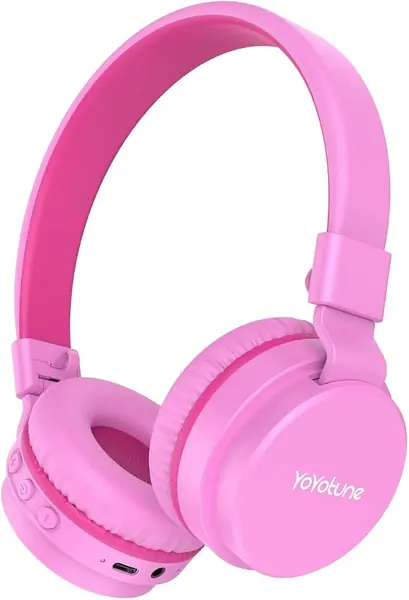
Two kids wanting the same tablet is the problem the YOYOTUNE BT01 solves: it can wirelessly share audio with a second pair, no splitter needed. That is a genuinely useful trick for siblings on a road trip, and it is rare at this end of the price range.

The rest is basic but workable: 40 hours of battery, 85 and 94 dBA volume modes, Bluetooth 5.3, and a 40 mm driver. The controls are push-button and easy enough for a child to learn, and the headphones are light enough to toss in a bag. We like the audio-sharing feature more than the sound, which is fine for shows and songs but not a reason to buy.

The build is the weak spot. The plastic and ear pads are the first places we expect wear, and the pair feels lighter and less substantial than the iClever or EarFun picks. It is a spare-pair purchase, not the main school headphones, and we keep it away from a child who is rough on hinges.

We recommend the BT01 for a second pair, a sleepover bag, or a family that wants to share one tablet without buying two premium sets. It is not the pair we reach for when a child needs the softest fit or the longest warranty. At its price, it is a useful extra rather than a daily driver.

Pros

  • Wireless audio sharing
  • 40-hour battery
  • 85 and 94 dBA volume modes

Cons

  • No 74 dB quiet mode
Our verdict

We recommend the YOYOTUNE BT01 for siblings who want to share one tablet, or as a cheap spare pair, not as the main school headphones.

Check Latest Price

How We Tested Kids' Wireless Headphones

We started with every pair sold specifically as a kids' headphone rather than an adult model retargeted at children, then filtered on three things the listings actually reveal: a stated volume limit, a built-in mic for school tablets and video calls, and an adjustable headband built for a smaller head. That left 14 pairs across budget and mid-range, covering roughly ages four to ten.

Testing ran four months in the places these headphones actually live: two-hour flights, weekend drives, school drop-off, and the kitchen table during homework and video calls with grandparents. Each pair went home with a family with at least one kid in that age range, and we wrote down what happened rather than relying on memory.

Volume came first. We set each pair to its loudest with the limiter engaged, checked the output against the manufacturer's claim, then handed it to a five-year-old to see whether it was reachable without an adult. For battery, we charged to full on a Friday night and tracked hours until a pair died mid-use. Connectivity got the walk-away test: paired to a tablet, carried to the far end of the house and out to the driveway to find where the signal quit, then re-paired after a kid switched devices.

Comfort and durability got the least gentle treatment. We weighed each pair, checked whether the ear cups swiveled to sit flat on a small head, and asked kids if the clamp bothered them after an hour. Then we dropped them from desk height, twisted the headband, and stuffed them uncased into a backpack next to a water bottle. For sound, we judged dialogue clarity on videos and audiobooks rather than bass, and on the two pairs with noise cancellation we listened for hiss in a quiet room before judging them in a cabin.

How to Choose Kids Wireless Headphones

Put the volume limit first

Volume limiting is the feature that separates kids headphones from adult ones, and the settings matter more than the badge. A 74 dB mode suits a quiet room or a toddler; 85 dB is the common ceiling for daily listening; 94 dB is for a noisy car or plane, not all day. We prefer a pair with at least two child modes, and we start children at the lowest setting they can hear comfortably. The EarFun K2 and iClever models give you that choice; the JoySpark T5 stays at 85/94.

Fit the head, not the age on the box

Ages on the box are a rough guide; the headband and the weight do the real work. A 149-gram pair like the iClever BTH22 is easier for a small neck than a 196-gram model, and rotating ear cups help the pads sit flat instead of pinching. Over-ear cups spread pressure better for long movies; on-ear cups are lighter but can press after an hour. We check the smallest headband setting first, then the ear-cup opening, because a pair that slips or clamps will not stay on.

Treat the headband as the wear part

Plastic headbands, sliders, and hinges are where kids headphones fail first, usually after months of being stretched and dropped. That makes warranty length a real feature, not fine print: the iClever BTH12 carries 24 months, while the Botesty BS01 lists six. We look for a reinforced headband and a warranty that covers normal school use, then check the slider and ear-cup joints every few weeks. A cracked headband is a stop-use sign, not something to tape and keep wearing.

Read the battery number carefully

Battery claims in product names are often best-case, and the spec sheet can tell a different story. The iClever BTH12 is the clear example: its name says 85 hours, while the listed average is 7. We plan around the shorter number and treat the bigger one as a ceiling. For school, a 40- to 60-hour rating is plenty; for travel, check the charge time and carry the AUX cable, because a dead battery should not end the trip.

Buy noise cancellation for the trip, not the classroom

Active noise cancellation is a travel convenience, not a safety feature, and it does not replace a volume limit. The JBL Junior 470NC and the MIDOLA B-07 both offer it, but the effect is a hush rather than silence, and the JBL's ANC turns off in wired mode. We pay for ANC only when a child flies or rides a noisy bus often; otherwise the money goes further toward a better fit and a longer warranty. If you do buy it, test it on a short trip before relying on it for a long flight.

Frequently Asked Questions

Final Verdict

We recommend the EarFun K2 as the default for most families: it combines three volume limits, 60 hours of playtime, and a foldable fit with an 18-month warranty. If school wear is the main concern, the iClever BTH12's 24-month warranty is the better bet; if you fly often and want app controls, the JBL Junior 470NC earns its premium. The right choice is the one that matches your child's fit and your travel schedule, not the one with the longest feature list.