Best Wireless Earbuds for Kids of 2026

My 8-year-old started borrowing my earbuds last spring, and one bus ride showed me the problem: the buds slid out before the first stop, and the volume was a fight every time. A kid doesn't need a smaller copy of an adult pair. They need something that stays in small ears, caps how loud things get, and survives a backpack. We spent four months with 14 pairs, from school mornings to backyard afternoons to two long road trips.

The volume limiter is what parents ask about first, and it's worth checking twice — a cap built into the earbuds holds at 85 decibels no matter what your kid taps on the phone, while an app-only limit vanishes the moment they borrow a tablet. Looks matter more than the spec sheet suggests: kids wear what they think is cool, and a favorite color or a goofy charging case keeps a pair out of the bottom of a backpack.

The picks below are the ones that held up and the ones the kids kept asking for.

The Best Wireless Earbuds for Kids

1

Belkin SoundForm Nano 2 Best Overall

88 /100
TKZ Score Excellent

Key details

Water Resistance
IPX5
Battery
8 hrs per bud, 28 total
Volume Limit
85 dB
Age Range
7 and up
View on Amazon

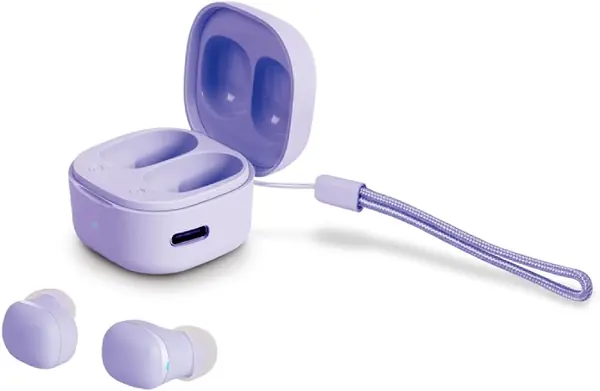
A volume ceiling built into the earbud, not into an app, is the whole reason the SoundForm Nano 2 is our default pick. Hand a kid a phone, a school Chromebook or a hand-me-down iPad and the 85 dB cap travels with the buds — nobody has to remember a setting before the handover. The 7-and-up age rating matches the hardware rather than the packaging: small shells, three sizes of antimicrobial ear tip, and a touch panel Belkin built for a child's hand.

Eight hours in each bud and twenty more in the case makes a 28-hour buffer, and that's enough that charging becomes a weekend job instead of a daily one — not something we can say about the cheaper sets here. The IPX5 shell and Belkin's drop-and-spill testing matter more than the rating suggests, because kids' earbuds land on blacktop and get shoved loose into a backpack. The two-year warranty is also the longest on this list, and a rechargeable battery, not a cracked shell, is what usually ends a pair's life.

Two boundaries are worth knowing. The fit runs generous for a 7+ product, so a six-year-old's ears are likely to be too small and a small five-year-old's certainly are. And the cap cuts both ways in noise: in a quiet room the sound is clear and comfortable, but a capped bud has less headroom on a plane, so a kid watching a movie in the air will hear the cabin as much as the dialogue.

Pros

  • 85 dB cap built in, so every paired device stays safe
  • 28 hours total with the charging case
  • IPX5 shells, drop tested, two-year warranty

Cons

  • One earbud can drop its connection or go silent
Our verdict

Our default for most families: the cap lives in the bud, the smallest tips fit small ears, and 28 hours with the case means nobody has to remember to charge.
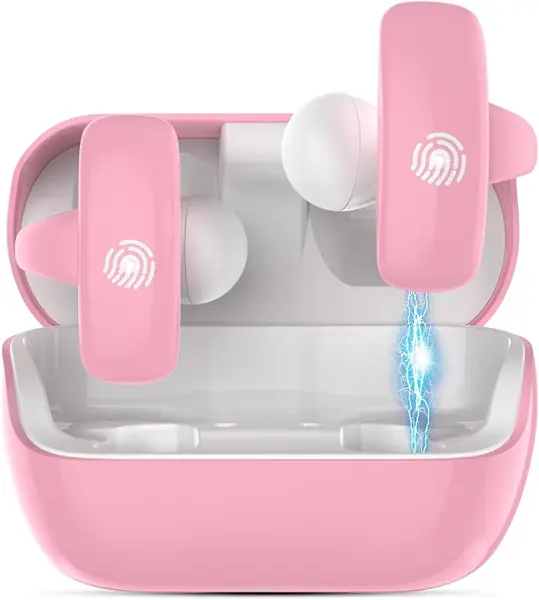
Check Latest Price
2

KENKUO Y6 Kids Earbuds Best Budget

87 /100
TKZ Score Excellent

Key details

Water Resistance
IPX6
Bluetooth
5.3
Volume Limit
85 dB
Bud Weight
0.09 oz
View on Amazon

Two and a half grams per bud is the number that decides this one. The Y6 is the lightest earbud in the guide, and it's the pair we hand to a kid whose complaint is that everything else pushes — soft silicone wings hold the bud against the ear instead of wedging it into the canal. The 85 dB limit is the other half of the argument: this is the least expensive pair here that caps volume in the hardware rather than in an app.

The case is smaller than the rest of the set suggests, under an inch and a half across, with a detachable strap that clips onto a backpack loop. IPX6 is the highest water rating of anything here, which matters when the buds ride home in a damp gym bag, and Bluetooth 5.3 pairing has been quick and stable across the phones and tablets we paired them with.

Where it gives ground is longevity. Some Y6 pairs stop charging, or lose a bud to silence after a few weeks, and the low price is what makes that tolerable — this is a one-school-year purchase, not a hand-me-down, and we don't hand it to a kid who is hard on gear. If you want the pair that reaches a second year, the Belkin is the safer spend.

Pros

  • 2.5 g buds that stay put in tiny ears
  • 85 dB hardware cap at the lowest price here
  • IPX6 water resistance and a clip-on case

Cons

  • An earbud can stop charging or go quiet
Our verdict

The pick for small ears and a small budget — the lightest buds here, with a hardware volume cap and a case that clips to a backpack.

Check Latest Price
3

iDIGMALL Kids Open-Ear Earbuds Best Open-Ear

86 /100
TKZ Score Excellent

Key details

Water Resistance
IPX4
Battery
5 hrs per bud, 20 in case
Volume Limit
85 dB
Design
Open-ear clip
View on Amazon

Some kids won't keep a bud in their ear canal — it itches, it works loose, it needs adjusting every few minutes — and for that child an open-ear clip isn't a compromise, it's the fix. The iDIGMALL set hooks over the ear on a soft C-shaped arm and aims sound at the canal instead of sealing inside it, so there's nothing to push back in. It also leaves both ears open to traffic and to a parent calling from the next room, which is the strongest safety argument in this guide for a kid who walks or bikes.

The 85 dB cap is here too, which puts it in a small group on this list, and Bluetooth 5.4 is the newest version here. We were struck by how little there is to get wrong — no seal to break, no tip to lose, no hair catching on the arm. Each bud runs about five hours and the 300 mAh case adds roughly three top-ups, so the case is doing most of the work.

Sound is where the open design shows its limits. There's no bass weight to speak of next to the in-ear picks and dialogue is clear but thin — good for audiobooks, a video call and a coach's instructions, less satisfying for music. And because nothing seals, everyone within a few feet hears the video too, which rules it out for a quiet classroom or the back seat of a shared car.

Pros

  • Nothing goes in the ear canal
  • 85 dB cap with the newest Bluetooth here
  • Keeps a kid aware of traffic and voices

Cons

  • Five hours per bud means charging most nights
  • Open fit lets sound in and out
Our verdict

For the kid who won't wear anything in their ear, this is the answer: a clip-on that keeps them aware of traffic, capped at 85 dB.

Check Latest Price
4

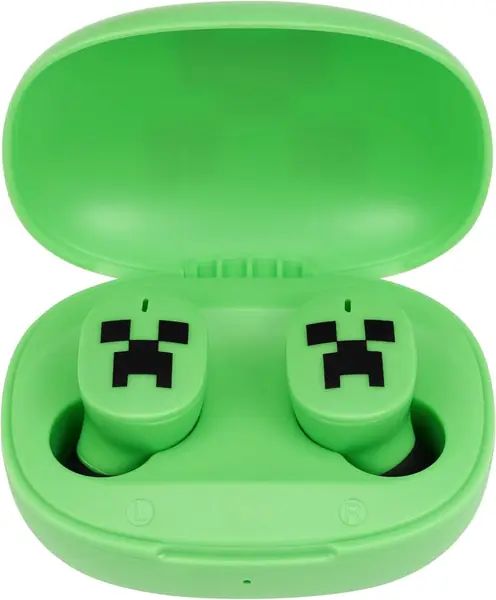
eKids Minecraft Earbuds Best Character Design

85 /100
TKZ Score Excellent

Key details

Water Resistance
Not water resistant
Battery
22 hrs total
Bluetooth
5.2
Design
Minecraft buds and case
View on Amazon

There's no volume cap on these, and we won't bury that. The Minecraft buds are standard Bluetooth earbuds in a themed shell, which means the ceiling has to come from the phone or tablet — and both iOS and Android will hold a limit once an adult sets it. If your kid listens on one device you control, that's workable. What it isn't is a limit that follows them to a friend's iPad.

What the eKids set does have is 22 hours of total playtime, with the case recharging the buds about two and a half times, plus a microphone that's clear enough for video calls and game chat. The design is the real purchase, though: buds and case match, the Minecraft graphics sit on both, and the ear cushions and wings are comfortable on an eight- or nine-year-old. A themed pair gets worn; a plain black one stays in the drawer.

Fit is the part to get right. These are full-size buds, and it's the six- and seven-year-olds with genuinely small ears who end up frustrated — by eight or nine the shell sits fine. Our read is that this is the best character set here for a kid who is past the small-ear stage, and the one to skip if your child is still losing standard earbuds to the couch cushions.

Pros

  • Minecraft graphics on buds and case
  • 22 hours of playtime with the case
  • Mic is clear for calls and game chat

Cons

  • Fit runs large for kids under eight
  • No water resistance rating
Our verdict

Buy these for the theme and the 22 hours, not for the safety spec — a Minecraft fan will wear them daily, and the volume limit is the phone's job.

Check Latest Price
5

AMAFACE Kids Earbuds Cheap First Pair

84 /100
TKZ Score Excellent

Key details

Water Resistance
IPX5
Battery
4–6 hrs per bud
Bluetooth
5.0
Case
Blinking-eye character case
View on Amazon

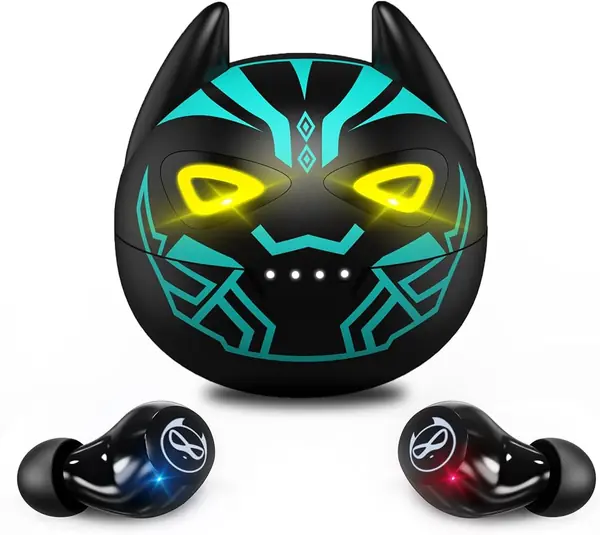
Despite the cartoon head on the case, these run bigger than the kids they're marketed to. The buds are standard in-ear shells, so six-, seven- and eight-year-olds are the ones pushing them back out, while older kids, tweens and adults with narrow canals get along with them fine. The listing's own age range says teenagers and adults, which is a more honest guide than the blinking eyes.

What you're buying is the case: a small character head whose eyes blink while it charges, the sort of thing a kid carries around for its own sake. Behind it sits a competent, inexpensive earbud — IPX5, three tip sizes, four to six hours per bud with another three or four charges in the case, and sound that's louder and clearer than the price implies. We treat this as a first pair rather than a last one, the same way we'd think about a kid's first phone case.

The caveat is the electronics. Some pairs arrive with one side that won't pair or won't charge, so open the box, test both buds and keep the packaging for a week; the return is easy at this price, and it's the difference between a bargain and a waste. Bluetooth 5.0 is the oldest version in this guide, and it pairs fine — just more slowly than the newer sets.

Pros

  • Blinking-eye character case kids carry everywhere
  • IPX5 with three ear-tip sizes
  • Lowest price in this guide

Cons

  • No built-in volume cap
  • Buds run large for younger kids
Our verdict

A cheap, cheerful first pair for a tween: the blinking case is the fun part, and the shells fit older kids better than the six-year-olds the packaging winks at.

Check Latest Price
6

FEFURS Kids Earbuds 2-Pack Best for Siblings and Spares

83 /100
TKZ Score Excellent

Key details

Water Resistance
Not water resistant
Battery
36 hrs total
Bluetooth
5.4
Pack
2 pairs
View on Amazon

Two complete sets, two charging cases, one purchase — that's the pitch, and it lands at roughly what one of our other picks costs. For siblings it ends the argument about whose turn it is; for an only child it means a spare that lives in the car and a spare that lives in the backpack. With kids' earbuds the realistic failure mode isn't breakage, it's disappearance.

The hardware is better than the two-pack price implies. Bluetooth 5.4 is the newest version in this guide, playtime runs to 36 hours across the buds and the cases, and the sound is fuller than the money suggests, with enough weight for music as well as video. A smaller child-sized tip is included and it does help the canal, but the shell itself is teen-sized rather than built small.

Where we land: this is the pair for a nine- or ten-year-old, or for two kids splitting one order, and it's our answer when a set has already gone missing this year. Check the current fit before you commit — if your child's existing earbuds already work their way out, a teen-sized shell won't fix that.

Pros

  • Two pairs and two cases in one box
  • 36 hours of total playtime
  • Bluetooth 5.4 with sound beyond the price

Cons

  • No volume limit in the buds
  • No water resistance rating
Our verdict

Two pairs for roughly the price of one, sized for older kids — buy it for siblings, spares, or a kid who has already lost a set.

Check Latest Price

How We Tested the Best Wireless Earbuds for Kids

We started by pulling every kids' pair we could find with an advertised volume cap, a charging case, and a build small enough for a 7-year-old's ear, then filtered out anything without a mic or with a case too bulky for a backpack pocket. That left 14 pairs, which we rotated through the same group of kids ages 6 to 11 over four months.

Testing happened where the earbuds actually live: on the school bus, at a desk during a video lesson, on a trampoline, in the back seat on a long drive, and in gym class. We handed each pair to a kid and asked them to shake their head, run across the yard, and sit through a full movie. Every bud that fell out got written down, and that count told us more than any size chart. For volume, we paired each set to a phone, ran a song at maximum with a decibel meter at the speaker, then re-paired it to a tablet to see whether the cap held or reset.

Battery got a real-world check: charged Friday night, then used for a week of bus rides and homework, and we noted which day they died. We walked to the far end of the house with the phone left in the kitchen to catch dropouts, dropped each case on the driveway, and sent the buds to school loose in a backpack. For sound, the bar was a teacher's voice staying clear at half volume and music not sounding hollow. Since looks decide whether a kid wears them at all, we let the kids pick from the pile and noted which pairs they grabbed first. Price came last: not which set was cheapest, but which was worth replacing after a lost bud.

How to Choose Wireless Earbuds for Kids

Put the Volume Cap First

An 85 dB hardware limit is the first thing we check, because it's the one feature that keeps working when the device changes — a hand-me-down phone, a school tablet, a friend's iPad. A cap set in an app is better than nothing, but it's easy to undo and it doesn't travel.

Belkin, KENKUO and iDIGMALL build the limit into the earbud; the eKids, AMAFACE and FEFURS sets don't, so those need a device-level limit set before the handover. The trade-off is headroom: a capped bud has less to give on a plane or in the back seat of a car.

Fit Decides Whether They Get Used

An earbud that doesn't fit is a drawer ornament. Look at bud weight and ear-tip options before the age on the box: 2.5 grams with silicone wings is a different proposition from a full-size shell with a smaller tip fitted to it. Titles are loose with the word kids — two sets here list teenagers or adults as the intended wearer.

If your child won't tolerate anything in the ear canal, an open-ear clip like the iDIGMALL sidesteps the fight entirely: it rests outside the ear and never needs to seal.

Count the Case, Not Just the Bud

Per-bud figures in this group run from five hours to eight, and that gap matters less than what the case adds. A bud that dies at lunchtime can go back in the case while the other one takes over; a case with no charge is a dead pair.

Total playtime including the case runs from about 20 hours to 36, and anything over roughly 22 gets a kid through a school week. Charging the case itself on a Sunday night is the whole maintenance routine.

Durability, Water and What Actually Breaks

IPX5 or IPX6 handles sweat, a tipped water bottle and a wet walk to the bus; IPX4 is splash-only, and two of these earphones carry no water rating at all — worth knowing before a pair goes to soccer practice. Drop testing matters more than the number implies, because kids' buds land on concrete and get shoved loose into a backpack.

None of these are built to be handed down, so treat water resistance as insurance rather than a promise.

Controls a Kid Can Work Alone

Every set here uses a touch panel instead of a button, which cuts both ways: small fingers find the tap zones hit-or-miss, and hair, hats and hoods set them off. Learn the two gestures that matter — usually a single tap to pause and a long press for volume or the assistant — and teach those rather than the whole command list.

Setup is a one-time job on an adult's device. After the first pairing the buds reconnect on their own, which is why it's worth doing properly once.

Frequently Asked Questions

Final Verdict

The Belkin SoundForm Nano 2 is the pair we recommend first: an 85 dB cap that lives in the earbud, tips small enough for a seven-year-old, 28 hours with the case and a two-year warranty. If tiny ears and a tight budget decide it, the KENKUO Y6 is lighter, cheaper and capped the same way. And if your kid simply won't keep anything in their ear canal, skip both and go open-ear with the iDIGMALL.