Best Telephoto Lenses for iPhone

Your phone's digital zoom is mostly a lie — you can see it in the smeared faces at the back of the school gym and the gray blob where the moon should be. A clip-on telephoto lens fixes that with real glass that magnifies the image before it ever reaches the sensor, and a bad one is worse than no zoom at all.

I started carrying one after a concert where my phone turned the stage into a lit-up ant farm. Over the past four months, my team has shot with 14 of these lenses — clipping them on, seating them over the camera, propping them on tripods and pairing the little Bluetooth remotes. What separates them is glass quality, how firmly the mount holds, and whether the lens centers cleanly over your camera. The zoom number on the box is the least useful thing about it; a clean 2x beats a mushy 20x every time.

None of these turn a phone into a DSLR. What the good ones do is put a usable long lens in your pocket for the price of dinner out, and the picks below are organized by what you'd actually shoot rather than by the biggest number on the box.

The Best Telephoto Lenses for iPhone

1

APEXEL 10X Tele-Macro Pro Best Overall
86 /100
TKZ Score Excellent

Key details

Magnification
10X
Mount
Universal spring clip
Weight
5.12 oz
Focus Range
30cm to infinity
View on Amazon

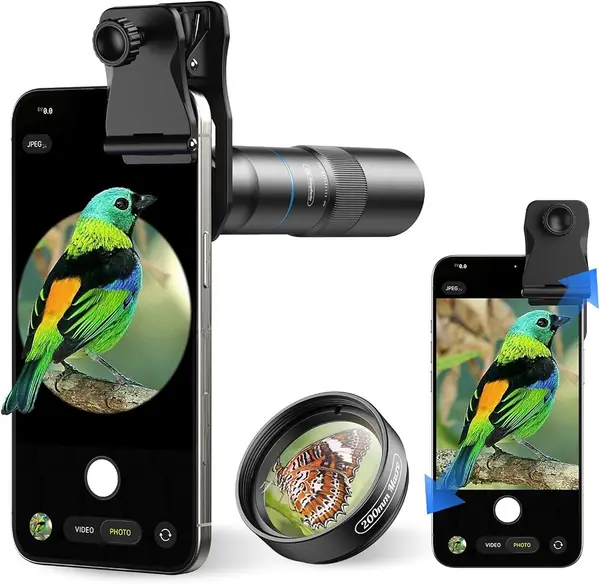
Two lenses, one clip, and 5.12 ounces is the whole argument for this as the default. The APEXEL 10X pairs a 10X telephoto with a separate macro lens, both riding a spring clip that grips most phones without a backplate, a cage, or a tripod. It's the only pick here that asks nothing of you before you can take a picture, and that is worth more than a specification sheet suggests.

The telephoto side is a 12-element design with full-surface multi-layer coating and an 8.6-degree angle of view, which gives you the compressed, long-lens look rather than an iPhone crop blown up. Focus is manual, by ring, and in practice that's fine for anything that holds still — a stage, a sign, a bird on a railing. The macro lens turned out to be the sleeper of the kit: indoors, where a telephoto has nothing to reach for, it keeps the whole thing earning its place in the bag.

What you give up is steadiness. There's no image stabilization in the lens, so at full 10X every wobble is magnified alongside the subject; brace your elbows or lean the phone on something solid for the longest shots. The clip is the other thing we appreciate — it moves between phones in a household, so this is the lens that survives somebody's upgrade.

Pros

  • Telephoto and macro lenses in one kit
  • 5.12 oz, so it rides in a pocket
  • Universal clip works without a case system

Cons

  • No stabilization, so 10X needs a steady brace
Our verdict

For most iPhone owners this is the lens to buy: it clips on, fits a pocket, needs no tripod, and adds a macro lens for the same money.
Check Latest Price
2

TELESIN 3.5X Master Grip Kit Best for iPhone 18 Pro Max

80 /100
TKZ Score Excellent

Key details

Magnification
3.5X
Reach
400mm equivalent
Compatibility
iPhone 18 Pro Max
Minimum Focus
7m+
View on Amazon

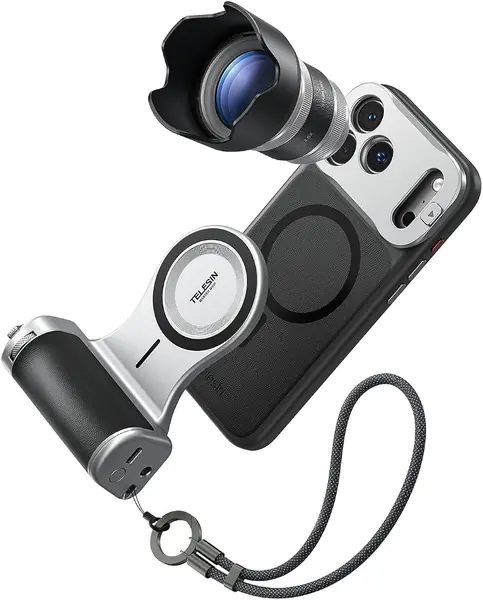
Four hundred millimeters of reach and a shutter under your thumb: the TELESIN kit is the closest thing in this group to shooting with a camera rather than a phone. The 3.5X lens stacks onto the iPhone 18 Pro Max's own telephoto camera, and the Master Grip beneath it adds a two-stage mechanical shutter, a 3,200mAh battery that charges the phone wirelessly, and enough handle to hold the whole rig steady.

The grip is what we kept coming back to. Half-press to lock and then fire is how a camera is supposed to feel, and the compact 6.4cm optical design keeps the weight back over your palm instead of hanging a front-heavy tube off the lens mount — a small thing that decides whether you can hold the thing still. Add the Reef Color app's 4K60 electronic stabilization, tuned for the long end, and handheld video at this length stops being a compromise.

What it won't do is anything close. Minimum focus distance is about 7 meters, so portraits, flowers, and whatever is in the room with you are out. Wildlife across a field, a quarterback from the stands, a bird that won't let you approach — that's the brief. Judged against it, the kit is excellent. Judged as your only lens, it's a specialist that lives for a handful of outings a year.

Pros

  • About 400mm equivalent reach
  • Two-stage shutter plus a 3,200mAh battery
  • Compact 6.4cm lens keeps the balance back

Cons

  • Fits only the iPhone 18 Pro Max telephoto camera
Our verdict

Buy it if you shoot distant subjects on an iPhone 18 Pro Max and want a shutter and battery under your thumb; on any other iPhone it simply doesn't apply.

Check Latest Price
3

MIAO LAB 20-60X Zoom Telephoto Best Zoom Range

79 /100
TKZ Score Very Good

Key details

Weight
3.8 lb
Filter Thread
58mm
Objective Lens
45mm
Zoom Range
20-60X
View on Amazon

A 20-60X range is the outlier here: every other lens in this group is fixed, and being able to pull back without unclamping the phone changes how you shoot. You find the subject at 20X, then dial in to 60X, instead of hunting for something you can't see at maximum magnification.

At 3.8 pounds it's a tripod instrument, not something you sling over a shoulder. The aluminum body sits on a matching aluminum tripod, and the phone clamps into a spring clip you slide until the lens sits over one camera. That slide is where the work is: on a multi-camera iPhone, the phone can hop to a different lens the moment you touch the screen, and the longer the focal length, the more visible the misalignment. Set the phone to one camera, check the framing, then keep your fingers off the screen.

Do that and it offers the most flexible framing in this group — one instrument that takes in a skyline at 20X and then pulls a single window out of it at 60X. The 45mm objective gives the long end something to work with, and the 58mm front thread accepts filters no clip-on can take. Nothing about it is quick, though, and that's the trade: it's a lens for a fixed position and a distant subject, not for a walk in the woods.

Pros

  • Variable 20-60X zoom frames without moving the rig
  • Aircraft-grade aluminum body and matching tripod
  • 58mm front thread takes filters

Cons

  • 3.8 pounds, so it stays on its tripod
Our verdict

Pick it when you want one lens that covers both a wide look and a 60X pull, and you're willing to shoot from a tripod to get it.

Check Latest Price
4

APEXEL 50X Telephoto Best for Extreme Reach

78 /100
TKZ Score Very Good

Key details

Magnification
50X
Objective Lens
5.6 cm
Clip Range
2.8-3.9 in
Focal Length
1200mm
View on Amazon

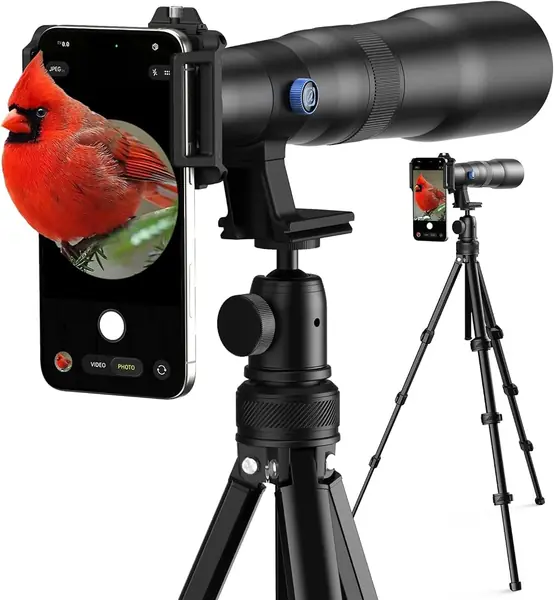
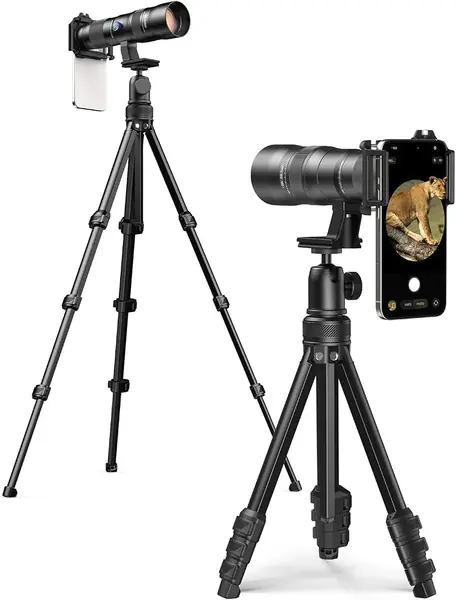
Fifty power sounds like marketing until you point it at the moon and get a disc with craters instead of a bright dot. What we didn't expect to use is the eyecup: at this magnification, tracking anything through a phone screen is miserable, so the routine becomes finding the subject with the lens used as a monocular, setting the tripod, and only then clipping the phone on. That one small accessory is what makes 50X practical rather than a number on a box.

The rest is properly built for the job. It's a 1200mm scope in an aircraft-grade aluminum body, with 10 elements in 7 groups and multi-layer coating to hold down ghosting and flare, plus a ball-head tripod in the box. The 5.6cm objective gathers enough light to keep the long end usable, and the adjustable clip spans 2.8 to 3.9 inches.

Everything else is manual — focus, exposure, framing — and there's no stabilization, so the tripod isn't optional. That's physics at this length rather than a design flaw, but it does mean the 50X is a second lens for planned outings, not the one that lives in your bag.

Pros

  • 1200mm reach for the moon and wildlife
  • Works as a monocular with the silicone eyecup
  • Aluminum body and ball-head tripod included

Cons

  • Does not fit iPhone mini or iPhone 8 and older
Our verdict

The extreme-reach pick: buy it to photograph the moon, a distant nest, or a shoreline you can't walk to, and plan on a tripod every time.

Check Latest Price
5

NEEWER 65mm LS-66 Best for Existing 17Mm Rigs

77 /100
TKZ Score Very Good

Key details

Magnification
1.7X
Mount
17mm thread
Filter Thread
58mm
Optics
7 elements in 5 groups
View on Amazon

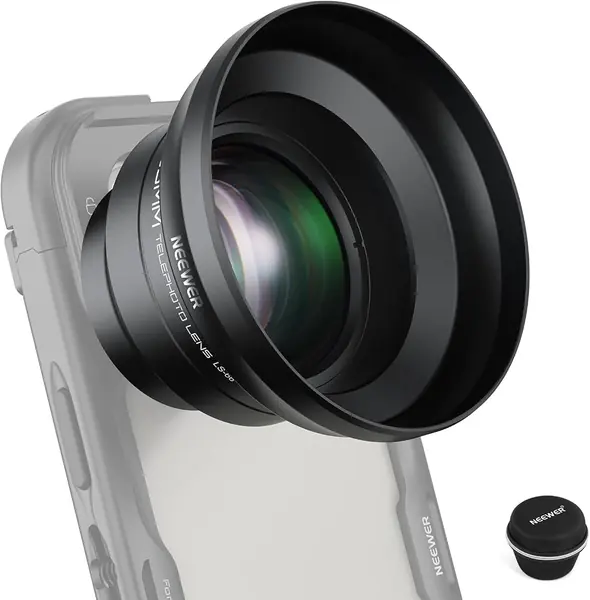
This one doesn't clip on. The LS-66 screws into a 17mm thread — a NEEWER PA018 or PA019 backplate, or one of the brand's 17mm-thread cages and cases — so the mount you already own decides whether it's a bargain or a project. Buy the backplate first if you don't have one; there's no adapter in the box, just the lens and its hood.

Once mounted, sitting square and staying there is worth more than it sounds, and the LS-66 is built better than its price suggests: seven elements in five groups, multicoated HD glass, and a black anodized aluminum shell that shrugs off a bag. The 58mm front thread is the real argument, though. It takes the hood it ships with and any 58mm circular polarizer or ND filter, which is the difference between fighting bright light and controlling it — no clip-on here gives you anywhere to screw a filter on.

The trade is reach. At 1.7X and 18.2 degrees of view this is a portrait and cityscape lens, tightening the frame and compressing the background, not a wildlife tool. Focus is fixed, so you move yourself to frame rather than turning a ring, and close-up work is out. As the everyday half of a rig that already exists, it makes sense; as a first telephoto for a bare phone, it's the wrong place to start.

Pros

  • Thread mount keeps the lens square over the camera
  • 58mm front thread takes CPL and ND filters
  • Multicoated seven-element glass in an aluminum shell

Cons

  • Needs a NEEWER 17mm backplate or case, sold separately
Our verdict

Worth it only if you already run a NEEWER 17mm cage or backplate — then you get clear glass and a real filter thread; without that mount, look elsewhere.

Check Latest Price

How We Tested iPhone Telephoto Lenses

We built the shortlist by pulling roughly 40 clip-on and mount-style lenses sold for iPhones, then filtering on three practical questions: does the mount fit a current iPhone with a case left on, does the kit include some way to hold the phone steady, and is the price defensible against simply cropping a photo. That left 14 lenses, which we shot with for four months.

Most of the testing happened where these lenses actually earn their keep — a middle-school basketball game under gym lights, a backyard bird feeder at dusk, two concerts, a clear night chasing the moon, and a weekend trip where every lens had to fit in a jacket pocket. We also set each one up on a deck railing in a stiff breeze to see how the tripods and clamps held.

At each scene we shot the same frame twice — once through the lens and once with the phone's own zoom — then compared both at full size. We noted whether corners stayed sharp or went soft, whether bare branches against a bright sky picked up purple fringing, and how badly a shot flared with the sun just outside the frame.

Then came the unglamorous parts: whether the clip gripped a cased phone without creeping after 20 minutes of handheld shooting, whether the lens sat centered over the right camera or half over the ultrawide, and how much fiddling it took to get there. We paired every Bluetooth remote that came in a kit, timing the shutter lag and walking away until it stopped firing. Value got settled last — a lens that costs less than a dinner out but beats the phone's digital zoom is worth carrying; one that only matches it isn't.

How to Choose a Telephoto Lens for Your Iphone

Start With the Mount

Clip-on lenses grip the phone's edges and fit almost any iPhone, which is why our top pick is one. Thread-mounted lenses like the NEEWER LS-66 screw into a 17mm backplate or cage and are superb once that system exists — useless if it doesn't. A dedicated kit like the TELESIN is built around a single model. Decide which of those three you're buying before you compare magnification numbers, because the numbers mean nothing if the lens won't sit flat over your camera.

Whichever mount you pick, look at the camera bump. A thick or rugged case can hold a clip off the phone's surface and tilt the lens a degree or two off axis, which shows up as softness on one side of the frame. Test the fit with the case on before you leave the house.

Read the Magnification Honestly

The X figure multiplies whatever the phone's camera already sees, so the same lens reaches further on a phone with a longer built-in telephoto. A 10X clip-on is a concert and stadium lens; 50X and 60X are for stationary subjects a long way off, and they ship with tripods because nothing at that length is handheld.

The trap is the phone itself. On a multi-camera iPhone, the camera can switch lenses when the light changes or when you tap the screen, leaving your lens sitting over a camera that isn't the one taking the picture. Choose the lens you've mounted, confirm it in the preview, and keep your fingers off the screen between shots.

Plan for Support

None of the lenses here stabilizes the image, so every bit of hand shake is multiplied along with the subject. Up to about 10X, bracing your elbows or leaning the phone on a railing is enough. Past that, you need legs: the MIAO LAB and the APEXEL 50X both include tripods, and their weight tells you the manufacturers know it.

If handheld is the entire point, stay in single-digit magnification and accept that the longest end of a zoom will be softer than the middle. If you want the extreme reach, budget for a tripod as part of the purchase rather than an afterthought.

Check Focus, Filters, and Minimum Distance

Focus is mostly manual on these lenses — you turn a ring — and the NEEWER is fixed at one distance. That's fine for a still subject and awkward for a moving one. Minimum focus distance is the spec that catches people out: the TELESIN can't focus closer than roughly 7 meters, while the APEXEL 10X starts at 30cm, so one lens does a bird across a field and the other does a flower on a table.

If you shoot through a polarizer or an ND, only a thread-mount lens with a front thread gives you somewhere to screw one on. Clip-ons hold glass over your camera and nothing else.

Frequently Asked Questions

Final Verdict

For most people, the APEXEL 10X Tele-Macro Pro is the answer. It's the one lens here that asks nothing of you — no backplate, no tripod, no specific iPhone — and it puts a telephoto and a macro in a jacket pocket for a fraction of what the tripod rigs cost.

Two situations justify going elsewhere. If your phone is an iPhone 18 Pro Max and your subjects are far off and moving, the TELESIN kit's shutter and battery are worth the step up. If they're far off and still — a nest, a ridge, the moon — the APEXEL 50X reaches where the others can't.