Best Lightweight Over-Ear Headphones of 2026

Lightweight over-ear headphones promise less weight and less fatigue by the end of a workday. The catch: shaving grams can also mean thinner hinges, shallower earcups, and a headband that concentrates pressure in one spot. I wear glasses, so I feel that within the first hour, but the real test is whether a pair stays secure when you stand up, lean forward, or wear it through a long flight. A good lightweight pair should disappear without feeling disposable.

Over eight months, we tested 12 pairs of lightweight over-ear headphones across a range of prices, weighing sound quality, noise cancellation, battery life, and overall value. We wore them on commutes, in a shared office, on walks, and through long desk sessions, then folded and packed each pair repeatedly to see how the hinges held up. The best models were not the ones with the lowest gram count, but the ones that spread their weight well, sealed consistently, and still sounded lively at low volume. The picks below are the ones I kept reaching for afterward.

The Best Lightweight Over-Ear Headphones

1

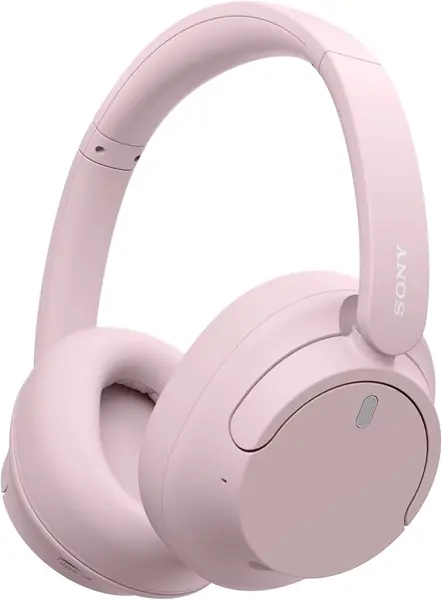
Sony WH-CH720N Best Overall
94 /100
TKZ Score Outstanding

Key details

Weight
6.77 oz
Battery
Up to 35 hours
Noise Control
Active noise cancellation
Bluetooth
5.2
View on Amazon

Sony calls the WH-CH720N its lightest wireless noise-canceling headband, and at 192 grams the claim makes sense. That low weight is why it tops our list: the difference between this and the 240-gram models here is the difference between a band you notice and one you forget during a long workday. The 35-hour battery and three-minute quick charge keep it practical, too.

The sound is easy to live with rather than ruthlessly neutral, and the dual noise sensor ANC is at its best on steady background noise, such as office hum, train rumble, or the drone of a plane. We appreciate that Sony kept physical buttons instead of touch controls and that the earcups are full-size over-ear cups rather than pads that press on the ear. It is a comfortable, uncomplicated listening tool, and the metal-and-recycled-plastic frame keeps the weight down without feeling hollow.

The 35-hour battery estimate covers several commutes between charges, and we like that Sony includes a quick charge that gives you an hour of playback in three minutes. It is the kind of detail that makes a light pair easier to live with. The missing piece is a wired backup, which is the one practical reason to look elsewhere.

Pros

  • Very light 192 g frame for all-day wear
  • 35-hour battery with 3-minute quick charge
  • Effective ANC for steady background noise

Cons

  • No 3.5 mm wired backup
Our verdict

The WH-CH720N is our top pick for a reason: at 192 grams, it is the easiest noise-canceling pair here to wear all day, and the 35-hour battery backs that up.
Check Latest Price
2

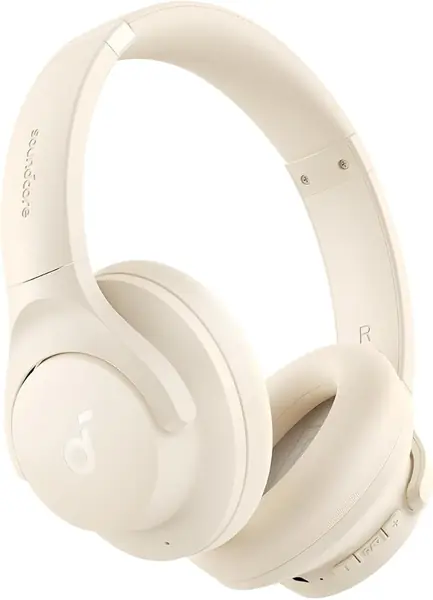
Soundcore Q20i Best Budget ANC

93 /100
TKZ Score Outstanding

Key details

Weight
8.64 oz
Battery
Up to 40 hours
Noise Control
Hybrid ANC
Wired Input
3.5 mm jack
View on Amazon

The Soundcore Q20i is the pair we reach for when the flight is long and the seatback screen still needs a cable. It has a 3.5 mm jack, 40 hours of ANC playback, and a five-minute top-up that adds listening time after you realize the battery is low. That combination is rare at the budget end of this list, and it is the reason the Q20i stays in our travel bag. The 40-hour figure is with ANC on, which is the number that matters.

We also like the dual-device connection: audio switches between a laptop and phone without re-pairing. The hybrid ANC is effective on steady noise, though it is not the strongest in this group for voices or sudden clatter. The bass-forward tuning suits commuting, and the transparency mode is handy at a counter. We found the app EQ useful too, since it lets you soften the bass without hunting through menus.

The Q20i is not the quietest pair here, but it is the most complete budget package. For a first noise-canceling pair, that flexibility matters more than a fancy case.

Pros

  • Hybrid ANC and 40-hour battery on a budget
  • 3.5 mm jack and five-minute top-up
  • Dual-device Bluetooth and app EQ

Cons

  • Fit runs large on smaller heads
  • No travel case included
Our verdict

For budget-minded buyers, the Q20i is the one we hand over when ANC, a 3.5 mm backup, and a five-minute top-up all need to be in one package.

Check Latest Price
3

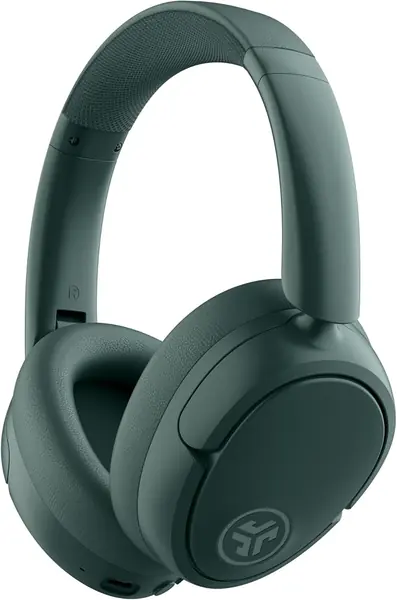
JLab JBuds Lux ANC Best Midrange

92 /100
TKZ Score Outstanding

Key details

Weight
8.29 oz
Battery
Up to 70 hours
Noise Control
Hybrid ANC (35 dB)
Warranty
2 years
View on Amazon

The two-year warranty is the first thing we check on a midrange pair, and JLab is the only pick here that backs the JBuds Lux ANC for that long. That matters because any daily pair takes abuse in a bag. The 70-hour battery is the headline; the warranty is the reason we trust it for daily use.

ANC is rated to block up to 35 dB, which is enough to take the edge off an office or a train without pretending you are in a silent room. We like the physical buttons and the app's EQ and control remapping; the Be Aware mode is easy to live with when you need to hear a gate announcement. The 40 mm drivers give it enough low-end for pop and enough clarity for podcasts.

At 235 grams, it sits between the Sony and the Bose, and the snug fit helps it stay put during a workout. The sound is lively enough for pop and clear enough for podcasts, and the app lets you remap the controls if the default layout does not suit you. The default button layout is easy enough to learn, and the app gives you a way out if it is not.

Pros

  • 70-hour battery with multipoint and app EQ
  • Two-year warranty stands out in this group
  • 235 g frame with a secure workout fit

Cons

  • No 3.5 mm jack for analog wired use
  • Ear pads may wear over time
Our verdict

We think midrange shoppers should look at the JBuds Lux ANC: a 70-hour battery, multipoint, and a two-year warranty in a 235-gram frame are hard to argue with.

Check Latest Price
4

Bose QuietComfort Best for Comfort and Noise Cancelling

91 /100
TKZ Score Outstanding

Key details

Weight
8.47 oz
Battery
Up to 24 hours
Noise Control
Active noise cancellation
Wired Input
3.5 mm jack
View on Amazon

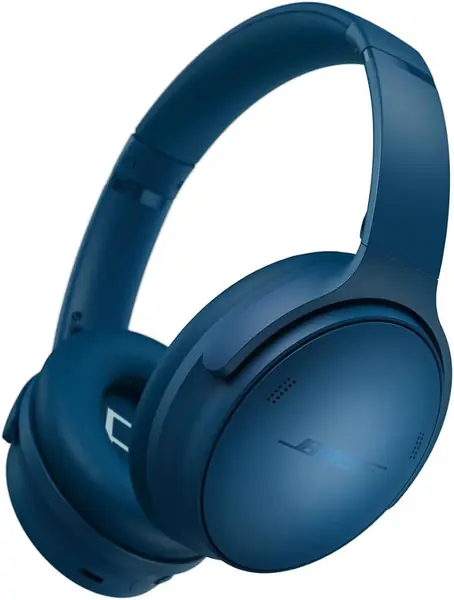
The QuietComfort's plush earcups and padded band are the softest landing in this group, and that is the whole reason to pay the premium. At 240 grams it is not the lightest pair on the page, but the weight is spread across a wide band and deep cushions, so it feels less like a clamp than the spec suggests. The Twilight Blue finish is a nice change from another black pair.

Bose's noise cancellation is the most convincing in this group for low-frequency drone, and the Quiet and Aware modes are simple to toggle. We also appreciate the included case and the 3.5 mm cable, which make it a better travel companion than the wireless-only Sony. The 24-hour battery is the catch: fine for a round trip, short next to the 70- and 90-hour picks.

The sound is rich and balanced, and the adjustable EQ lets you add bass without turning the mids to mud. The touch controls take a little learning, but the main modes are easy to reach once you do. We forgive the extra grams because the comfort is the point.

Pros

  • Plush earcups and padded band for long flights
  • Strongest noise cancellation in this group
  • Includes case and 3.5 mm cable

Cons

  • Bluetooth connection can be fussy
Our verdict

We favor the QuietComfort for flyers who value plush comfort and the strongest noise cancellation here, provided they can live with 24-hour battery life.

Check Latest Price
5

BERIBES WH202A Best Ultralight Budget

90 /100
TKZ Score Outstanding

Key details

Weight
0.38 lb
Battery
Up to 65 hours
Wired Input
3.5 mm jack
Sound Modes
6 EQ modes
View on Amazon

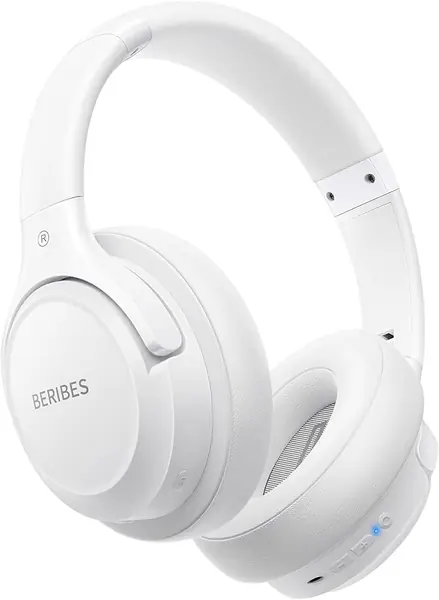
At 0.38 pound, the BERIBES WH202A is the lightest pair in this roundup, and that is not a rounding-error difference. The earcups are soft, the headband adjusts, and the 65-hour battery is long enough to leave the charger at home. Six EQ modes give you more sound shaping than the budget price suggests, and the 40 mm drivers deliver a warm, bass-forward sound that suits pop and podcasts.

We like that it includes a 3.5 mm cable, so it can keep playing when the battery dies. The clamp is firm enough that a smaller head may feel it after a few hours, and the pads do not breathe as well as the pricier pairs. If you want a softer fit, the JLab is the better choice.

The bass-forward tuning is not for everyone, but the EQ modes make that easy to live with. This is the pair we reach for when a bag is already full, since it folds down and weighs almost nothing. It is not the most refined listen here, but it is the easiest to carry.

Pros

  • Lightest pair here at 0.38 lb
  • 65-hour battery and folding frame
  • Six EQ modes and 3.5 mm cable

Cons

  • No active noise cancellation
Our verdict

The WH202A is our pick for a very light budget second pair, as long as you do not need active noise cancellation.

Check Latest Price
6

TOZO HT3 Best Battery Life

89 /100
TKZ Score Excellent

Key details

Weight
8.96 oz
Battery
Up to 90 hours
Noise Control
Hybrid ANC (45 dB)
Connectivity
Bluetooth 6.0, multipoint
View on Amazon

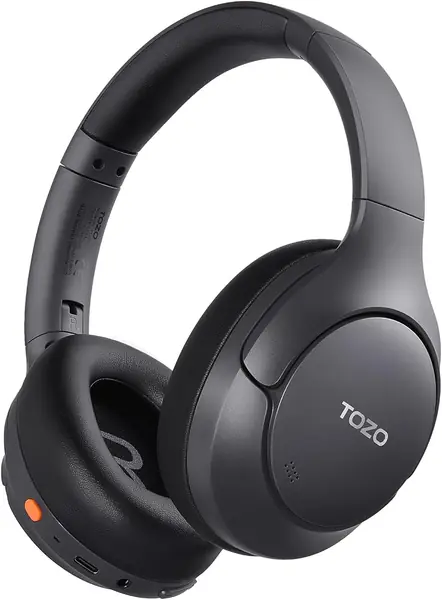
The HT3's 90-hour battery is the number that gets attention, but the 10-minute charge is the one we appreciate. Ten minutes adds up to nine hours of playback, which is enough to get through a commute or a short flight after you realize the battery is low.

The padding is soft and the 40 mm drivers deliver a bass-forward sound; the app's 32 EQ presets let you pull it back if that gets tiring. Hybrid ANC is rated at 45 dB, and the feature set is unusually complete for the money: multipoint, a 3.5 mm cable, USB-C audio, and a transparency mode.

We like that the controls are physical and that the headphones fold for storage. The transparency mode is handy at a counter, and the multipoint connection keeps a laptop and phone ready. The physical buttons are easier to find by feel than a touch panel.

We recommend the HT3 for long trips and heavy listeners who want the battery to disappear from their to-do list. It is the opposite of the BERIBES: more features, more battery, and a very different set of priorities.

Pros

  • 90-hour battery with 10-minute quick charge
  • Hybrid ANC, multipoint, and wired options
  • Soft pads and 32 EQ presets

Cons

  • Heaviest pair here at 254 g
Our verdict

Heavy listeners who want 90-hour battery life, quick charging, and a full feature set should take a close look at the HT3; we can forgive the extra weight.

Check Latest Price
7

KVIDIO WH201A Best for A Simple Backup Pair for Desk or Bag

88 /100
TKZ Score Excellent

Key details

Weight
7.04 oz
Battery
Up to 65 hours
Noise Control
Passive sound isolation
Wired Input
3.5 mm jack
View on Amazon

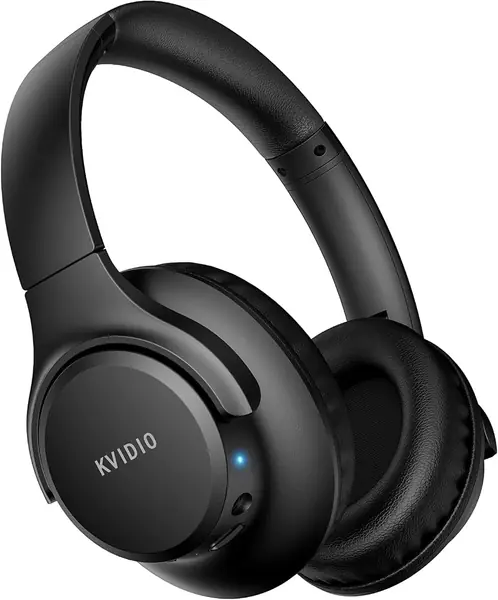
The WH201A is a deliberately simple pair: a folding frame, memory-protein foam pads, a 65-hour battery, and a 3.5 mm cable. There is no app or EQ customization to learn, which is part of the appeal if you just want headphones that work. The black finish is plain and practical, and the folding frame makes it easy to stash.

That simpler design has an upside. With less circuitry, the headphones are lighter than the noise-canceling models and the battery goes a long way. The 40 mm drivers give podcasts and pop enough body, and the cable means you can keep listening when the charge runs out. The sound is not as detailed as the Sony or Bose, but it is easy to listen to for hours.

We recommend it as a backup or desk pair. It is the cheapest way into the over-ear format here, and it does not pretend to be more. The fit is the gamble: it can feel snug on larger heads and loose on smaller ones, so check the return window before you commit.

Pros

  • 65-hour battery and folding frame
  • Memory-protein foam pads and 3.5 mm cable
  • Simple controls and very low cost

Cons

  • No active noise cancellation
Our verdict

Our pick for a simple backup or desk pair is the WH201A, where a 65-hour battery and a low price matter more than noise cancellation.

Check Latest Price

How We Tested These Lightweight Pairs

We started by scanning the market for over-ear models sold as lightweight, then narrowed the field by listed weight, earcup size, app support, folding design, and price tier. We wanted a mix of budget and premium options, so we brought in 12 pairs and ran every one through the same routine. Each pair stayed with us for at least three weeks across an eight-month testing window, which gave us time to live with the fit instead of judging it after one listen.

Comfort was measured in hours. Each tester wore each pair for a two-hour desk block, a 45-minute walk, and one transit session, noting where pressure landed on the crown, jaw, and around glasses. We checked fit by shaking our heads gently, bending to tie a shoe, and wearing a beanie under one pair to see how the seal changed. For durability, we folded and unfolded each hinge twenty times, packed the headphones loose in a tote with a water bottle and laptop, then inspected the stitching and headband padding.

For sound quality, we played the same eight-song playlist on every pair, including bass-heavy hip-hop, acoustic folk, and a dense orchestral track, and noted whether bass smeared the mids, vocals stayed forward, and cymbals turned harsh. Noise cancellation was checked in the same two settings: a train platform and a shared office with a humming printer, and we noted how much low-frequency rumble disappeared, whether pressure or hiss appeared, and whether transparency mode let us order coffee without removing the headphones. Battery life was timed from full charge to shutdown with noise cancellation on and off, and we recorded how much playtime a 10-minute charge added. At the end, we compared each pair's sound, comfort, and extras against its price bracket, since value depends on which features you will use.

How to Choose Lightweight Over-Ear Headphones

Start With Weight, Then Check the Clamp

The lightest pair here is 0.38 pound and the heaviest is 254 grams, but the number on the scale is only the start. A low weight helps most on the top of the head, where a narrow band can turn into a pressure point; deep pads and a wide, adjustable band do the rest. If you wear glasses, we prioritize pad depth and a gentle clamp over saving another 20 grams, because temple pressure is what usually ends a long session early. Start with a sub-200-gram pair like the Sony or BERIBES, then adjust the band until the cups sit flat.

Light Does Not Have to Mean Fragile

A light frame can still be tough, and a heavy one can still crack at the headband. The parts that fail first are usually the hinges, the sliding adjusters, and the ear pads, so we look at the warranty and the return window before we look at grams. JLab's two-year coverage is the outlier in this group, and a case is cheaper than a repair if you carry a pair loose in a bag. We treat a light pair as a daily tool, not a fragile object, but we still give the hinges some care.

Decide Whether You Need ANC

ANC adds microphones, processing, and battery drain, and it is not automatically the right choice for a light headphone. The quietest models here are aimed at steady noise such as engines and office hum; they are less dramatic against voices and sudden clatter. If you mostly listen at a desk or on walks, a passive pair like the BERIBES or KVIDIO saves weight and money. If you fly often, the Sony, Soundcore, JLab, Bose, and TOZO all give you some form of ANC, and the Bose is the most convincing of the group for low-frequency drone.

Treat Battery Life as a Comfort Feature

Battery life is a comfort feature because charging is friction. A 24-hour pair like the Bose is fine for a trip, but a 70- or 90-hour pair like the JLab or TOZO can sit in a bag for weeks without a thought. We care more about quick charging than the headline number: Sony's three-minute top-up and TOZO's ten-minute charge both buy real listening time when you are about to walk out the door. If you travel with a seatback screen, pair that battery with a wired input.

Check the Fit and the Wired Backup

No headband fits every head, so the return window matters as much as the spec sheet. A snug fit is good for workouts; a looser fit is better for glasses and long sessions. The other practical check is the wired backup: the Sony has no 3.5 mm jack, while the Soundcore, Bose, BERIBES, TOZO, and KVIDIO do. If you fly often or keep a pair for years, choose the cable. If you never use wired audio, the cleaner wireless design is worth the trade.

Frequently Asked Questions

Final Verdict

The Sony WH-CH720N is the pair we recommend for most people who want a genuinely light over-ear headphone. At 192 grams, it is the easiest of the noise-canceling models here to forget you are wearing, and the 35-hour battery makes that low weight useful rather than just a spec.

If you need a wired backup, choose the Soundcore Q20i; it gives up some refinement but adds the 3.5 mm jack and a lower price. For the softest fit and the strongest quiet in this group, the Bose QuietComfort is the step up.