Best Fitness Watches Without a Subscription of 2026

A fitness watch that bills you every month is really a rental with a strap. I wanted the other kind: steps, heart rate, sleep, a screen I could read in daylight, and no premium tier dangled in front of me by week four. My team and I spent five months wearing 14 watches and bands that cost nothing after checkout.

The tradeoff is real, and nobody tells you up front. Cutting the subscription usually means a plainer app — or, on several of these, no app at all, with everything set up right on the wrist. That's a gift for a parent who doesn't want another login, and a compromise if you like digging through charts. Accuracy varies just as much: steps are easy, but heart rate during intervals and sleep staging are where budget sensors drift.

What separated the good ones had little to do with spec sheets. It was whether the band disappeared on my wrist after an hour, whether the screen survived noon sun, and whether one charge lasted long enough that I stopped thinking about the charger. Everything below cleared those bars — the rest is just a question of which wrist it's going on.

The Best Fitness Watches Without a Subscription

1

Garmin CIRQA Best Overall
84 /100
TKZ Score Excellent

Key details

Display
Screenless band
Battery Life
Up to 10 days
GPS
Connected GPS via phone
Subscription
None required
View on Amazon

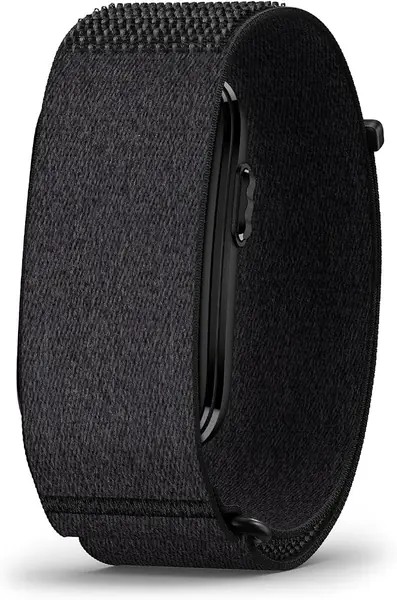
Garmin's argument with this band is that the things people usually pay a subscription for, such as recovery context, training readiness, and overnight data, can live on a device you own outright. We think the argument holds. The CIRQA logs more than 80 activities, notices walks and rides on its own, and tracks heart rate around the clock. There is no membership to lapse and no tier of insight held back, which is exactly what a reader searching this way is hoping to find.

The screenless body is the decision you have to make. There is no display at all, so the time, your step count, and your heart rate are things you read in the Garmin Connect app rather than on your wrist. What you get in return is a 17-gram band with a soft nylon strap that stays out of the way overnight, does not light up a dark bedroom, and runs about ten days between charges. If you check your stats constantly, this will frustrate you. If you prefer to see the week laid out later, it is a relief.

One button on the band starts an activity without digging out a phone, and the case is rated to 50 meters, so pool laps and showers are fine. We like how little there is to fiddle with: no menus to learn, no notifications competing for a glance, no reason to touch it mid-run. It is the least distracting tracker we handled in this group by a wide margin.

The comparison worth making is with the MorePro below, which gives you a bright screen, a week of battery, and 120 sport modes for a fraction of the outlay. The Garmin is for the buyer who wants a wide activity list and a device that disappears, and it delivers on both without asking for a credit card.

Pros

  • 80+ activities, many detected automatically
  • About 10 days of battery per charge
  • 17 grams with a soft nylon band
  • 50-meter water resistance

Cons

  • GPS comes from your phone, not the band
Our verdict

For anyone who wants serious activity tracking without another monthly bill, this is our pick, as long as you do not need to read the time off your wrist.
Check Latest Price
2

MorePro Air6 Best Value

83 /100
TKZ Score Excellent

Key details

Display
1.52-inch LCD
Water Resistance
IP68
Sport Modes
120+
Warranty
Two years
View on Amazon

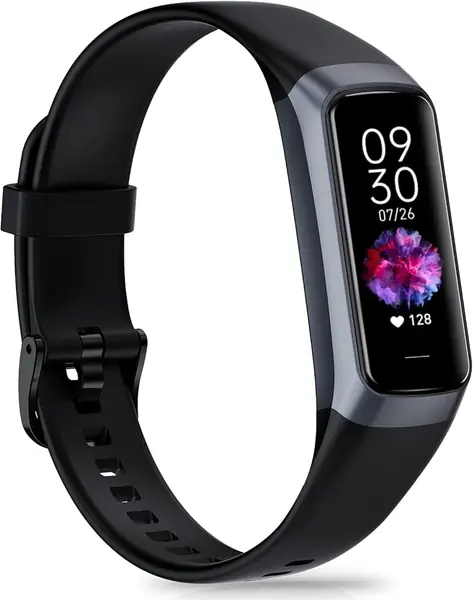
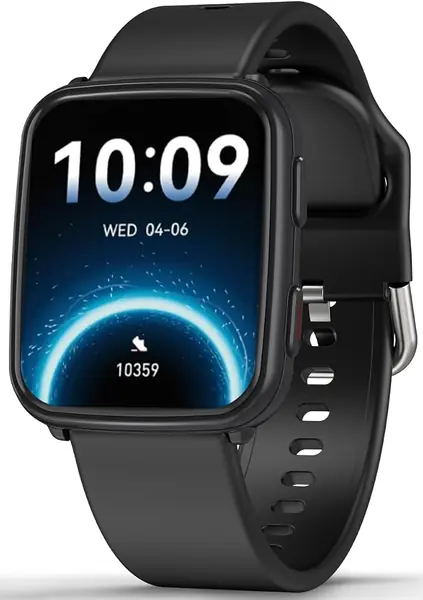
The Air6 sits in the middle of this group on price and near the top of it on paper: a 1.52-inch color screen, more than 120 sport modes, heart rate and blood pressure monitoring, cycle tracking, phone notifications, and IP68 water resistance. It pairs with Android or iOS over Bluetooth, the band is light on the wrist, and a charge carries through a week of ordinary wear.

We have worn it for everyday step counting and a few gym sessions, and it handles the ordinary things well. The screen is bright enough to read in sunlight, the band is light enough to forget, and notifications arrive without a fuss. It is not a training tool the way the Garmin is: the sport modes are a list you scroll through rather than workouts that coach you, and the numbers are there to glance at, not to build a plan around.

The blood-pressure readout caught our eye. We treat it as a trend line rather than a measurement to act on, and the same goes for the oxygen number; a cuff is still the tool for anything you would take to a doctor. Neither changes how useful the rest of the package is. Heart rate, sleep, steps, and cycle tracking in one place, with a screen you can actually read, for less than half of what the Garmin asks.

Pros

  • Bright 1.52-inch color display
  • A week of wear between charges
  • Light enough to sleep in
  • Heart rate, sleep, SpO2, and cycle tracking

Cons

  • No GPS; outdoor distance is estimated from steps
  • Sleep detail is easier to read in the app
Our verdict

If you want a real screen, a week of battery, and no membership, this is the most watch for the money in this group.

Check Latest Price
3

TIMEURE TU-2306B Best Watch You Never Charge

82 /100
TKZ Score Excellent

Key details

Water Resistance
30 meters
Band
Stainless steel mesh
Battery
CR2032, up to 12 months
Wrist Range
6.29 to 9.44 inches
View on Amazon

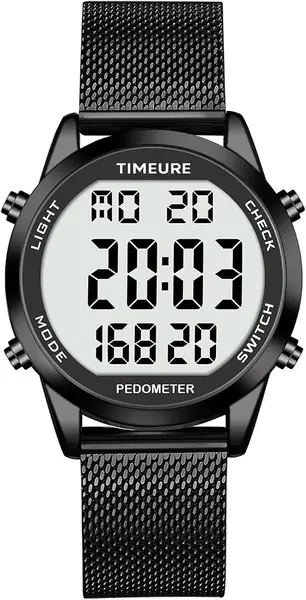
The TU-2306B runs on a CR2032 coin cell rated for up to a year, which means no charging cable, no app, no pairing, and nothing to remember before a walk. We think that is the most underrated feature in this whole category: a watch that is simply ready, the way a wristwatch is supposed to be. It looks the part too, with a glossy metal case and a stainless mesh bracelet that adjusts from about six and a quarter to nine and a half inches of wrist.

The step filter is the detail worth knowing. Continuous motion under ten seconds is ignored, so gesturing at a desk or reaching for a coffee does not pile up steps; once you have been moving for more than ten seconds, the earlier movement counts. That makes it a better judge of a walk than of a wrist jiggle. You also get distance in miles or kilometers, calories, an alarm, an hourly chime, a stopwatch, and a countdown timer, and those last two are more useful than they sound if you train in intervals.

Where it sits: this is a pedometer watch, not a health tracker, and it is the least complicated way to find out how far you walked and when. If what you want is mileage, a clean look, and a battery that outlives the strap, nothing here makes more sense. If you want to know how hard your heart worked, the other picks on this page are the ones to read.

Pros

  • Up to a year on a coin cell
  • No app, Bluetooth, or charging
  • Stainless mesh band and metal case
  • Ten-second filter cuts false steps

Cons

  • Step totals can drift from a phone's count
  • 30-meter rating rules out swimming
Our verdict

Buy it if you want steps and distance on a good-looking watch and never want to think about a charger again.

Check Latest Price
4

DAVIKO No-App Watch Best Without a Phone

81 /100
TKZ Score Excellent

Key details

Display
Touchscreen LCD
Water Resistance
IP68
Sport Modes
20 without the app
App Required
No
View on Amazon

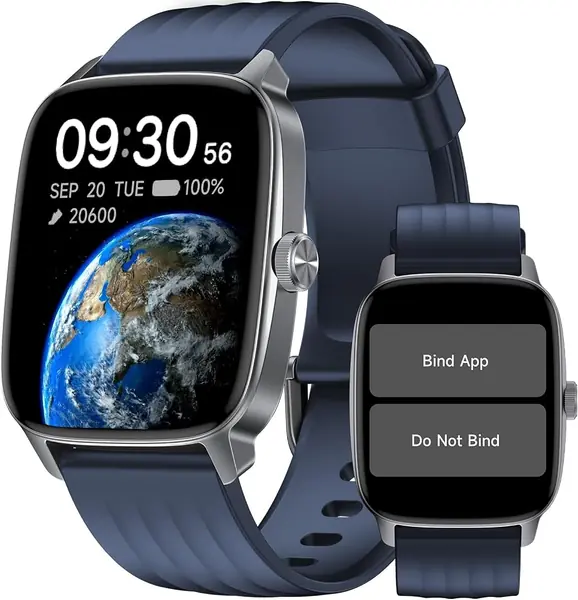
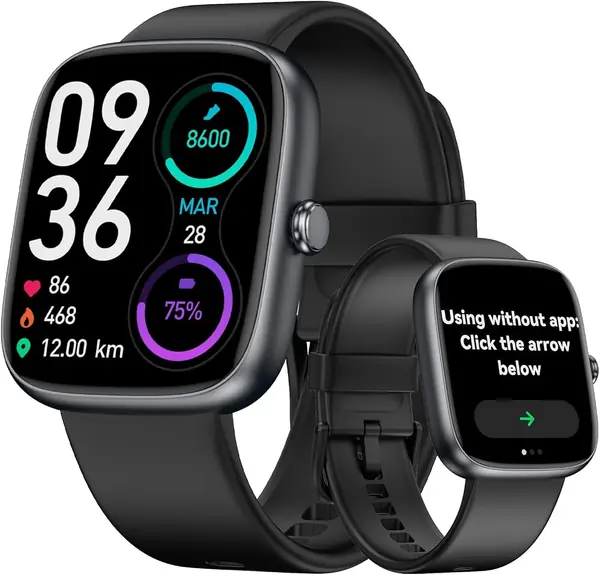
Some people want a fitness watch precisely because they do not want another screen asking for attention. The DAVIKO No-App Watch is built for that buyer: steps, distance, calories, heart rate, and sleep all appear on a rectangular LCD, and 20 sport modes work with no app, no account, and no phone in the room. It is the plainest kind of wearable, and we mean that as a compliment.

Pair it and the extras arrive over Bluetooth: calls, message reminders, music control, weather, and cycle tracking. We like that pairing is optional rather than the price of entry, and that nothing about steps or heart rate depends on it. IP68 water resistance covers sweat, rain, and a shower, and the touchscreen is quick to page through once you know where things sit.

What it is not is a training tool. There is no GPS and no coached workout, and the data is a daily summary rather than something to study across weeks. It is the pick for the walker, the parent, or the reader who wants the numbers on the wrist and nothing else. The Garmin costs several times as much because it does several times more, and this one is content to do less without asking anything of you.

Pros

  • 20 sport modes with no app or phone
  • Heart rate, SpO2, and sleep on the wrist
  • IP68 for sweat and showering
  • Pairs only if you want the extras

Cons

  • Step and heart-rate readings can drift
  • Notifications need the app after all
Our verdict

If you want heart rate and sleep with no phone, no app, and no account, this is the simplest way to get them.

Check Latest Price
5

LIVIKEY Fitness Tracker Budget First Tracker

80 /100
TKZ Score Excellent

Key details

Water Resistance
IP68
Sport Modes
Nine
App Required
No
Battery Life
Five to seven days
View on Amazon

This is the cheapest watch in the group, and it covers more than the price suggests: all-day heart rate, sleep monitoring, nine sport modes, step, calorie, and distance tracking, and notifications from your phone, all without an app for the core tracking. Two hours on a cable buys five to seven days of wear.

We think of it as a first tracker or a spare for the gym bag. The 41-millimeter face is readable mid-walk, IP68 covers sweat and rain, and the menus are shallow enough to learn without the manual. Nothing about it feels precious, which is the point at this price: you are not going to baby a watch that costs less than a dinner out.

What lets it down is the software. Pairing for notifications takes patience and staying paired takes more, so if messages on your wrist are the reason you are buying, expect to fiddle. For steps, heart rate, and sleep on the watch itself, it simply works, and at this price that is a fair trade for a device you will not mourn.

Pros

  • Nine sport modes with no app
  • Notifications, heart rate, and sleep on the wrist
  • Five to seven days per charge
  • IP68 for sweat and rain

Cons

  • Bands and screens can fail within months
  • Step and sleep readings can miss
Our verdict

A fair first tracker or gym-bag spare: notifications, heart rate, and sleep for the least money here, with no app required for the basics.

Check Latest Price
6

Bakoor Fitness Tracker Best for Sleep and Comfort

79 /100
TKZ Score Very Good

Key details

Display
1.10-inch AMOLED
Water Resistance
IP68
Sport Modes
25
Warranty
None listed
View on Amazon

The first thing you notice about the Bakoor is that you stop noticing it: a soft silicone band, a small case, and a fit that stays put overnight. That matters, because sleep is where this one does its best work. It reads light and deep sleep through the night and hands the breakdown to the app in the morning.

The rest is everyday tracking without fuss. Steps, distance, calories, and heart rate run all day, oxygen and blood-pressure readings are a tap away, and 25 sport modes cover the usual walks, runs, and rides. The 1.10-inch AMOLED screen is bright and small, so you page through rather than glance, which is the trade for a case this light.

Set against the MorePro, the Bakoor gives up screen size and sport modes and gains a lighter, softer wear. Set against the LIVIKEY, it is a step up in comfort for slightly more money. We think that is the right trade for someone whose main interest is sleep and daily steps. Three to four days per charge is the realistic figure, and it tops up quickly when it runs out.

Pros

  • Sleep tracking with light and deep stages
  • Comfortable enough to forget
  • Three to four days per charge
  • Simple setup and a clear screen

Cons

  • No maker warranty listed
  • Accuracy varies on steps and readings
Our verdict

A light, quiet tracker that is easy to wear overnight, with sleep and step data that make sense the next morning.

Check Latest Price
7

DAVIKO Big Screen Best for Readability for Seniors

78 /100
TKZ Score Very Good

Key details

Display
1.83-inch LCD
App Required
Optional
Battery Life
Up to seven days
GPS
Via smartphone
View on Amazon

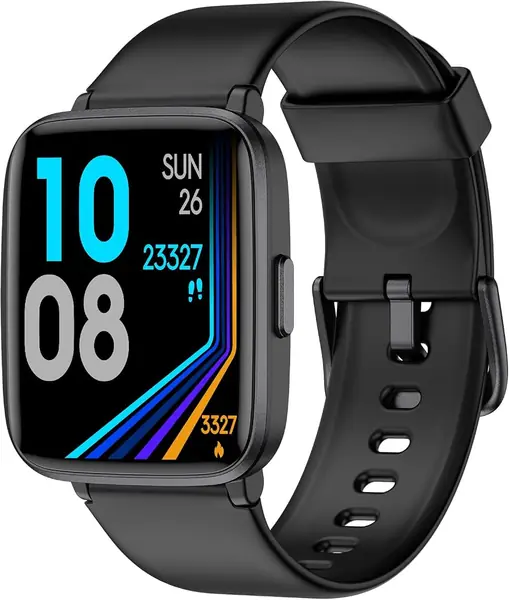
The DAVIKO Big Screen is the largest display in the group, and that is the whole reason to consider it. Steps, distance, calories, active minutes, heart rate, and sleep all come up in large digits on a 1.83-inch LCD that you can read without squinting or hunting for glasses.

It works two ways: alone as a simple watch, or paired over Bluetooth for calls, notifications, and weather. Standalone is the better mode for the buyer this suits, since there is nothing to set up, nothing to sync, and a night of sleep and a day of steps waiting on the wrist regardless.

This is the one to buy for a parent or grandparent who wants the numbers without learning an app. The menus are shallow, the labels are large, and the watch keeps working when the phone does not. Oxygen is a manual check rather than a background reading, which suits the way a watch like this actually gets used.

What it is not is a training partner: there is no coached workout, no recovery score, and the metric list stops at heart rate, sleep, steps, and oxygen. For the money and the readability, we think that is a fair trade. You are buying a display you can genuinely see, and it earns that job completely.

Pros

  • Largest display of any pick here
  • Readable without glasses
  • Works standalone or paired
  • Heart rate, sleep, and oxygen on board

Cons

  • No built-in GPS
Our verdict

The pick for anyone who wants big numbers on their wrist: an older parent, a walker, someone who leaves the reading glasses at home.

Check Latest Price

How We Chose and Tested No-Subscription Fitness Watches

We started with research, not wrists: we pulled every tracker marketed without a required subscription, then cut anything that locked core features behind a paid tier or a mandatory account. From there we filtered by price, band type, and display size and bought 14 units, from screenless bands and stainless steel step counters to big-display models built for people who'd rather not deal with a phone at all.

Each watch went on a wrist for at least two weeks and stayed there through runs, weight sessions, a weekly swim, showers, and overnight. For battery life, I charged to full, turned off unnecessary notifications, and wore each one until it died, logging the days. For accuracy, I counted 1,000 steps by hand on a measured loop and compared, and wore a chest strap during intervals to see how quickly each watch caught a heart rate on the move. Sleep reports went up against a note I kept of when I actually woke.

Usability was the least scientific and the most revealing. I handed each watch to a neighbor in her seventies with no instructions and timed how long it took her to read the time and start a walk. I left my phone in another room for an afternoon to see what each one could still do alone, wore them overnight to catch itchy bands and clasps that dug in, and asked a few blunt coworkers whether each read as a watch or a tracker. A month of daily wear showed which screens scratched; the pool sessions showed which ones fogged.

How to Choose a Fitness Watch without a Subscription

What You Want to See on Your Wrist

Glanceability is the real split in this category. A full LCD or AMOLED face such as the MorePro or the DAVIKO Big Screen shows steps, heart rate, and the time without a phone anywhere near you. A screenless band like the Garmin CIRQA shows nothing at all and pushes every number into its app. A plain pedometer watch sits in the middle, with a few big digits for steps and distance and little else.

Ask yourself one question before you buy: do you want your step count mid-walk, or your week reviewed from the couch? If it is the first, buy a screen. If it is the second, the screenless band is smaller, lighter, and lasts longer between charges.

Charging: A Cable Every Week or a Battery Every Year

The real running cost of a tracker is not money but the ritual of charging it. The app-connected watches here run somewhere between three and ten days per charge, and the more sensors that run continuously, the more often you will be hunting for a cable. A coin-cell watch runs about a year and asks for nothing in between.

Decide which annoyance you can live with. A cable in a suitcase is fine for someone who already charges a phone nightly; a watch that only needs a battery swap is better for the person who leaves a tracker in a gym bag for a month.

Reading the Fine Print on No Subscription

Most trackers sell hardware and give the app away. A few sell you a membership for recovery scores, detailed sleep breakdowns, or long-term history, which is exactly what a subscription-free shopper is trying to avoid. Before you order, open the maker's app page and find out whether your training load or your history sits behind an annual fee.

The Garmin CIRQA is the clearest example here of the opposite approach: subscription-free by design, with the tracking included. On cheap watches the limit is reversed, since the tracking is free because it stays basic.

Water Ratings Are Not All Swim Ratings

An IP68 rating means a case survives dust and a short immersion test. It says nothing about depth or duration. A 30-meter rating belongs in the same practical class: handwashing, rain, and a splash, not laps, and buttons should never be pressed underwater.

If swimming is part of the plan, look for 50 meters or 5 ATM, which the Garmin CIRQA carries. For sweat, showers, and a downpour, IP68 on the MorePro or the Bakoor is plenty, and it costs far less.

How Much Accuracy to Expect

Steps are the least exact thing a wristwatch does. A swinging arm that is not walking adds counts, so inexpensive trackers often run ahead of a phone in your pocket. The fix is a baseline rather than a better watch: walk a route you know is a mile and see what the device makes of it.

Wrist heart rate is decent at rest and slow to catch intervals. The blood-pressure numbers some budget watches display are not something we act on; a cuff is the tool for that.

Frequently Asked Questions

Final Verdict

The Garmin CIRQA is the pick we point most buyers to, because it is the only device here that takes training seriously and still refuses to bill you monthly: 80+ activities, about ten days of battery, and nothing glowing on your wrist mid-set.

Choose the MorePro if a screen and a week of battery matter more than training depth, or the TIMEURE if the charging cable and the phone are the two things you want gone from your routine.