Best AirPods for Kids of 2026

The first thing most parents check is the volume limit, and that instinct is correct. Most kids' earbuds cap output somewhere around 85 decibels, the ceiling audiologists generally point to for long listening sessions. But a cap printed on the box and a cap that actually holds when a 9-year-old discovers the touch sensor are two different things. What you're really shopping for is a pair small enough to stay in a child's ear, tough enough to ride loose at the bottom of a backpack, and simple enough that they can pair it without handing you the phone.

My own two kids have been through more lost, cracked, and mysteriously dead earbuds than I care to count, so I had opinions before we started. We spent three months with 14 pairs, from clip-on designs built for small heads to the open-ear styles teens gravitate toward, and the gap between them came down to fit and reliability far more than specs. Price didn't predict much either; a couple of the cheapest pairs held a charge better than ones that cost twice as much. The picks below are the ones that stayed in, stayed connected, and got used without me being summoned to fix something.

The Best AirPods for Kids

1

Belkin SoundForm Nano 2 Best Overall

89 /100
TKZ Score Excellent

Key details

Battery With Case
8 hrs + 20 hrs
Volume Limit
85 dB
Water Resistance
IPX5
Recommended Age
7 and up
View on Amazon

Eighty-five decibels is the number that decides this one. Belkin builds that ceiling into the earbuds themselves, so a kid leaning on the volume button of a hand-me-down iPad gets nothing louder than a level hearing specialists consider safe for long listening. Add eight hours per bud, twenty more in the case, and a two-year warranty, and we think it is the pair most families should buy.

Fit is where most kids' earbuds fail, and this one comes with several tip sizes to work through. The shell is a rounded, shallow shape rather than a shrunken adult bud, which is the difference between a bud that stays in during recess and one that ends up in a coat pocket. The tips also carry an antimicrobial treatment, a small thing that stops being small after a pair spends a week at the bottom of a gym bag.

Day to day there is very little to manage. Bluetooth 5.3 pairs to a school iPad in one pass and remembers it, the touch controls sit on the outside of each bud where a child can actually reach them, and IPX5 handles sweat and a tipped juice box. The microphone uses environmental noise cancellation to keep a voice clear on video calls, which matters more than music quality for the way these get used.

A bud that goes quiet or drops its connection is the failure to watch for, and it is the main reason we treat the two-year warranty as part of the product: keep the order confirmation and file a claim rather than buying a replacement out of pocket. Sound is tuned toward voices and shows, which suits a ten-year-old watching videos far better than a teenager chasing bass.

Pros

  • 85 dB cap built into the buds
  • 28 hours total with the charging case
  • IPX5 rating and a two-year warranty

Cons

  • Sound favors voices over music
  • Sized for ages 7 and up
Our verdict

We recommend the Nano 2 as the default kids' pair: a hard 85 dB ceiling, a full school day of battery, and a warranty long enough to cover the phase where everything gets dropped.
Check Latest Price
2

myFirst CareBuds Best for Very Small Ears

88 /100
TKZ Score Excellent

Key details

Battery With Case
6 hrs + 25 hrs
Volume Limit
85 dB
Water Resistance
IPX4
Ear Tips
Six sizes, XXS up
View on Amazon

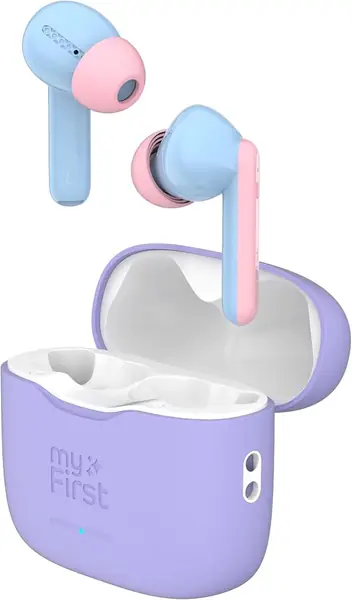
Six pairs of ear tips come in the box, and the smallest is genuinely small, the kind that fits a five-year-old's canal rather than a shrunken adult one. That is the argument for the CareBuds in a line, because most earbuds sold for children solve the volume problem and skip the fit problem entirely.

Everything around the tips is competent: an 85 dB limiter set at the factory, IPX4 against sweat and spills, six hours per bud and another twenty-five in the USB-C case. What we did not expect to care about is the anti-loss strap, a soft loop that ties the two buds together so they hang around a neck instead of disappearing between car seats. It is the sort of accessory that only exists because someone watched a kid lose one.

The trade-offs are honest ones. Six hours per charge is two fewer than the Belkin, so a long travel day wants a case top-up at lunch. We still point to this pair first when a child is at the young end of the range, because the tip range is what keeps the buds in and nothing else here goes as small.

Pros

  • Six tip sizes, down to XXS
  • Anti-loss strap keeps the pair together
  • Factory 85 dB cap and IPX4

Cons

  • Priciest pair in this group
Our verdict

For a small-eared kid who has already rejected one pair, these are the ones we hand over: the tip range goes smaller than anything else here, and the strap keeps them from vanishing.

Check Latest Price
3

iDIGMALL Kids Open-Ear Best Open-Ear Option

87 /100
TKZ Score Excellent

Key details

Battery With Case
5 hrs + 20 hrs
Volume Limit
85 dB
Weight Per Earbud
0.18 oz
Fit Style
Open-ear clip
View on Amazon

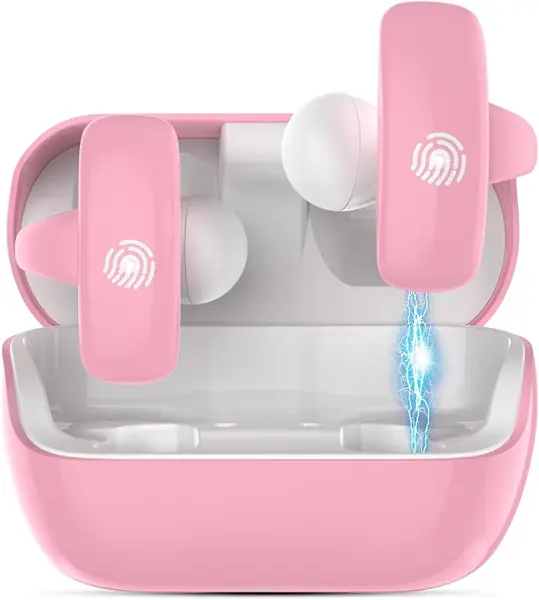
Nothing goes inside the ear canal. The T506 hooks over the top of the ear and floats the driver just outside it, which sidesteps the problem that breaks most kids' earbuds: a canal too small for even the smallest silicone tip.

That makes it the odd one out in this group, and we noticed the difference in daily use. There is no tip to seat, no seal to break when a kid chews or yawns, and nothing to push back out during a run. Five grams per bud means they are forgotten within a minute.

The safety side is handled: an 85 dB cap set at the factory, Bluetooth 5.4 for a steady pairing, IPX4 against sweat, five hours per bud with twenty more in the case, and a twelve-month warranty behind it.

What you give up is quiet. An open design lets in the bus, the traffic, and the other kid's cartoon, and it leaks a little of whatever is playing outward. At the kitchen table that is a feature; on a plane it is a nuisance. We like these best for the child who has lost the fit battle, and for sport and outdoor use where hearing a parent matters more than hearing every note.

Pros

  • No tip has to fit inside the ear
  • 85 dB cap and Bluetooth 5.4
  • Five hours per bud plus 20 in the case

Cons

  • Clip fit depends on ear shape, with no tips to swap
Our verdict

If small ears have already defeated two pairs of earbuds, we recommend these: they hang on instead of plugging in, and the volume cap comes built in.

Check Latest Price
4

eKids Spider-Man Earbuds Best Character Design

86 /100
TKZ Score Excellent

Key details

Battery With Case
Up to 22 hrs
Design
Spider-Man graphics
Warranty
1 year limited
Microphone
Built in
View on Amazon

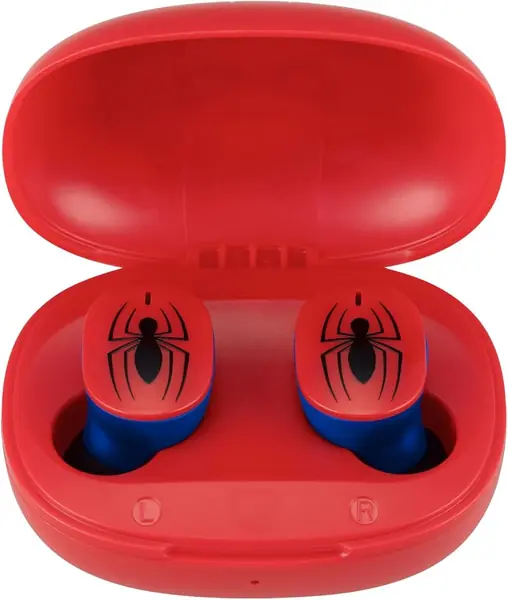
A child who will not wear plain earbuds will wear these, and that is a bigger deal than it sounds, because the hardest part of this purchase is getting a kid to keep the buds in their ears long enough to be worth owning. Webbing on the buds, a matching Spider-Man case, twenty-two hours of total playtime, and a microphone for the video calls that come with homework.

Fit is the detail that decides whether they work for your child. The housing is closer to a small adult bud than a preschooler's ear, so these land best on a seven- or eight-year-old, and the rubber tips come in sizes to fine-tune the seal. The buds themselves are light enough that a kid stops noticing them within an afternoon.

Compared with the Belkin you are trading a two-year warranty and a water-resistance rating for the character and a lower price. That is the right trade when the look is what gets them worn, and the wrong one if the pair is going straight into a backpack to be forgotten.

Pros

  • Spider-Man graphics that get worn
  • Up to 22 hours with the charging case
  • Built-in mic for calls and games

Cons

  • No factory volume cap
  • Occasional Bluetooth dropouts
Our verdict

We recommend these for the kid who will actually wear Spider-Man graphics: the battery and mic are fine, and the look is the whole reason to pick them over a plainer pair.

Check Latest Price
5

FEFURS 2-Pack Kids Earbuds Best for Siblings

85 /100
TKZ Score Excellent

Key details

Battery With Case
36 hrs
Bluetooth
5.4
Age Range
Teens and adults
Pairs Included
Two
View on Amazon

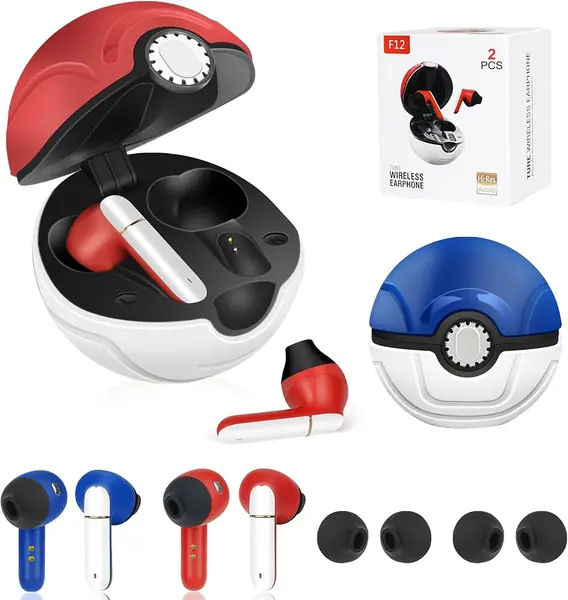
Two kids, two sets of earbuds, one box. The F12 arrives as a pair of complete units, one in red and one in blue, each with its own charging case, which ends the argument over whose turn it is. For a household with siblings close in age, that is the most useful thing on this page.

The cartoon faces and the matching cases are clearly the point; the hardware underneath is ordinary and fine. Thirty-six hours of playtime with the case covers more than a week of school commutes, Bluetooth 5.4 pairs cleanly with an iPad or a Chromebook, and the touch panels handle play, pause, and calls without reaching for a phone.

Sizing is the thing to check. These are built for teenagers and adults rather than small children, so a nine- or ten-year-old is usually fine while a six-year-old will be swimming in them. That is the trade for getting two pairs in one go, and we think it is a fair one for the right family. If both children are under seven, buy one pair of CareBuds and let them share until the younger one's ears catch up.

Pros

  • Two complete pairs for sibling households
  • 36 hours of playtime with the case
  • Cartoon design kids pick themselves

Cons

  • No built-in volume limiter
  • Not water resistant
Our verdict

We recommend the two-pack for siblings: two working pairs and two cases in a single purchase, with the phone's volume limit doing the job the buds do not.

Check Latest Price
6

Awaiymi F2 Kids Earbuds Best for Tight Budgets

84 /100
TKZ Score Excellent

Key details

Battery With Case
36 hrs
Water Resistance
IPX4
Bluetooth
5.0
Driver Size
13 mm
View on Amazon

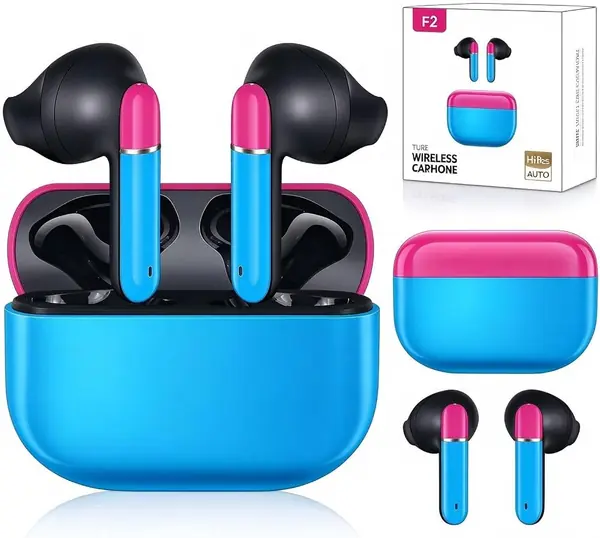
These look like mom's. The F2 is a plain, glossy blue bud in a matching case with no cartoon in sight, which for a certain nine-year-old is precisely the point, since being handed a kid version of anything reads as an insult. It is a low-cost way to answer that request without handing over an actual pair of AirPods.

Underneath the plain shell it is a normal set of earbuds: thirty-six hours total with the case, IPX4 for sweat and spilled drinks, a 13 mm driver, and touch controls a child learns in an afternoon. Bluetooth 5.0 is the oldest standard in this group, and it is the one specification that dates the product; it pairs and holds across a house, but it is not the version to buy for a kid who will eventually juggle two devices.

Fit runs small, which is good news for six- to nine-year-olds and makes the F2 a sensible first pair for a kid who wants to look like everyone else. Nothing about it feels like a punishment purchase, which is more than we expected at this end of the price range.

Pros

  • 36 hours total with the charging case
  • IPX4 for sweaty kids and spills
  • Plain design that mimics adult earbuds

Cons

  • No factory volume cap
  • Bluetooth 5.0 is the oldest here
Our verdict

For a kid who wants earbuds that look like everyone else's, we recommend the F2, provided the phone's volume limit is set and locked first.

Check Latest Price
7

COOTIMOCK Koala Kids Earbuds Best for Budget First Pairs

83 /100
TKZ Score Excellent

Key details

Battery With Case
30 hrs
Volume Limit
Under 85 dB
Ear Tips
S, M, and L
Weight Per Earbud
0.14 oz
View on Amazon

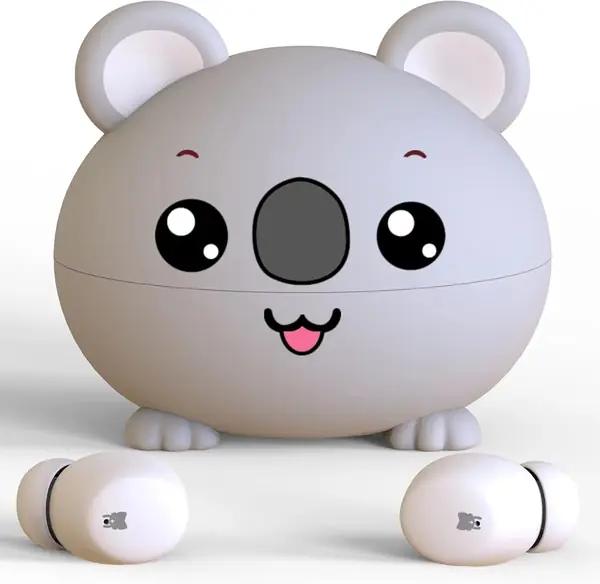
The case is a koala. That is the pitch, and it works: a small grey head that sits in a blazer pocket, four-gram buds a kid forgets are in, and thirty hours of playback with the case. For a first pair bought as a gift, the animal does more work than any spec line.

Underneath there is more substance than the case suggests. The volume ceiling is a real limiter under 85 dB rather than a marketing line, the shell is built from a tougher ABS than most of the plastic in this group, and three tip sizes cover most children. That combination of a genuine cap and a low price is why it earns a place here at all.

For an eight- or nine-year-old who has outgrown the novelty of a cartoon but still loses things, it is a reasonable middle: enough battery for a week of school, a cap that holds against a curious finger, and a case that is easy to spot in a bag. It is the pair we hand to the kid who is nearly ready for adult earbuds and not quite there.

Pros

  • Under-85 dB limiter on a budget pair
  • Thirty hours with the charging case
  • Four-gram buds kids forget about

Cons

  • Runs large for kids under eight
Our verdict

The Koala is our budget pick that still caps volume in hardware; buy it for a kid around nine or older, since the shell runs large.

Check Latest Price

How We Tested Kids' Earbuds

We started by gathering more than 30 pairs from the brands that surface repeatedly in kids' audio, then narrowed to 14 using three filters: a stated volume limit, at least two ear tip sizes, and a price that wouldn't sting when one inevitably went missing. Testing ran for three months with kids ages 4 through 14 across my household and two colleagues' families, in the places these actually live — the kitchen table during homework, the school bus, the back seat on weekend drives, and the sideline at soccer practice.

Volume came first. I held a decibel meter against the speaker of each pair, played a test track at full volume from both a phone and a tablet, and noted where the output actually topped out, then checked whether the cap could be pushed past from the source device, because on some pairs it can. For sound quality, the kids watched videos with dialogue-heavy scenes and reported whether voices came through clearly or turned to mush. Louder did not mean better.

Fit got the most real-world attention. Each child seated the buds themselves, and we counted how many times they dropped out during ten jumping jacks and a lap around the block, then tracked which tip sizes were actually reached for. Durability meant drops from counter height, a week loose in a backpack with no case, and a wipe-down to see how much grime the seams collected. For connectivity, we paired each pair to an iPad, a school Chromebook, a handheld game console, and an Android phone, then walked to the far end of the house to watch for dropouts. Battery life was timed from full to dead, with a stopwatch running again on the recharge.

Touch controls and microphones got their own pass, since both are where inexpensive pairs tend to fall apart. The kids tried skipping tracks with cold hands and taking a call from a grandparent while I listened on the other end to hear how they came through.

How to Choose Earbuds for Kids

Start With the Volume Limit, Not the Sound

Eighty-five decibels is the figure hearing specialists use for extended listening, and the only version of that ceiling that survives contact with a child is one built into the earbuds. A cap in the hardware holds when a kid finds the volume slider; a limit set on a phone or tablet only works if it is switched on and locked behind a passcode. The Belkin, the myFirst, and the Cootimock all cap volume inside the buds.

The trap is assuming the word kids on the box means there is a limiter inside. Often it means a smaller shell and a cartoon case. For anything without a built-in cap, open the device's sound settings, turn on the headphone limit, and set a passcode before the buds change hands.

Fit Decides Whether They Get Worn

The most common reason a kids' earbud ends up in a drawer is that it will not stay in. A six-year-old's ear canal is much smaller than a sixteen-year-old's, and a housing built around an adult nozzle works its way out no matter which tip you fit. Check how small the tips go before anything else: the myFirst set runs six sizes down to XXS.

A tip changes the seal, not the shell. If two pairs have already popped out mid-playground, the housing is the problem and no amount of tip-swapping fixes it. That is the point at which an open-ear clip design becomes the sensible answer rather than a compromise.

Open-Ear or In-Ear?

Open-ear buds rest outside the canal and hook over the ear. They cannot fall out of a canal they never enter, and they leave traffic, a coach, and a parent audible, which is why we like them for younger riders and sporty kids. The iDIGMALL pair is the clearest example here.

The cost is isolation. Nothing blocks a bus engine or an airplane cabin, and a little of the audio leaks outward. In-ear buds seal, hold up better in noise, and demand a correct fit. Choose open-ear for awareness, in-ear for quiet focus, and do not expect one design to do both.

Battery, Warranty, and the Lost-Bud Problem

Per-bud runtime matters more than the total on the box, because that is what a child gets between charges: five to eight hours across these picks. The case total then decides whether the pair survives a weekend away. A bright case and a strap that ties the buds together do more against loss than any spec.

Read the warranty before you buy, because the failure that actually happens is a single bud going quiet. Belkin covers two years, myFirst offers a year plus a 30-day money-back window, and the budget pairs generally stop at one. Keep the order confirmation; a covered replacement beats buying a second pair.

Frequently Asked Questions

Final Verdict

If you want one pair and no further research, the Belkin SoundForm Nano 2 is the one we recommend: an 85 dB ceiling built into the hardware, eight hours per bud, and a two-year warranty that covers the failure these things actually have.

Spend more on the myFirst CareBuds only if your child is at the small end of the range and has already rejected a pair, since six tip sizes buy a fit nothing else here matches. And if earbuds simply will not stay in at all, skip both and clip on the iDIGMALLs.