Best Video Tripods of 2026

A video tripod is a tug-of-war between two things you rarely get at once: a head that pans smoothly enough to follow a moving subject, and legs heavy enough to stay put while your hand is on the pan arm. Go light and every zoom shows the shakes; go heavy and it lives in the trunk. A good one just puts that compromise where it belongs for the way you actually shoot.

I once watched a cheap tripod shiver in a parking-lot breeze while the shot I wanted drifted out of frame. Over the past six months, my team and I have set up and torn down 12 video tripods, from aluminum workhorses to carbon fiber travel sticks. The spec that changes the buying decision is often the one nobody advertises: a 75mm bowl levels the head in seconds, and payload ratings tend to be optimistic once you add a cage, a monitor, and a long lens.

The picks below are the ones that stayed planted, packed without a fight, and didn't make me swear during setup. They're built for people who move between rooms, yards, and job sites, not for a tripod parked in a studio corner.

The Best Video Tripods

1

Cayer BV30L Best Overall
93 /100
TKZ Score Outstanding

Key details

Weight
8.8 lb
Max Load
13.2 lb
Max Height
72.5 inches
Head Base
75mm flat base
View on Amazon

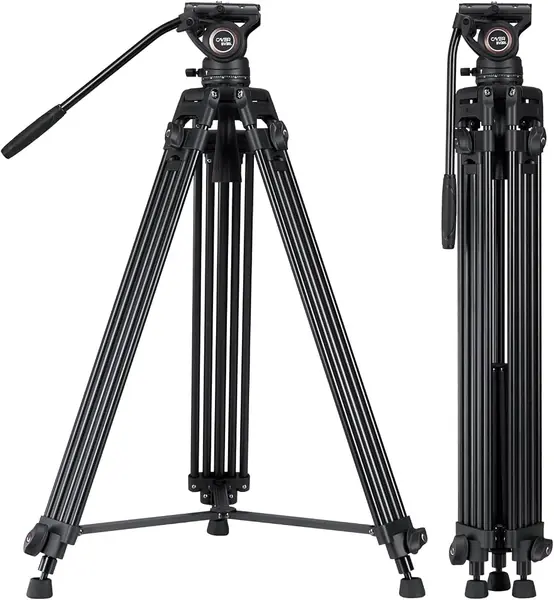
Leveling a tripod on uneven ground is the chore that eats the first five minutes of a shoot, and the BV30L's 75mm bowl is the fix. Set the legs roughly, loosen the bowl clamp, and tilt the head until the bubble centers, with no re-dialing of three leg locks after every adjustment. We noticed the difference on sloped ground the first time we set it up, and it is why this is the tripod we hand to someone who needs the shot right away.

Everything else is built for the same kind of work. Twin aluminum tubes per leg, a mid-level spreader that stops the legs splaying under weight, and two quick-release plates in the box so a second camera body stays plated and swaps in seconds. At 8.8 pounds it carries 13.2, which covers a mirrorless body with a zoom, a cage, and a monitor without strain. What settled it for us was the head: pan and tilt start and stop without the hitch that ruins a slow follow, and a loaded rig stays where it is pointed.

One habit worth forming is checking the leg locks before every setup. A leg that settles under load shows up as a slow height drift mid-take, and the spreader is what keeps that from turning into a ruined shot. Cayer backs the tripod with a two-year warranty, which matches the longest coverage in this group.

Pros

  • Leveling bowl speeds setup on uneven ground
  • Two quick-release plates in the box
  • Smooth pan and tilt with a 13.2 lb payload

Cons

  • Short pan handle limits leverage on slow tilts
Our verdict

We recommend the BV30L for anyone shooting video who wants a leveling bowl, a spreader, and two plates in one package, since it sets up fast and pans cleanly.
Check Latest Price
2

NEEWER TP74 Best for Mixed Plate Setups

92 /100
TKZ Score Outstanding

Key details

Weight
10.9 lb
Max Load
17.6 lb
Max Height
74 inches
Quick Release
DJI RS and Manfrotto plates
View on Amazon

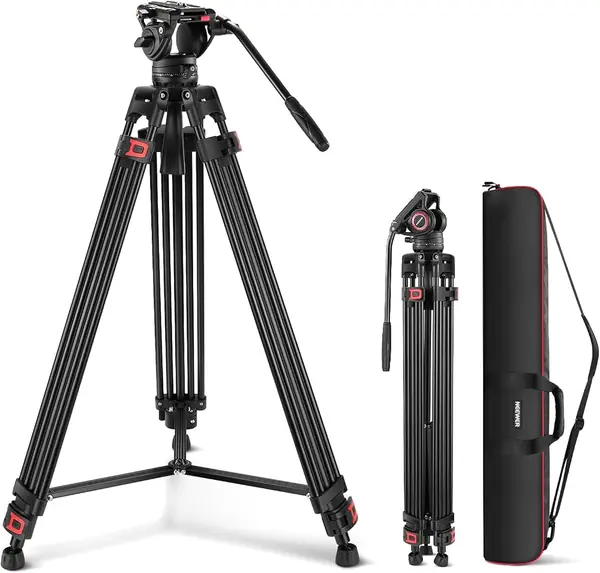
Two kinds of plate fit the TP74's head: DJI RS2, RS3, and RS3 Pro gimbal plates, and Manfrotto 501PL and 504PL. If a camera moves between a gimbal and a tripod in the same shoot, that is the feature that earns this tripod its place, because the plate stays on the camera and the head takes it either way. We rate that above a bigger payload number, since a plate you have to swap costs a minute every time the camera changes hands.

The head pans a full 360 degrees and tilts from -75 to +90, with separate locks for each axis and a bowl that levels the head when the legs are sitting crooked. At 74 inches it clears eye level for most shooters, and the twin-tube legs carry 17.6 pounds, which is a mirrorless body with a long zoom and a monitor with room to spare.

A studio, a stage, or a shoot within a few steps of the car is where this tripod belongs; a location you walk to is where the carbon picks take over. Set the height once and it stays set, which is what you want when the camera comes on and off the head all day.

Pros

  • Two plate modes cover DJI RS and Manfrotto plates
  • Head levels without moving the legs
  • 17.6 lb capacity reaching 74 inches

Cons

  • 10.9 lb before you mount a camera
Our verdict

If your cameras move between a gimbal and a tripod, this is the head that ends plate swapping, and we rate that flexibility above a bigger payload number.

Check Latest Price
3

K&F CONCEPT VA3+BV70 Best Value

90 /100
TKZ Score Outstanding

Key details

Weight
12.3 lb
Max Load
17.6 lb
Max Height
79.5 inches
Folded Size
36.2 inches
View on Amazon

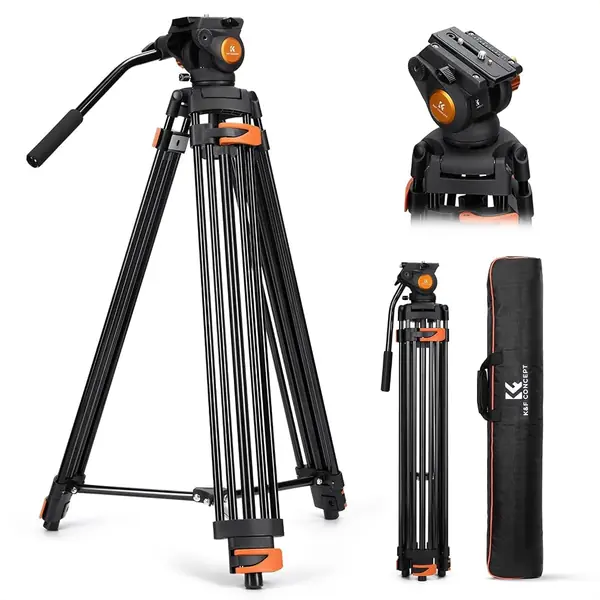
The VA3+BV70 is the least expensive way in this group to get a camera past 79 inches, and that number is not a gimmick. At a wedding or a game, standing height plus a foot of clearance is how you shoot over the people in front of you. Three-section flip-lock legs run from 34.6 inches to 79.5, and the whole thing folds to 36.2.

The head is better than the rest of the package suggests. Pan and tilt are damped rather than merely stiff, the oversized orange tension knob is easy to grab with cold or gloved hands, and the pan handle mounts on either side, which matters more than it sounds when the head sits close to a wall or the operator works left-handed.

We kept reaching for it any time the camera needed altitude, and it is the pick of this group when the tripod travels by car. As a first video tripod that has to cover weddings, events, and school plays, it handles more situations than anything else at its price.

Pros

  • 79.5 inches of reach at a budget price
  • Damped pan and tilt with a grabbable tension knob
  • Handle mounts on either side of the head

Cons

  • 12.3 lb, the heaviest tripod here
  • Folds to 36.2 inches, long for a backpack
Our verdict

For tall framing on a budget, we reach for the VA3+BV70: 79.5 inches and a damped head, provided the tripod lives near the car.

Check Latest Price
4

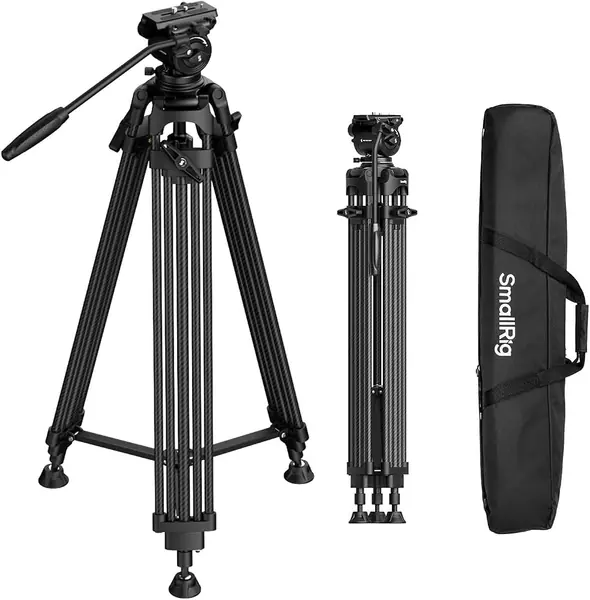
SmallRig FreeSpeed 5443 Best Lightweight

89 /100
TKZ Score Excellent

Key details

Weight
7.5 lb
Max Load
22 lb
Max Height
73 inches
Bowl
75mm
View on Amazon

A 7.5-pound tripod rated for 22 pounds sounds like a misprint until you pick it up. The legs are carbon fiber, the hardware is metal, and the frame feels denser than its weight suggests. What we kept coming back to is the leg design: one knob releases the leg sections instead of a clamp at every joint, so the tripod goes from folded to height in a single pull.

The 75mm bowl levels the head without touching the legs, the tilt damping knob takes up the difference between a bare body and a loaded rig, and the swivel feet pivot on rock instead of skidding, with flat feet in the box for studio floors. For a crew carrying gear to a location, 7.5 pounds on the shoulder and 22 pounds of rated capacity is the whole argument.

Watch the spreader. It is the part that takes the abuse when a tripod gets thrown in a van, and folding the legs before you load it is the habit that keeps it square. Otherwise it does the work of the aluminum twins here at a fraction of their weight.

Pros

  • One knob releases the leg sections
  • 7.5 lb frame rated to 22 lb
  • Swivel feet plus a 75mm leveling bowl

Cons

  • Bottom height stops at 34 inches
Our verdict

For crews who carry their gear to the location, we pick the FreeSpeed 5443: 7.5 pounds, a 22-pound rating, and a leveling bowl that keeps setup short.

Check Latest Price
5

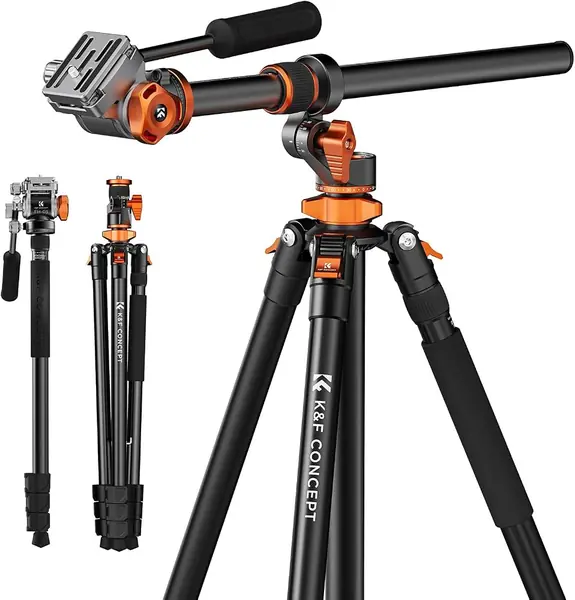
K&F CONCEPT T254A7 Best for Overhead Shots

88 /100
TKZ Score Excellent

Key details

Weight
4.9 lb
Max Load
11 lb
Max Height
90 inches
Folded Size
21.3 inches
View on Amazon

Some shots do not exist on a normal tripod: straight down at a table, out over a balcony rail, along a shelf. The T254A7's center column pivots from vertical through 120 degrees to horizontal, so the camera can hang over a subject instead of facing it. That is the trick that earns it a place here, and nothing else in this group does it.

Away from overhead work it is a genuinely light kit: 4.9 pounds, four leg sections, folded to 21.3 inches, so it rides on the outside of a daypack rather than in a trunk. It reaches 90 inches at full extension, and the center column pulls out to become a monopod, a walking staff that also steadies a shot.

It is not a heavy-rig tripod. The head and legs are rated to 11 pounds, which is fine for a mirrorless body and a zoom and not fine for a built-up cinema camera. Overhead product work and travel are its two jobs, and we treat it as the second tripod that makes a shot possible rather than the one that does the daily work.

Pros

  • Column swings to horizontal for overhead shots
  • Folds to 21.3 inches at 4.9 pounds
  • Center column converts to a monopod

Cons

  • Column gets wobbly near its full height
Our verdict

We keep the T254A7 for overhead and top-down work: the column swings horizontal and it folds to 21 inches, so it travels as a second tripod.

Check Latest Price
6

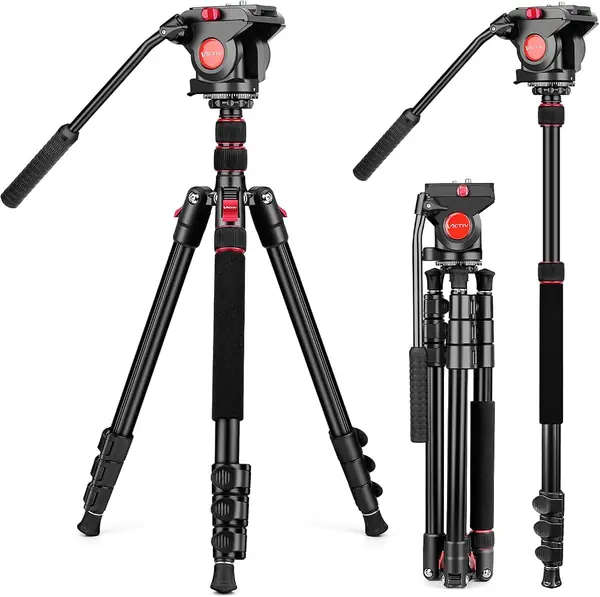
Victiv VTH7 Best for Light Camera Kits

87 /100
TKZ Score Excellent

Key details

Weight
4.7 lb
Max Load
20 lb
Max Height
72 inches
Min Height
16.5 inches
View on Amazon

Under five pounds and 21 inches folded, the VTH7 is the tripod that lives behind a car seat. It also drops to 16.5 inches, lower than anything else here, which is how you get a low-angle shot without carrying a separate low hat.

For the money it does the two jobs a video tripod has to do. The head pans 360 degrees and tilts +90/-70 with enough drag that a light camera moves smoothly, and the leg locks set at three angles quickly. The head ships detached and bolts on out of the box, which we do not mind: it is a minute of work, and it means the head can be swapped later.

Where it earns its keep is a light kit. A small camcorder, a spotting scope, or a phone rig sits still on it, and the 20-pound rating covers what the head will clamp. Treat it as a travel tripod, a second tripod, or a first tripod for a small camera and it makes sense.

Pros

  • Drops to 16.5 inches for low angles
  • 4.7 lb and 21 inches folded
  • Converts to a monopod

Cons

  • Gets shaky once the rig gets heavy
Our verdict

Buy the VTH7 as a light-kit tripod: it goes low, packs short, and we found it steadiest with a small camera on top.

Check Latest Price
7

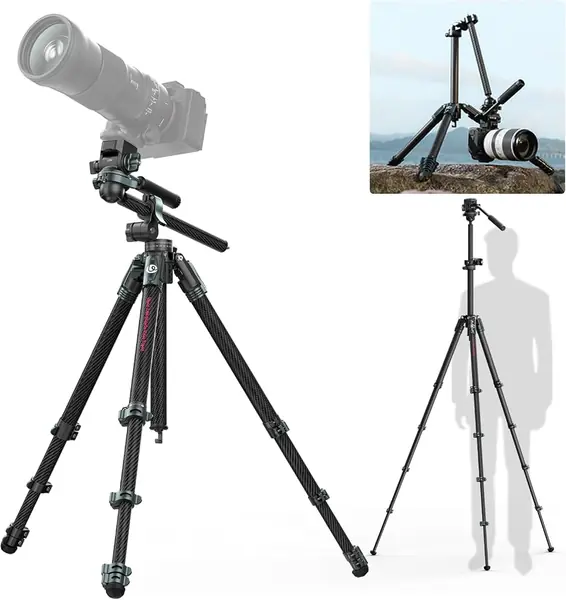
ULANZI JJ06 GlideGo Best for Travel and Packing

86 /100
TKZ Score Excellent

Key details

Weight
3.9 lb
Max Load
11 lb
Max Height
73.6 inches
Folded Size
20.3 inches
View on Amazon

The JJ06 is a carbon travel tripod that pans, not a fluid-head video tripod, and that distinction decides who should buy it. Its head is a ball with a rotating base and a column that also turns, so you can level it, swing a full 360 degrees, and lock it off cleanly with a light camera on top.

As a travel tripod it is very good. Carbon legs and machined aluminum come to 3.9 pounds, folded to 20.3 inches, and five leg sections cover 17.3 inches to 73.6, which is a tabletop shot and a standing interview from the same tripod. The quick release has a safety lock so the plate cannot slide free while you move between setups, and the legs click into three angles for uneven ground.

The built-in screwdriver handle with seven interchangeable bits is the detail we keep using: it lives in the tripod, so tightening a cage or a monitor arm does not mean walking back for a tool roll. For locked-off shots and simple pans, this is the tripod that packs smallest of anything here.

Pros

  • Carbon frame at 3.9 lb, folds to 20.3 inches
  • Quick release with a safety lock
  • Built-in screwdriver handle with seven bits

Cons

  • Ball head cannot carry a damped slow tilt
  • Leg locks are the weak point on this design
Our verdict

The JJ06 is what we pack when the tripod has to disappear into a small bag, and it is for travel, locked-off shots, and simple pans rather than slow tilts.

Check Latest Price

How We Tested Video Tripods on Real Shoots

We built the shortlist by reading listings for head type, bowl size, maximum height, folded length, and stated payload, then cut anything that called itself a video tripod but shipped a photo ball head. Twelve tripods made the cut, and we spent six months with them — long enough for the novelty to wear off and for leg locks to start showing their habits.

Testing looked like actual shooting. We set each one up alone, timed bag to level, and counted the knobs and locks it took to reach full height. With a long lens mounted, we panned slowly past a fixed object and watched for stutter, then tapped the pan arm to see how much the frame recoiled. For stability, we shot in a breezy open field and on a wooden deck where footsteps carry, and checked after half an hour whether the horizon had crept.

We also weighed each tripod with its bag and carried it a mile, folded and unfolded it a few dozen times on concrete, and checked for play in the head at the end of every session. Smoothness, adjustability, and build quality got scored on what the tripod asked of us versus what it gave back — an expensive rig that needs two hands and a knee to raise is worse value than a cheaper one you can set up in the dark.

How to Choose a Video Tripod

The Head Matters More Than the Legs

The legs hold the frame still, but the head decides whether a pan is usable. A true fluid head damps pan and tilt with viscous drag; at these prices you are mostly getting friction damping, a knob that stiffens the axis, and that is enough for a mirrorless camera. What you do not want is a head that stutters when you tilt slowly. Mount your camera, unlock the tilt, and push the lens down an inch at a time. If the image moves in visible steps instead of one arc, those steps will be in your footage. The Cayer BV30L and the NEEWER TP74 were the smoothest here.

Match the Payload to the Rig You Actually Mount

The number on the box is usually the head's clamp capacity, and it is a ceiling rather than a target. Add the body, the lens, a cage, a monitor, and batteries; a long zoom can weigh more than the camera it sits on. Then leave headroom, because long glass pushes the balance point far forward of the plate and the head has to drag more weight than the total suggests. Where there is a hook under the column, hang a bag from it with heavy glass instead of trusting the clamp. A head with separately adjustable tilt drag, like the SmallRig FreeSpeed, lets you dial resistance to the weight.

Height, Folded Length, and the Carry

Maximum height is measured with the center column raised, which is also the least stable the tripod gets. If you shoot standing, choose one whose legs alone clear your eye line and keep the column down for critical takes; the K&F VA3 tops 79 inches and the SmallRig reaches 73. Then weigh the carry. The lightest full-height models here run 4.7 to 4.9 pounds, the aluminum twins 8.8 to 12.3, and that difference decides whether the tripod leaves the trunk. Check the minimum height too if you shoot low angles or products: the Victiv drops to 16.5 inches while the SmallRig stops at 34.

Leveling: Bowl, Spreader, or Neither

Leveling separately from the legs is the difference between a two-minute setup and a ten-minute one. A 75mm bowl lets you set the legs roughly and level the head with a clamp, which is what the Cayer BV30L, the NEEWER TP74, and the SmallRig FreeSpeed give you. A mid-level spreader keeps the legs from splaying further once weight is on them, and on a smooth floor it is what stops the whole thing walking. A flat 75mm base has a second life: the head unbolts and mounts on a slider or a high hat, so a head you like can outlast the legs it came with.

Plates and Compatibility

Quick-release compatibility is where video tripods quietly stop cooperating. Manfrotto 501PL and 504PL are the common plates, and DJI RS gimbal plates are the other family worth having. The NEEWER TP74 takes both, which is why it is our pick for mixed gear. Confirm the exact gimbal generation a head names rather than assuming a whole family fits, and count the plates in the box: a second plate is what lets two cameras share one tripod without swapping screws, and the Cayer ships with two.

Frequently Asked Questions

Final Verdict

The Cayer BV30L is the tripod we point most people to. A leveling bowl, a mid-level spreader, two plates, and a head that starts and stops without a hitch cover the work most of us actually do, and 8.8 pounds is light enough to get it out of the trunk.

Carry it any real distance and the SmallRig FreeSpeed is worth the step up: 7.5 pounds with a higher payload. Shoot top-down and only the K&F T254A7 does the job. Buy for the shot you take most often, not the one you might.