Best USB-C Car Chargers of 2026

A phone that dies mid-navigation is a special kind of frustrating, and the fix is one of the cheapest upgrades you can make to a car. Over four months we've tested 14 USB-C car chargers, from palm-sized two-port plugs to a three-port unit that will run a laptop. What separates them has less to do with the wattage printed on the box than you'd expect.

What matters most is what each port actually gets, not the total: a charger advertised at 40 watts often splits that between two ports, so two phones charge at a fine but unremarkable pace, while a laptop-friendly model can push far more through one USB-C port with nothing else plugged in. Heat matters just as much — a plug that runs hot on a July dashboard gets slower, then flaky. Retractable cords kill the console tangle in one move, though the cord becomes the part most likely to wear out.

We charged phones, earbuds, tablets, and a laptop on commutes, errands, and one long highway weekend, and the picks below are the ones that held up. Some are built to vanish into a glovebox; others are meant to anchor a road trip.

The Best USB-C Car Chargers

1

Anker 40W PowerDrive III Duo Best Overall
96 /100
TKZ Score Outstanding

Key details

Total Output
40W
Ports
2x USB-C
Weight
1.12 oz
View on Amazon

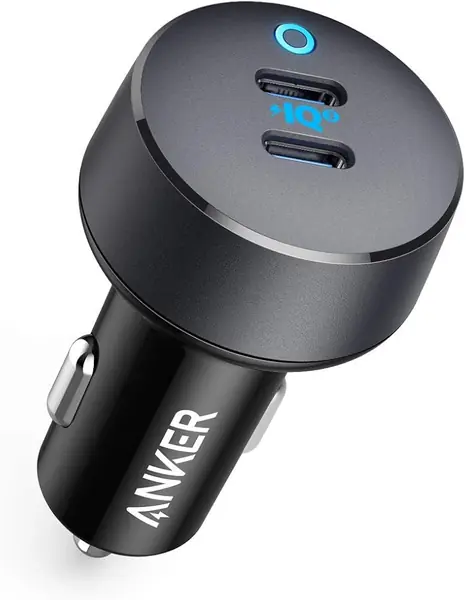
Two USB-C ports and no USB-A is the whole idea behind the PowerDrive III Duo, and for most drivers it is the right call. The body is small and light enough, at 1.12 ounces, that it disappears into the socket instead of crowding the console, and both ports run Anker's PowerIQ 3.0, which negotiates fast charging with iPhones, Galaxy phones, and Pixels without you having to think about it.

We made it our default because it solves the everyday problem: two people, two USB-C cables, no adapter to share. Plug in a phone and a passenger's phone and both keep charging at a useful rate, so nobody has to decide whose battery matters more on the drive home.

What it doesn't have is a USB-A slot, which turns a drawer of older cables into one more thing to replace — a small annoyance in an all-USB-C household and a real one when a passenger turns up with a USB-A cable. Try a new unit on a familiar phone in the first few days; the occasional one stops delivering power early, and the 18-month warranty makes that an inconvenience rather than a loss.

Pros

  • Two USB-C ports cover driver and passenger
  • Small 1.12-ounce body sits out of the way
  • PowerIQ 3.0 fast charging for iPhone and Galaxy

Cons

  • 40W is shared across both ports, not 40W each
Our verdict

We recommend the PowerDrive III Duo to anyone charging phones rather than laptops: two USB-C ports, proper fast charging, and a body that stays out of the console's way.
Check Latest Price
2

Anker 167.5W 3-Port Best for Road Trips

95 /100
TKZ Score Outstanding

Key details

Total Output
167.5W
Ports
2x USB-C, 1x USB-A
Included Cable
3.3 ft USB-C to USB-C
Top USB-C Port
100W
View on Amazon

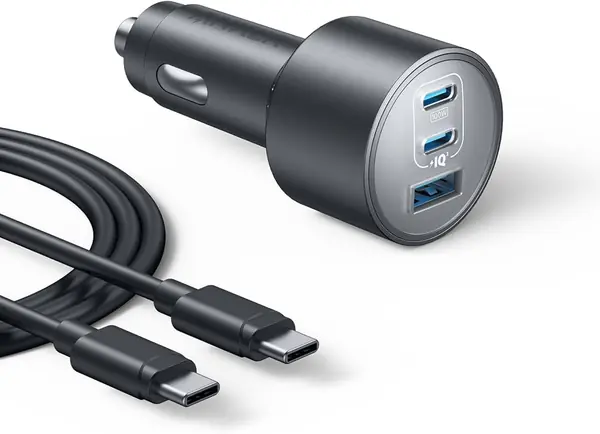
One hundred watts from a cigarette lighter socket is the number that sets this Anker apart, and it changes what a car charger is for: with 100W on the first USB-C port, a 16-inch MacBook Pro runs at full speed off the dash. Nothing else in this group comes close on a single port, which is why it's our pick for anyone whose car doubles as an office.

Behind that port sit a 45W second USB-C for phones and tablets and a USB-A slot for a legacy cable, with the total landing at 167.5W when all three are in use. Anker includes a 3.3-foot USB-C to USB-C cable, so a laptop starts charging before you've left the driveway, and the plug is compact enough to stay seated in the socket instead of levering itself loose over bumps.

If the heaviest thing you charge is a phone, none of that headroom does anything for you, and the 40W Anker is the smarter buy. This one earns its place when a laptop, a tablet, or a Starlink Mini comes along for the ride — and it happens to be the highest-rated charger here, which suggests the extra power doesn't come at the cost of the basics.

Pros

  • 100W USB-C port runs a laptop at full speed
  • 45W second USB-C plus a USB-A slot
  • 3.3-foot USB-C cable included in the box

Cons

  • Premium price for headroom many drivers won't use
Our verdict

Buy the 167.5W Anker if something in your car has a big battery to fill; if you only charge phones, the 40W model is the better spend.

Check Latest Price
3

LISEN 2-Pack Car Charger Best Value

93 /100
TKZ Score Outstanding

Key details

Shell
Aluminum
Pack Count
2
USB-A Output
18W QC
USB-C Output
36W PD
View on Amazon

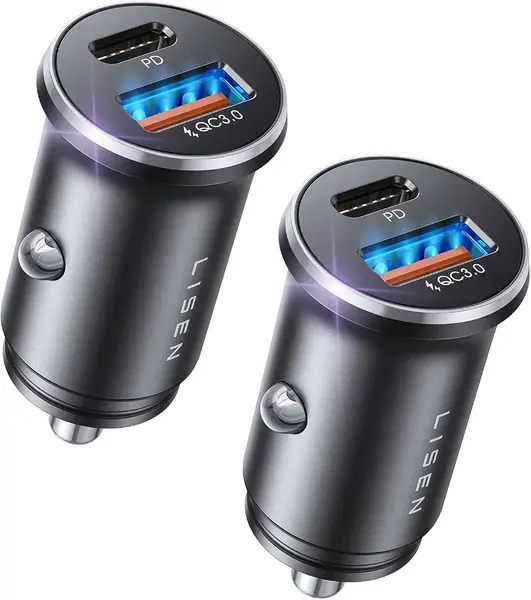
Two chargers for less than most single-port adapters cost is the entire pitch, and it's a good one for anyone with two vehicles: leave one in each, and stop carrying an adapter between the cup holder and the garage shelf.

Each unit gives you 36W on USB-C and 18W on USB-A inside an aluminum shell about the size of a thumb. That's a practical split — the USB-C side fast-charges a modern phone, while the USB-A keeps an older cable or a passenger's device alive without demanding a second plug. We also prefer metal to plastic in something that bakes in a sunny socket all summer.

Fit is the thing to check against your own car. The body is short, so in a deep socket it sits almost flush; in a shallow or worn one the collar can stand proud, and a rough road may interrupt the connection. Push it fully home, keep the socket clean, and it behaves.

Pros

  • Two chargers, one for each vehicle
  • 36W USB-C and 18W USB-A per unit
  • Aluminum body, small enough to sit nearly flush

Cons

  • One USB-C port per charger
  • Six-month warranty
Our verdict

For a household with more than one car, the LISEN two-pack is the sensible spend: two solid 36W chargers where most brands sell you one.

Check Latest Price
4

UGREEN 130W 3-Port Best for Samsung Fast Charging

92 /100
TKZ Score Outstanding

Key details

Total Output
130W
Ports
2x USB-C, 1x USB-A
PPS Port
45W
Socket Input
12V/24V
View on Amazon

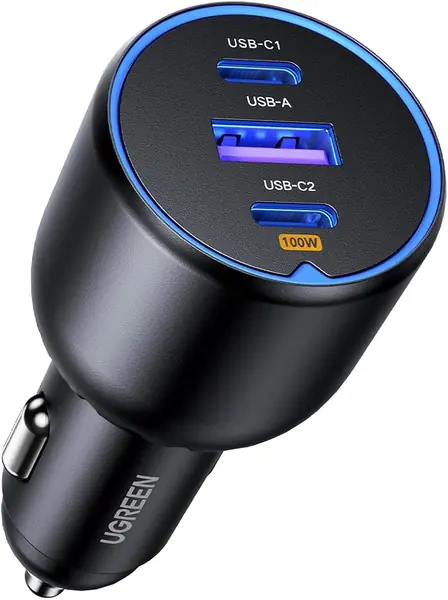
Samsung's fastest in-car charging runs on PPS, a protocol most car chargers skip entirely. UGREEN builds it into this charger's second USB-C port at up to 45W, which is the difference between a Galaxy S24 Ultra showing Super Fast Charging 2.0 and merely topping up — and it's why this is the one we point Samsung owners to.

The rest of the package is sensible rather than flashy, which suits us fine: 130W spread across two USB-C ports and a USB-A, a scratch-resistant gray body, and a soft blue LED that lets you find the port at night without lighting up the cabin. We also like that UGREEN rates it for both 12V and 24V sockets, a detail that matters if you drive a truck, a diesel, or an RV rather than a sedan.

Two practical notes before you order. There's no cable in the box, which is the difference between charging on the drive home and waiting on a delivery, so add a USB-C to USB-C cable if you don't have a good one. And the PPS support lives on that second USB-C port specifically, so the Galaxy belongs there rather than on the other one.

Pros

  • 45W PPS port for Samsung Super Fast Charging
  • 130W spread across two USB-C and one USB-A
  • Rated for both 12V and 24V sockets

Cons

  • No charging cable in the box
Our verdict

For a Galaxy that needs PPS to reach Super Fast Charging 2.0, the UGREEN is the one we name, with two more ports for everything else.

Check Latest Price
5

LISEN 84W Retractable Best for Tangle-Free Consoles

91 /100
TKZ Score Outstanding

Key details

Total Output
84W
USB Ports
2
Cable Reach
31.5 in
Built-in Cables
USB-C and Lightning
View on Amazon

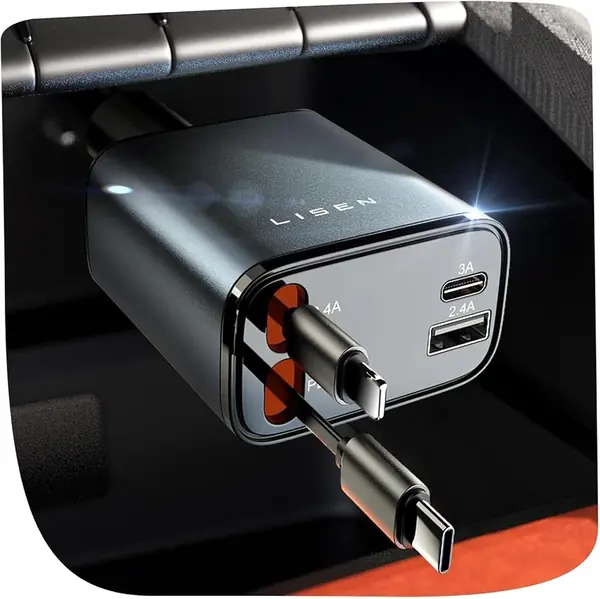
Cables are the part of car charging nobody wants to manage: they slide between the seats, loop around the shifter, and vanish under a passenger's foot. This LISEN pulls two of them out of its own body instead — one USB-C, one Lightning — each reaching 31.5 inches and winding back in with a short tug.

Add the two USB ports on the front and you have four ways to charge from a single plug, with 45W on the built-in USB-C cable, enough to fast-charge a current iPhone or Galaxy without borrowing a cable from your bag. The cord also holds at whatever length you pull it to, so a passenger can keep a phone in their lap without slack looping across the console.

The compromise is data: the built-in cables carry power only, so there's no CarPlay and no audio through them. Keep a separate cable if your car needs a wire for maps — a small price for a console that stays clear, and the deal we're happy to make for daily driving.

Pros

  • Two retractable cables plus two USB ports
  • 45W USB-C fast charging from the built-in cable
  • Cord holds at the length you pull it to

Cons

  • Built-in cables can't be replaced when they wear
Our verdict

For a family car where loose cables are the daily annoyance, the retractable LISEN is the pick: four ways to charge and nothing to untangle.

Check Latest Price

How We Tested USB-C Car Chargers

We started by collecting every USB-C car charger with a meaningful track record in customer reviews, then filtered hard: enough total output to be useful, at least one USB-C port that could fast-charge a modern phone, a plug short enough to sit close to flush in a standard 12-volt socket, and a price a normal person would pay for something that lives in a cupholder. We also judged value per usable port rather than per box, which matters when a set ships as a two-pack. Fourteen chargers made the cut, and we ran them for four months.

Each charger got at least a week as the main plug in my car — commuting, school pickup, errands, and one 600-mile highway weekend — with a phone up front, a tablet in the back seat, earbuds in the console, and a 14-inch laptop along for the long drive. We timed a phone from 10 percent to 50 percent, then plugged in a second device and timed it again to see whether the first one slowed down. After 30 minutes of charging we checked each unit by hand and with a thermometer, then repeated that test with the car parked in the sun on a hot afternoon.

Fit and durability got the crude tests they deserve. We bounced over speed bumps and a washboard dirt lot to see whether the plug crept out of the socket mid-charge, checked whether a charger blocked the outlet beside it, and gave a few cords a harder yank than anyone should to see what happened. The retractable model got 50 pulls to watch for snagging or a cord that quit spooling, and we scored cord management by whether the cable was still where we left it at the end of the week. Two units developed a rattle, and one ran noticeably hotter than the rest.

How to Choose a Usb-C Car Charger

Decide How Many USB-C Ports You Need

The port question is really about people. One USB-C port covers the driver; two cover the driver and a passenger, which is the reason to spend a little more. A USB-A slot is worth having only if someone still travels with an older cable, since the fast charging happens on USB-C either way.

Three ports look generous on paper but rarely run at full speed together. Plug three devices into a plug this size and the total is split three ways, so your phone may charge no faster than it would alone. Buy the port count you'll use at the same time, not the biggest number.

Match Watts to the Device, Not the Label

A phone fast-charges at roughly 20W to 30W, a tablet wants 30W to 45W, and a laptop wants 65W or more. Anything above what your device accepts is headroom for the next thing you plug in, not a benefit to the phone in your hand today.

Samsung owners should hunt for PPS, which is what switches on Super Fast Charging 2.0 for a recent Galaxy. The UGREEN lists 45W PPS on its second USB-C port; most chargers at any price say nothing about it, and a Galaxy will still charge without it, just well short of its ceiling.

Check the Fit Before the Spec Sheet Wins You Over

Two chargers with identical wattage can behave very differently in a socket. A short body sits nearly flush in a deep 12V socket, but in a shallow or worn one the collar can stand proud, and a loose plug means charging that cuts out over every bump.

Look for something that seats fully and stays put once pushed home, and keep the socket free of dust and old residue. Pull the charger out by its body rather than by the cable, which is how a lot of these end up in a drawer with a frayed cord.

Weigh Cables and Cable Management

A bundled USB-C cable saves money and hassle, and a built-in retractable one removes clutter entirely. The catch is that a built-in cable is the part you can't replace, so a worn cord retires the whole charger with it.

We treat retractable plugs as a convenience buy for a tidy console and a plain plug with your own cable as the longer-lived choice. Check what comes in the box either way, because several chargers here ship with nothing at all.

Treat Early Failure as a Category Risk

A car charger lives in a hot, vibrating, dusty socket, and the failures that turn up tend to come early — within weeks rather than years. Run a new one on a phone you know during the first few days, while the return window is still open.

Warranty coverage is the honest signal of how much a maker expects from its own hardware; Anker's 18-month coverage is the benchmark in this group, and the budget picks back themselves for six months or a year. Heat matters too: sustained high-wattage charging warms any plug, and metal bodies handle it better than thin plastic.

Frequently Asked Questions

Final Verdict

Most drivers should buy the Anker PowerDrive III Duo. Two USB-C ports, proper fast charging for an iPhone or a Galaxy, and a body small enough to forget about — that's the whole job, done without clutter or a cable you have to supply.

If a laptop or a Starlink Mini rides with you, the Anker 167.5W is the upgrade that matters, with a 100W port and a cable in the box. And if your household runs on Galaxy phones, the UGREEN 130W is the one with the PPS support the others lack.