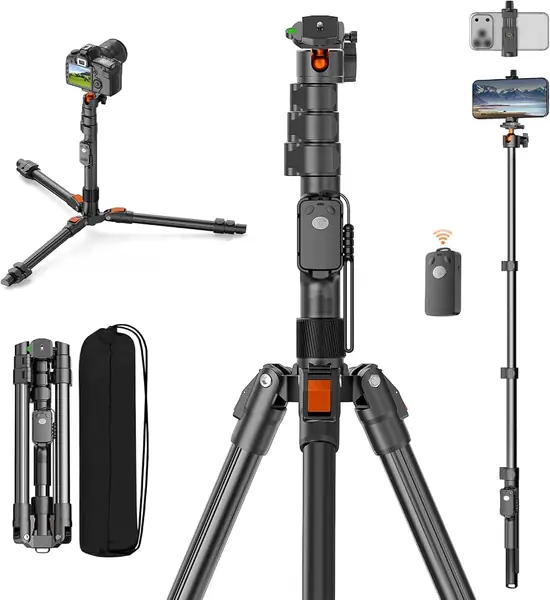
Best Travel Tripods of 2026

Every travel tripod is a negotiation between two things that don't get along: weight and steadiness. Go light and the whole rig shivers in a breeze the moment you raise the center column; go heavy and it stays in the closet while you shoot handheld. What you're actually buying is permission to carry a real camera somewhere far from home and still come back with a sharp frame.

I've hauled these through airports and up trails for years, and this time my team and I spent eight months living with 12 of them — aluminum, carbon fiber, and a few that fold small enough to vanish into a daypack. The keepers weren't the ones with the best spec sheets. They were the ones whose ball heads held a heavy lens without creeping, whose leg locks I could work with cold hands, whose folded size I'd actually carry all day, and, yes, the ones that don't look like plumbing when you set them up in a nice lobby.

One thing I wish I'd known sooner: folded length matters more than maximum height. A tripod that doesn't fit your bag stays in the hotel room. The picks below earned their place on weekend city trips and long trail days alike.

The Best Travel Tripods

1

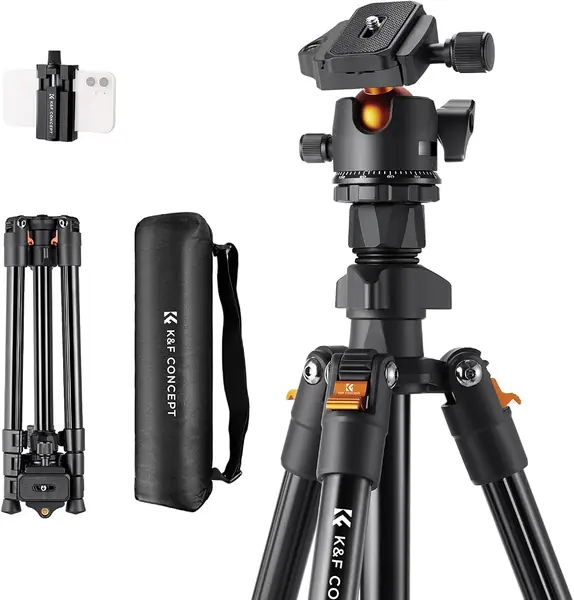
K&F Concept 64-Inch Travel Tripod Best Overall
93 /100
TKZ Score Outstanding

Key details

Weight
2.5 lb
Maximum Height
64 in
Folded Length
15.5 in
Load Capacity
17.6 lb
View on Amazon

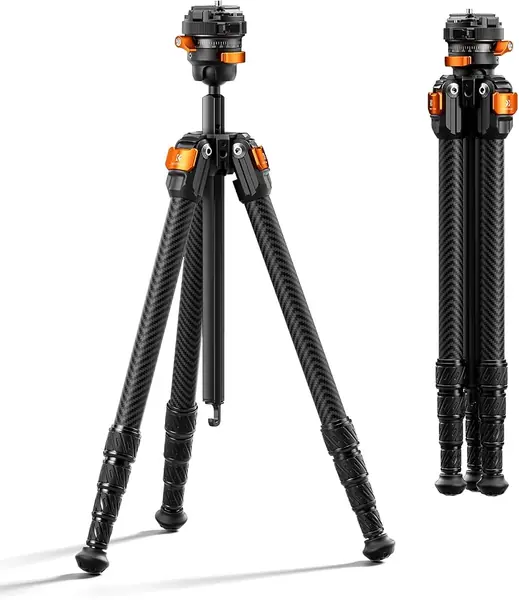
Fifteen and a half inches folded and about two and a half pounds is the arithmetic that won this slot. That is short enough to drop into a daypack beside a water bottle, light enough that you stop thinking about it on a walk, and the 64-inch maximum reaches eye level without cranking the center column all the way up. Four aluminum sections, flip locks, a 17.6-pound rating, a phone holder and a bag in the box: it is the least compromised all-rounder here, and the one we recommend to anyone who does not have a specific reason to buy something else.

The ball head is more than the price suggests. A 36mm ball is wider than most budget heads, which gives the friction surface more to grab, so a small telephoto stays where you put it instead of creeping between frames. The flip locks open with one hand, and the center column inverts for ground-level work — the sort of feature you use twice a year and are very glad to have when you do.

Where it gives ground is at the top of its range. Fully extended on a breezy afternoon it stops feeling planted, and the hook under the center column is plastic where the carbon picks use metal. Drop a section, hang your bag on the hook, and it settles. If you habitually shoot at full height with a long lens, that is the argument for spending more.

One practical wrinkle that does not show up in any listing: the carry bag is a tight fit. Every leg section has to be collapsed all the way and folded exactly right before the zip closes, which adds a few seconds to every pack-up. Annoying, and nowhere near enough to change the recommendation.

Pros

  • Folds to 15.5 inches at 2.5 pounds
  • 36mm ball head holds a small telephoto without creeping
  • Flip locks open all four legs one-handed

Cons

  • Legs get lively at full 64-inch height
  • Plastic hook under the center column
Our verdict

For most travelers this is the tripod we point to first: 15.5 inches folded, 2.5 pounds, and enough height for eye-level shots without a premium price.
Check Latest Price
2

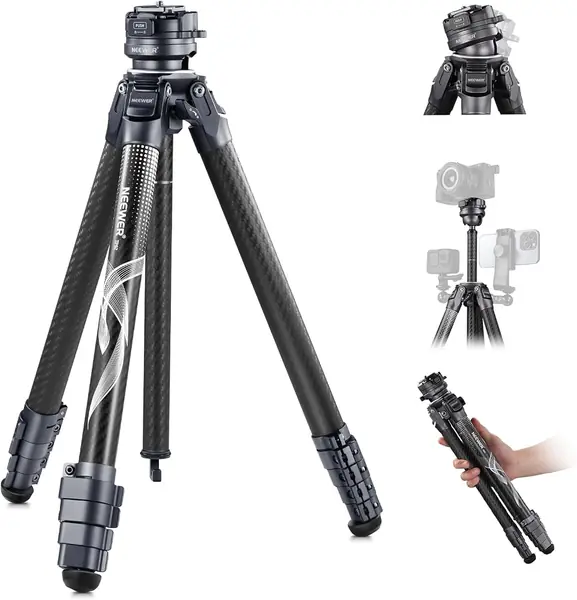
NEEWER LITETRIP LT32 Best Carbon-Fiber Pick

91 /100
TKZ Score Outstanding

Key details

Weight
2.6 lb
Maximum Height
62 in
Folded Length
17 in
Load Capacity
22 lb
View on Amazon

Carbon fiber at 2.6 pounds, 62 inches at full height and 17 inches folded puts the LT32 in the same weight class as the aluminum K&F while carrying a higher 22-pound rating. The leg sections are held by spring-loaded flip buckles that pop open with half a squeeze, and the head detaches if you want to strip the whole thing down to the legs.

The head is what you are really buying. Its base is a 30mm panning ring with 15 degrees of leveling in either direction, which is a different tool from a free ball head: you can square a horizon on a slope in seconds without touching the legs, but you lose a lot of tilt when you turn the camera to portrait. For landscape and architecture we think that is a good trade. For anyone who shoots vertical all afternoon it is a frustrating one.

The plate is Arca-type and also compatible with PD clips, so a camera can move between a backpack strap and the tripod without swapping hardware — a small convenience that changes how often you bother. There are quarter-inch threads on the plate and on the legs for accessories, and a side button releases the plate in one push.

Two things to know before you commit. The quick-release plate can work loose under a heavy zoom, so check the screw when you change lenses, and this is the second most expensive tripod in this group. If neither bothers you, it is the most capable light tripod here.

Pros

  • Carbon legs at 2.6 pounds with a 22-pound rating
  • Leveling base squares a horizon without touching the legs
  • Plate fits Arca and PD-style clips

Cons

  • Leveling head limits tilt in portrait
  • Plate can loosen under a heavy zoom lens
Our verdict

The LT32 is for the traveler who wants carbon legs, a 22-pound rating and a leveling base, and can live with a head that tilts less freely.

Check Latest Price
3

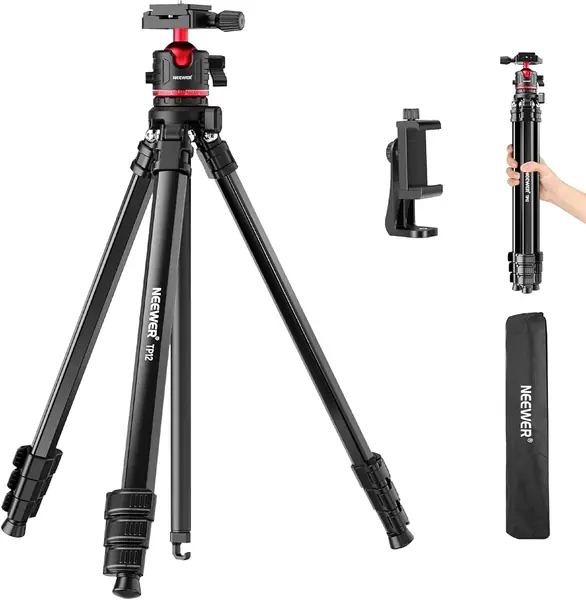
NEEWER Basics TP12 Best Full-Height Value

90 /100
TKZ Score Outstanding

Key details

Weight
2.9 lb
Maximum Height
66.5 in
Load Capacity
11 lb
Leg Sections
4
View on Amazon

Sixty-six and a half inches is a lot of tripod for the money, and it is why this one earns a place. The TP12 reaches higher than the K&F for less, on four aluminum sections, with a 40mm panning base under a low-profile head. It is the pick for anyone who shoots over crowds, up a slope, or at eye level while standing straight.

NEEWER calls this the Basics line, and the savings show up in finish rather than function: more plastic in the collars and the phone holder, and a head that pans smoothly without feeling as tightly machined as the carbon NEEWER above. What you get for it is a tripod that feels denser and more planted than its price suggests, with a quick-release clamp that takes both Arca-style plates and PD clips. The phone holder swivels between portrait and landscape without unclipping, which we ended up using more than the ball head on a phone-only afternoon.

The trade-offs are weight and reach. At 2.9 pounds it is heavier than every carbon pick here and heavier than the K&F, and 11 pounds of rated load is roughly two-thirds of what the K&F will take. The clamp is Arca-type, which covers most plates, but it is not universal — if you already own a plate from another system, check the fit before you commit.

Pros

  • 66.5 inches of height on four aluminum sections
  • 11-pound rating and an included phone holder
  • Clamp takes Arca-style plates and PD clips

Cons

  • Heavier than the carbon picks at 2.9 pounds
  • Clamp takes Arca-style plates, not every brand's
Our verdict

If you want maximum height for the money, the TP12 is our pick: 66.5 inches of aluminum with an 11-pound rating and a phone holder included.

Check Latest Price
4

K&F Concept A225C2 Carbon Tripod Best Ultralight

89 /100
TKZ Score Excellent

Key details

Weight
2 lb body
Maximum Height
60 in
Folded Length
16.5 in
Plate Width
37 mm
View on Amazon

Two pounds for the body, 2.8 pounds for the whole package with the bag, the spare plate and the short column: the A225C2 is the lightest thing here that still behaves like a camera tripod. It folds to 16.5 inches, stands 60 inches at full height, and drops to 15.7 inches for low angles.

What we appreciated most is the honesty of the specification. The 28mm ball head is rated to 6 kg, but K&F separates that from what the 22mm carbon legs are for — mirrorless and entry DSLR kits up to about 3.3 pounds — and says so out loud. Most listings let you assume the head rating is the whole story, and then a 70-200 turns your tripod into a pendulum.

The plate is where you have to pay attention. The clamp is built around a 37mm plate, and K&F warns that standard 38mm Arca plates will not seat fully, so measure your L-bracket before you order. We prefer a clamp that swallows the common plate, but at least the warning is there, and a plate that half-seats is worse than no plate at all.

The legs use twist locks rather than the flip clamps on the other K&F, which pack tighter and do not snag on straps but ask for two hands. Two quick-release plates, a short column and hex keys ship in the bag — a generous kit for something this small, and the reason it is the one we reach for when the pack is already heavy.

Pros

  • Two-pound carbon body, 16.5 inches folded
  • Leg and head limits stated separately and honestly
  • Two plates, short column and hex keys included

Cons

  • Legs suit camera kits up to about 3.3 pounds
  • 37mm clamp may not seat standard 38mm plates
Our verdict

This is the tripod for the traveler counting ounces: two pounds, 16.5 inches folded, and honest about the 3.3 pounds of camera it will actually hold.

Check Latest Price
5

Amazon Basics 50-Inch Tripod Best Budget Pick

88 /100
TKZ Score Excellent

Key details

Weight
1.23 lb
Maximum Height
50 in
Folded Length
16.9 in
Load Capacity
4.4 lb
View on Amazon

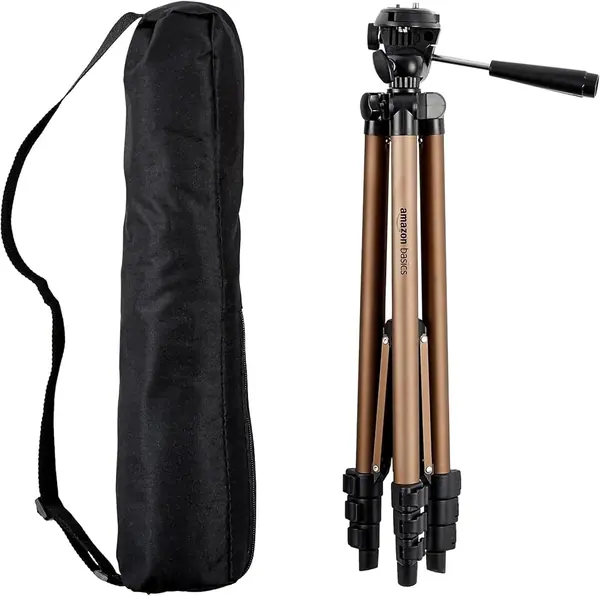
Fifty inches is where the conversation starts, because that is the ceiling: for most adults that is chest height, so you will either stoop to the finder or shoot looking down at a screen. For a group photo, a time-lapse or a phone propped for a call, that is fine. For eye-level portraits it is not, and no amount of good design fixes it.

Everything else about it is thoughtfully light. At 1.23 pounds it disappears into a daypack, folds to 16.9 inches, and uses three-section lever locks that a gloved hand can work. The head is a three-way pan-and-tilt rather than a ball, which holds a phone in portrait without drama and pans more evenly than a ball head at this weight, and there is a bubble level on the platform plus a quick-release plate small enough to leave on a compact camera.

We like it for what it refuses to be: this is not a camera tripod pretending to be a professional rig. The 4.4-pound rating is honest, the whole thing weighs about as much as a full water bottle, and it will hold a phone or a small camera steady in light that blurs a handheld shot. Keep it out of the wind and below eye level and it is the best deal here.

Pros

  • 1.23 pounds and 16.9 inches folded
  • Three-way pan head holds a phone in portrait
  • Plate is small enough to leave on a camera

Cons

  • Tops out at 50 inches, so you will stoop
  • 4.4-pound limit rules out most DSLR kits
Our verdict

For phones, point-and-shoots and light mirrorless bodies, this is the tripod we hand to casual travelers — just plan around the 50-inch ceiling.

Check Latest Price
6

SmallRig CT-10 Best for Trail and Wildlife

87 /100
TKZ Score Excellent

Key details

Weight
3.4 lb
Maximum Height
71 in
Folded Length
16.9 in
Load Capacity
33 lb
View on Amazon

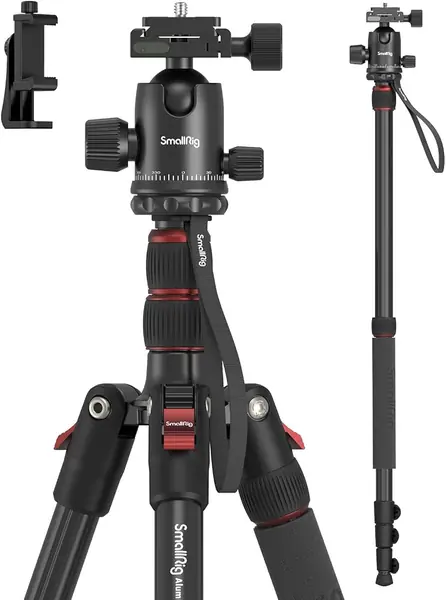
Seventy-one inches tall, 16.9 inches folded, 3.4 pounds, and a rated payload of 33 pounds: on paper the CT-10 is the strongest aluminum tripod in this group, and it is the only one that converts. Unscrew a leg, attach it to the detachable center column, and the tripod becomes a monopod.

That conversion is the reason to buy it. For wildlife, birding or a long lens on a hike, a monopod gives you support without three legs to level on a slope, and having both tools in one bag saves carrying two. We think it is worth the extra pound over the K&F if you will actually use the monopod, and not worth it if you will not.

The caution is in the hardware. The ball head can struggle to lock a camera down hard, the leg collars can loosen with use, and 33 pounds is a rating for what will not collapse, not for what stays vibration-free at 71 inches. Treat it as a light-to-medium rig, re-tighten the plate screw and the collars before a shoot, and there is a lot of tripod here for the money.

Pros

  • Converts to a monopod without extra gear
  • 33-pound rated payload on aluminum legs
  • 71 inches of height, folds to 16.9

Cons

  • Clamps and ball head can loosen with use
  • 3.4 pounds is heavy for a daypack
Our verdict

Buy the CT-10 for the monopod conversion and the 33-pound rating, then check the leg clamps and the plate screw, because those are the parts that loosen.

Check Latest Price
7

Falcam TreeRoot F38 Pro Best for Frequent Professional Setups

86 /100
TKZ Score Excellent

Key details

Weight
4.4 lb
Maximum Height
61 in
Folded Length
18.6 in
Load Capacity
11 lb
View on Amazon

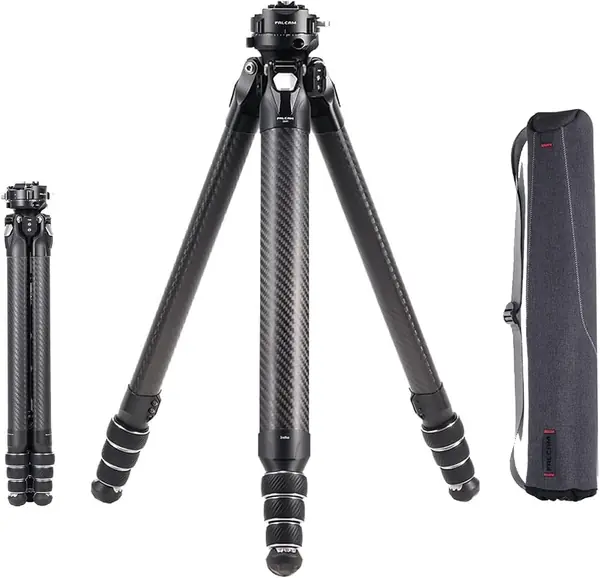
The leg collars take about a third of a turn to loosen or tighten, which sounds trivial until you have done it four times on a cold morning with a camera in one hand. Three sections, 61 inches at full height, 18.6 inches folded, and a butterfly latch that pulls the center column out without tools.

The F38 plate is the other half of the argument. It locks in one step, fits most Arca-Swiss plates, and lets you mount the camera to the clamp before the tripod is even unfolded — useful when gear moves between a gimbal, a strap and the sticks. There are F22 quick-release interfaces, quarter-inch ARRI threads and carry-strap holes, so accessories go on the legs rather than on a cage.

What it is not is light. At two kilograms it is the heaviest thing here that still counts as a travel tripod, and it is the most expensive by a wide margin. The bag is a genuine step up from the nylon sleeves the others ship with, with two pockets for long and short columns, but a good bag does not make two kilograms easier to carry up a hill.

We liked it most in the middle of a shoot, when the speed compounds: fold, lock, level, move, with no fumbling for a clamp screw. For one setup at golden hour it is overkill. The people this belongs to are the ones who notice, every single time, that the other tripods take twice as long to plant.

Pros

  • Leg collars loosen in about a third of a turn
  • F38 plate locks in one step and fits most Arca-Swiss plates
  • F22 and ARRI threads along the legs

Cons

  • Two kilograms is heavy for a hiking pack
  • Highest price here buys speed, not lightness
Our verdict

The Falcam is for working shooters: third-turn leg locks, an F38 plate and a bag built to protect, at a weight and a price that casual travelers should skip.

Check Latest Price
8

XXZU 75-Inch Camera Tripod Best for Phone-First Travel

85 /100
TKZ Score Excellent

Key details

Weight
2.2 lb
Maximum Height
75 in
Folded Length
14.4 in
Load Capacity
17.6 lb
View on Amazon

The Bluetooth remote is the giveaway: this tripod was designed for a phone in a way most of the others here were not. The clamp rotates from portrait to landscape, the remote pairs with the phone so you can start recording from across the room, and the center column detaches into a 43.9-inch monopod that doubles as a selfie stick.

For all that, it is a capable camera stand too. Seventy-five inches at full height, 14.4 inches folded, 2.2 pounds, three-section legs with three angle positions, and a ball head that pans 360 degrees and tilts 90 for overhead shots.

The head is the limit. It holds a small mirrorless body fine but starts to sag with a zoom lens hanging off the front, and the 17.6-pound rating describes what the legs will not collapse under rather than what stays sharp. Keep the camera light and the column down and it behaves.

Durability is the honest risk: the leg clips are the part that gives out, and a 2.2-pound aluminum tripod is built light on purpose. We treat it as the tripod that comes along because it is small, not the one you hand down — and for a phone-first traveler who wants 75 inches in a daypack, that is a fair trade.

Pros

  • Bluetooth remote and rotating phone clamp
  • Folds to 14.4 inches and stands 75 inches
  • Center column converts to a 43.9-inch monopod

Cons

  • Head sags with a zoom lens mounted
  • Leg clips are the first part to fail
Our verdict

If your trips are phone-first with the occasional camera shot, the XXZU's remote and 14-inch fold are hard to argue with; keep the camera light.

Check Latest Price

How We Tested the Best Travel Tripods

We built the shortlist from tripods that keep surfacing in photography forums and long stretches of retailer reviews, then filtered by folded length, weight, stated load capacity, and price so the group covered both budget aluminum and mid-range carbon fiber. We brought in 12 and lived with them for eight months, packed in carry-ons, strapped to daypacks, and set up on everything from airport carpet to granite.

Each one went through the same round of handling. We timed setup and teardown with a camera mounted, first in a living room and then on a windy overlook with a telephoto zoom attached, watching whether the head held its framing after we locked it down. We raised every center column to full extension and shot long exposures to see which ones went soft. In the field we worked city streets at dusk, hotel balconies, and crowded markets where a couple of the convertible models got switched into monopod mode.

We noted how the leg locks felt in bare hands and gloves — flip clamps against twist collars — and whether the sections still slid cleanly after a season of sand and grit. Back home we checked that quick-release plates stayed seated when we swapped bodies, that the safety stops did their job, and that Arca-type plates from different makers actually fit the clamps, along with how easily phone holders and 1/4-inch accessories went on. We also looked at each tripod after months of use, since scuffed paint and chipped anodizing tell you how it will age, and weighed what each one cost against what it delivered.

How to Choose a Travel Tripod

Packed Length Comes Before Height

The number that decides whether a tripod comes with you is its folded length. Around 14 to 17 inches it slides into a daypack or the corner of a carry-on; at 20 inches or more it rides outside the bag or stays in the room. Watch listings that call a tripod compact and then quote the folded diameter or the bag length instead — it is the most common way a travel tripod turns out bigger than expected.

For scale: the XXZU folds to 14.4 inches, the K&F 64-inch to 15.5, the Falcam to 18.6. Measure the tallest pocket in the bag you actually carry, then buy under that number rather than hoping a strap will make it work.

Weight Is a Budget You Spend All Day

Two pounds is the line we care about: below it you stop noticing the tripod on a long walk, above it you start leaving it in the room. Aluminum gets you close for very little — the K&F 64-inch is 2.5 pounds and the NEEWER Basics is 2.9 — while carbon buys back half a pound and damps vibration through the legs.

Pay for carbon if the camera stand rides on your back all day; save the money if it rides in the car. Check whether a quoted weight includes the head and bag, because some listings quote the legs alone.

Match the Rated Load to the Kit You Actually Carry

A 17- or 22-pound rating is what the legs and head will not collapse under, not what stays sharp in a breeze. The number that matters is your camera, lens and plate together, and the useful small print is the split some makers now publish: K&F rates the A225C2 ball head at 6 kg but its carbon legs for mirrorless and entry DSLR kits up to 3.3 pounds.

If you shoot a DSLR with a fast zoom, buy leg stiffness and a wide ball rather than a big number. If you shoot mirrorless, almost anything here will do.

Leg Locks Decide How Much You Fidget

Flip locks open with one gloved hand and set three legs at once, which is why most travel tripods use them. Twist locks pack a little tighter and do not snag on straps, but they ask for two hands and a clean collar every time.

The Falcam's third-turn collars are the fastest mechanism here; the K&F A225C2's twist locks are the slowest to deploy and the smallest when folded. Choose flip or quick-lock if you shoot in a hurry or in cold weather, and twist if packed size matters more than setup speed.

Heads, Plates and the Fit That Bites

Three head designs turn up here: a plain ball head, a leveling ball head and a three-way pan head. A ball head is fastest to aim; a leveling base such as the NEEWER LT32's squares a horizon on a slope but limits portrait tilt; a pan head like the Amazon Basics' is smoother for slow pans and slower for stills.

Then check the plate, because that is where a good tripod bites you. The K&F A225C2's 37mm clamp will not seat every 38mm Arca plate. Measure your L-bracket before you buy — a plate that half-seats is worse than no plate.

Frequently Asked Questions

Final Verdict

The K&F Concept 64-inch is the tripod we recommend to most travelers because it makes the fewest demands: 15.5 inches packed, 2.5 pounds on your back, and 64 inches when you need to get above a crowd. It is not the lightest or the stiffest tripod here, and it does not need to be.

Spend more only for a reason you can name. The K&F A225C2 if every ounce counts, the NEEWER LT32 if you want carbon and a leveling base, the NEEWER Basics if height matters more than weight, and the Amazon Basics if the tripod is for a phone and a point-and-shoot.