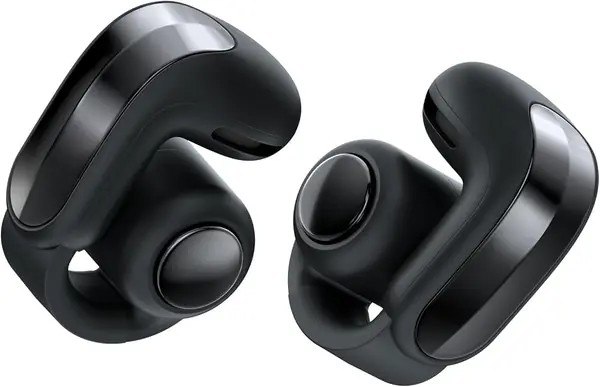
Best Sounding Open-Ear Earbuds of 2026

Open-ear earbuds are a trade: nothing goes into your ear canal, so the world stays audible while the music plays. The catch is that with no seal to work with, sound depends almost entirely on placement — a driver sitting a few millimeters off can come across thin and far away, and a pair that shifts when you pull a hoodie on loses its low end completely. Find one that sits right and stays there, and you stop thinking about your ears at all, which is the whole point.

I started wearing them on bike commutes because I got tired of pulling an earbud out at every crosswalk, and I've kept a pair within reach ever since. Over six months, my team and I have worn 12 pairs — clip-ons, ear hooks, and a few that sit somewhere between — through workouts, workdays, and far too many conference calls. Clip-ons and hooks press on completely different parts of your ear, so the one that suits you is often decided by anatomy rather than specs. The picks below are the ones we kept reaching for.

The Best Sounding Open-Ear Earbuds

1

Baseus Bowie MC2 Best Overall
90 /100
TKZ Score Outstanding

Key details

Driver
11 mm tri-magnet
Battery
11.5 hrs, 55 hrs with case
Water Resistance
IP67
Codec
LDAC
View on Amazon

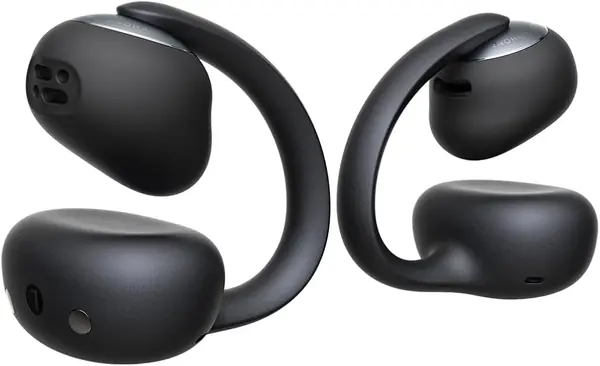
The gap between open-ear sound and a regular pair of earbuds is narrower than it used to be, and the Baseus Bowie MC2 closes more of it than anything else on this page. It is the only set here with LDAC, the higher-bitrate codec, and Baseus pairs that with a custom 11 mm tri-magnet driver seated in a memory-titanium C-ring. We got the fullest low end of any pick in this group, and it never feels like a compromise you are settling for.

Weight is where it earns the all-day half of the claim: 5.1 grams per earbud, light enough that the clip disappears behind your ear. The frame flexes without pinching, and Baseus includes M, L, and XL cushions so you can move the driver closer to your canal opening, which is exactly what an open design needs to keep any punch. Comfort held through long stretches of our testing, which is not something we can say for every hook here.

Battery is 11.5 hours on a charge and 55 with the case, and a 10-minute top-up buys roughly 3 hours. IP67 means sweat, rain, and a rinse under the tap are all fine, Bluetooth 6.0 held its pairing across rooms, and the four-mic array kept voices intelligible on a call from a busy sidewalk.

Two things to know before you order. LDAC only pays off if your phone supports it, so check that before you treat the codec as the reason to spend. And bass lives or dies on the cushion you pick — start with the largest one that stays comfortable, because that is what puts the driver where it needs to be relative to your ear.

Pros

  • LDAC hi-res audio, unique in this group
  • 11.5 hours a charge, 55 with the case
  • 5.1 g per earbud on a flexing titanium clip
  • IP67 seals out sweat and rain

Cons

  • LDAC needs a phone that supports it
Our verdict

We recommend the Bowie MC2 as the sound-first default here: the only LDAC set in the group, with 11.5 hours a charge and buds light enough to forget.
Check Latest Price
2

Soundcore V20i by Anker Best Budget

89 /100
TKZ Score Excellent

Key details

Driver
16 mm dynamic
Battery
8 hrs, 36 hrs with case
Water Resistance
IP55
Fit
Four hook positions
View on Amazon

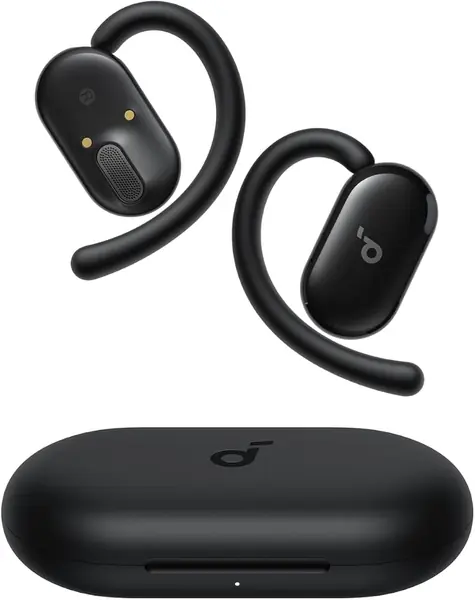
The V20i is the pair we hand to someone who wants to spend as little as possible and still be heard on a windy street. Its 16 mm drivers with titanium-coated domes are the largest stated size here, and that headroom matters: an open design bleeds energy, so the set with power to spare is the one that does not turn thin the moment traffic picks up.

The four-position hook is the detail we kept coming back to. A quarter turn changes where the pod sits against your ear, so you can move the driver closer to the canal opening instead of accepting wherever it lands. Add IP55, multipoint pairing, and 8 hours a charge with 36 in the case, and the value argument is genuinely hard to beat.

What you accept at this price is uneven long-term luck. Units that develop a silent earbud are part of the picture, and the 18-month warranty is the recourse when it happens, so registering the pair on day one is a habit worth forming. None of that undoes the math: if you want to find out whether open-ear suits you without much risk, this is the entry point.

Pros

  • The biggest stated driver here
  • Four hook positions to aim the pod
  • Multipoint and 36 hours in the case

Cons

  • Battery falls short of 8 hours for some
  • Hook pressure builds over long sessions
Our verdict

We point budget shoppers to the V20i: 16 mm drivers, four hook positions, multipoint, and the least money spent of anything on this page.

Check Latest Price
3

SHOKZ OpenDots 2 Best Premium

88 /100
TKZ Score Excellent

Key details

Driver
Dual 11.8 mm
Battery
10 hrs, 40 hrs with case
Audio
Dolby Audio
Earbuds
Interchangeable left and right
View on Amazon

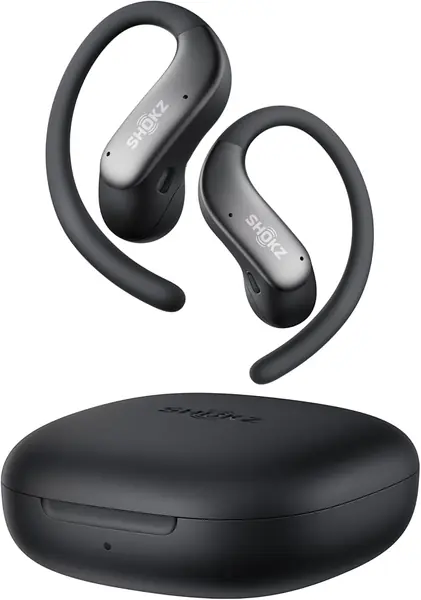
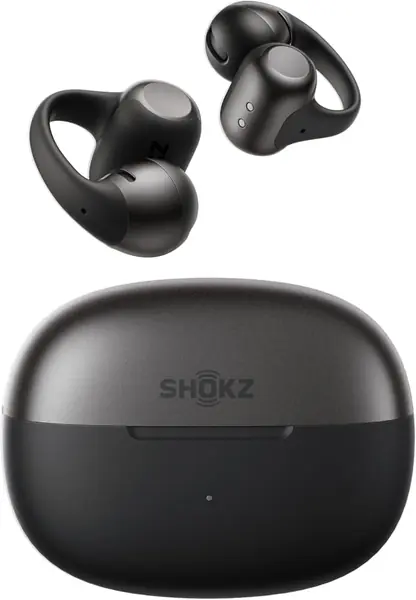
Shokz took the ear-cuff idea, gave it dual 11.8 mm drivers and Dolby Audio, and priced it near the top of this group. The OpenDots 2 is the most refined thing on this page: the case is small, the silicone is soft, the buttons are physical, and the whole set feels like it came from people who have been building ear-worn audio for a while.

The feature we love most solves a real annoyance. There is no left and no right — ear detection assigns the channel once you clip one on — so a pair that separates in a bag still works, and losing one does not end the set. Three microphones, one of them bone conduction, kept our voice clean when a truck went by.

The weak spot is stability. A single earbud that drops its connection is the failure this one runs into, and it is the reason we do not call it the default despite the best fit and finish here. Buy it for the comfort, the interchangeable buds, and 10 hours a charge; if you want the most sound for the money, our Baseus pick costs less and never made us re-pair mid-run.

Pros

  • Dolby Audio with dual 11.8 mm drivers
  • Interchangeable left and right earbuds
  • 10 hours a charge, 40 with the case

Cons

  • One earbud can drop its connection
Our verdict

We recommend the OpenDots 2 to anyone who wants the most comfortable, best-finished set here and can tolerate the occasional dropped connection.

Check Latest Price
4

Baseus Inspire XC1 Best for Calls

87 /100
TKZ Score Excellent

Key details

Driver
Hybrid two-way
Battery
8 hrs, 40 hrs with case
Water Resistance
IP66
Tuning
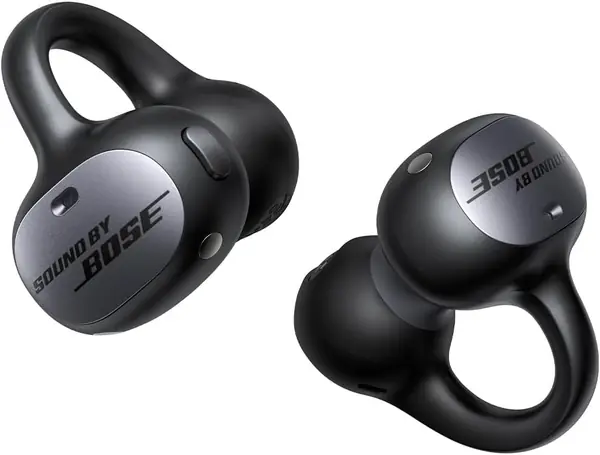
Sound by Bose
View on Amazon

If most of your listening is actually talking — standups, school pickup, the call you take walking to the train — the Inspire XC1 is the one to buy. Its four beamforming microphones with wind-noise reduction did the best job here of getting a voice through traffic, and Baseus had Bose's engineers tune the rest of the sound.

The driver setup is unusual at any price: an 11 mm dynamic woofer for low end plus a Knowles balanced-armature tweeter for detail, crossed over digitally. In practice that gives the most separated, least muddy presentation in this group, with vocals sitting on top rather than inside the bass. IP66, Bluetooth 6.1, 8 hours a charge and 40 with the case, and a 10-minute top-up for about 2.5 hours round it out.

The caveat is fit. The air cushions and ring joints need a swap or two before the pods sit where they should, and get it wrong and the sound thins out fast. The two-year warranty is the most generous here, and a single side that gives up is the failure to watch for over the first few months.

Pros

  • Sound by Bose with a hybrid two-way driver
  • Four-mic calls that cut through wind
  • IP66 and 40 hours with the case

Cons

  • Fit takes a couple of cushion swaps
Our verdict

We recommend the Inspire XC1 for anyone who takes calls in the wind and wants the clearest voice of any pick in this group.

Check Latest Price
5

Nothing Ear (Open) Best Design

86 /100
TKZ Score Excellent

Key details

Driver
Stepped dynamic
Battery
8 hrs, 30 hrs with case
Water Resistance
IP54
Fit
50-degree tilt
View on Amazon

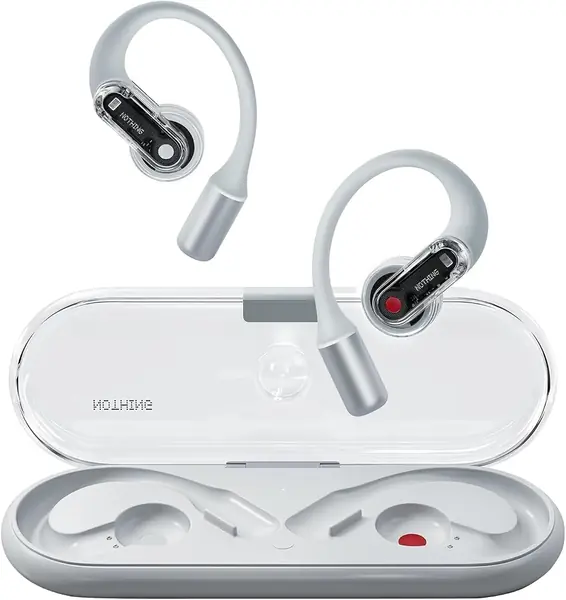
The transparent case and see-through stems are what people notice first, and that counts for something in a category where you wear the product on the side of your head. Nothing's cylinder case is the easiest thing here to drop into a pocket, and the buds sit close against the ear instead of ballooning off it.

The 50-degree tilt is the part that matters for sound. It aims the stepped driver at your canal opening rather than past it, which is why vocals arrive clearly at low volume — and why you can keep the music quiet enough that the room around you hears mostly nothing. Battery runs 8 hours a charge and 30 with the case, IP54 covers sweat, and the dual-mic setup handles calls.

Where it wobbles is fit. The hook is rigid and does not adjust, so it either lands on your ear correctly or it does not, and for the ears it does not suit this is the least forgiving pick in the group. Bluetooth 5.3 is also a generation behind everything else here. Buy it for the look and the low-volume clarity; pass if you need a fit you can tune.

Pros

  • Slim transparent case and standout design
  • 50-degree tilt keeps vocals clear at low volume
  • 8 hours a charge, 30 with the case

Cons

  • Rigid hook with no adjustment
  • Bluetooth 5.3 is the oldest here
Our verdict

We recommend the Ear (Open) to anyone who wants earbuds that look like nothing else here and does not need a fit they can adjust.

Check Latest Price
6

Shokz OpenFit Air 2 Best for All-Day Wear

85 /100
TKZ Score Excellent

Key details

Driver
Dual, 16 mm-equivalent output
Water Resistance
IP55
Bluetooth
6.1
Weight
7.2 g per earbud
View on Amazon

At 7.2 grams an earbud, the OpenFit Air 2 is among the lightest things here, and the frame is why that number translates into comfort: a 0.75 mm nickel-titanium alloy holds its shape instead of clamping down on your ear. The pod itself is narrow enough to sit behind the fold of the ear rather than on top of it.

It is also the pick we would hand to someone who genuinely forgets they are wearing earbuds. We kept a pair in through a full workday and stopped noticing them by mid-morning, which is the highest compliment this category can earn. Sound is bigger than the size suggests too, with a dual-driver setup whose output matches a custom 16 mm driver, plus IP55 and Bluetooth 6.1.

The gamble is the hook. It is fixed, so it either hugs your ear or feels like it is about to slide off, and smaller ears are where that goes wrong. When it does fit, this is the set you leave in from breakfast to dinner, and it is the cheaper of the two Shokz picks here.

Pros

  • 7.2 g per earbud with a titanium frame
  • Bass output matching a 16 mm driver
  • IP55 and Bluetooth 6.1

Cons

  • Fixed hook does not suit every ear
Our verdict

We recommend the OpenFit Air 2 to anyone who leaves earbuds in all day and wants the lightest set that still produces real bass.

Check Latest Price
7

TOZO OpenEarRing Best for Budget EQ Tinkering

84 /100
TKZ Score Excellent

Key details

Battery
10 hrs, 40 hrs with case
Fit
Clip-on
Bluetooth
5.4
Equalizer
32 app presets
View on Amazon

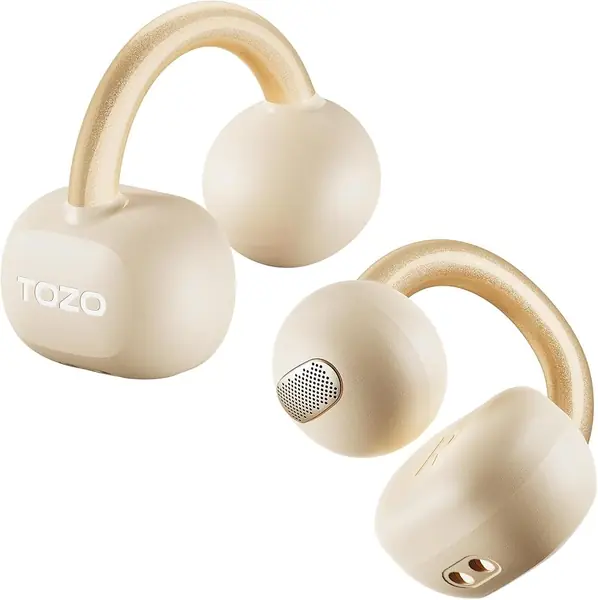
The OpenEarRing's real trick is in the app: 32 EQ presets, more tuning control than anything else on this page. Open-ear designs lose bass to physics, so being able to push the low end yourself is a fix rather than a gimmick, and it is the main reason this set sounds better than its price suggests.

Everything else is aimed at getting through a week without hunting for a charger. Ten hours on a charge and 40 with the case, a digital display that shows the level at a glance, touch controls, and an aluminum clip-on body that stayed put through a run. Bluetooth 5.4 paired quickly and held at a distance.

What gives us pause is longevity. Durability is the weakest area of any pick here — this is the set where a pair can stop holding a charge or break inside a few months — and battery and pairing vary unit to unit as well. We would not plan on handing these down.

For a gym-bag spare, a second pair for the office drawer, or a gift where you would rather not spend much, that trade is worth making. It is also the pick for someone who likes fiddling with equalizers and wants to hear what a cheap open-ear set can be talked into sounding like.

Pros

  • 32 EQ presets in the app
  • 10 hours a charge, 40 with the case
  • Clip-on body that stays put

Cons

  • Durability is the weakest in this group
  • Charging and pairing vary unit to unit
Our verdict

We recommend the OpenEarRing as a cheap second pair for anyone who wants to shape the sound themselves and does not expect years of service.

Check Latest Price
8

Bose Ultra Open Earbuds (2nd Gen) Spatial Audio

80 /100
TKZ Score Excellent

Key details

Driver
12 mm dynamic
Battery
9 hrs, 28 hrs with case
Bluetooth
5.4
Audio
Spatial with head tracking
View on Amazon

The Ultra Open Earbuds are the most expensive thing on this page, and they behave like it: a metal finish, a cuff that curves around the outside of your ear rather than sitting in front of it, and a case that feels engineered rather than packaged. Clipped on, they read as jewelry in a way the plastic hooks here simply do not.

What justifies the money, if anything does, is TrueSpatial. Head tracking and spatialized audio place the mix around you in a way no other pick attempts, and it is a genuinely different listening experience rather than just a louder one. Bose's updated 12 mm drivers also deliver more low end than the first generation managed.

The rest is ordinary in a good way: 9 hours a charge, 28 with the case, wireless charging, multipoint, and Bluetooth 5.4. Water resistance is described as water resistant with no IP number attached, so treat these as splash-safe rather than run-proof.

Here is the honest arithmetic. This is both the lowest-rated and the most expensive pick in the group, and the cuff does not land on every ear. What you are paying for is the spatial trick and the look, and for the right person that is enough. For everyone else, the money goes further elsewhere on this page.

Pros

  • Spatial audio with head tracking
  • Cuff sits entirely off the canal
  • 9 hours a charge, 28 with the case

Cons

  • Highest price in the group
  • Lowest rating in this group
Our verdict

We recommend the Ultra Open Earbuds to the listener who wants spatial audio and a piece of jewelry and is not shopping on value.

Check Latest Price

How We Tested Open-Ear Earbuds

We started by collecting every open-ear model we could find that claimed a secure fit, a real water-resistance rating, and at least a few hours of playtime per charge, then cut duplicates and anything with a pattern of connection complaints in user reviews. That left 12 pairs. Each one got a full eight-hour workday before I formed an opinion, since comfort problems only surface around hour six.

Fit was the first thing I judged: a mile run, a head shake, a beanie pulled over the top, sunglasses on, then a check of whether the driver had drifted off target and how much bass went with it. For sound I played the same three tracks on every pair — one bass-heavy, one acoustic, one spoken-word — at a desk, on a busy sidewalk, and on a bike, noting where instruments muddied and how much of the street came in over the top.

Calls were recorded on a windy corner and played back, and a colleague sat an arm's length away at 60 percent volume to confirm whether my podcast was audible to them. I paired each set with a phone and a laptop and switched between them mid-meeting to see which ones held the signal. Battery ran from full charge to shutdown on a stopwatch, then got checked against a week of real use.

Durability was unglamorous: sweat, a faucet rinse, a few knocks onto hardwood, six months of being shoved loose into a bag, and a hard look at hinge and clip construction. Value ran through all of it — a case that rattled or an app that demanded an account pulled a score down no matter how good the tuning was.

How to Choose Open-Ear Earbuds

Why Open-Ear Bass Is a Design Problem

An open-ear driver fires at your ear without sealing it, so low frequencies escape before they arrive. The fix is mechanical rather than digital: a clip or cuff that curves over the canal opening, cushions that let you seat the pod closer, or an app equalizer that puts back what physics takes. Our top pick ships with three cushion sizes for exactly this reason, and the Nothing Ear (Open) uses a 50-degree tilt to aim its driver at the canal mouth.

If bass is your first priority, choose the shape that sits closest and give yourself a week to adjust it before you decide the sound is thin. Of the open-ear headphones we tested, the ones that let you change the seating position were consistently the ones we could live with.

Hooks, Clips, and Cuffs: Pick by Ear and by Day

Hooks wrap behind the ear and stay put through sprints. Clips pinch the outer ear and nearly disappear. Cuffs curve around the whole ear and look the most like jewelry. Hooks are the most secure for running, clips are the least fussy to put on, and cuffs usually sit furthest from the canal.

The practical question is pressure over hours, not grip. A hook that clamps will hurt by hour three and a clip that fits loosely will drift when you bend down, so if you plan to wear a set for a whole shift, favor the design you can leave alone rather than the one that holds hardest.

Codecs Only Matter If Your Phone Agrees

High-bitrate codecs need support at both ends. Android flagships usually offer LDAC; iPhones do not. If you are on iOS, the money you would put toward a hi-res badge is better spent on fit and battery, and our top pick still earns its place on comfort and runtime with the codec switched off.

Check your phone's Bluetooth audio settings before you buy anything because a codec is printed on the box. Detail matters most at low volume in a quiet room; on a windy sidewalk, driver size and a good seal against your ear shape do far more for the sound.

The Per-Charge Number Is the One You Live With

Case totals are marketing; the single-charge figure is your actual day. Eight hours covers a workday plus a commute, six covers the gym and the walk home, and anything under four means the case is coming with you everywhere. A ten-minute top-up that buys hours, as the Baseus picks do, is more useful than a bigger case you forget to plug in.

Look at hours per charge first and the case total second, then at quick charging. If you travel, the case size matters as much as the number, because a set that lives in a jacket pocket is one you actually carry.

Calls, Controls, and What Your Hands Are Doing

A four-mic array with wind reduction is the difference between a call and a guessing game, and it is the one feature worth paying up for if you work on the move. Controls matter just as much: touch panels misfire under a beanie or a wet thumb, while buttons need a press that pushes the earbud against your ear.

Decide which annoyance you can live with. Runners and cyclists tend to want buttons they can find blind; anyone who listens in gloves will hate a touch panel by February.

Frequently Asked Questions

Final Verdict

The Baseus Bowie MC2 is the pair we point most people to. It is the only set here with LDAC, it runs 11.5 hours a charge at 5.1 grams an earbud, and it is rated for the kind of sweat and rain that ends cheaper pairs. That combination is the whole promise of an open-ear design, delivered without asking you to give up bass or comfort.

Spend less and you give up codec support and some low end; spend more and you are buying fit and finish, or spatial audio, rather than better sound. If your day is mostly calls in the wind, the Baseus Inspire XC1 is the step up that makes sense.