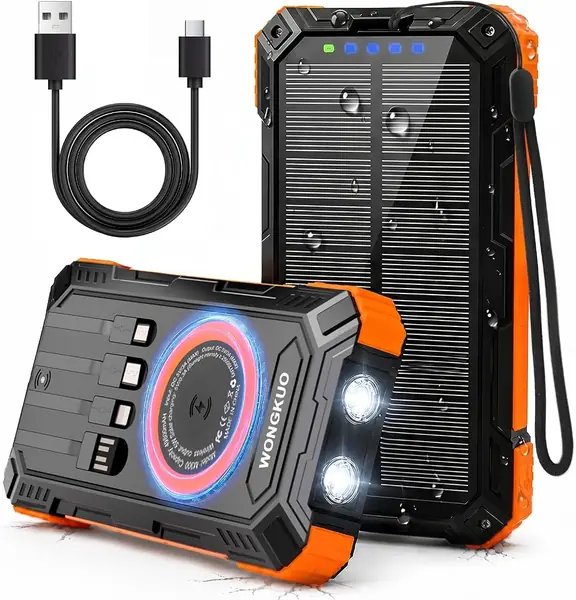
Best Solar Phone Chargers of 2026

The first time a solar panel is your only option, you learn what the spec sheet leaves out: a palm-size panel is a trickle, not a rescue. Three days of full sun can refill a battery you drain in an afternoon. What actually matters is how fast it refills a dead phone, whether the cables are built in, and whether it survives a season in a backpack.

I've carried one on every camping trip for years, and watching a percentage tick up on a ridge never gets old. Over the past five months, my team and I ran 14 solar chargers through backyard afternoons, a wet weekend at a campsite, a week of commutes, and a two-day outage at home. The differences were not subtle.

One thing to know before you buy: wireless charging on these banks is convenient but slow and fussy about placement, and claimed capacities rarely translate into matching real-world charges. Below are the ones I'd hand a friend before a trip, chosen for power you can count on, not panel count.

The Best Solar Phone Chargers

1

FEELLE Solar Power Bank 50,000mAh Best Overall
89 /100
TKZ Score Excellent

Key details

Battery Capacity
50,000 mAh
Wireless Charging
15W magnetic
Solar Setup
4 panels plus hand crank
Charging Outputs
4 cables, 3 ports
View on Amazon

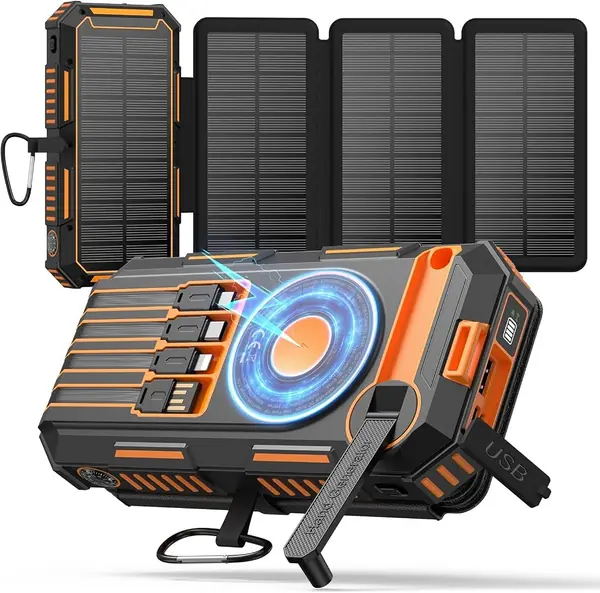
The four-panel array and hand crank are what make the FEELLE the most convincing solar power bank in this group. With 50,000mAh, four built-in cables, and a 15W magnetic wireless pad, it is built to keep several devices going on a weekend away rather than just top up one phone. We like that the panels fold out together; that larger solar surface is the reason it earns the top spot.

The panel array is still a top-up, not a wall-charger replacement, so we start every trip with the bank full. The cable set covers USB-C, Lightning, micro-USB, and USB-A, which meant one less pouch in the bag. The magnetic pad is the feature we value most at night: a compatible phone snaps into place without hunting for a cable.

The hand crank is a last-resort tool, not a routine charger; we treat it as insurance for the day the sun never appears. Our advice is to fill it from the wall before you leave and let the four panels stretch the charge. That is how the design earns its keep, and it is why this is the bank we choose when several people share one power source.

Pros

  • Four solar panels plus hand crank
  • 50,000mAh for shared charging
  • Built-in cables and magnetic wireless

Cons

  • Heavy at 0.5 kg for backpacking
Our verdict

The FEELLE earns our top spot because four panels, a hand crank, and 50,000mAh make it the most credible off-grid bank here.
Check Latest Price
2

SOARAISE Solar Power Bank 50,000mAh Best for Fast Charging

88 /100
TKZ Score Excellent

Key details

Battery Capacity
50,000 mAh
Max Output
22.5W
Wireless Charging
15W
Built-in Cables
2 cables, 3 ports
View on Amazon

The SOARAISE has the highest stated wired output in this group: 22.5W USB-C PD, plus a 15W wireless pad. For a 50,000mAh bank, that is the difference between a slow overnight top-up and a quick charge before you leave the tent.

We think it is the best high-capacity bank for someone who cares more about charging speed than solar surface area. The FEELLE has more solar panels; the SOARAISE has the quicker plug-in charge and a cleaner wireless setup. It also powers six devices at once through two built-in cables and three ports, which matters when a family shares one battery.

The flashlight, compass, and thermometer make the outdoor-kit pitch feel less decorative than it sounds. We were surprised by the thermometer, but it is the kind of detail that makes the bank feel designed for a pack rather than a desk. The built-in Lightning and USB-C cables cover the two phones most people carry, and the extra ports handle a tablet or earbuds. Treat the wireless pad as a nightly convenience; a cable is still the efficient way to recharge a phone from a bank this size.

Pros

  • 22.5W USB-C fast charging
  • 15W wireless pad
  • Two built-in cables plus three ports

Cons

  • 16-ounce body is heavy for daily carry
Our verdict

For fast phone charging from a high-capacity bank, the SOARAISE is our pick: 22.5W wired and 15W wireless are the quickest claims in this group.

Check Latest Price
3

SolarTred Solar Power Bank 20,000mAh Best Waterproof Four-Panel

87 /100
TKZ Score Excellent

Key details

Battery Capacity
20,000 mAh
Weight
1.63 lb
Solar Setup
4 integrated panels
Water Resistance
IP67
View on Amazon

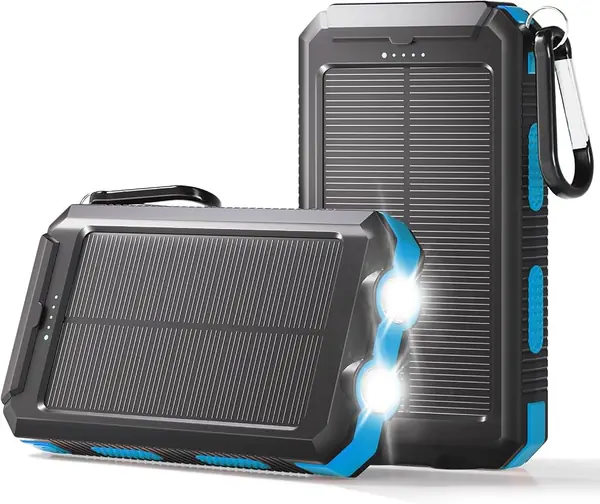
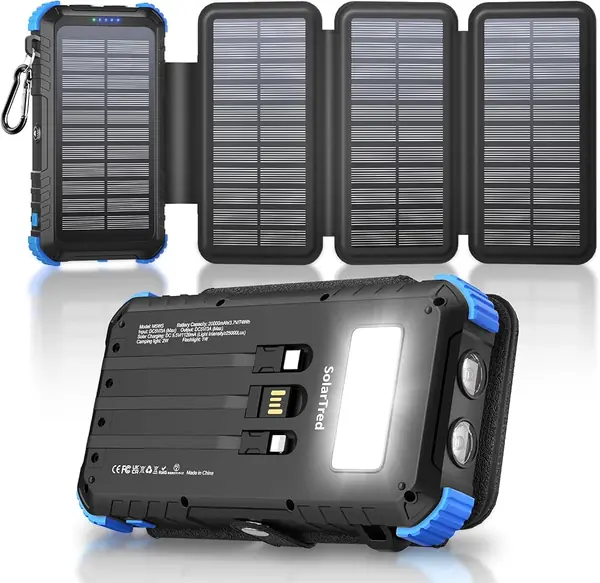
The SolarTred is the weatherproof one: four integrated solar panels, an IP67 body, and a 20,000mAh battery. That combination is rare in this group, where most banks have a single panel and a splash rating at best. At 20,000mAh, it sits between the pocket banks and the 50,000mAh models.

We like the four-panel design for a simple reason: more panel area means more chances to collect sun when the light is not perfect. The panels fold into the body rather than hanging loose, so there is less to snag in a pack. The built-in USB-C, Lightning, and USB-A input cable cover common phones without a tangle, and the camping light and dual flashlight are useful around a tent.

This is the pick for wet, messy trips where a sealed body matters more than maximum capacity. The 20,000mAh battery means fewer full phone charges than the big banks, but it is enough for a solo phone over a long weekend. We treat the four panels as a genuine top-up source, not a replacement for a wall charge. The IP67 rating is the reason it stays in the set: it is the only power bank here with that sealed body and four integrated panels.

Pros

  • Four integrated solar panels
  • IP67 dust and water protection
  • Built-in USB-C, Lightning, and USB-A cable

Cons

  • Weighs 0.74 kg despite the 20,000mAh battery
  • 20,000mAh limits group charging
Our verdict

Choose the SolarTred if wet weather is likely; its IP67 body and four integrated panels make it the most weather-ready power bank here.

Check Latest Price
4

GEYOTO 35W Solar Panel Charger Best Direct Solar Panel

86 /100
TKZ Score Excellent

Key details

Max Output
35W
Water Resistance
IP68
Folded Size
4.76 x 8.29 x 1.57 in
Solar Efficiency
26%
View on Amazon

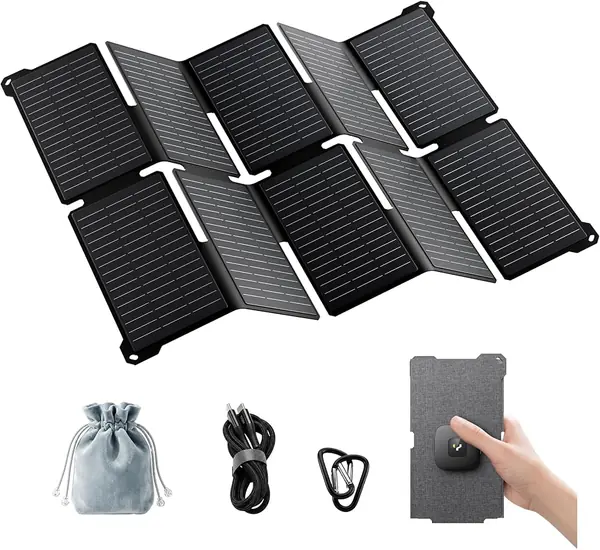
The GEYOTO has no battery, and that is the point. It is a 35W foldable panel with USB-C and USB-A outputs, 26% monocrystalline cells, and an IP68 laminated surface. It turns sunlight into phone power directly, which makes it the most honest solar charger in this group.

We like that it folds to 4.76 x 8.29 x 1.57 inches and weighs 1.54 pounds; it disappears into a daypack until you need it. The dual ports let you charge a phone and a power bank at once. The trade-off is obvious: when the sun goes, charging stops, so we pair it with a battery for anything beyond a day hike.

Use it to charge a power bank during the day, then charge the phone at night; that is the pattern that makes a panel this size useful. A foldable panel is not a replacement for a charged bank; it is the thing that keeps the bank from dying on a long trip. For backpackers who want true sun-to-phone charging, this is the specialist to pack.

Pros

  • 35W USB-C and USB-A output
  • 26% monocrystalline efficiency
  • IP68 and 1.54-pound folded body

Cons

  • 35W output is shared between both ports
Our verdict

We like the GEYOTO for backpackers who want true sun-to-phone charging, provided they carry a battery for clouds and evening.

Check Latest Price
5

YELOMIN Solar Power Bank 38,800mAh Best Budget High-Capacity

85 /100
TKZ Score Excellent

Key details

Battery Capacity
38,800 mAh
Weight
9.9 oz
Ports
2 USB-A, 1 USB-C
Dimensions
5.9 x 2.95 x 0.98 in
View on Amazon

At 9.9 ounces, the YELOMIN is the easiest high-capacity bank in this group to toss in a daypack. It pairs a 38,800mAh rating with three outputs, dual LED lights, and a carabiner. That is a lot of claimed capacity for the weight, and the carabiner makes it easy to hang inside a tent. The 5.9 x 2.95 x 0.98-inch body still fits a side pocket.

We think it is the budget pick for a reason: you get a lot of stated capacity for the money, and the dual LED modes—steady, strobe, and SOS—are more useful than a single flashlight. The solar panel is a backup trickle, not a reason to leave the wall charger at home. The carabiner is simple, but it makes the bank easy to hang.

The 9.9-ounce figure is the number that sold us; it is light enough to carry on a day hike without negotiating. We treat the capacity as a weekend reserve, not a week-long group battery. If you want maximum stated capacity for the least weight, this is the one.

Pros

  • 38,800mAh at 9.9 ounces
  • Three outputs and carabiner
  • Dual LED with SOS and strobe

Cons

  • Solar charging is a slow top-up
Our verdict

The YELOMIN is the budget high-capacity pick we reach for: 38,800mAh and a 9.9-ounce body make it easy to carry and easy to justify.

Check Latest Price
6

Etsuati Solar Power Bank 20,000mAh Best Built-In Cables

84 /100
TKZ Score Excellent

Key details

Battery Capacity
20,000 mAh
Max Output
20W
Built-in Cables
4 cables
Recharge Time
3.8 hours
View on Amazon

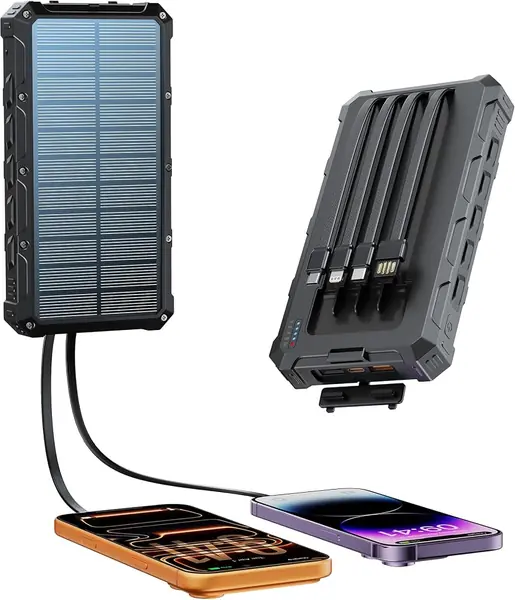
The Etsuati's four built-in cables are the reason it earns a spot: Micro USB, USB-C, Lightning, and USB-A are attached, so there is no pouch of cords to lose. The 20,000mAh battery, 20W output, and 3.8-hour wall recharge make it a practical travel bank rather than a basecamp brick.

We like it for travel because the auto-on charging is genuinely hands-free: connect a device and it starts, with no button to hunt for. The built-in cables cover the phones most people carry, and the extra ports handle a second device or earbuds. It is the bank we reach for when the bag is already full. The 6.89 x 3.74 x 0.99-inch body is flat enough for a laptop sleeve.

The solar panel is the backup, not the main event; this is a bank you charge from the wall before you go. The 20,000mAh capacity is the trade-off for the compact body, so it is best for a solo traveler or a couple rather than a group. For that role, the balance is right.

Pros

  • Four built-in cables
  • 20W fast charging
  • 3.8-hour wall recharge

Cons

No notable drawbacks to flag.

Our verdict

Our travel pick is the Etsuati, because four built-in cables, 20W output, and a 3.8-hour recharge cut the cord clutter.

Check Latest Price
7

BLAVOR Solar Power Bank 10,000mAh Best Compact Wireless

83 /100
TKZ Score Excellent

Key details

Battery Capacity
10,000 mAh
Max Output
20W USB-C
Wireless Charging
Qi
Weight
9.3 oz
View on Amazon

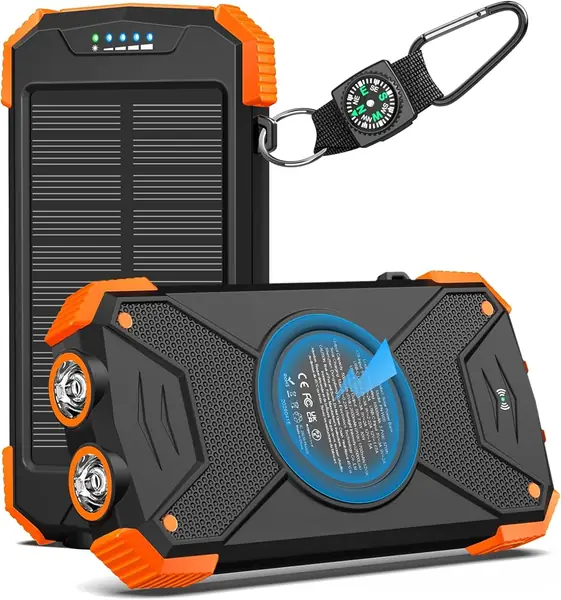
The BLAVOR is the pocket option: 10,000mAh, 9.3 ounces, and a Qi wireless pad on the back. It is small enough to live in a purse or glovebox, and the dual flashlights make it more useful than a plain battery in a power outage.

We like the 20W USB-C output for a quick top-up, and the IPX5 body handles rain or a splash at the edge of a campsite. The wireless pad is the feature we use most: a compatible phone sits on the back without a cable, which is handy when you are moving between the car and a tent.

The solar panel is there to slow the drain, not refill the bank; we charge it from the wall before a trip and let the sun add a little when it is sitting out. The 10,000mAh capacity is a reserve for one phone, not a group.

What we appreciate most is the honesty of the design: it does not pretend to be a solar workhorse. For a compact emergency bank with wireless charging, that is enough.

Pros

  • Pocketable 9.3-ounce body
  • Qi wireless charging
  • 20W USB-C and dual flashlights

Cons

  • 10,000mAh limits multi-day use
Our verdict

The BLAVOR is the compact wireless bank we keep in a purse or glovebox; it is not the one for a week off-grid.

Check Latest Price
8

wongkuo Solar Power Bank 49,800mAh Budget Big-Capacity

81 /100
TKZ Score Excellent

Key details

Battery Capacity
49,800 mAh
Wireless Charging
Qi
Built-in Cables
4 cables
Charging Standard
QC 3.0
View on Amazon

The wongkuo packs a 49,800mAh battery, QC 3.0 charging, Qi wireless, and four built-in cables into a body that costs less than the premium banks here. On paper, it is the value play of the group.

We like the built-in cables and wireless pad for family use: a passenger can drop a compatible phone on the pad while another device uses a cable. The 5.7 x 3 x 0.67-inch body is flat enough to slide into a laptop sleeve, and the three-year warranty is longer than most.

The 49,800mAh rating is a big claim, so we treat it as a reserve for a car or cabin rather than a guarantee of a week of power. The feature set is broader than the price suggests, which is why it stays in the roundup.

What we like most is the simplicity of the kit: four cables, Qi, and a big battery without a separate pouch. It is not the bank we choose for a week in the backcountry, but it is a sensible budget reserve for a vehicle or a cabin.

Pros

  • 49,800mAh and QC 3.0
  • Qi wireless and four built-in cables
  • Three-year warranty

Cons

No notable drawbacks to flag.

Our verdict

We see the wongkuo as a budget reserve for a car or cabin: four cables, Qi charging, and a big battery without a premium price.

Check Latest Price

How We Chose and Tested Solar Phone Chargers

We started with research: every solar charger we could find that claimed at least 20,000mAh, offered built-in cables or a wireless pad, and published an actual output wattage. Listings without a waterproofing claim, or with a pattern of reviewers reporting swollen batteries, got cut. That left 14 models, which we bought at retail so no brand could send us a ringer.

Testing ran five months, from spring into fall. The chargers lived where they'd really live: a backyard table in July sun, a rainy weekend at a campsite, a week of commutes split between a jacket pocket and a car's center console, and a two-day outage at home when the wall sockets were useless.

We drained each bank to zero, timed how long it took to bring a dead phone to 50 percent, and counted how many full charges it delivered before quitting — the number that actually predicts usefulness. To judge the panels honestly, we set each charger outside at 9 a.m. and logged its readout every hour until 5, which separated the panels that do something from the ones that are decoration. Wireless pads were tested with a case on, then nudged an inch to see whether the connection held.

Durability got the clumsy treatment: two waist-high drops onto concrete, dusty ports, rain, and repeated yanks on the built-in cables, a common failure point. We weighed each one packed and ready, since portability is the entire point, and kept notes on which banks lost capacity or stopped holding a charge by month five. Value came down to cost per usable charge, not cost per claimed milliamp hour.

How to Choose a Solar Phone Charger

Start With the Panel, Not the Battery

A built-in solar panel on a power bank is a top-up tool. The panel is small, so a sunny day adds charge slowly; plan to fill the bank from a wall outlet before a trip and let the sun stretch it. A folding panel such as the GEYOTO 35W is a different tool: it turns sunlight into USB power directly, with no reserve for clouds or evening. Choose the built-in panel for overnight backup and the folding panel for daytime charging on the trail.

Match Capacity to the Weight You Will Carry

Capacity and weight rise together, and the right balance depends on how far you carry the bank. A 10,000mAh model like the BLAVOR is a pocket or purse reserve; a 20,000mAh bank like the Etsuati suits a daypack and a phone plus a tablet; a 38,000-50,000mAh model like the FEELLE or YELOMIN is a basecamp battery you share. Do not read the mAh number as a promise of full phone charges—conversion losses and phone battery size eat into it, and a bigger number is not automatically better for a hike.

Check Output Power and Cable Clutter

For a phone, 20W USB-C is a sensible floor, and 22.5W like the SOARAISE is the quickest stated output here. Built-in cables are a real travel convenience: the Etsuati carries four, so you can skip a pouch of cords. Wireless charging is handy at night but slower and less efficient than a cable; use it for convenience and keep a cable for the fastest top-up. More ports help only if you are willing to carry the extra weight.

Look for a Rating, Not Just a Waterproof Claim

Waterproof is a marketing word until it comes with an IP rating. IPX5 handles splashes; IP67 and IP68 add dust protection and survive a dunk. The SolarTred's IP67 body and the GEYOTO's IP68 panel are the clearest wet-weather choices here. Also weigh the emergency extras: a flashlight is useful, a hand crank is insurance, and a compass is a bonus. Buy for the conditions you actually expect, not for every badge on the box.

Frequently Asked Questions

Final Verdict

The FEELLE is the one we recommend first for solar-first trips: four panels, a hand crank, and 50,000mAh give it the most ways to keep several devices alive when the grid is gone. If fast phone charging matters more than panel area, the SOARAISE is the quicker high-capacity bank; if you want to charge directly from the sun without a battery, the GEYOTO 35W panel is the specialist to pack.