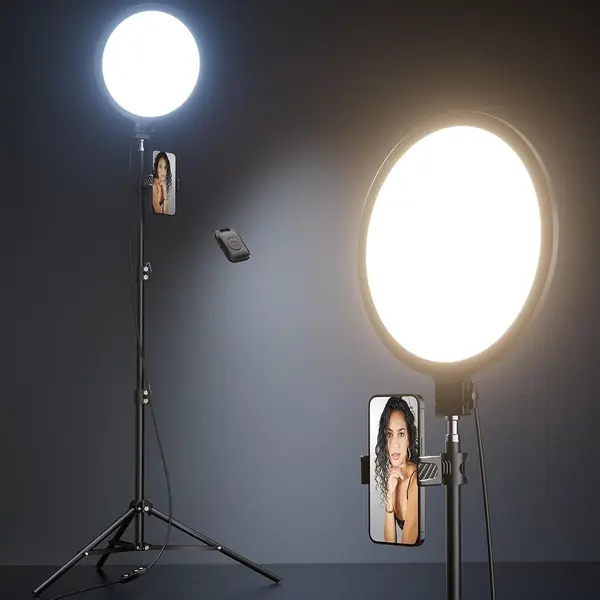
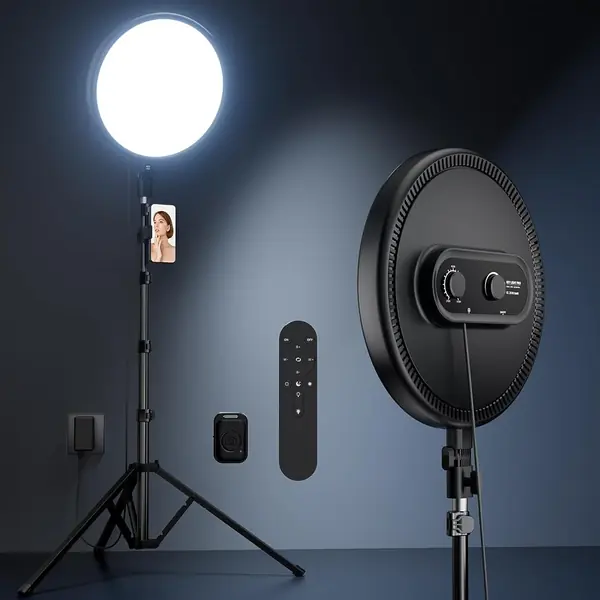
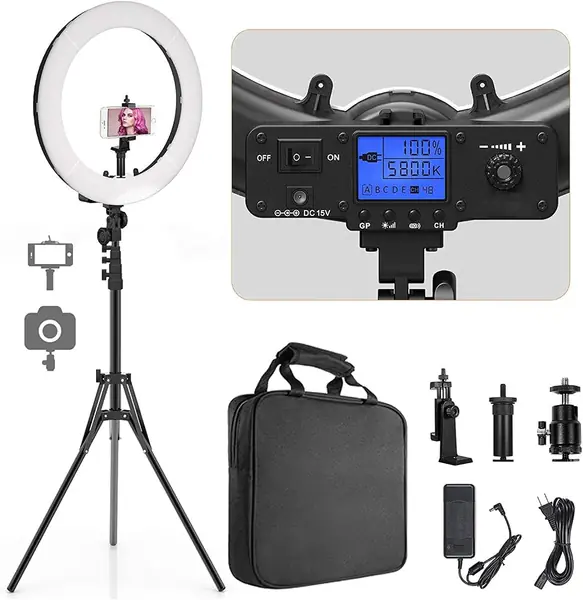
Best Ring Lights for Photography of 2026

A ring light is supposed to make a face look even and bright, but a bad one can make skin look flat, orange, or lit by a flickering office fluorescent. The stand is usually the first giveaway: if it wobbles when you tap the phone, you will spend more time adjusting it than shooting. I’ve spent the past six months using 12 ring lights—from compact desk models to larger studio kits—at a makeup vanity, on a desk for video calls and livestreams, and on a few weekend portrait shoots.

The better ones shared a few traits: brightness that dims smoothly, color temperature that shifts without turning skin gray or magenta, and a stand that stays put when you angle the ring. I also learned to check the phone holder and remote before the light itself; a beautiful beam is useless if your phone droops mid-take. What follows are the ones I’d actually keep plugged in, chosen for lighting quality, adjustability, stability, and value rather than sheer wattage.

The Best Ring Lights for Photography

1

EOTO 18-Inch Ring Light Best Overall
94 /100
TKZ Score Outstanding

Key details

Diameter
18 in
Color Temperature
2900–6500K
Stand Height
22.8–69 in
Color Rendering
CRI 90
View on Amazon

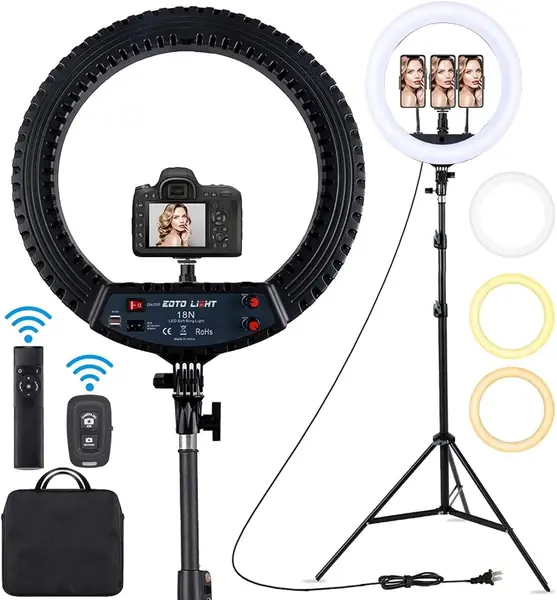
Three hot shoe ports is the detail that settled this one for us. The EOTO is an 18-inch ring — the size where a ring light stops being a webcam accessory and becomes a real source for portraits and product shots — and those three shoes hold two phones and a small camera at once. Add bi-color output running from 2900K to 6500K with no filter to swap, and it handles a warm lamp-lit room and cool daylight without a compromise.

The rest of the kit aims at the same buyer. The aluminum tripod runs from roughly 23 inches to 69, so it sits on a desk for a product shot and stands behind a chair for a head-and-shoulders portrait. Two USB charging ports on the back keep the phone you are shooting with alive through a long session, and you get both a Bluetooth shutter for the camera and an IR remote for the light, which means fewer walks back to the screen. CRI 90 trails the top of this group; it holds up for faces and video, and it is the number to trade up for only if you photograph merchandise for sale.

The physics of the shape is the other thing to know: an 18-inch ring close to a face throws its own ring into the eyes at close range, so back it off and turn it up when you want a clean reflection. That is the trade against a full-screen panel, and for portraits we take it — the hollow center is also what lets you put a camera in the middle and shoot straight through it.

Pros

  • 18-inch ring gives soft, even light
  • Bi-color 2900–6500K without color filters
  • Three hot shoe ports and two USB charging ports

Cons

  • Stand gets top-heavy near full height
Our verdict

For most people shooting portraits, products, or video at home, this is the ring light we recommend first: 18 inches of bi-color light and mounts for two devices.
Check Latest Price
2

NEEWER RL-18 Ring Light Kit Best for Studio Work

93 /100
TKZ Score Outstanding

Key details

Diameter
18 in
Color Temperature
5600K
Stand Height
61 in
Power
55W
View on Amazon

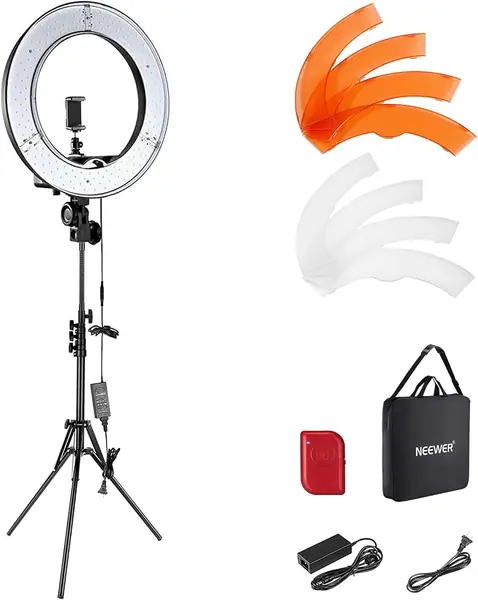
Fifty-five watts through an 18-inch ring is the highest output in this group, and you feel it the moment the room is not dark enough. Where the 10- and 12-inch lights have to run at full and start to look harsh, the RL-18 has headroom — it will light a corner of a room and still leave you somewhere to go on the dial. That is why it turns up in makeup, lash, and tattoo work, and why we reach for it over the smaller rings for anything shot from more than a few feet away.

The kit is what makes this a working light rather than a desk accessory: a 61-inch aluminum stand, a soft tube that lets the head swing to almost any position, white and orange filters, a ball-head hot shoe adapter for a DSLR, a phone holder, and a bag. That is a starter studio in one box, and it is the reason we call this the studio pick rather than just the brighter one.

The trade-off is fixed color. 5600K is daylight and nothing else; the orange filter gets you toward tungsten, but a filter costs you output and you cannot dial a value the way you can on the bi-color lights here. In a studio with one consistent setup that is a non-issue, and the rest of the kit is good enough that we forgive it. Matching the warm lamp in someone's living room at eight in the evening, it is the wrong tool.

Pros

  • Brightest output in this set at 55W
  • Soft tube, filters, bag, and camera shoe included
  • 18-inch ring lights a whole corner of a room

Cons

  • Fixed 5600K; filters instead of a color dial
  • Stand and phone holder are the weak points
Our verdict

Buy the RL-18 when output is the whole point: 55 watts through an 18-inch ring is the brightest kit here, and the bag and soft tube make it a light you can take places.

Check Latest Price
3

UBeesize 12-Inch Ring Light Best Budget Pick

90 /100
TKZ Score Outstanding

Key details

Diameter
12 in
Stand Height
62 in
Output
930 lumens
Color Modes
5
View on Amazon

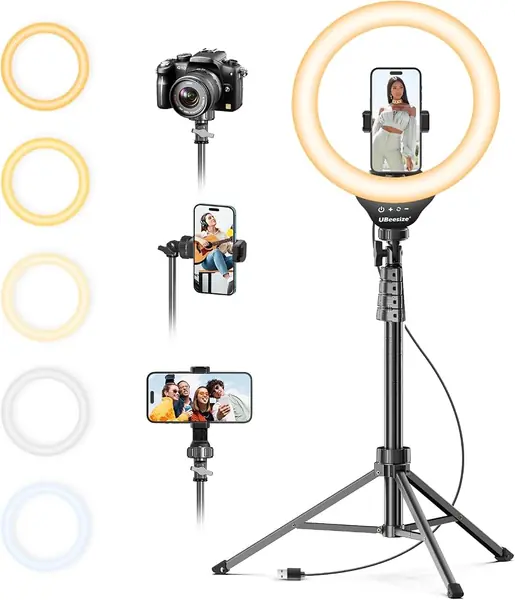
The lowest price of any full-size light here still buys a complete kit: a 12-inch ring with 240 LEDs, a 62-inch tripod that unscrews into a handheld selfie stick, a phone holder that rotates through 360 degrees, a Bluetooth shutter, and the USB adapter in the box, so nothing else has to be bought before the first shoot. We recommend it to anyone who wants to find out whether ring lighting suits them before spending real money on the question.

The touch panel is the detail we appreciate most. Five color modes and ten brightness steps are adjusted on the face of the ring, where you can see what you are doing, instead of on a rocker halfway down the power cord. At 930 lumens it is bright enough for a bedroom or a small studio corner, and 1.2 pounds for the whole thing means it goes in a bag without a second thought.

Where it gives ground is reach. Twelve inches is a close light: at three or four feet it wraps a face nicely, and by the time you are shooting a standing subject across a room it has run out of coverage no matter what the dimmer says. That is the honest boundary of a light this size, and at this price it is a boundary worth accepting.

Pros

  • Complete full-size kit at the lowest price here
  • Five color modes and ten steps on a touch panel
  • Tripod converts into a handheld selfie stick

Cons

  • Tips forward when the head is tilted with a phone mounted
Our verdict

The one we hand to a first-time buyer: a complete 12-inch kit for less than any other full-size light here, as long as you keep the head level and the stand low.

Check Latest Price
4

Weilisi Full-Screen Ring Light Best Soft Light for Faces

89 /100
TKZ Score Excellent

Key details

Diameter
10.5 in
Color Temperature
3000–6000K
Stand Height
39–69 in
Brightness Steps
10
View on Amazon

The face of this light is a full-screen panel rather than a narrow band of LEDs, and that is the whole reason to consider it. Spreading the emitters across a wider surface gives softer, more uniform output and a bigger pool of light from the same distance — the difference between a light that flatters a face and one that leaves a hotspot across a forehead. For talking-head video and selfies, that softness is worth more than another hundred lumens.

The stand surprised us. It is aluminum, it runs from 39 to 69 inches, which covers a seated desk setup and a standing one without an extension, and the collars tighten down hard enough to hold height with a phone mounted. Assembly takes a couple of minutes, the wireless remote fires the phone for stills and video, and the two-year warranty is longer than most here.

Color runs from 3000K to 6000K across ten brightness steps, and the range is the useful part — warm enough to sit inside a lamp-lit room, cool enough for daylight, with no filter to lose along the way. Where it stops is reach: a panel this size is a close-quarters light, lovely at three feet and thin across a room, which is the boundary of the design rather than a fault.

Pros

  • Full-screen panel gives softer, more even light
  • Aluminum stand runs 39 to 69 inches
  • Wireless remote and a two-year warranty

Cons

  • Long-term reliability is still unproven
Our verdict

Pick this for talking-head video and selfies where you want soft, even light on a face and a stand tall enough to get above eye level.

Check Latest Price
5

Weilisi 13-Inch Ring Light Best for Full-Length Shots

87 /100
TKZ Score Excellent

Key details

Diameter
13 in
Color Temperature
2700–6500K
Stand Height
72 in
Color Rendering
Above 95
View on Amazon

Seventy-two inches is the number that separates this from the rest of the group. Stand height decides what you can frame, and at 72 the head sits above a standing adult — what you need for full-length shots, a pair of people, or a light placed above the eyeline and out of the frame. The stands here mostly stop between 61 and 70 inches, and the gap shows up exactly where you would notice it, at the bottom of a photograph.

Behind that stand is a 13-inch full-screen panel with CRI above 95, dimming from 1 to 100 percent, and three color temperatures from 2700K to 6500K. 8700 lux at 0.3 meters is serious output for a fixture this shape, which is what gives you the option of backing it off to six feet for a softer wrap and still keeping brightness in reserve. The head tilts 180 degrees, the phone holder turns a full circle, and neither adjustment needs a tool.

What sold us is the pairing: a tall stand and a big, color-accurate panel in one kit, which is normally where the price jumps into studio territory. It does not jump here. The three-year warranty is the longest in this guide, and on a light that lives on a stand in a corner and gets knocked twice a week, that is not a small thing.

Pros

  • 72-inch stand puts the light above a standing subject
  • CRI above 95 with 1–100% dimming
  • Three-year warranty, the longest here

Cons

  • Phone holder stops at 3.74 inches
Our verdict

The one to buy for full-length frames or two people at once: 72 inches of stand under a 13-inch full-screen panel with CRI above 95.

Check Latest Price
6

Evershop Overhead Ring Light Best for Overhead Flat-Lays

76 /100
TKZ Score Very Good

Key details

Diameter
10 in
Color Rendering
Above 95
Max Height
70.8 in
Lighting Settings
30
View on Amazon

This is the one light here built to shoot straight down. The arm cantilevers off a floor stand with the ring and the phone holder riding the same bracket, so you can swing both out over a tabletop — the setup you want for filming your hands at cooking, crafts, repairs, or flat-lay product shots. No desk clamp, no tripod legs in the frame, no stack of books holding a phone.

Thirty lighting settings — three color temperatures by ten brightness steps — and CRI above 95 make it a better light than the shape and the price suggest. The base is a thickened 4-millimeter disc rather than a tripod, so it sits flat and takes less floor than splayed legs, and the stand reaches 70.8 inches, which is what lets the arm clear a table without craning.

The arm is where our confidence drops. It is a flexible bracket, and the heavier the phone the more it wants to droop and drift out of the position you set, so weekly flat-lay shooting means fighting that drift between takes. Occasional overhead work means living with it happily instead, and at this price that is a lot of capability for the money.

Pros

  • Only pick here that shoots straight down
  • CRI above 95 across 30 lighting settings
  • Disc base takes less floor than a tripod

Cons

  • Mount is not rated for heavy cameras
Our verdict

Choose the Evershop if your work happens on a tabletop and you need the camera looking straight down at it.

Check Latest Price
7

NEEWER R06 2-Pack Ring Lights Best for Desk and Calls

75 /100
TKZ Score Very Good

Key details

Diameter
7 in each
Color Temperature
3000–6500K
Color Rendering
Above 95
Height Range
23.5–33.1 in
View on Amazon

Two lights instead of one is the whole pitch, and it holds up. Cross-lighting a face from both sides at about 45 degrees kills the shadow under the nose and the shine on a forehead that a single ring exaggerates, and it does it without the harshness of one bright source straight on. At 7 inches across, neither of these will light a room — but as a matched pair on a desk, they are a small studio.

Each is 84 LEDs at 10 watts with CRI above 95 and five color temperatures from 3000K to 6500K, stepped rather than continuous. The base is weighted metal, the center column twists up from 23.5 to 33.1 inches, and each light ships with a phone holder — so you can light with one and shoot on the other, or light both sides and shoot on a laptop webcam, which is where this pair earns its keep.

Placement is the other half of the job. The 23-to-33-inch column is a desk range, so these light a seated face and a tabletop and not much else, and there is nothing in the kit to extend them with. Position them roughly shoulder width apart and slightly forward of the subject, angled in, and the pair reads as one soft source rather than two bright dots.

Where we land is that this is a fixed-desk answer, not a roaming kit. Set them either side of a laptop and you get flattering light for calls and close product shots for less than any single light here; take them to a shoot and you miss the height and the reach. For a home office or someone photographing jewelry flat on a table, that trade is easy to make.

Pros

  • Two lights cross-lit beat one source on a desk
  • CRI above 95 with five color temperatures
  • Round panels avoid a ring reflection in the eyes

Cons

  • No remote; controls sit on each fixture
  • No wall adapter, and the cable is 6.2 feet
Our verdict

Two small lights beat one big one for desk work, and this pair adds flattering, glare-free light to calls and close-up shots for less than any single light here.

Check Latest Price
8

PIXEL R45C 19-Inch Ring Light Best for Color-Critical Work

74 /100
TKZ Score Very Good

Key details

Diameter
19 in
Color Temperature
3000–5800K
Color Rendering
CRI 97 or higher
Dimming
1–100%
View on Amazon

CRI 97 is the highest color rendering in this group, and TLCI 99 is the number broadcasters care about. If you photograph products for sale, match a brand's palette, or shoot portraits you intend to print, that is the specification that decides it: skin and merchandise come back the color they are, and you spend less time in post. The LCD on the back, showing brightness and color temperature as numbers rather than a slider position, is the other thing a photographer will appreciate — you can return to a setting exactly.

The rest is a working studio light. 55 watts through a 19-inch ring is bright, the range runs 3000K to 5800K with 1 to 100 percent dimming, and a cold shoe adapter takes a DSLR while the phone holder takes a phone. There is a built-in 2.4GHz receiver for PIXEL's own remote, which is bought separately, and the kit ships with a stand and a carrying bag.

The stand is the compromise. It is the lightest part of the kit rather than the heaviest, which is the wrong way round on a ring this size, and the head wobbles when you touch it and drifts when you do not. In a fixed studio corner where nothing bumps the table it is fine. As a kit you set up and strike every week, it is the wrong one — budget for a sturdier stand and the light itself still earns its place.

So: a specialist's light. If color accuracy is the reason you are buying — sellers, portrait photographers, anyone matching product to screen — this is the one here that gives you a number to trust and a readout to come back to. If you mainly want flattering light for video and social, you can spend less, get a taller stand, and never miss the extra two points of CRI.

Pros

  • Highest color rendering here at CRI 97
  • LCD shows exact brightness and color temperature
  • 19 inches of light with 1–100% dimming

Cons

  • Stand is too light for the head it carries
  • Almost eight pounds before the stand and bag
Our verdict

If color accuracy is the point — selling products, matching a brand palette — the PIXEL's CRI 97 panel and numeric readout earn the premium.

Check Latest Price

How We Tested Ring Lights for Photography

I started with a broad sweep of current ring lights, then narrowed the shortlist by size, stand height, phone-mount design, remote control, color-temperature range, and whether the kit included a carry bag. I skipped clamp-only lights and anything that looked like it would need a sandbag to stay upright.

We tested 12 lights over six months. They lived at a makeup vanity, on a desk for livestreams and video calls, and on weekend portrait shoots against a plain wall; the portable kits also got packed and unpacked for those shoots. That rotation mattered, because the light that works for a five-minute selfie often feels different during a two-hour session.

For lighting quality and brightness, I dimmed each ring from full to its lowest setting and watched the monitor for flicker, color shift, and the point where skin started looking flat. For color adjustment, I photographed the same hand and gray T-shirt at warm, neutral, and cool settings, then compared the files side by side. For stability and adjustability, I raised each stand to its top height, tilted the ring forward, bumped the table, and timed how long the wobble lasted; I also moved a phone from eye-level to overhead without re-clamping the holder. For build quality, durability, and reliability, I collapsed and rebuilt each kit repeatedly, packed and unpacked the bags, and left the lights running through long sessions to see whether joints loosened, cables frayed, or output drifted.

Value came down to whether the included phone holder, remote, and bag actually worked, not just whether they were present. And the last note in my spreadsheet was simple: which light did I actually love using? Those are the ones that earned a spot below.

How to Choose a Ring Light for Photography

Start With Diameter, Not Wattage

A ring light's softness comes from its surface area relative to the subject, not from its power rating. A 7-inch ring has to sit about two feet from a face and still leaves a hotspot; an 18-inch ring at the same distance wraps the whole face. Bigger also buys reach — the 18- and 19-inch lights here can fill a standing subject, which a 10-inch cannot however bright it runs.

Shoot at a desk and small is easier to live with. Shoot people at five feet or more and buy the largest ring you can store, because you will not fix a small ring's coverage by turning it up.

The Stand Is Half the Purchase

These lights live or die on their stands, and the failure is predictable: you tilt the head down to aim at a face, the phone's weight moves in front of the legs, and a light tripod becomes a tipping hazard. Height matters just as much. A 62-inch stand puts the ring at eye level for a seated subject; 69 to 72 inches clears a standing adult's head.

If you plan to shoot full-length or overhead, pay for the height, weight the legs, and keep the base out of foot traffic.

Color Temperature and Color Rendering

Two numbers do different jobs. Color temperature is the warmth of the light: a fixed 5600K is daylight and nothing else, while bi-color lights run from about 2900K to 6500K and let you match a room's lamps or warm a portrait without a filter eating your output. CRI is how faithfully the light renders color, and it is the number that matters if you sell what you photograph.

CRI 90 is fine for faces and video; 95 and up is what we want over a product table.

Mounts: Phone, Camera, or Overhead

Three questions settle this. What holds your phone, and does it rotate for portrait and landscape? Is there a cold or hot shoe, or a 1/4-inch screw, for a camera or action cam? And does the light need to sit above the subject rather than in front of it?

Overhead work — cooking, crafts, flat-lay product shots — needs a cantilever arm, and only one light in this guide has one. A shoe adapter also limits what you hang on it: phones and small cameras, not a heavy DSLR on these stands.

How You Control the Light

There are two separate controls to think about: the light and the camera. A Bluetooth shutter pairs with your phone so you can step away and fire the shot; the light's own remote, infrared or 2.4GHz, lets you dim between takes without crossing the room.

Cheaper kits put brightness buttons on the fixture and skip the remote entirely, which is fine on a desk and annoying anywhere else. If you shoot alone, treat both remotes as required rather than nice to have, and check which batteries they take.

Frequently Asked Questions

Final Verdict

The EOTO 18-inch is the ring light we point most people to: a genuinely soft, bi-color source big enough for portraits and products, with three hot shoes and a stand that reaches 69 inches. Step up to the NEEWER RL-18 only if raw output and a soft tube in a carry bag matter more than color flexibility, and step sideways to the Evershop if your work happens on a tabletop and needs the camera looking straight down at it.