Best Phone Stands for Recording of 2026

My phone spent a solid year propped against a stack of cookbooks whenever I needed to film something, and it slid, it tipped, and twice it landed screen-first on the counter. A stand built for recording fixes exactly that: it holds the phone where you aimed it, keeps it steady through a whole take, and frees both hands so you can actually work while the camera rolls.

What separates the good ones isn't the spec sheet. It's whether the base stays put when you tap the screen, whether the height locks where you set it, and whether the little remote pairs on the first try and still connects a month later. We've spent four months with 14 of these, and the difference is obvious within an afternoon.

One thing worth knowing before you shop: the tallest tripods reach past five feet, which is wonderful for standing shots and wobbly on a breezy day unless the base is weighted and the legs splay wide. Buy for the shot you take most often. The picks below cover both ends of that range, from desk stands to full-height tripods, and each one earned its spot.

The Best Phone Stands for Recording

1

SENSYNE 62-Inch Phone Tripod Best Overall
95 /100
TKZ Score Outstanding

Key details

Weight
1.43 lb
Phone Fit
2.8 to 5.7 inches wide
Maximum Height
62 inches
Accessory Thread
1/4-inch screw
View on Amazon

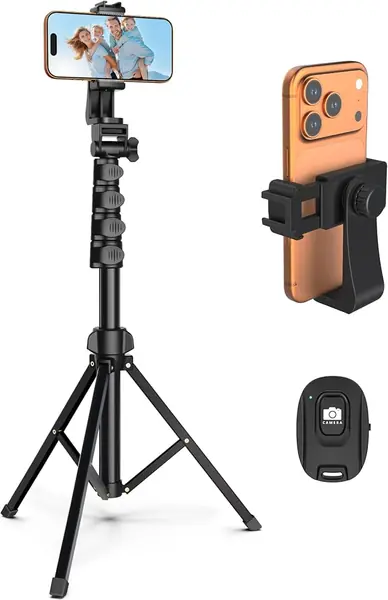
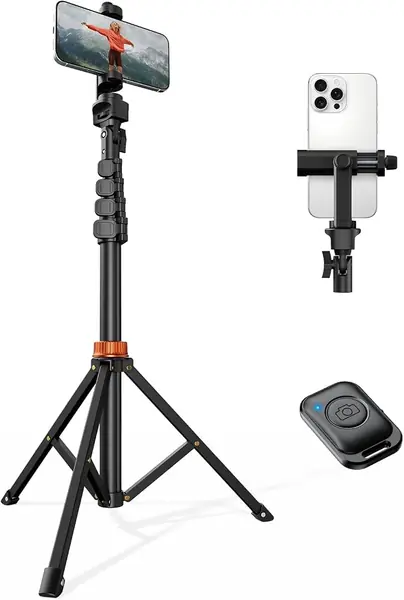
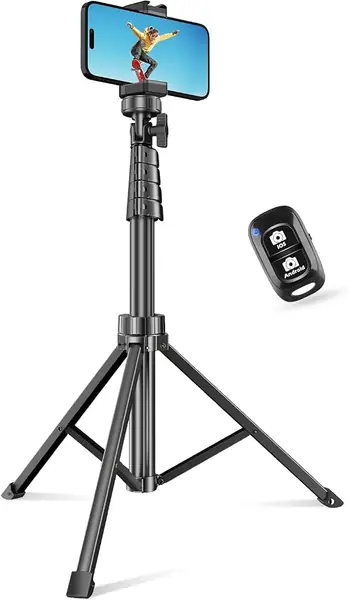
The first time we locked the legs and ran the pole up to eye level, the SENSYNE stopped being interesting, which is the nicest thing we can say about a recording stand. The phone stayed where we put it, we stepped back, pressed the remote, and the take was steady. That is why it is our top pick: it asks almost nothing of you. The latches are obvious, the pole moves smoothly, and 62 inches puts the lens at face height for most adults standing.

The holder is what you deal with every session, and this one opens wide. SENSYNE rates it for phones 2.8 to 5.7 inches wide, the broadest range in this set, so a big handset in a rugged case still seats without a fight. The head rotates through 360 degrees for portrait and landscape, and there is a standard 1/4-inch screw for a small camera or an action-cam mount later. We flipped orientation mid-setup without a struggle.

Height is where the compromise lives. At the full 62 inches the top sections have visible give — it is light aluminum on short legs, so a bumped table or a gust will show up in the footage. Our fix is unglamorous and works: frame yourself with the last section down, stand the feet on a hard floor rather than carpet, and keep the tripod out of the path people walk. At chest height on a still floor, the frame is as locked down as a talking-head take needs.

Sixty-two inches is also the right size for a first stand: tall enough for standing content, short enough for a closet corner, and 650 grams light enough to carry to a shoot. The EUCOS does the same job with an accessory shoe on top. If you do not need to bolt anything to it, this is the one we reach for.

Pros

  • Locks at eye level with simple, visible latches
  • Widest phone clamp here, 2.8 to 5.7 inches
  • Wireless remote plus a 1/4-inch accessory screw

Cons

  • Holder can sit slightly off-level after a big angle change
Our verdict

This is the stand we point most people to: it reaches eye level, holds a big phone in a case, and the remote means you never walk back to the phone to hit record.
Check Latest Price
2

EUCOS 62-Inch Phone Tripod Best for Lights and Mics

94 /100
TKZ Score Outstanding

Key details

Weight
12.8 oz
Maximum Height
62 inches
Folded Length
12 inches
Accessory Mount
Cold shoe
View on Amazon

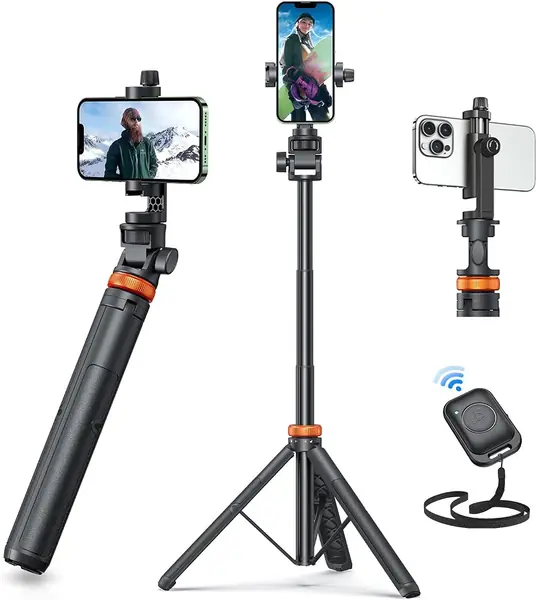
A cold shoe is a small piece of metal that changes what a phone stand is for. On the EUCOS it sits on top of the holder and takes a compact LED panel or a shotgun mic directly above the screen, so the stand carries your whole recording setup rather than just the phone. That shoe is the reason this one made the list; the rest of it is a competent 62-inch tripod.

What we like is how little it asks you to carry: 12.8 ounces, folded to about 12 inches, with lifetime coverage and a remote that works from up to 33 feet. The clamp holds phones 2.2 to 3.6 inches wide, the head rotates for portrait and landscape, and an included vertical mount makes an overhead shot easier than propping the phone on a book.

The mount is the limit worth naming: 2.2 to 3.6 inches covers a big handset but not a tablet, and with a single shoe you pick either a light or a mic. As a rig for one person recording alone that is plenty, and at this weight it is the stand most likely to already be in the bag when you leave the house.

Pros

  • Cold shoe takes a light or mic above the phone
  • 12.8 ounces and a 12-inch fold
  • Lifetime coverage and a 33-foot remote

Cons

  • Polymer leg joints are the weak point under regular setup
Our verdict

Buy it if your videos are growing past the phone itself — the cold shoe lets you bolt a light or a mic on top without a second stand.

Check Latest Price
3

COOPER ChatStand Best for Desk Recording

93 /100
TKZ Score Outstanding

Key details

Height Range
9 to 13 inches
Phone Fit
2.6 to 3.6 inches wide
Base
Weighted metal
Rotation
360 degrees
View on Amazon

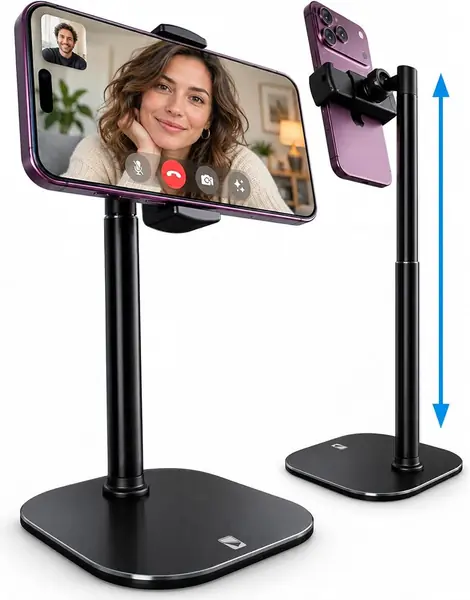
A tripod at a desk is a nuisance: three legs competing with the keyboard, the mug, and the notebook. The ChatStand takes the legs away. A weighted metal base about four and a half inches square sits behind or beside the laptop, and a single rod brings the phone up to your face while you are seated.

For recording at a desk, this is the shape that works. Nine to 13 inches of adjustment puts the lens at eye level when you are sitting, the metal base is heavy enough that a bumped desk does not tip it, and the swivel holds its angle instead of drooping halfway through a take. Assembly is a one-time job with the included Allen wrench, and the holder grips snugly enough that we stopped checking it between takes.

The phone fit runs 2.6 to 3.6 inches wide, which takes a large handset in a case, and the 360-degree swivel flips to landscape for a screen recording or a two-person demo. The padded base sits on a glass desk without scratching it, and the whole thing is small enough to shove aside when the laptop needs the room.

Pros

  • Puts the phone at eye level on a desk
  • Weighted metal base resists knocks and tipping
  • 360-degree swivel holds its angle without drooping

Cons

  • 13-inch ceiling rules out standing or full-body shots
Our verdict

For recording at a desk, this is the one: face-level height, a weighted base that ignores a bumped table, and no tripod legs in your keyboard.

Check Latest Price
4

Aureday 92-Inch Tripod Best for Overhead Shots

92 /100
TKZ Score Outstanding

Key details

Maximum Height
92 inches
Head
Ball head
Gooseneck
15 inches
Minimum Height
13.5 inches
View on Amazon

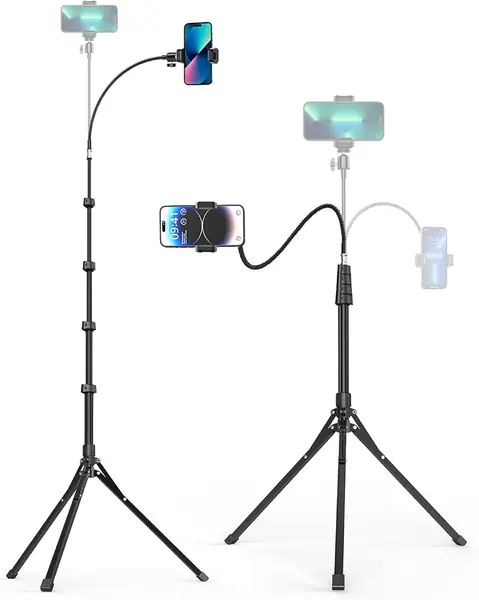
Ninety-two inches is more height than most people need, and it is the reason the Aureday exists. Fully extended it puts a phone above a door frame; with the arm bent it hangs the lens over a table for a top-down shot of your hands. For full-body fitness videos, standing demonstrations, or craft footage shot from above, nothing else here reaches that far.

The pieces that get you there are a three-section aluminum tripod, a ball head, a 15-inch gooseneck, a cold shoe on the holder, a wireless remote, and a carry bag. We paid closest attention to the gooseneck, because it is what separates an overhead shot from a straight-on one, and it is shorter in person than the product photos suggest, so measure the reach you need before ordering.

This is the pick when the frame, not the phone, is the problem. It is the tallest stand in this set and the only one with a flexible arm long enough for real overhead work, and the ball head lets you level the phone once and leave it. At 92 inches the whole assembly is a lever, so treat the height as something you set up for a shot rather than leave standing in a hallway.

Set it up on a hard, level floor away from doors, and do not run the last section out unless the shot needs it. The 13.5-inch minimum is the other half of its usefulness: drop it down and it becomes a tabletop tripod for product shots, which is more range than most of us will use in a single session.

Pros

  • 92 inches of reach for full-body and high angles
  • 15-inch gooseneck for top-down framing
  • Ball head, cold shoe, and remote in one kit

Cons

  • Phone mount is the weakest part
  • Folds to 16 inches, so it lives in a car or a closet
Our verdict

The only stand here that can frame a full body or hang the lens over your hands, which is worth the extra care it asks for.

Check Latest Price
5

RISEOFLE 71-Inch Tripod Best for Travel

91 /100
TKZ Score Outstanding

Key details

Weight
9.31 oz
Height Range
12.2 to 70.9 inches
Folded Length
12.2 inches
Payload
4.41 lb
View on Amazon

The RISEOFLE costs less than our top pick, weighs less than half as much, and goes nine inches taller — on paper, an easy win. In practice the extra height is exactly why it is not the default. Seventy-one inches on a pole that folds to 12 is a lot of leverage, and you feel it as soon as the top sections come out.

What you get for that is a seven-section aluminum pole, a 360-degree holder that flips between portrait and landscape, a ball head, and a Bluetooth remote, all of it 264 grams. Folded, it disappears into a daypack or a tote, and the ball head lets you fine-tune the angle without moving the legs.

Outdoors is where the trade shows. Extended fully on a hard floor indoors it is fine; on a balcony or a playing field the base is small for the reach and the pole picks up every gust. If you need 70 inches in the wind, you need a heavier stand, and the heavier stands in this group are the ones that stay home.

For travel, this is our pick. It packs small, gets the lens to eye level, and for a solo shooter working away from home that matters more than a rock-solid base. Just do not ask it to be both a travel stand and a tripod you can leave standing in a busy room.

Pros

  • 264 grams and 12 inches folded for travel
  • Reaches 71 inches from a 12-inch pack size
  • Ball head and 360-degree holder for quick angle changes

Cons

  • Stiff spring holder takes a firm pull to open
Our verdict

It packs to the size of a water bottle and still gets the lens to eye level, which is why it is the one we take on location.

Check Latest Price
6

Liphisy 64-Inch Tripod Best All-Metal Build

90 /100
TKZ Score Outstanding

Key details

Weight
1.61 lb
Height Range
17 to 64 inches
Folded Length
17.7 inches
Material
Aluminum alloy and stainless steel
View on Amazon

Aluminum alloy and stainless steel, 1.6 pounds, and locks that snap rather than creep: the Liphisy 64 is the stand here that feels most like equipment and least like an accessory. We trust it with a big phone at height in a way we do not trust the lighter sticks, and the two-year warranty is longer than most in this group.

The height range runs from 17 to 64 inches, and the head rotates through 210 degrees with a holder that spins a full turn, so low angles and portrait shots are both covered. Setup is three sections and two locks, and once they are closed the stand feels rigid rather than springy.

Grip is the one thing to test early. A very large phone in a thick case can work loose in the jaws over a long take, so run a two-minute recording with your own phone and case before you trust it at height. Do that once and the rest of the stand is unremarkable in the best way: it locks, it holds, and it stays where you left it.

Pros

  • All-metal build that feels rigid at full height
  • 210-degree head and 360-degree holder cover low and vertical shots
  • Two-year manufacturer warranty

Cons

  • Folds to nearly 18 inches, so it needs a tote
  • Remote does not always pair on the first attempt
Our verdict

Pick this when the phone is a big one and you want metal under it — the locks hold, and the frame stays where you set it.

Check Latest Price
7

Vimose 66-Inch Tripod Best for Heavy Phone Rigs

89 /100
TKZ Score Excellent

Key details

Weight
1.28 lb
Height Range
19 to 66 inches
Payload
8.8 lb
Accessory Mount
Cold shoe
View on Amazon

Eight point eight pounds is a strange number to print on a phone tripod, and it is the most interesting thing about the Vimose 66. That is the stated payload, several times what most stands here claim, which means the stand stops being the limit when the phone is in a cage, on a clamp, or wearing a battery case.

The rest is standard in a good way: 19 to 66 inches of aluminum, a 360-degree mount with locking flanges for portrait, landscape, and 45-degree shots, a cold shoe on top, a 10-meter Bluetooth remote, and 36 months of support from the maker. At 0.58 kilograms it stays easy to move around a room.

What makes it worth a place is the headroom. If you record with the phone in a rig, this is the stand in this set that will not be the weak link, and it costs no more than the mid-range options around it. If your phone travels naked, the simpler SENSYNE is the better buy.

Pros

  • 8.8-pound payload rating, the highest here
  • Cold shoe and a 10-meter Bluetooth remote
  • 19 to 66 inches with 45-degree locking positions

Cons

  • Can sit slightly off-vertical with a heavy phone
Our verdict

A sensible buy if your phone lives in a cage or a chunky case: the payload rating is the highest here by a wide margin.

Check Latest Price
8

MAGIPEA Gooseneck Phone Holder Best for Overhead Work

88 /100
TKZ Score Excellent

Key details

Weight
8.8 oz
Phone Fit
3.5 to 7 inches
Arm Length
28 inches
Clamp Opening
Up to 3 inches
View on Amazon

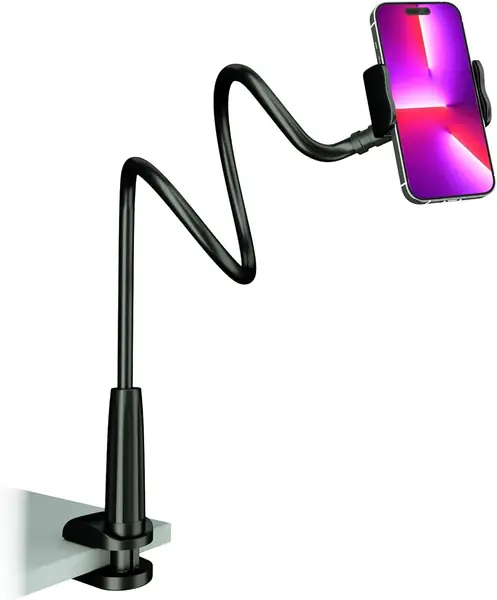
Clamping changes the question from where you can put a stand to where you can put the phone. The MAGIPEA grabs a shelf, a bed frame, or a desk edge with a 3-inch clamp and hangs a 28-inch arm out over the space below, which is how you get a camera directly above a cutting board, a keyboard, or a sketchbook without a tripod in the shot.

The arm is stiffer than the price suggests. It holds a bend instead of sagging back, the clamp at the end rotates the phone through 360 degrees, and at 8.8 ounces the whole thing disappears once it is mounted. For reading a script or recording a top-down demo, it beats a tripod, because the phone is out of your eyeline and still in frame.

What it is not is a substitute for a tripod. Full extension is where it gets shaky — a long, straight reach turns every footstep into camera shake — so clamp close to the work, keep the arm bent rather than stretched, and give it a second to settle after you adjust it.

That makes it the pick for overhead work in a fixed spot: a desk, a workbench, a bed. Set the clamp somewhere solid and leave it there, and the MAGIPEA quietly does a job a tripod would need the middle of the room to do.

Pros

  • Clamps where a tripod cannot stand
  • Stiff 28-inch arm holds its bend
  • 360-degree rotation at 8.8 ounces

Cons

  • Arm wears out where it gets bent in the same spot
Our verdict

Hang a phone over a workbench or a bed and this clamp does the job a tripod cannot.

Check Latest Price

How We Picked and Tested These Phone Stands

The shortlist started with research, not luck. We read through hundreds of customer reviews, filtered by height range, base style, mount type, and whether a remote was included, and kept the field within a similar price band so we weren't comparing a desk clip to a professional rig. That left 14 stands and tripods, everything from weighted desk stands to 92-inch tripods with goosenecks, and we used each one for four months.

Testing happened where these products actually live. I recorded a recipe at the kitchen counter every weekend, filmed short videos at a desk with the phone at eye level, and hauled the tripods outside for standing shots and group photos. Each time, I extended the legs and pole, set the angle, then tapped the screen hard enough to see whether the whole thing shook or the phone slowly dipped.

Stability got the roughest treatment: I bumped the desk mid-take, nudged the legs with a knee, and set each tripod up on uneven pavement to see which ones tipped and which just wobbled. For durability, I collapsed and re-extended every pole dozens of times, checked whether the joints still held their position after a few weeks, and watched for bases that cracked or mounts that loosened. Build quality showed up fastest in the joints.

Remote controls were paired with both an iPhone and an Android phone, used from across a room, then left in a bag for a week to see if they reconnected without a fight. Adjustability came down to whether the holder gripped a phone in a thick case and whether a height setting survived a knock. We judged value on the whole package: the stands that worked without fuss, and didn't require a second purchase to be useful, scored highest.

How to Choose a Phone Stand for Recording

Start with the shot, not the stand

If you record seated at a desk — talking-head videos, calls, hands-on demos — a desk stand that rises to about 13 inches is steadier and less obtrusive than a tripod, and the COOPER ChatStand is the one we keep going back to. For standing shots you want a tripod that reaches eye level, roughly 55 to 65 inches for most adults. For top-down work, a clamp-on gooseneck or a tripod with a flexible arm puts the lens over the surface instead of in front of it. Sketch your usual frame before you shop and the form factor mostly picks itself.

Height and stability pull in opposite directions

Every tripod here weighs under two pounds, and a light pole at 60-plus inches is a lever: the longer the extension, the more the top moves when someone walks past. That is not a flaw to shop around, it is physics to plan for. Work out the shortest height that frames you, set the feet on a hard floor rather than carpet, and keep the base out of the room's traffic. Weight buys steadiness; the Liphisy 64 is the heaviest tripod in this group at about 1.6 pounds, and you can feel where that weight goes.

The mount does more work than the pole

Angle control is where cheap holders show themselves. The phone should swivel between portrait and landscape without tools, the tilt should hold once you let go, and the clamp should grip a large handset without you wincing. A cold shoe on top of the holder is the upgrade that matters if you record with a light or a mic — the EUCOS and the Vimose 66 both have one, and it saves buying a second stand for your accessories.

Folded length decides whether you carry it

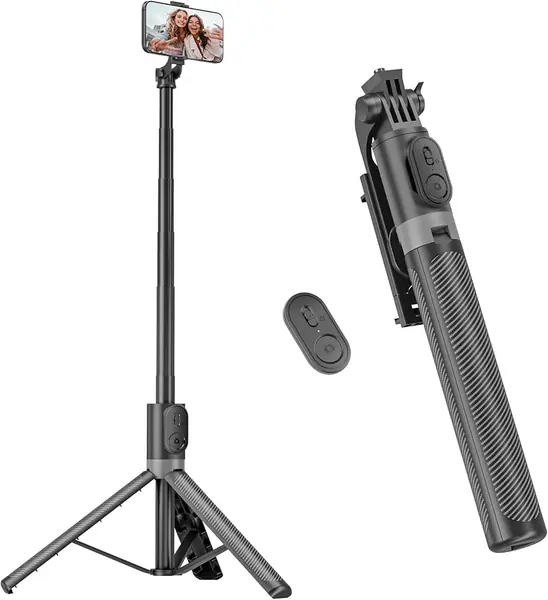
A stand that stays home is not a stand. For most bags, folded length matters more than weight: the RISEOFLE collapses to about 12 inches and 264 grams and vanishes into a daypack, while the Liphisy 64 folds to nearly 18 inches and wants a tote or a car trunk. A selfie stick tripod with a long fold is the same story. Pick the folded size from the bag you actually carry, then take the tallest stand that fits it.

Frequently Asked Questions

Final Verdict

Our pick for most people is the SENSYNE 62-inch. It gets the lens to eye level, holds a large phone in a case, and fires from across the room, and nothing else here combines those three things with as much of a track record behind it. If you record sitting down, the COOPER ChatStand is the better shape for a desk; if the frame has to be overhead or full-body, the Aureday 92-inch is the only stand here that gets there.

Buy for your usual shot. The tallest pole is not the best stand if you never stand up to record.