Best Outdoor Bluetooth Speakers with Good Bass of 2026

Bass is the first thing the outdoors takes away. A speaker that rattles the kitchen cabinets can sound thin from across a campsite, with no walls to bounce the low end back at you. The fix isn't more power alone — it's a bigger cabinet, a real passive radiator, and a battery that can feed both well past sunset.

I've hauled speakers to the beach and carried them home with sand in the charging port, so I check what the spec sheet buries: whether it floats, and whether the battery lasts a full day at volume. Over six months, my team and I put 12 speakers through backyard cookouts, a rainy campsite, a dock, and a dusty garage, weighing how each one sounded, lasted, carried, and connected.

The wattage on the box matters far less than the cabinet it's bolted into — a well-tuned small speaker can beat a cheap loud one outdoors, and a lot of that bass fades once you push past two-thirds volume. The picks below held their low end at the levels people actually listen at, and took a drop without a rattle.

The Best Outdoor Bluetooth Speakers with Good Bass

1

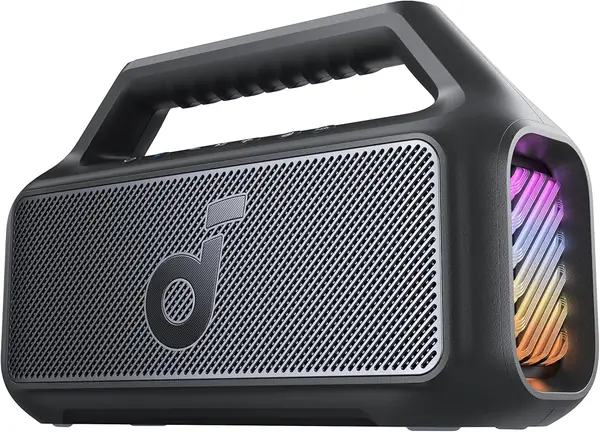
Soundcore Boom 2 Best Overall
95 /100
TKZ Score Outstanding

Key details

Battery
Up to 24 hours
Outdoor Rating
IPX7, floatable
Max Output
80W
Bass Hardware
4-inch subwoofer, BassUp 2.0
View on Amazon

The Boom 2 is the speaker we reach for when the plan is genuinely outdoors: a tailgate, a beach afternoon, or a backyard dinner that runs past dark. It earns the top spot because it gets the three things that matter here right at once. A 4-inch subwoofer and BassUp 2.0 give it real low-end weight, IPX7 and a floatable body mean a splash or a tumble into the pool is not the end of the day, and 24 hours of rated playtime covers more than one outing. At 3.7 pounds it still fits in a tote without becoming a burden.

The bass is the reason we keep coming back. The dedicated subwoofer gives kick drums and bass lines a physical push that the smaller speakers here cannot match, and the effect survives at patio volume. The app's Pro EQ is worth opening once: the default tuning is fun, but pulling a little low-end back makes acoustic tracks and podcasts clearer. BassUp adds weight without making vocals disappear, which is the trick most budget speakers miss.

Battery and weather protection are where this speaker separates itself from a desk-bound Bluetooth box. The 24-hour rating covers a long day out, USB-C charging is straightforward, and the built-in power bank can top up a phone when the outlet is far away. IPX7 and the floatable body make it the one we are least nervous about at a pool or on a boat. The physical buttons are also easier to find with sunscreen on your hands than a touch panel.

What you get in return is a speaker that can anchor a small gathering without a second unit. The app gives you a repeatable way to tune the bass, and the physical controls are simple enough to run without looking. It is the speaker we hand to someone who wants one outdoor box for the patio, the pool, and the car.

Pros

  • Deep bass from a dedicated subwoofer
  • IPX7 and floatable for pool use
  • 24-hour playtime plus phone power bank
  • App EQ makes bass easy to tailor

Cons

  • Too heavy for backpack-first trips
Our verdict

For most people, we think the Boom 2 is the outdoor speaker to buy: real subwoofer bass, IPX7 protection, and 24-hour playtime in a body you can still carry to the beach.
Check Latest Price
2

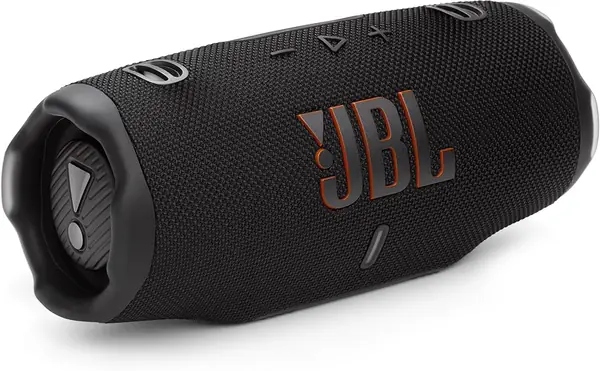
JBL Charge 6 Best All-Around Upgrade

94 /100
TKZ Score Outstanding

Key details

Battery
Up to 28 hours
Outdoor Rating
IP68
Max Output
45W
Power Bank
Built-in
View on Amazon

The JBL Charge 6 leads with a 28-hour battery rating and a built-in power bank, which sounds like the right answer to a long day away from an outlet. The useful part is that it does not make you carry a brick to get there. At 2.2 pounds, it fits in a daypack beside a water bottle, and the removable strap gives you a way to hang it from a chair or a tent loop.

What makes it the upgrade pick is the balance. The 45W output produces deep, controlled bass that punches rather than swells, and vocals stay clear when the volume climbs. We prefer it to the Boom 2 for acoustic music and podcasts, where the Soundcore can sound thicker. The body is rated IP68 for dust and water, and JBL also rates it drop-proof, so a dusty campsite or a sandy beach is less of a worry.

The battery is the headline for a reason. JBL rates it at up to 28 hours, and the built-in power bank can revive a phone when you are away from the car. USB-C charging is standard, and Auracast lets you pair it with another compatible JBL speaker for a wider setup. The app provides EQ control, which is useful if you want more low end without changing the speaker's overall character.

The Charge 6 is not the loudest speaker here for a big yard, and it is not the pick for a crowd that wants chest-thumping bass. For travel, a small patio, or a tailgate where the speaker has to come home in a bag, it is an easy choice. If you need to fill open space, the Boombox 4 is the better tool.

Pros

  • Up to 28 hours with power bank
  • IP68 dust and water protection
  • Deep, controlled bass with clear vocals
  • Light 2.2-pound body with strap

Cons

  • No charging cable in the box
  • Premium price for a compact speaker
Our verdict

We reach for the Charge 6 when the day is long and the bag is small; its 28-hour battery, power bank, and IP68 body make it our premium travel upgrade.

Check Latest Price
3

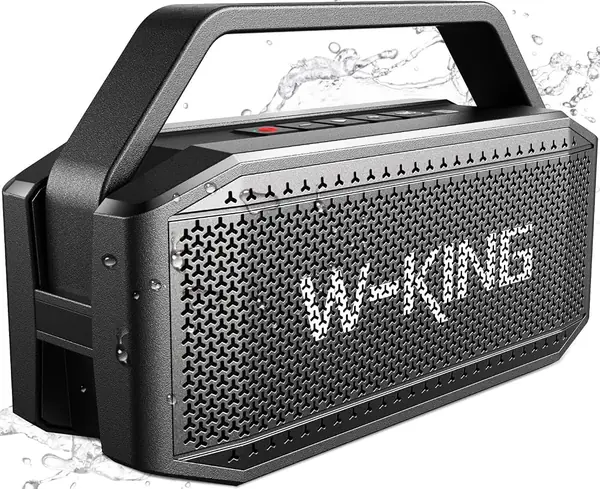
W-KING D9-1 Best Value for Big Bass

93 /100
TKZ Score Outstanding

Key details

Battery
Up to 40 hours
Outdoor Rating
IPX7, floatable
Peak Power
100W
Bass Hardware
7.2-inch passive radiator
View on Amazon

The 7.2-inch passive radiator on the back of the D9-1 is not subtle, and that is the point. It is the largest bass-moving piece here, and it explains why the W-KING can push a low end that feels bigger than its 100W peak rating suggests. This is a speaker designed around the thump, not around a flat response.

W-KING rates the D9-1 at 100W peak and 60W output, with 108dB of claimed volume. The result is a speaker that gets loud enough for a driveway party and keeps a beat you can feel across a deck. The 40-hour battery rating is the longest in this group, and IPX7 plus a floatable body make it a legitimate poolside option. A handle makes the big box easier to move from car to patio.

At its price, this is the value pick for bass-first listeners. The big radiator and 100W peak deliver the kind of low-end that usually asks for more money, and the onboard EQ modes are easy to switch when you want a different balance. It is not the speaker for critical listening; it is the one for a loud backyard, a tailgate, or a garage where the bass is the point. If you want a more polished sound, the Soundcore is the friendlier choice.

Pros

  • Huge 7.2-inch passive radiator for bass
  • 100W peak and 108dB output
  • IPX7 and floatable for pool use
  • Up to 40 hours of rated playtime

Cons

  • 40-hour rating is at low volume
  • EQ is limited to two presets
Our verdict

Bass per dollar is the reason we keep the D9-1 in the mix: a 7.2-inch passive radiator, 100W peak output, and IPX7 protection for loud outdoor parties.

Check Latest Price
4

JBL Boombox 4 Best for Large Outdoor Parties

92 /100
TKZ Score Outstanding

Key details

Battery
Up to 34 hours
Outdoor Rating
IP68
Weight
13 lb
Bass Hardware
Two woofers, three passive radiators
View on Amazon

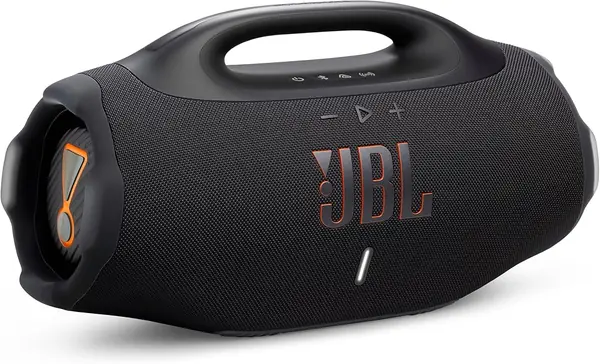
The JBL Boombox 4's driver array is the reason it exists: two woofers, two tweeters, and three passive radiators in a cabinet that weighs 13 pounds. This is the biggest-sounding speaker in the group, and it is the one that makes a backyard feel like a venue. The sound has more weight and scale than the Charge 6, with low end you can feel across a deck.

The payoff is in the bass settings. JBL gives you Deep Bass for chesty lows and Punchy Bass for a tighter hit, and the difference is obvious on hip-hop and electronic music. We preferred Deep Bass outdoors, where open air swallows low end; indoors it can overwhelm a small room. The 65W rating is not the highest number here, but the cabinet and driver array do more with it than the peak-wattage party boxes.

Battery and weather protection are built for a long outdoor day. JBL rates it at up to 34 hours, and IP68 covers dust as well as water, so a pool deck or a dusty tailgate is within its comfort zone. Auracast lets it pair with other compatible JBL speakers, including the Charge 6, which makes it a useful anchor for a larger setup. The handle is sturdy, and the controls are easy to find by feel.

The Boombox 4 is not the speaker you carry on a hike or squeeze onto a small apartment shelf. It is the one you leave by the patio door, load into the trunk for a tailgate, or set up beside the pool for a party. If you want most of that sound in a bag-friendly body, the Charge 6 is the compromise; if the speaker will live outdoors, the Boombox 4 earns its footprint.

Pros

  • Deepest bass in this set
  • Two bass modes for indoor or outdoor
  • IP68 dustproof and waterproof
  • Up to 34 hours of playtime

Cons

  • Premium price puts it in a different budget
Our verdict

The Boombox 4 earns its 13 pounds with the deepest bass in our group, plus IP68 protection and up to 34 hours for a serious outdoor party.

Check Latest Price
5

OHAYO X10 Max Best for Small Patios, Camping

91 /100
TKZ Score Outstanding

Key details

Battery
Up to 24 hours
Outdoor Rating
IPX7
Weight
15.9 oz
Max Output
35W
View on Amazon

The OHAYO X10 Max is the budget route to a speaker that can actually go outside: 35W, IPX7, a 450-gram body, and a 24-hour rating. It is small enough to sit on a picnic table without taking over, and it looks less like a piece of tailgate gear than the bigger boxes here. For a patio, a campsite, or a small deck, it covers the basics without asking for much space.

The bass is present and tuneful at normal patio volume. OHAYO uses an 8-centimeter woofer and a bass-boost setting, and the result has more low end than the size suggests. Vocals stay clear, and the compact body is easy to tuck under a chair or on a shelf. USB-C audio and TWS pairing are useful extras at this level.

What sells it is the combination of price and weather protection. You can leave it out in a drizzle, toss it in a bag, and not treat it like a fragile indoor device. It is the one we pack when space is tight and the car is already full. The body feels ready for that job, and the controls are simple enough to run without the manual.

Pros

  • IPX7 waterproof in a 450-gram body
  • Up to 24 hours of playtime
  • Bass boost adds low end beyond size
  • USB-C audio and TWS pairing

Cons

  • 35W output is modest for large yards
Our verdict

Small patios and campsites are where we see the X10 Max earning its keep: 35W of clear sound, IPX7 protection, and 24-hour playtime in a 450-gram body.

Check Latest Price
6

BassBloom ROAR 3 Best for Ultra-Light Camping

90 /100
TKZ Score Outstanding

Key details

Battery
Up to 24 hours
Outdoor Rating
IPX6
Weight
1.06 lb
Bass Feature
JIKE bass enhancement
View on Amazon

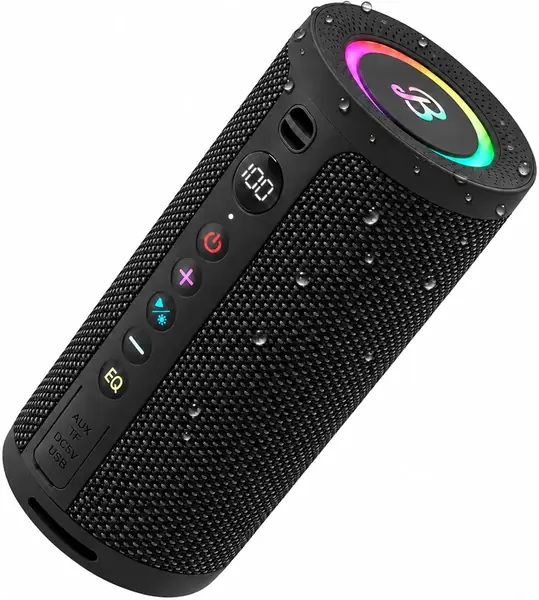
We did not expect much bass from a speaker this small, and the ROAR 3 is a good reminder that tuning can matter more than a big cabinet. At 480 grams, it is one of the lightest speakers here, yet its JIKE bass algorithm gives it a warm low end that makes a picnic table sound better than it has any right to. It is the one we toss in a bag and forget about until we need it.

The rest of the package is sensible for the size. BassBloom rates the battery at up to 24 hours, and the percentage display takes the guesswork out of charging. IPX6 handles rain and poolside splashes, Bluetooth 5.4 paired quickly with a phone, and TWS lets you add a second speaker for stereo. The RGB lights add some fun without changing the sound.

This is a speaker for a campsite table, a garage shelf, or a small balcony, where its warm sound and light weight are the point. The carry strap makes it easy to clip to a backpack, and the display means you are less likely to be caught with a dead battery. For the size, it is an easy spare to keep charged and ready.

Pros

  • Very light 480-gram body with strap
  • JIKE bass tuning sounds bigger than size
  • IPX6 spray resistance for outdoor use
  • Battery display and 24-hour rating

Cons

  • IPX6 is not submersible
  • Small driver limits party volume
Our verdict

We find the ROAR 3 one of the easiest to toss in a bag, and its 480-gram body, IPX6 shell, and warm bass tuning make it a handy campsite spare.

Check Latest Price
7

Wilody Boost10X Ultra Best for Feature-Packed Camping

85 /100
TKZ Score Excellent

Key details

Battery
Up to 20 hours
Outdoor Rating
IPX7, floatable
Peak Power
100W
Phone Charging
Wireless top pad
View on Amazon

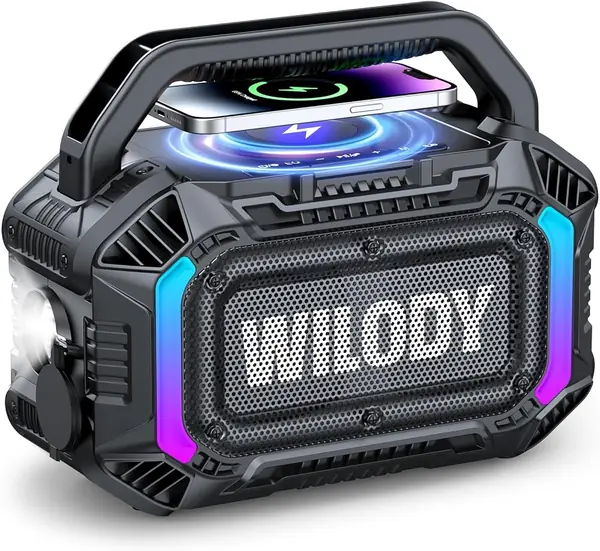
A wireless charging pad and a flashlight on a party speaker sound like extras designed to win a spec-sheet contest. On the Boost10X Ultra they are the details that make it useful on a camping table: you can top up a phone without hunting for a cable and light the cooler after sunset. The 100W dual-driver setup also gives it more output than the compact picks here.

The rest of the hardware is aimed at outdoor use. IPX7 and a floatable body mean it can handle a pool or a sudden shower, and Bluetooth 5.3 paired quickly in our testing. The battery is rated at 20 hours, and TWS lets you add a second unit for stereo. A handle and a 12-inch-wide body make it a car-camping speaker rather than a backpack one.

The wireless pad is the feature we used most. It sits on top, so a phone can charge while the speaker plays, and the flashlight is handy for a cooler run after dark. The controls are physical buttons, which is the right call for a device that will be handled with sunscreen and campfire smoke on your hands. The LED accents are there if you want them and easy to ignore if you do not.

For a weekend car camper, the combination of 100W output, IPX7, and a phone charger makes a lot of sense. The 20-hour rating is enough for a weekend, though it trails the longest-running picks here. The wireless pad and flashlight are the reasons to choose it over the OHAYO or the BassBloom, and the sound has more weight than either.

Pros

  • Wireless phone charging pad on top
  • Built-in flashlight for campsite use
  • IPX7 and floatable body
  • 100W output with TWS pairing

Cons

  • Early failures on some units
Our verdict

We recommend the Boost10X Ultra for car campers who want a phone charger and flashlight built in, with 100W output and IPX7 protection; just know the reliability risk.

Check Latest Price
8

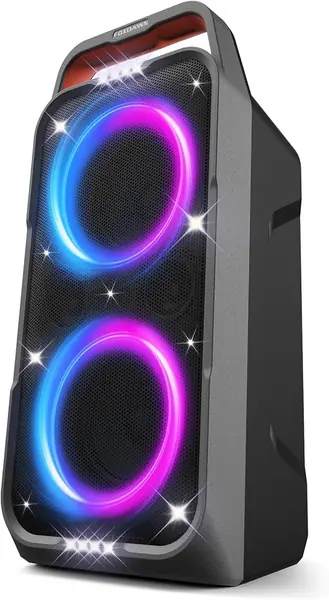
Foxdawn PT300 Best for Covered Patios

84 /100
TKZ Score Excellent

Key details

Battery
Up to 15 hours
Outdoor Rating
IPX4
Weight
12.5 lb
Peak Power
240W
View on Amazon

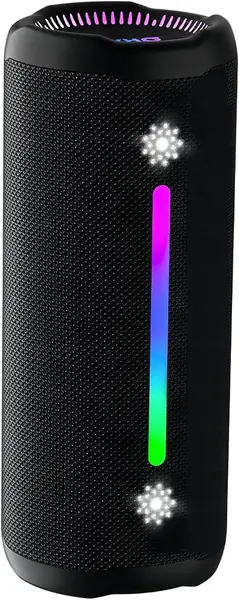
The PT300 is the most extroverted speaker here: a 240W peak party box with a 5.25-inch subwoofer and a light show that syncs to the music. It is built to be seen and heard, and the handle makes it easier to move than its size suggests. This is a speaker for a covered patio, a garage, or a tailgate where the party has a roof and room for a big box.

The 240W peak figure is not comparable to the RMS ratings on the JBL and W-KING boxes, but the 5.25-inch sub and large cabinet give it a big, room-filling sound. Vocals stay clear when the bass is up, which is not always true of party speakers at this level. The bass has weight, and the light show adds energy after dark without changing the sound.

Battery life is rated at up to 15 hours, with fast charging to get you back out sooner. TWS pairing lets you add a second PT300 for a wider setup, and Bluetooth 5.3 connected quickly in our testing. The lights are the centerpiece rather than a subtle accent, so this is a speaker that wants attention. The handle is positioned well for carrying.

The PT300 makes the most sense when the party has a roof and a little space. It is not the speaker for a beach bag or a rainy campsite; the JBL Boombox 4 is the more weatherproof upgrade. The 5.25-inch subwoofer gives it more low-end than the smaller party boxes, and it costs less than the JBL.

Pros

  • 240W peak power and 5.25-inch subwoofer
  • Music-synced LED light show
  • 15-hour battery and fast charge
  • TWS pairing and carry handle

Cons

  • 12.5-pound body stays close to the car
  • 15-hour battery trails the longest-running picks
Our verdict

For a covered patio or garage, we like the PT300's 240W peak power, 5.25-inch subwoofer, and synced light show without the JBL price.

Check Latest Price

How We Tested Bass That Survives the Outdoors

We started by pulling every outdoor speaker we could find with at least an IPX6 rating and a claimed 15 hours of playtime, then sorted them into price tiers so we weren't comparing a budget box against a flagship. That left a shortlist of brands we already knew plus a few cheaper models that kept surfacing in customer reviews. We bought 12 of them and lived with the group for six months.

Testing happened where these speakers actually live: a patio during cookouts, a campsite with no outlet for two days, a dock, and a garage with a table saw running. We played the same three tracks — one bass-heavy, one vocal, one acoustic — at low, medium, and max volume, then walked 30 feet away to hear what survived. A decibel meter at three feet and again at 30 gave us numbers to compare. Every unit ran from full to dead at 70 percent volume with a timer going, and each one went into a cooler of water for half an hour, where we noted which floated faceup, which sank, and whether the buttons still worked once dry.

For connectivity, we paired from 30 feet with a wall between phone and speaker, then walked out to the mailbox to see where the signal broke. We paired two units of the same model in stereo, charged a phone off any speaker that offers it and noted what that cost in playtime, and ran the light shows after dark to see whether they visibly drained the battery. Portability was a one-handed carry test down the block, handle and weight included. Reliability took the longest: the survivors sat on a covered porch through a month of rain and heat, and we rechecked charging ports, battery capacity, and whether each one still paired on the first try.

How to Choose Outdoor Bluetooth Speakers with Good Bass

Bass Comes From the Cabinet, Not the Wattage

Peak wattage is the easiest number to print and the least useful to compare. A small speaker can advertise a big peak figure and still run out of low end when the volume climbs. What moves air outdoors is the driver and cabinet: a dedicated subwoofer, a passive radiator, or both. The Soundcore's 4-inch sub and the W-KING's 7.2-inch passive radiator do more for bass than a higher watt number on a smaller box.

If bass is the priority, choose a cabinet big enough for its woofer and an EQ that keeps punch without smothering vocals. The JBL Boombox 4's two woofers and three passive radiators are the clearest example here of hardware earning the weight.

Match Battery Life to Loud Outdoor Hours

Battery ratings are usually measured at a moderate volume, so a 24-hour speaker does not give you 24 hours at party level. Outdoors, you also tend to run the volume higher because open air absorbs sound. Treat anything in the 20-hour range as an all-day speaker and anything under 15 hours as a shorter outing.

A power bank or fast charge can matter as much as the headline number. The JBL Charge 6 pairs a 28-hour rating with a built-in power bank; the W-KING D9-1 claims 40 hours at low volume. If you plan to run at high volume, prioritize 24 hours or more and keep a charging cable in the car.

Buy the Weather Rating Your Setting Requires

IP ratings are not a ladder where a higher number is always better for every outing. IPX4 handles splashes; IPX5 and IPX6 add stronger water jets; IPX7 allows temporary immersion; IP68 adds dust protection. A floatable IPX7 speaker is the right choice for a pool or boat. An IPX4 party box belongs under a roof or in a garage.

The trap is assuming waterproof means weatherproof. These ratings do not cover UV damage, saltwater corrosion, or being left out in a storm. If the speaker will live on a patio, bring it in when the weather turns.

Carry Weight Is Part of the Sound

Bigger cabinets generally produce more bass, and they also get heavy. The JBL Boombox 4 weighs 13 pounds; the OHAYO X10 Max weighs 450 grams. Both are portable, but they are portable in different ways: one is a car-to-patio boombox, the other goes in a daypack.

Decide how far you will carry the speaker before you fall for its output. A handle helps, but it does not make a 13-pound box a hiking speaker. If the walk from the car is short, size is mostly a storage question. If it is long, the smaller speaker gets used more.

Controls, EQ, and Pairing Matter Outside

On a beach or by a pool, you are often changing volume with wet or sandy hands. Physical buttons are easier to find than a touch panel, and a clear battery display saves guessing. An app EQ is worth having if you care about bass, because it lets you tune the low end to the setting instead of accepting one preset.

Stereo pairing is brand-specific in practice. Soundcore, JBL, W-KING, and the others here pair two matching speakers, not a mix of brands. If you want a wider soundstage, buy the same model twice or choose a family that supports the pairing you need.

Frequently Asked Questions

Final Verdict

Start with the Soundcore Boom 2. It has the deepest bass in a package we can still carry to a beach or a backyard, and its IPX7 body and 24-hour rating remove the usual outdoor compromises. If you want longer battery life and a built-in power bank in a lighter body, the JBL Charge 6 is the upgrade. If the speaker will mostly travel from car to patio for big parties, the JBL Boombox 4 is the one that fills the space.