Best Key Finders for Android of 2026

You know those ten seconds of dread when your keys aren't in the bowl by the door. A finder should replace it with an indignant beep from under the cushion, and on Android that's where the promises get shaky — plenty of these tags were built for iPhones first, so the box says compatible while the app disagrees. What you want is one that rings loud enough to hear in the next room and shows you where the keys were last seen.

For four months, my team and I have carried 14 of them on key rings, in backpacks, and in a checked suitcase. The biggest lesson: the network matters more than the tag. A dual-system tracker that works with both Apple's and Google's finding networks leaves room to switch phones later; a single-network one locks you to the ecosystem you're in this year.

And a quiet tracker is nearly useless: cushions, totes, and coat pockets eat a beep. Volume, battery style, how fast the app finds the tag, and whether it looks decent on a key ring all matter. Here's what held up.

The Best Key Finders for Android

1

UGREEN Finder Duo 4-Pack Best Overall
87 /100
TKZ Score Excellent

Key details

Pack Size
4 tags
Range
100 meters
Battery
Rechargeable, up to 1 year
Alert Volume
80 dB
View on Amazon

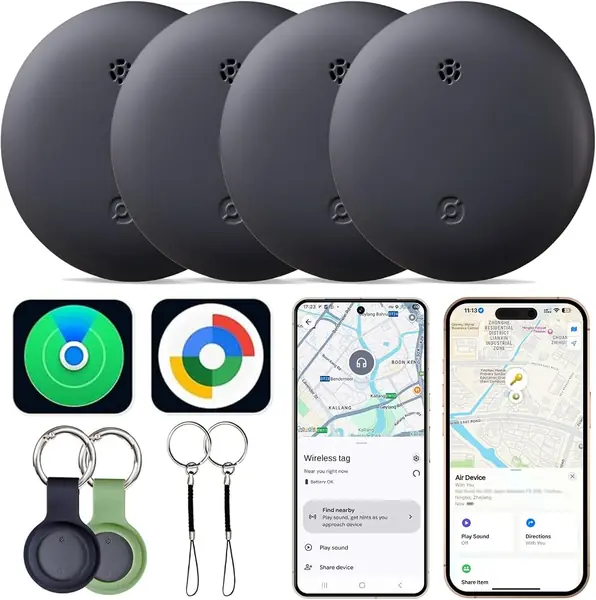
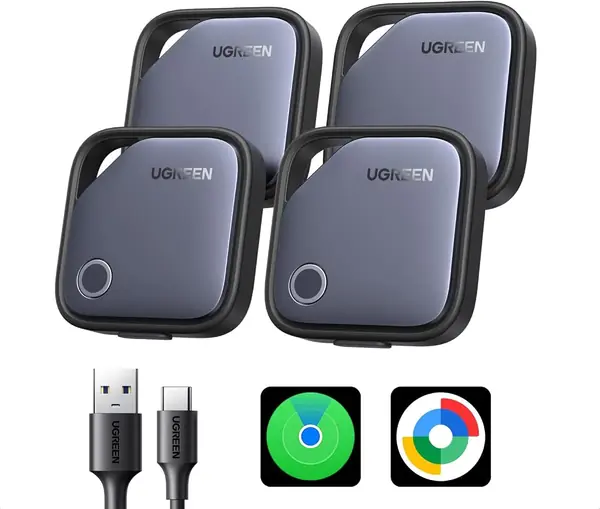
The Finder Duo tags charge over USB-C, and that one decision removes the worst chore in this category. No coin cell to buy, no back plate to pry off with a thumbnail, no drawer of dead CR2032s. UGREEN rates a charge at about a year, and each tag has a small light that pulses when you ping it from the app, so hunting for one in a bag is a visual job as well as an audio one.

Four of them for roughly what a single premium tracker costs is the other half of why this is our default pick for Android owners. One on the car keys, one in the work bag, one in a checked suitcase, and a spare in a drawer until something goes missing. The ring is rated at 80 dB, loud enough to follow from the next room, and because the tags are certified for both Google Find Hub and Apple Find My, a household split between Android and iPhone can use the same set instead of buying twice.

Setup is the part to test on day one. Pairing is a single tap when it takes, but these have been stubborn on some Android 14 and 16 handsets — pair all four while the return window is open, and confirm each one rings and appears in Find Hub before you trust one to a checked bag. Physically they sit closer to a matchbook than to a coin cell, which is the price of that USB-C port and a battery you do not throw away.

Pros

  • USB-C charging ends coin-cell buying
  • Four tags cover keys, bags, and luggage
  • Works with Google Find Hub or Apple Find My

Cons

  • Phone finding from the tag is unreliable
Our verdict

For most Android owners we recommend the Finder Duo set: four tags, no coin cells, and it keeps working if the house ever adds an iPhone.
Check Latest Price
2

Life360 Tile Best Budget

86 /100
TKZ Score Excellent

Key details

Pack Size
1 tag
Range
350 feet
Alert Volume
100 dB
Battery Life
3 years
View on Amazon

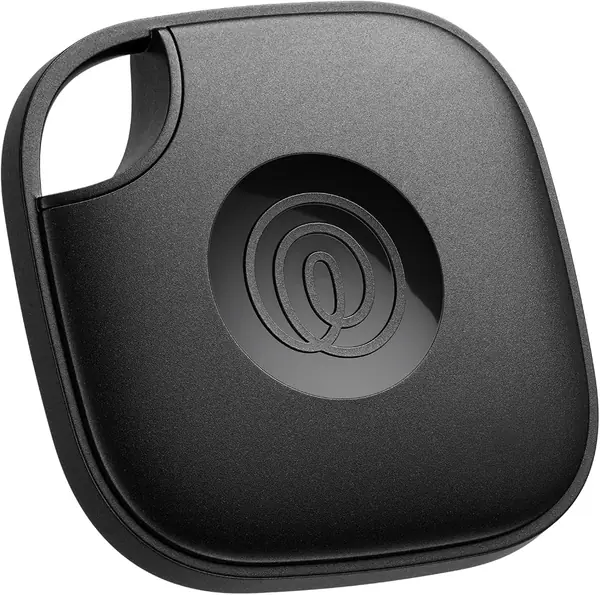
There is no port and no battery door on the Tile: the cell is sealed inside and rated for three years. That trade suits something living on a keyring, because there is nothing to charge and nothing to remember until the day the whole tag retires.

What you get for it is the simplest tracker here. It runs through the Tile app and Life360 rather than Google Find Hub, so it pairs with any Android phone regardless of brand, and it rings at 100 dB from up to 350 feet. The button works in both directions: press it and your phone rings, even on silent. That is the feature we came back to most, because a phone lost under a couch cushion is a more frequent emergency than lost keys.

For a first tracker, a spare for a teenager, or a water bottle that never comes home, this is the one we hand over without a second thought: no charging routine, no app to learn, and a button that earns its keep every time someone misplaces a phone. Simple is what survives a real hallway.

Pros

  • Rings your phone even when it is silenced
  • Three-year sealed battery, nothing to charge
  • Pairs with any Android phone, not one brand

Cons

  • Sold one tag at a time, not as a pack
Our verdict

Buy the Tile if you want tracking with no charging routine and no learning curve — it is the low-risk single tag we hand to first-timers.

Check Latest Price
3

Pebblebee Clip 5 Best Loud Alert

85 /100
TKZ Score Excellent

Key details

Pack Size
1 tag
Range
500 feet
Battery
Rechargeable, 12 months
Alert Volume
130 dB
View on Amazon

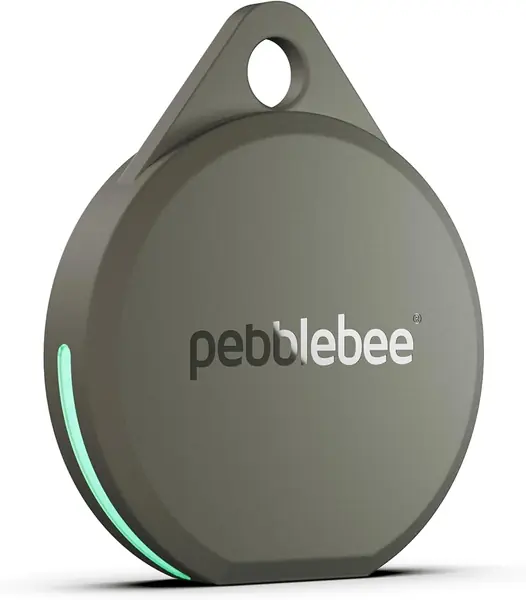
One hundred and thirty decibels is not a spec-sheet flourish — it is the difference between a tag you can hear through a closed door and one you have to stand next to. The Clip 5 is the loudest thing in this guide, and it pairs the siren with a bright LED strobe, so a keyring under a car seat gives you something to see as well as something to follow. That combination is why we reach for it when the keys are genuinely lost rather than merely misplaced.

The rest is built around that alert. At 500 feet the range is the longest of the picks here, charging is USB-C about once a year, and the shell is IP66, so rain and a dropped bag are survivable. Two caveats. The initial pairing has been fussier than most on Android, so set it up, then test the button again a week later before you depend on it. And the Clip 5 ships without a manufacturer's warranty, which is a real thing to weigh at this price.

Pros

  • 130 dB siren plus a visible strobe
  • 500-foot range, the longest here
  • USB-C recharge, about once a year

Cons

  • Ships without a manufacturer's warranty
Our verdict

If your keys vanish inside a cluttered house, the Clip 5 is the one to buy: nothing else here is this loud or this easy to spot.

Check Latest Price
4

Reyke Android Tracker 4-Pack Best for Families

84 /100
TKZ Score Excellent

Key details

Pack Size
4 tags
Range
180 feet
Battery
Replaceable, 1 year
Sharing
Up to 10 people
View on Amazon

Google Find Hub lets you share a tag, and the Reyke set leans into it: up to ten people can see the same tags, which is the feature that makes the case for a shared car, a shared luggage pile, or a house where three people all lose the same keys. One person pairs them; everyone can look.

The hardware is deliberately unremarkable, and that is a compliment. At 1.26 inches square and about a third of an inch thick they sit flat against a keyring, and they fit the holders people already bought for AirTags — a set can move straight into a luggage loop, a carabiner case, or a collar pouch without new accessories.

Power is old-fashioned in the best way: each tag takes a replaceable cell rated for about a year, so the tag outlives its battery rather than the other way around. The IP66 shell handles rain and a damp bag, and pairing on a Pixel through Find Hub has been as quick as any dual-system tag here.

Range is the compromise. 180 feet is the shortest of the multipacks here, which means you lean on the crowd network sooner than you do with the UGREEN set. Inside a house, a bag, or a suitcase that hardly matters; for a bike locked three blocks away, it does.

Pros

  • Share each tag with up to 10 people
  • Fits holders made for AirTags
  • Replaceable cells and IP66 shell

Cons

  • Shortest Bluetooth range of the multipacks
Our verdict

For a household sharing one set of tags, the Reyke four-pack is our pick — up to ten people can see the same keys, bag, and suitcase.

Check Latest Price
5

Samsung Galaxy SmartTag2 Best for Galaxy Phone Owners

83 /100
TKZ Score Excellent

Key details

Pack Size
1 tag
Range
120 meters
Battery
Replaceable CR2032, 500 days
Water Resistance
IP67
View on Amazon

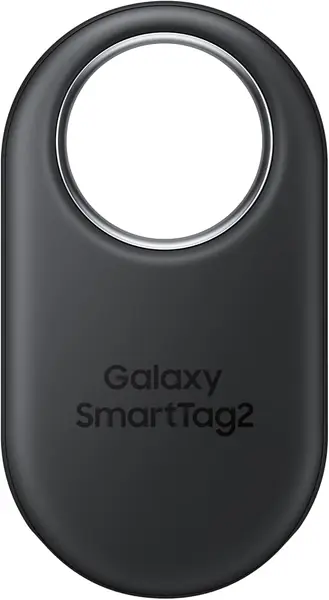
Buy the SmartTag2 only if your phone says Samsung on the back. It pairs with Galaxy phones and tablets running Android 11 or later through SmartThings Find, and it does not work with a Pixel, a Moto, or a OnePlus. Check that first, because no amount of range makes up for a tag that will not talk to your handset.

Inside that walled garden it is the most feature-complete tag here. The ring is loud, Search Nearby walks you toward the item with a compass-style view when you are close, and the IP67 shell means a wet keyring is not a worry. Samsung rates the battery at 500 days, and the cell is replaceable, so the tag is not disposable when the power runs out.

The battery is also where the trouble shows up. Low-battery warnings do not always track real remaining life, and a tag that fails to reconnect cleanly after a swap can look dead when it is not — do that swap at home with the app open, not in an airport, and confirm the tag comes back before it goes in a bag. For a Galaxy owner none of that outweighs the compass view and the fit with the phone; it is the best-supported tracker for your handset, and every caveat is about the cell.

Pros

  • Compass-style guidance when you are close
  • IP67 shell and a 500-day battery
  • Replaceable cell rather than a sealed tag

Cons

  • Pairs only with Samsung Galaxy devices
  • Replacement coin cell is not in the box
Our verdict

The best-fit tracker for a Samsung phone and useless for any other Android handset — check your phone's brand before you consider it.

Check Latest Price
6

VOCOlinc Air Tracker 4-Pack Best for Battery Swap Fans

81 /100
TKZ Score Excellent

Key details

Pack Size
4 tags
Range
200 feet
Battery
Removable, 4 included
Alert Volume
80-100 dB
View on Amazon

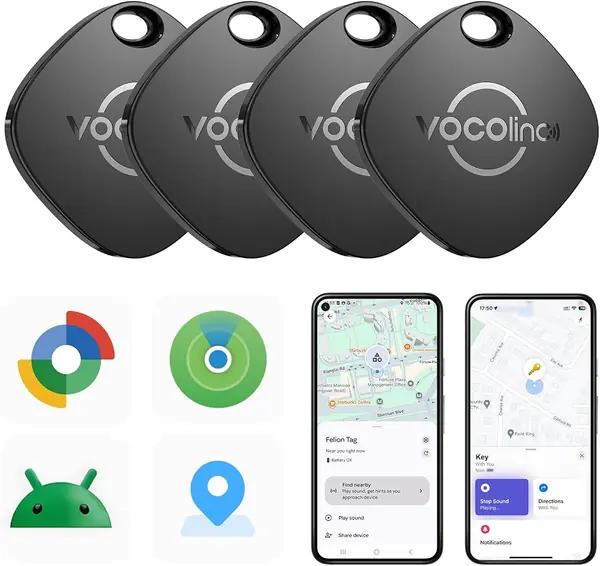
The cells in the VOCOlinc tags come out, and that is the design decision everything else follows from: no sealed unit to throw away when the power runs out, just a battery you replace and a tag that keeps going. Four come in the box, they are certified for both Google Find Hub and Apple Find My, the speaker runs 80 to 100 dB, and the listed 200-foot range is longer than most here. If you keep a card of spare cells in a drawer, this set rewards the habit.

The honest caveat is track record. This is the least proven of the multipacks here — a newer design with a shorter history behind it than the UGREEN or the Tile — so you are buying on specification rather than on a long record of other people's keys. Nothing in the design reads as a gamble, and 200 feet is a best case in open air anyway, so the real test is your hallway. Buy it for the swappable battery and the dual-system flexibility.

Pros

  • Removable batteries keep the tags usable
  • Certified for Find Hub and Find My
  • Four tags with a 200-foot listed range

Cons

  • Newer design with a shorter track record
Our verdict

Buy the VOCOlinc set if you would rather swap a battery than retire a tag — it is a sound design on a shorter record than our top picks.

Check Latest Price
7

MiLi Air Tracker Best for A Single Keyring

80 /100
TKZ Score Excellent

Key details

Pack Size
1 tag and case
Range
150 meters
Battery
Replaceable CR2032, 1 year
Water Resistance
IP67
View on Amazon

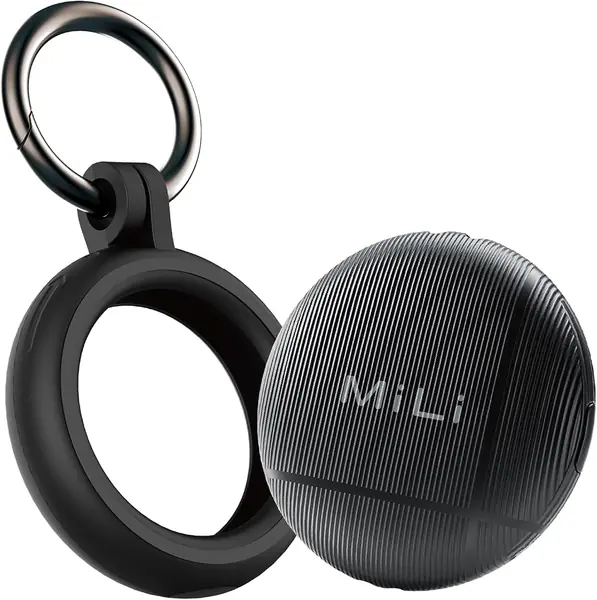
Most of this list comes in packs, and the MiLi is the counterargument: one tag, one case, one keyring, at the lowest price in this guide. If exactly one item keeps going missing and the luggage already has a system, four trackers is money sitting in a drawer.

It gives more than that position suggests. The CR2032 is replaceable and rated for about a year, the case comes in the box rather than as a separate purchase, the shell is IP67, and at 7 grams it disappears on a keyring. It supports Android 9 and later through Google Find Hub, with Apple Find My there if the household switches phones.

The limit is scale — one tag finds one thing, and it will not help with the bag or the suitcase in the same bad week. As a fix for a single keyring it is enough, and it is the least expensive way to find out whether tracking changes your habits at all.

Pros

  • Lowest price of any tag here
  • Case included, so nothing extra to buy
  • 7 grams, IP67, replaceable cell

Cons

  • One tag only, so one item covered
Our verdict

For one keyring and nothing else, the MiLi is the least expensive way in, and it arrives with the case already included.

Check Latest Price
8

TopMade Smart Keychain Tracker Best for Gifts and Keyrings

79 /100
TKZ Score Very Good

Key details

Pack Size
1 keychain
Battery
Rechargeable USB-C
Water Resistance
IP67
Build
PU leather, zinc alloy
View on Amazon

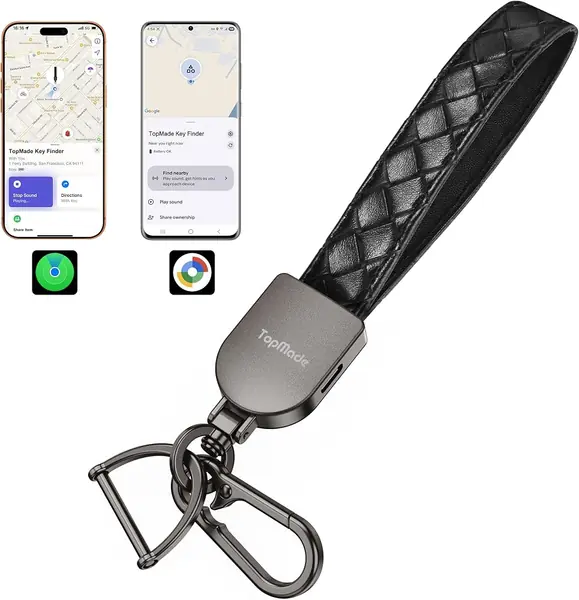
The TopMade looks like a leather key fob and nothing like a tracker, which is the entire reason it exists. The knit leather wrap and zinc-alloy hardware dress up a car key instead of announcing that its owner loses things, and the tracker is sealed inside — IP67, rechargeable over USB-C, no coin cell to swap.

That is a different bargain from the rest of this list. You spend premium money on a single tracker instead of four, so the value has to come from somewhere other than the pack. It comes from carrying it: the D-buckle and spring clip in the box let it hang off a bag strap as easily as a key, and the fob is the part you see, not a black plastic square.

The tracker underneath is standard issue — Find Hub and Find My support, a speaker, a rechargeable battery — and setup has been as hit or miss as the other dual-system tags, with a Bluetooth stall on some phones. Connect it, name it, and test it a day later before it goes anywhere near a car key.

So the decision is whether the fob is the point. For a gift, a nice keyring, or a bag strap that deserves better than plastic, it is; for four things that go missing, the multipacks win on math. The screwdriver, the spare clip, and the gift box in the packaging tell you which purchase this is meant to be.

Pros

  • Looks like a leather fob, not a gadget
  • USB-C rechargeable and IP67 sealed
  • Clip and D-buckle for bag straps

Cons

  • Premium money buys one tracker, not a set
Our verdict

The one to buy when the keyring is on show rather than hidden in a pocket — a leather fob that tracks, at a price to match.

Check Latest Price

How We Tested Key Finders for Android

We started with a list of about 30 Bluetooth trackers and cut anything locked to a single ecosystem, since a finder that only talks to one network becomes a paperweight the moment you change phones. From there we filtered by size and mounting style, battery type, water-resistance rating, and price per tag, favoring multipacks where the math made sense. Fourteen of them went into four months of daily use, each paired to an Android phone and, where supported, an iPhone.

Setup was timed from the moment the box opened to the first successful ring. We noted vague instructions, permission screens that asked for more location access than seemed necessary, and whether pairing was a single tap or a five-minute slog. We also pressed each tag to ring the phone it was paired to, since a finder that only works in one direction solves half the problem.

In daily life they lived on key rings, in backpacks, in a wallet, and in a checked suitcase that crossed the country twice. To judge loudness we rang each from a bedroom with the door closed, then again under a couch cushion and inside a canvas tote — a finder you can only hear in an empty room isn't much use. Accuracy got checked by leaving a tag in a parked car and refreshing the map from inside a store, and by walking away until a left-behind alert appeared.

Battery life went into a log, with charge dates for the rechargeable tags and install dates for the coin-cell ones. Durability meant drops onto pavement, a clip yanked on purpose, and a minute under a running faucet for anything rated for water. We carried each on our own rings for weeks to see whether the shell scuffed, yellowed, or looked cheap beside a set of keys.

How to Choose a Key Finder for Android

Start With the App, Not the Tag

Every tracker here talks to a phone app, and the app decides who the tracker works for. Google Find Hub covers most Android phones; Samsung's SmartThings Find covers Galaxy handsets only; the Tile app is its own network. A listing that says Android compatible can still mean one brand, which is the trap that catches most buyers of a cheap air tracker tag. Dual-system models work with Find Hub or Apple Find My, but you choose the network when you pair — one tag is not on both at once.

Understand What Range Really Means

Range figures are measured in open air, and walls, bodies, and a closed suitcase all shorten them. Inside Bluetooth range the tag rings; beyond it, you are looking at a last-known position reported by other people's phones passing nearby. That is accurate enough to tell you a bag stayed in Atlanta and not precise enough to walk you to it. None of these are GPS trackers, whatever the listing implies. For keys, range is the whole story; for luggage, the crowd network is.

Choose a Battery Strategy

Three designs, three kinds of upkeep. A sealed cell, as on the Tile, runs about three years and then the tag is done — nothing to do, nothing to salvage. A replaceable CR2032 is a yearly errand and a cheap fix, and you should buy spare cells with the tag, since Samsung's does not ship with one. USB-C rechargeables cost more up front and never need a coin cell, which matters most in a four-pack, where one annual charge per tag beats a drawer of dead batteries.

How Loud, and How Visible

Sound closes the last ten feet, so it is worth more than another hundred feet of theoretical range. The picks here run from 80 dB to a 130 dB siren with a strobe, and that is a genuine difference when keys are under a couch cushion and you are listening from the next room. A light helps when the sound is muffled by fabric. If you lose things inside a cluttered house rather than out in the world, spend on volume before you spend on network size.

Count the Tags Before You Buy

Four-packs are the value in this category, and they only pay off if you will use them: keys, work bag, suitcase, and a spare for the thing you have not lost yet. A single tag makes sense when one keyring is the whole problem. Sharing is the other half of the decision — Find Hub lets a household see the same tags, and the Reyke set allows up to ten people, which turns a tracker into something closer to a family system.

Frequently Asked Questions

Final Verdict

The UGREEN Finder Duo set is the one we point most Android buyers to: four tags, USB-C charging that ends the coin-cell habit, and dual-system support that keeps working if the household adds an iPhone. Test the pairing on all four while you can still return them.

If the budget is tighter than that, the Tile is the low-risk single tag with a three-year battery. And if the phone in your pocket is a Galaxy, the Samsung SmartTag2 is the better fit — provided you never plan to switch to another Android brand.