Best High-End Bluetooth Speakers of 2026

A cheap Bluetooth speaker plays music. A great one changes the room — the low end settles into the floorboards, a voice sits in the air a few feet in front of you, and you forget the box is even there. That leap is what the money buys at this end of the market, and it's also where the money can go wrong, because a beautiful cabinet can hide thin sound and a spec sheet full of Dolby Atmos and multiroom logos tells you nothing about whether it will actually fill your living room.

I've had speakers on bookshelves, kitchen counters, and back porches for years, and one thing keeps proving true: size and placement shape the sound more than any badge on the grille. A speaker that's too big for your shelf is a daily annoyance; one that's too small disappears in a big room. Over the past six months, my team and I have lived with eight of these high-end models, streaming through them every day and moving them from room to room.

Here's the piece most buyers learn too late: how you connect matters as much as how it sounds. Wi-Fi streaming holds up across a house, Bluetooth is the one that travels and takes guests' phones, and the app is what you'll use every time someone wants more bass. The picks below were judged on all three — plus the things you notice after week two, like battery life, finish, and whether the thing looks right where you put it.

The Best High-End Bluetooth Speakers

1

Marshall Acton III Best Overall
94 /100
TKZ Score Outstanding

Key details

Dimensions
5.91"D x 10.24"W x 6.69"H
Output
60 watts
Weight
6.2 lb
Power
Corded electric
View on Amazon

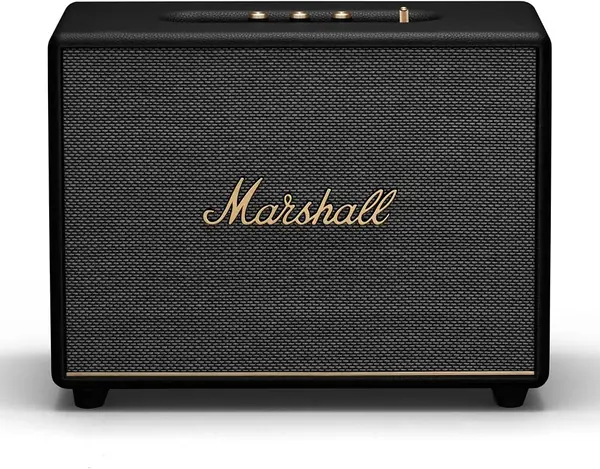
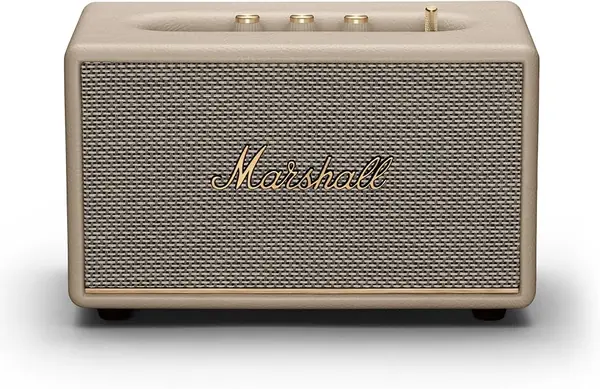
Ten and a quarter inches wide and six pounds, the Acton III looks like a bookshelf radio and behaves like something twice its size. It's the speaker we recommend first in this group, because it covers the ordinary case — a living room, an apartment, a bedroom that doubles as an office — without asking for a dedicated wall, a subwoofer, or an app.

Two knobs on top handle bass and treble, with a real click at each step, and that's the detail we kept coming back to. Tone control you can reach without unlocking a phone actually gets used: the speaker gets adjusted for a podcast, a record, or a late playlist instead of sitting on whatever the factory set. A 60-watt amp driving a four-inch woofer and a three-quarter-inch tweeter looks modest next to the 270-watt JBL below, and yet vocals stay clear, bass arrives with weight, and nothing turns muddy when you push it.

Setup is a plug and a pair, with no account and no app to install, which several speakers here can't match. Bluetooth range is listed at 33 feet, and a 3.5mm input lets a turntable with a built-in preamp or a laptop share the cabinet.

Cream vinyl, gold script, and a footprint that suits a sideboard next to books — this is the one here you don't hide. What it isn't is a party speaker; the JBL and the Woburn are for that. As the only speaker in a normal home, we haven't wanted for anything it doesn't do.

Pros

  • Fills a living room from a compact cabinet
  • Physical bass and treble knobs, no app needed
  • Looks good enough to leave on display

Cons

  • Corded only, so it stays in one room
Our verdict

We tell most people to start here: it fills a living room, looks like furniture, and gives you real tone knobs without an app.
Check Latest Price
2

Sonos Era 300 Best for Immersive Sound

91 /100
TKZ Score Outstanding

Key details

Dimensions
6.65"D x 6.65"W x 7.44"H
Output
300 watts
Streaming
Wi-Fi, Bluetooth, AirPlay, NFC
Audio
Dolby Atmos
View on Amazon

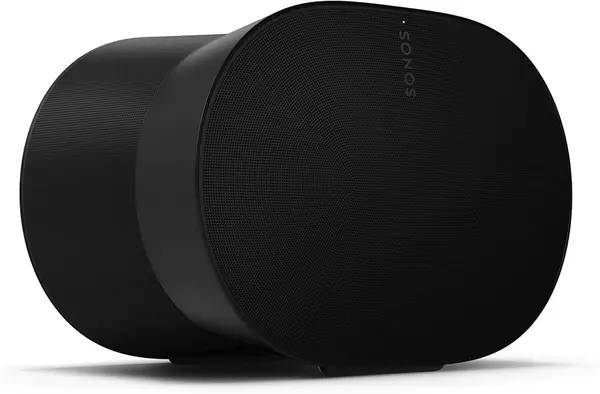
Six drivers — front, sides, and top — inside a cabinet the size of a large coffee can: the Era 300 is built around spatial audio in a way only one other speaker here attempts. Feed it a Dolby Atmos track from a supported service and the mix arrives with height and width, instruments placed behind and above you rather than in a flat line across the front.

The payoff showed up most on live recordings, where the venue becomes part of the track, and least on podcasts, where the extra drivers do nothing noticeable. It's also the most flexible speaker here on paper: Wi-Fi for high-resolution streaming, Bluetooth for a phone, AirPlay for Apple devices, and a USB-C line-in for a turntable. Pair two with a Sonos soundbar and they become rear channels in a surround system.

The hesitations are all software. Setup, EQ, and most control live in the Sonos app, and the app is the shakiest part of ownership — speakers that vanish from the list, an adjustment that takes two attempts. Wireless dropouts turn up in the same breath. Run it over Bluetooth from a phone once it's set up and most of that goes away, which tells you how much of the value sits in the network features.

Pros

  • Atmos height and width from six drivers
  • Wi-Fi, AirPlay, Bluetooth, and USB-C line-in
  • Pairs as surrounds with a Sonos soundbar

Cons

  • Setup and control depend on the Sonos app
Our verdict

Buy it for spatial audio and multiroom — nothing else here does Atmos as convincingly, as long as you can live with Sonos's app.

Check Latest Price
3

JBL Authentics 500 Best for Loud Rooms

89 /100
TKZ Score Excellent

Key details

Dimensions
10.07"D x 17.6"W x 9.45"H
Output
270 watts
Channels
3.1
Subwoofer
6.5 inches
View on Amazon

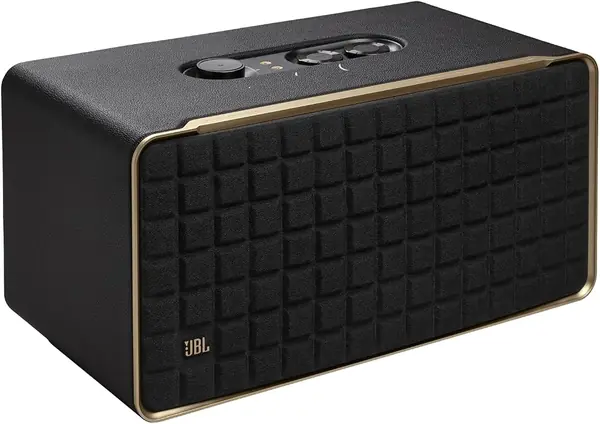
A big room needs a big speaker, and the Authentics 500 is built for exactly that: 270 watts across 3.1 channels, a 6.5-inch subwoofer, and a cabinet 17.6 inches wide. It's the one we point to when a space is large and the volume goes up, because it plays loud without hardening — rarer than the wattage suggests.

The retro brief is handled properly — cast-aluminum handle, wood-tone cabinet, a grille borrowed from a 1970s receiver — so it earns its floor space visually as well as acoustically. Underneath it's a networked speaker: Wi-Fi with AirPlay, Bluetooth for everything else, the JBL One app for EQ, and voice control through Alexa or Google Assistant. Dolby Atmos Music is supported too, though this box is more about weight and scale than about placing sounds around your head.

The cost is space and patience. At 17 pounds and 17.6 inches across it needs a solid surface and air around it, and the subwoofer is happy to overwhelm a small room; the bass and treble controls only partly tame it. Wi-Fi setup is the fussy half — network naming trips it up — while Bluetooth remains the two-second option.

Pros

  • 270 watts that stay clean at volume
  • 6.5-inch subwoofer for genuine low end
  • Wi-Fi, AirPlay, Bluetooth, and voice control
  • Retro looks worth leaving on display

Cons

  • Big cabinet needs a solid, open shelf
  • Wi-Fi setup is fussier than Bluetooth
Our verdict

For a large room or a party, this is the most speaker you can buy in this group — provided it has room to breathe.

Check Latest Price
4

Marshall Woburn III Best for TV and Large Rooms

88 /100
TKZ Score Excellent

Key details

Dimensions
7.99"D x 15.75"W x 12.48"H
Output
150 watts
Weight
16.4 lb
Inputs
HDMI, RCA, 3.5mm aux
View on Amazon

The Woburn III is the Acton III with everything turned up: a 15.75-inch cabinet, 16.4 pounds, 150 watts, and a six-inch woofer handling the low end. It belongs on a low console or a floor stand rather than a bookshelf, and it's the Marshall to choose when the room itself is the point.

What separates it from the smaller Marshall is the back panel. The HDMI input is the reason to pick it: one cable to the TV and the speaker becomes the room's sound system, with RCA and 3.5mm covering a turntable and a guest's phone, so it can be the only audio system in a den without a receiver in sight. It pairs with a phone in under a minute, and the app covers volume and EQ when you want to go past the defaults.

The case for it is headroom rather than volume. At low levels the bigger cabinet gives bass somewhere to go, where small speakers thin out; at high levels it stays composed in a way that makes 150 watts feel conservative. There's no spatial audio and no room correction, so a hard, glassy room will still sound like one — but for stereo music and TV in a large space, this is the most straightforwardly capable box here for that job.

Pros

  • 150 watts with genuine low-end weight
  • HDMI, RCA, and aux inputs
  • Composed at both low and high volume

Cons

  • Large cabinet needs dedicated space
  • No spatial audio or room correction
Our verdict

Choose the Woburn over the Acton when the room is big and a TV is involved; the HDMI input is what makes it a system.

Check Latest Price
5

Bose SoundLink Max Best Portable

87 /100
TKZ Score Excellent

Key details

Dimensions
4.13"D x 10.41"W x 6.38"H
Weight
4.9 lb
Battery
Up to 20 hours
Water Resistance
IP67
View on Amazon

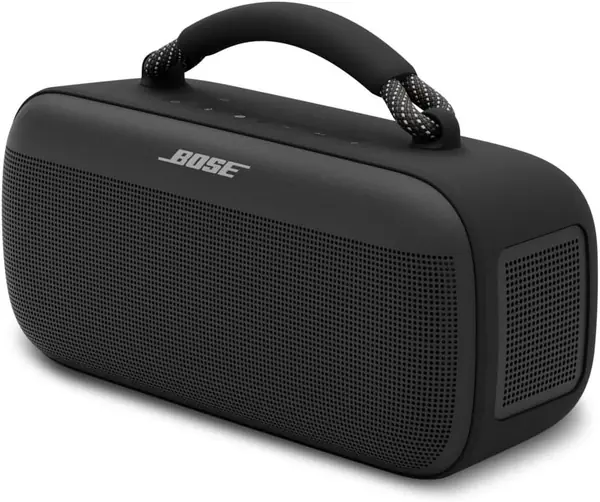
This is the speaker that leaves the house. IP67 sealing, a removable climbing-rope handle, and a battery rated at up to 20 hours put the SoundLink Max in a different class from the corded models here, and it's the one we take outside when the weather is a question. At 4.9 pounds and 10.4 inches across, it goes in a tote or behind a car seat without a fight.

What surprised us is how much of the home-listening experience survives the move. Bass is deep for a box this size, the sound stays composed as the volume climbs, and the USB-C port will charge a phone when someone's battery dies at the wrong moment. The handle is functional rather than decorative: one hand, one trip, no bag.

The trade is money and long-term confidence. The battery is sealed inside, so the day it stops holding a charge is the day a portable becomes a desk speaker, and that's the part of the design that ages. It also costs about what the bigger home speakers here do while sitting in the portable class — if it never leaves the living room, the JBL or the Marshall buys more sound for the same money.

Pros

  • IP67 sealing for pool and beach
  • Up to 20 hours of playback
  • Deep bass from a 4.9-pound box

Cons

  • Sealed battery ends its portable life
  • Costs as much as bigger home speakers
Our verdict

If the music goes where the outlet doesn't, this is the one — waterproof, loud, and easy to carry, with a sealed battery that sets its lifespan.

Check Latest Price
6

Bowers & Wilkins Zeppelin Pro Best for Critical Listening

86 /100
TKZ Score Excellent

Key details

Dimensions
7.64"D x 25.59"W x 8.27"H
Output
240 watts
Streaming
AirPlay 2, Bluetooth
Drivers
Five, including a 6-inch subwoofer
View on Amazon

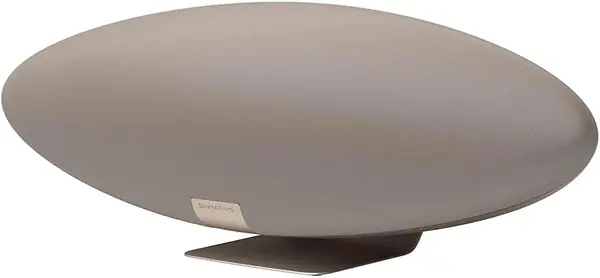
The Zeppelin Pro isn't really a Bluetooth speaker that happens to stream; it's a streaming speaker where Bluetooth is the fallback. Most of its quality shows up over AirPlay 2, Spotify Connect, or the Bowers & Wilkins app, and that's where the extra money goes — a plain Bluetooth connection is the least interesting way to feed it.

Five drivers — two 3.5-inch midrange units, two 1-inch titanium tweeters, and a 6-inch subwoofer — live inside a 25.6-inch winged cabinet with downward-firing light you can dim in the app. It's the most sculptural object here: fabric, metal, and a shape that reads as furniture from across a room.

Sound is the reason to forgive the shape and the app-first habits. The stereo image is the widest in this group, with instruments placed outside the cabinet's edges, and the subwoofer gives acoustic music a foundation the smaller speakers can't fake. At 22.7 pounds it also isn't moving once you set it down.

Treat it as a second system. In a room where you sit down and listen, it's the most resolving speaker here by a clear margin; as the household's only speaker, the dependence on an app and a streaming stack makes it fussier than models that cost less. That trade — better sound in one chair, less convenience for everyone else — is the whole decision.

Pros

  • Widest stereo image in this group
  • Five drivers including a 6-inch subwoofer
  • Sculptural design worth showing

Cons

  • Streaming app does most of the work
  • Costliest of the picks here
Our verdict

We recommend it for a listening chair and a streaming subscription; as a household's only speaker it asks for more patience than it returns.

Check Latest Price
7

Bose Lifestyle Ultra Speaker Best for Kitchen and Bedroom

85 /100
TKZ Score Excellent

Key details

Dimensions
6.59"D x 4.77"W x 7.27"H
Weight
3.7 lb
Streaming
AirPlay, Google Cast, Bluetooth
Audio
TrueSpatial
View on Amazon

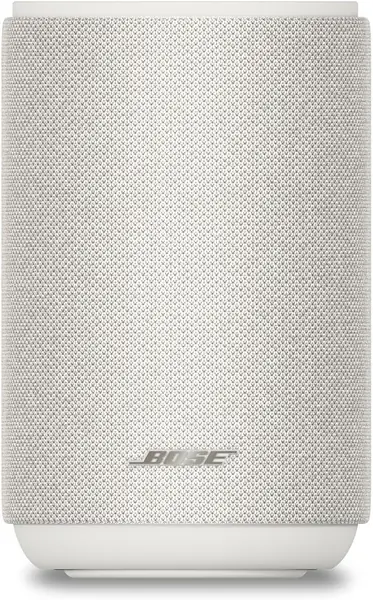
At 4.77 inches wide and under four pounds, the Lifestyle Ultra is the smallest speaker here by a distance. It fits where a Marshall or a Woburn won't: the end of a kitchen counter, a bedroom shelf, the corner of a home office. TrueSpatial processing widens the stage beyond what the cabinet suggests, which is the trick that makes a single unit usable on its own.

It's a network speaker first — AirPlay, Google Cast, Bluetooth, and Alexa+ voice control — and it pairs with a second unit for stereo or joins Bose's soundbar and subwoofer in a surround setup. Adjustable EQ in the app covers the rest, and the fabric wrap keeps it from looking like a smart-home gadget rather than a speaker.

Where it earns its place is as the second or third speaker in a house rather than the only one. Sound is full and clear for its size, but it's sized for a room, not a party; and because so much of it runs over Wi-Fi, your router is part of the purchase. A flaky network turns a good speaker into a frustrating one.

Pros

  • Small enough for a kitchen counter
  • AirPlay, Google Cast, Bluetooth, and Alexa+
  • Pairs for stereo or Bose surround

Cons

  • Network-dependent for Cast and AirPlay
Our verdict

Our pick for a kitchen counter or a bedroom shelf: Cast, AirPlay, and Alexa in something the size of a book, with Wi-Fi as the catch.

Check Latest Price
8

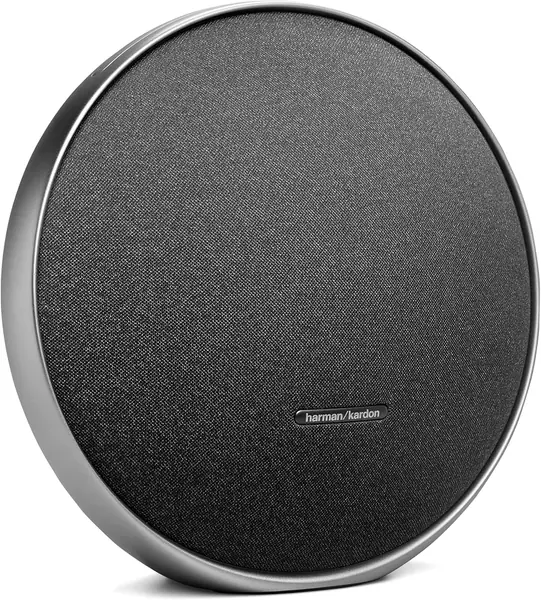
Harman Kardon Onyx Studio 9 Best for Tight Budgets

84 /100
TKZ Score Excellent

Key details

Dimensions
5.12"D x 11.39"W x 11.32"H
Output
50 watts
Weight
9.4 lb
Battery
Up to 8 hours
View on Amazon

The Onyx Studio 9 is the least expensive speaker here by a wide margin, and it doesn't behave like a budget pick: a 9.4-pound metal-bodied disc, 50 watts, a built-in battery, and a silhouette that owes more to sculpture than to portable audio.

Self-tuning is the useful trick. Power it on and it recalibrates to the space, which is why it holds together on a kitchen counter or a patio table better than its size suggests. The low end is generous — genuinely so in a small hard-surfaced room, where pulling the bass back helps.

It pairs with two phones at once, so a guest can take over the playlist without unpairing yours, and the USB port will top up a phone. A second unit can be added over Auracast for a wider stage, which is the closest this one gets to a party system.

We point people here when the budget is real but the sound still matters. Next to the Marshall it gives up the last layer of refinement — heavier-handed bass, a less articulate midrange — and the eight-hour battery is the shortest in this group. In a bedroom, a dorm room, or on a patio, neither of those costs you much.

Pros

  • Big sound for the least money here
  • Self-tuning for each room
  • Pairs with a second unit over Auracast

Cons

  • Bass runs heavy in small rooms
  • Eight-hour battery is the shortest here
Our verdict

We point budget-minded listeners here first — most of this group's sound for the least money, though the bass and the battery show where the savings went.

Check Latest Price

How We Tested the Best High-End Bluetooth Speakers

We began by reading through spec sheets and reviews for more than 40 speakers, then filtered for models at the higher end of the market with genuinely different approaches: large wood-cabinet speakers with wired inputs, Wi-Fi models with room-tuning apps, and a couple of battery-powered designs built to be carried outside. That narrowed to eight, which we bought at full price rather than accepting loaners.

Each one spent at least three weeks in a real home, cycling between a living room shelf, a kitchen counter, and a back porch, so we heard them in the spots where speakers actually live. We played the same handful of familiar tracks on every unit — a bass-heavy record, a sparse vocal, a dense orchestral piece — and noted where each one pulled ahead: how low the bass reached, whether voices sounded forward or recessed, whether the top end turned harsh on cymbals.

Then came the less glamorous checks. We pushed each speaker to maximum volume and walked into the next room to listen for distortion. We paired a phone over Bluetooth, wandered two rooms away, and counted dropouts and how long reconnection took when we came back. We timed setup in each companion app and spent a week adjusting EQ and room tuning to see whether the changes were audible or just decorative. Battery-powered models ran at a moderate volume until they died, timed from full. We measured footprints against shelf space, wiped fingerprints off every finish, plugged a turntable into anything with an aux or RCA input, and carted the portable ones outside for a weekend of porch use.

Through it all we kept a running note on value: which premium features earned their price and which were there for the spec sheet. Six months in, the differences between these speakers are real, and they're mostly about how and where you listen — which is why the list that follows splits by room and by habit rather than by wattage.

How to Choose a High-End Bluetooth Speaker

Corded or Battery: Decide This First

Every pick here falls on one side of a line. Corded speakers put the whole budget into amplification and cabinet volume — the Acton III's 60 watts, the Woburn III's 150 — while battery models spend part of it on a cell, sealing, and a handle. A portable that never leaves the house is money spent on capability you won't use.

The battery ratings here run from 8 hours to a rated 20, which is the difference between a patio evening and a weekend away. Match the rating to how far you actually go, and buy the corded model if the answer is nowhere.

Match Output to the Room

Watts don't scale the way shoppers expect. A 50-watt speaker in a solid cabinet can fill a living room, and a 270-watt box in a small hard room mostly makes bass you have to dial back. Think in cubic feet and surfaces: open-plan kitchens, high ceilings, and glass swallow sound, while carpet and soft furniture flatter it.

Between two models, the one with noticeably more cabinet volume usually wins on bass weight and on how good it sounds at low volume; the smaller one wins on placement. Buy for the room you have.

Know Which Inputs You Need

Bluetooth is the floor, not the ceiling. If everything comes from your phone, Bluetooth is enough and every speaker here does it. For lossless streaming or whole-house audio you need Wi-Fi with AirPlay, Google Cast, or a first-party app, and that brings your router into the purchase.

Wired inputs matter as soon as anything other than a phone is involved: a turntable wants a cable and a line-level input, and a speaker with no aux or HDMI can't take one.

Treat the App as Part of the Product

A speaker's software is now as much a part of ownership as its drivers. App-only control means tuning, input switching, and sometimes setup live behind a login — fine if you're the only user, less fine when a guest wants to play something.

Physical knobs are an underrated premium feature because they get used by whoever is in the room. Before you buy, find out how the speaker is set up and whether it plays without an account.

Expect the Finish to Matter

At this end of the market the speaker is furniture, and the models here are styled accordingly: Marshall's cream vinyl and gold script, JBL's aluminum handle, the Zeppelin's fabric wing. That isn't vanity. A speaker you're happy to leave out is a speaker that gets used, and one that has to be hidden ends up unplugged.

Check dimensions against the shelf you have in mind, and the finish against the room, before you fall for the sound.

Frequently Asked Questions

Final Verdict

Start with the Marshall Acton III. Nothing else here balances output, footprint, and price as neatly, and its physical tone knobs mean the whole household can use it without opening an app.

Choose differently only when a specific need pushes you: the Sonos Era 300 for Atmos and multiroom, the Bose SoundLink Max if the speaker leaves the house, the JBL Authentics 500 if the room is large and the volume goes high.