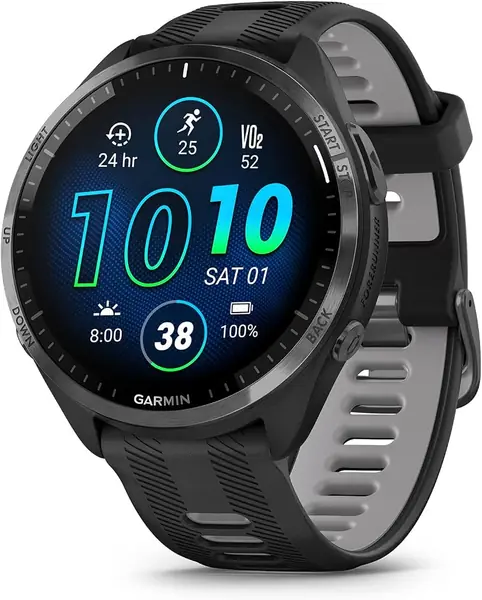
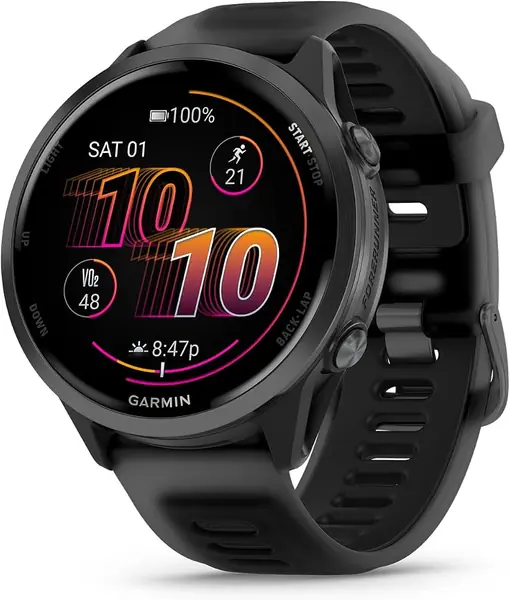
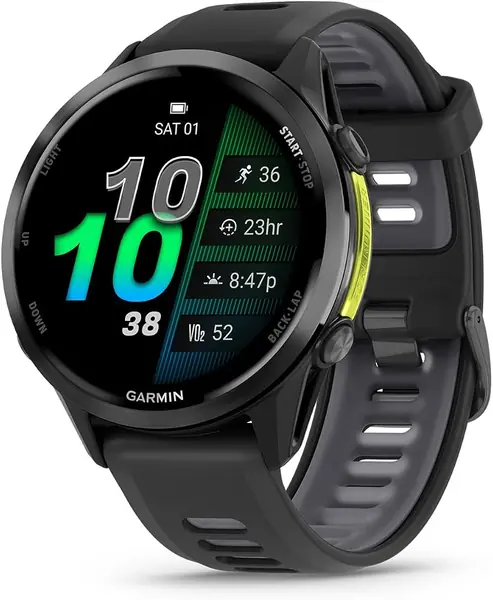
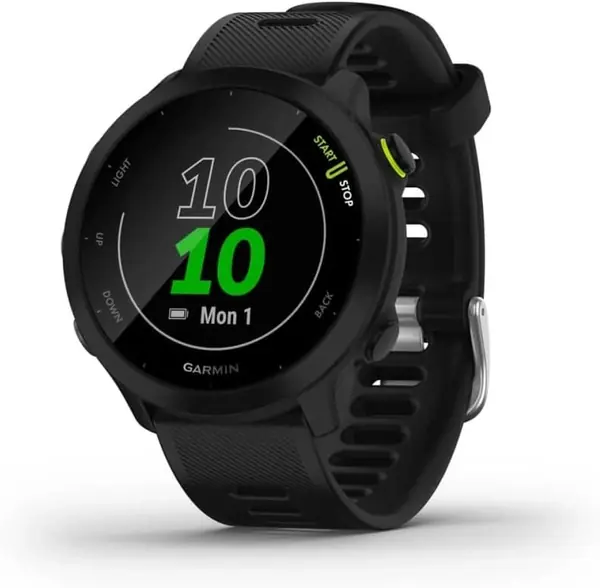
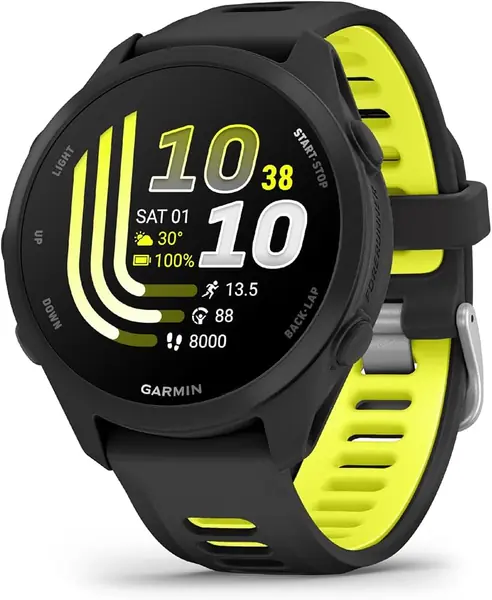
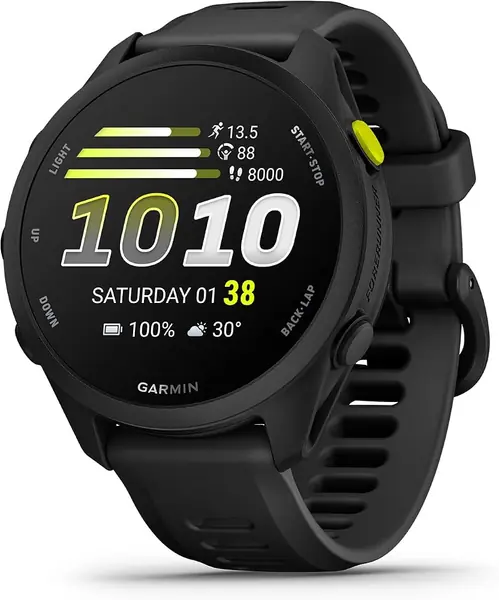
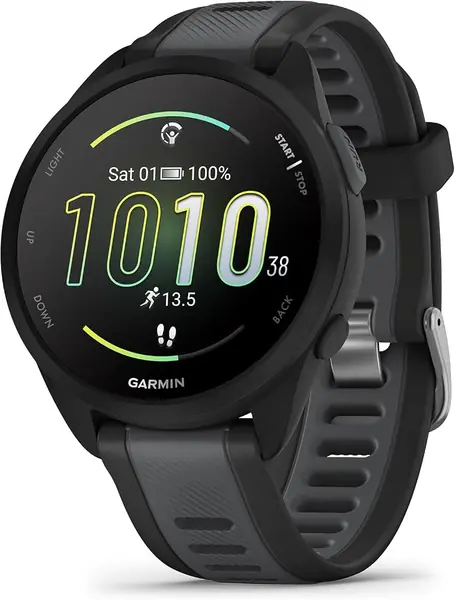
Garmin Forerunner 165 Best Overall
Key details
- Display
- 1.2-inch AMOLED, 324 x 394
- Battery Life
- Up to 11 days; 19 hours GPS
- Weight
- 1.38 oz
- Training
- Daily suggested workouts, Garmin Coach
Of all the Forerunners here, the 165 is the one we reach for when we want the essentials without paying for maps or a titanium case. It has the same bright AMOLED idea as the premium models in a smaller 43 mm body, plus the button-and-touch controls that make Garmin menus easier to manage with sweaty hands. At 1.38 ounces, it disappears on the wrist, which matters more on a long run than another metric screen.
The training package is the reason it earns our top spot rather than simply the affordable choice. Daily suggested workouts adapt to performance and recovery, Garmin Coach plans cover race build-ups, and the morning report pulls sleep, recovery, training outlook, weather, and HRV into one glance. We like that the 165 gives a new runner a clear next step without turning every run into a lab experiment. The 25+ activity profiles also mean it stays on for cycling, strength, and HIIT days.
Battery life is rated at up to 11 days in smartwatch mode and 19 hours in GPS mode. That is not the longest here, but it is enough for daily wear and a marathon-length effort with charge to spare. The glass is the part to protect first; a screen protector is cheap insurance for a watch that will meet doorframes and gym equipment.
If you want the smallest, lightest Forerunner that still feels current, this is our pick. The 965 is the step up when maps matter; the 970 adds flagship materials and a flashlight. Most runners will not miss either.
Pros
- Bright AMOLED screen in a light 43 mm body
- Daily suggested workouts and Garmin Coach plans
- Strong everyday and GPS battery life
Cons
- Shorter GPS battery than premium picks
We recommend the Forerunner 165 as the default for most runners who want a bright AMOLED screen, guided training, and a light 43 mm fit without paying for maps.