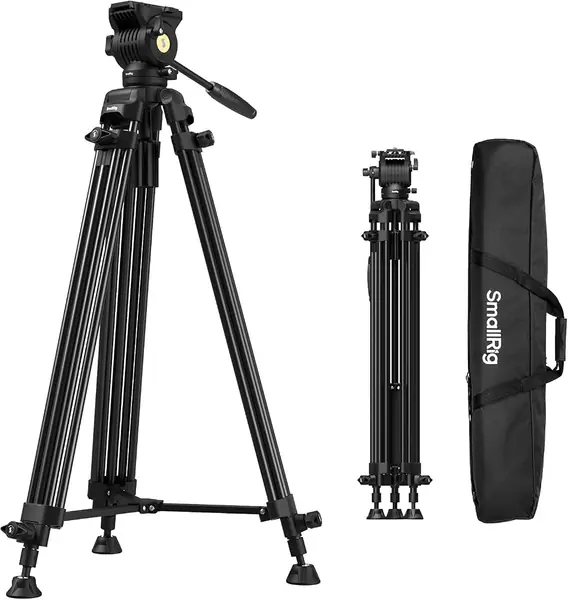
Best Camera Tripods of 2026

A tripod has one job, and it fails in the most annoying way possible — not all at once, but in a slow shiver that ruins the long exposure or the two-minute video you can't reshoot. The tradeoff is built in: the ones light enough to carry tend to wobble in a breeze, and the rock-solid ones stay in the closet. My team and I spent six months with 12 tripods to find the ones that hold still and still travel.

The head surprises most first-time buyers. A ball head adjusts fast and packs small, which suits stills and phone work; a fluid head pans smoothly for video, and that difference matters more than leg count. Check the leg locks, too — plastic clamps fail first, and a tripod that creeps half an inch under load is worse than none.

We mounted cameras and phones on all of them, folded and carried them, unscrewed the convertible ones into monopods, and weighed stability and durability against ease of use, adjustability, looks, and value. The picks below cover both ends of that tradeoff.

The Best Camera Tripods

1

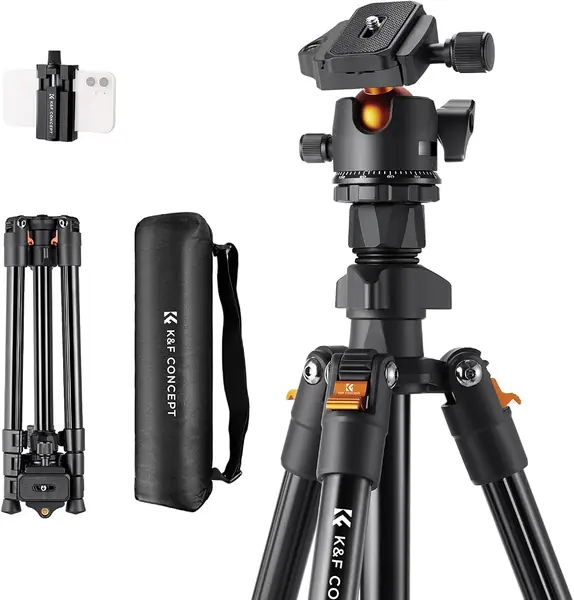
K&F CONCEPT 64-Inch Travel Tripod Best Overall
94 /100
TKZ Score Outstanding

Key details

Load Capacity
17.6 lb / 8 kg
Maximum Height
64.1 in / 163 cm
Folded Length
15.5 in
Head Type
36 mm ball head
View on Amazon

Most tripods in the midrange come with a three-way pan head and a handle sticking out the back. The K&F's ball head is why we made it our default: one knob to loosen, frame, and tighten, no handle to fold around, and a 36mm ball rated to 17.6 pounds, which covers a DSLR with a 70-200 mounted. The clamp is sized for the Arca-Swiss-style plates most working photographers already own.

Packed, it measures 15.5 inches, the shortest folded length of any full-height tripod here. The four-section legs use flip locks you can open and close with one hand, which matters when the other hand is holding a camera. The center column inverts, and a short column is included, so the camera can sit a few inches off the ground for macro or a low product angle. It costs more than the budget 74-inch tripods here, and the head and the fold are what you are paying for.

The compromise is height. At 64.1 inches the plate lands just below eye level for a six-foot shooter, so a level horizon means crouching slightly or composing from the screen. If you shoot standing all day, the 75-inch ZIKZOK or XXZU suits you better; if you shoot seated, at a table, or on the move, 64 inches is plenty and the packability is worth more.

Pros

  • 17.6-pound ball head holds a DSLR and long lens
  • Folds to 15.5 inches, shortest among full-height picks
  • Column inverts with a short column for low shots

Cons

  • No fluid drag, so video pans are stepped
Our verdict

We point most people here: a 17.6-pound ball head, an Arca-style clamp, and a 15.5-inch fold cover stills, travel, and low-angle work without asking you to choose.
Check Latest Price
2

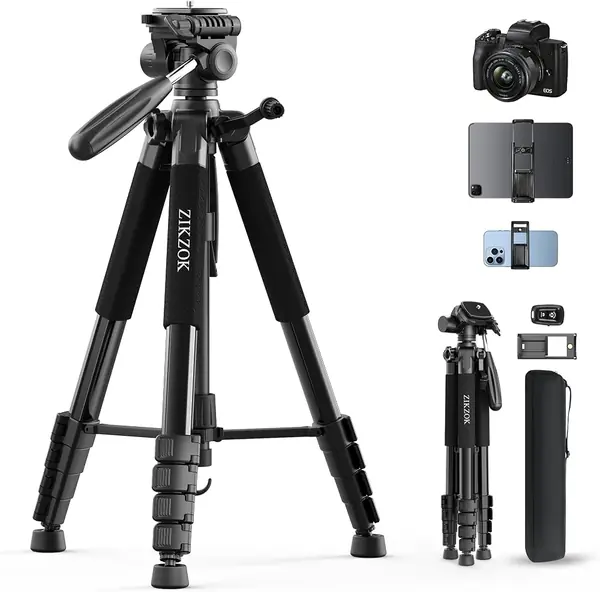
ZIKZOK 75-Inch Tripod Best for Phones and Tablets

93 /100
TKZ Score Outstanding

Key details

Load Capacity
15 lb
Maximum Height
75 in
Folded Length
20 in
Head Type
Three-way pan head
View on Amazon

The clamp is the reason this one is on the list. It is specified for an iPad Pro up to 11 inches, an iPad Air, an iPad Mini, and phones from recent iPhones through Galaxy and Pixel models, so the ZIKZOK works as a camera stand for a tablet running a script or holding a video call, not just a phone mount.

It also stands 75 inches tall, and the three-way pan head with its handle is easier to control than a ball head for a slow tilt: you turn the handle and the camera follows at a steady rate instead of loosening a ball and hoping it lands level. The legs are aluminum with rubber feet that grip a driveway or a gym floor, the whole thing weighs 3.2 pounds, and it folds to 20 inches.

We treat the 15-pound rating as a ceiling rather than a target. At full height the pan handle gives you something to lean on, and leaning on it flexes the top of the legs, so set the camera, step back, and shoot with a timer or a remote.

Pros

  • Holder fits tablets up to 11 inches
  • 75-inch height clears a crowd
  • Pan handle gives smooth, controlled tilts

Cons

  • Three-month warranty, the shortest stated here
Our verdict

If your camera is a phone or a tablet, this is the one we hand you — the holder fits an iPad, and the pan handle beats a ball head for slow, steady tilts.

Check Latest Price
3

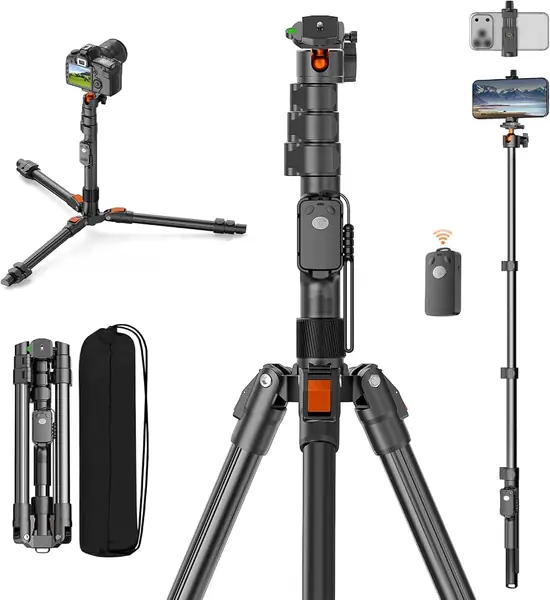
XXZU 75-Inch Tripod Best for Solo Creators

92 /100
TKZ Score Outstanding

Key details

Load Capacity
17.6 lb
Maximum Height
75 in
Weight
991 g (2.2 lb)
Head Type
360° ball head
View on Amazon

The collars are plastic and the legs are thin, and nothing about the XXZU feels like it will outlive the phone you mount on it. Then you open the box: a wireless remote, a phone holder, a carry bag, and a center column that detaches to become a monopod. At the budget end of this list, that is an unusual amount of kit.

It is also the lightest full-height tripod here at 2.2 pounds, and it still reaches 75 inches on three leg sections. The ball head turns a full 360 degrees and the legs have three angle stops, so you can splay it low on a slope or narrow it on a stair landing.

The remote is what we kept coming back to. It starts and stops recording from across a room, which is what makes the monopod and selfie-stick conversion worth having — a phone on a stick with no shutter control is just a stick. Three sections mean fewer joints to flex than the four-section tripods here, though 2.2 pounds of aluminum at 75 inches still wants the column down once a real camera goes on top.

Pros

  • Wireless remote makes solo filming practical
  • 2.2 pounds at 75 inches tall
  • Center column converts to a monopod

Cons

  • Light build may not survive daily use
  • Monopod mode tops out at 43.9 inches
Our verdict

Buy this if you film alone: the wireless remote and the monopod conversion do more for solo shooting than the savings, and it still reaches 75 inches.

Check Latest Price
4

K&F CONCEPT 90-Inch Overhead Tripod Best for Overhead Shots

91 /100
TKZ Score Outstanding

Key details

Load Capacity
22 lb / 10 kg
Maximum Height
90 in / 230 cm
Folded Length
21.3 in / 51 cm
Minimum Height
21.4 in
View on Amazon

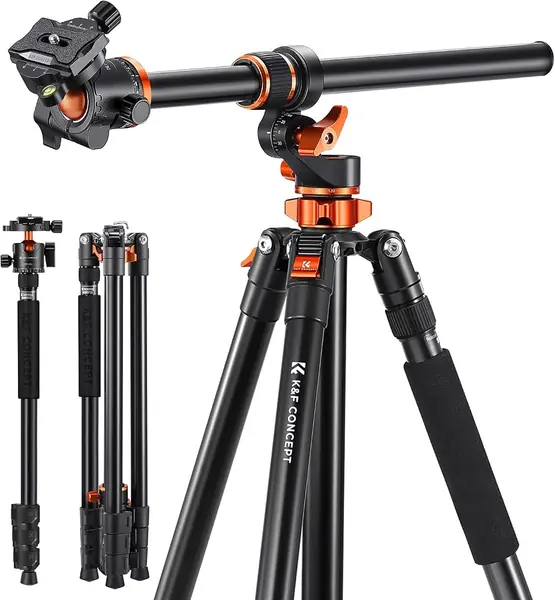
Ninety inches is taller than a standard door frame, which tells you this tripod is not for eye-level portraits. It is for the shot where the camera has to look straight down: a flat lay, a plated dish, a product on a table, a top-down video with your hands in frame.

The legs splay to 180 degrees and the 28mm center column swings out horizontal, so the camera hangs over the subject instead of beside it. The 28mm ball head carries 22 pounds — more than anything else here except the SmallRig CT-10 — and it is damped rather than free-swinging, which makes small framing changes possible with a heavy lens on board.

A detachable monopod adds a second life for a tripod that otherwise lives near a desk, and the 21.3-inch fold and 4.5-pound weight mean it can come along when the shoot moves. Buy it for overhead work and it earns its keep; buy it as your only tripod and you will spend most of your time at the bottom of its range.

Pros

  • Reaches 90 inches for overhead work
  • Legs splay flat and column swings horizontal
  • 22-pound ball head holds a full rig

Cons

  • Lower legs flex at the top of its range
  • Minimum height of 21.4 inches rules out ground-level shots
Our verdict

We reach for this when the shot is straight down — 90 inches of height, legs that swing flat, and a 22-pound ball head make overhead product and food work simple.

Check Latest Price
5

NEEWER 79-Inch Video Tripod Best Heavy-Duty for Video

90 /100
TKZ Score Outstanding

Key details

Load Capacity
17.6 lb / 8 kg
Maximum Height
79 in (200 cm)
Folded Length
35.8 in (91 cm)
Weight
12.4 lb (5.64 kg)
View on Amazon

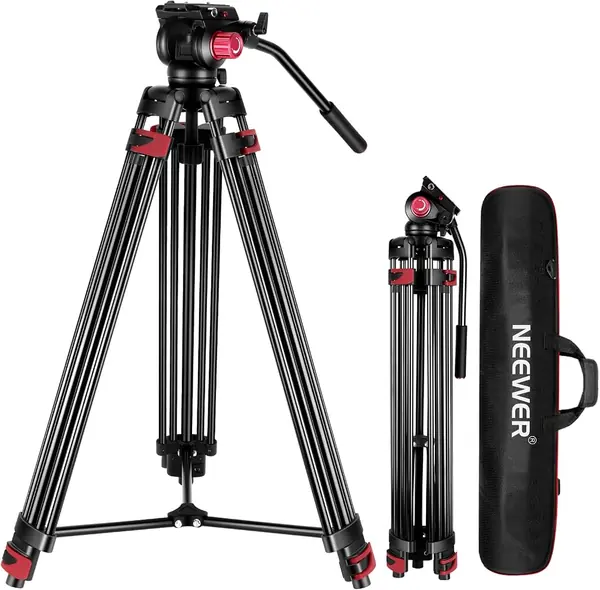
Twelve and a half pounds before you add a camera. The NEEWER is the heaviest thing here by a wide margin, and the weight is doing a job: double-tube aluminum legs, a 70mm bowl at the base of the column, and non-slip rubber feet that keep the whole thing planted when someone walks past the frame.

The fluid head is the other half of the argument. It pans 360 degrees and tilts from 70 degrees down to 90 up, with enough damping that a slow pan holds a constant speed instead of jumping at the start. Height runs from 88 cm to 200 cm on three flip-lock sections, the quick-release plate takes both 1/4-inch and 3/8-inch screws, and the bubble level sits where you can see it while you set up.

Where it earns its place is event and studio video, where the camera stays in one spot and the operator moves it. What we watch on a tripod like this is the joint between head and legs, which can work loose with repeated setup and teardown; give the bowl a twist before each shoot and it stays put.

Pros

  • Damped fluid head pans at a steady speed
  • 70mm bowl levels quickly on uneven ground
  • 8 kg payload on double-tube legs

Cons

  • 12.4 pounds and 35.8 inches folded: car, not backpack
Our verdict

For video that needs a real pan, this is the steadiest thing here: a damped fluid head on 12 pounds of legs that will not drift mid-take.

Check Latest Price
6

Amazon Basics 50-Inch Tripod Best Ultralight Budget

89 /100
TKZ Score Excellent

Key details

Load Capacity
4.4 lb
Maximum Height
50 in (127 cm)
Folded Length
16.9 in
Weight
1.23 lb (640 g)
View on Amazon

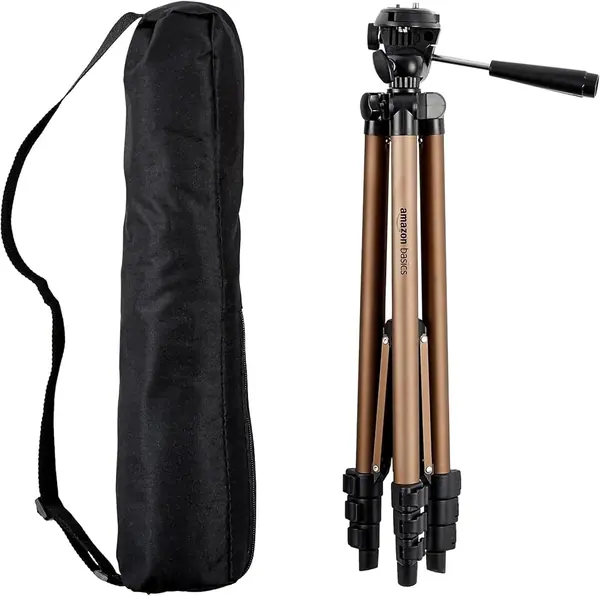
If your camera is a phone, a point-and-shoot, or a small mirrorless with a kit lens, this is the least expensive tripod here and the easiest to justify. It weighs 1.23 pounds, folds to 16.9 inches, and comes with a zippered bag — the kind of thing that lives in a backpack and gets used because it is already there.

The head is a three-way with a quick-release plate and a bubble level, more control than a phone needs and enough for a compact camera on a table. Height runs from 16.1 to 50 inches on three lever-lock legs. Fifty inches puts the plate at about chest height for an average adult with the column up, so this is a camera stand for shooting down at a subject, filming from a table, or getting a camera off the ground, not for eye-level portraits.

Stability is what you trade for the weight. Three thin legs with the column raised is the least steady version of any tripod, so keep the column down, spread the legs a notch wider than feels necessary, and set it on something solid when the ground is soft. Do that and it holds a phone or a compact still enough for a group shot or a time-lapse.

Pros

  • 1.23 pounds with a 16.9-inch fold
  • Quick-release plate and bubble level
  • Least expensive tripod in this group

Cons

  • 4.4-pound limit rules out most DSLR rigs
  • Light-duty plastic fittings at the joints
Our verdict

Take it if your camera is small and your bag is already full — barely over a pound, and steady enough for a phone or a compact at chest height.

Check Latest Price
7

SmallRig CT-10 Tripod Best for Heavy Camera Rigs

88 /100
TKZ Score Excellent

Key details

Load Capacity
33 lb
Maximum Height
71 in / 180 cm
Folded Length
16.9 in (43 cm)
Weight
3.4 lb
View on Amazon

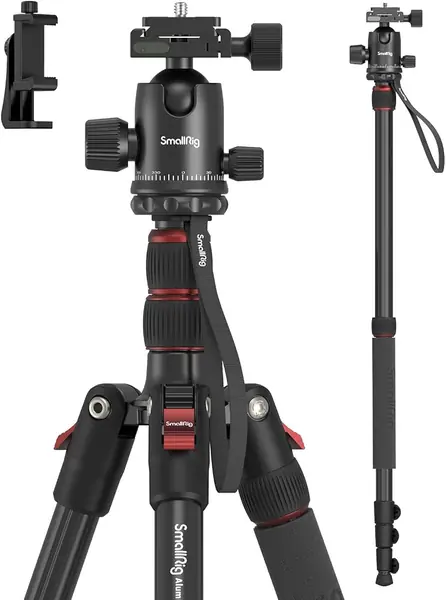
Compared with our top pick, the CT-10 nearly doubles the payload: 33 pounds against 17.6. That is the number that matters if you mount a gimbal, a long telephoto, or a camera with a monitor and a battery plate hanging off it.

It gets there with a 36mm ball head on magnesium-aluminum legs, four sections running from 16 to 71 inches, and a 3.4-pound body that folds to 16.9 inches. The center column detaches into a monopod, and the head takes both 1/4-inch-20 and 3/8-inch-16 threads, so accessories mount without an adapter.

The plate clamp is the part to test. Set your heaviest body on it, tighten the clamp, and press down on the front of the lens: a plate that creeps under that pressure is one that will drift during a long exposure. On a rig this heavy, the clamp is the difference between a sharp frame and a reshoot.

What tips it for us is the combination. Thirty-three pounds of rated capacity in something that folds to 16.9 inches and weighs 3.4 pounds is a rare pair of numbers, and if you already own a gimbal or a long lens, it saves buying a heavy-duty tripod and a travel tripod separately.

Pros

  • 33-pound payload, the highest here
  • Folds to 16.9 inches at 3.4 pounds
  • Center column converts to a monopod

Cons

  • Ball head needs two hands to fine-tune
Our verdict

Worth it for the payload: 33 pounds on a tripod that folds to 16.9 inches, as long as the plate clamp holds your heaviest camera before you trust it.

Check Latest Price
8

SmallRig AD-14 Video Tripod Travel Video

83 /100
TKZ Score Excellent

Key details

Load Capacity
18 lb (8 kg)
Maximum Height
73 in (186 cm)
Folded Length
34.6 in (88 cm)
Weight
6.8 lb (3.1 kg)
View on Amazon

A fluid head is what turns a tripod into a video support: pan and tilt are damped, so the camera moves at a constant speed instead of starting and stopping. The AD-14's head has infinite tilt drag and a range from 85 degrees above to 78 below, more travel than most mirrorless video needs and enough to go from a high angle to floor level in one move.

Under the head sits a 65mm bowl, so leveling means loosening the bowl and tilting rather than adjusting three legs, and the aluminum legs run from 33 to 73 inches. SmallRig rates it to 8 kg and lists 3.1 kg for the tripod, which puts it in a small group: a real fluid head you can carry a distance. Two 1/4-inch-20 mounts take a monitor or a mic arm, and a phone clamp, hex wrench, and bag are included.

The 18-pound rating covers a mirrorless body in a cage with a monitor and a modest zoom. A full cine build with a heavy zoom belongs on the NEEWER, which carries the same 8 kg on much heavier legs.

What decided it for us is the drag adjustment. A cheap fluid head is fluid in name only, a greased pan that sticks and then releases; being able to set a pan speed that matches the shot is the difference between usable footage and a reshoot. If you shoot video that moves and nobody is carrying your gear, this is the one here built for it.

Pros

  • Adjustable fluid drag for smooth pans
  • 65mm bowl levels without touching the legs
  • 6.8 pounds with an 18-pound payload

Cons

  • Folds to 34.6 inches, too long for a carry-on
Our verdict

A fluid head you can carry: 6.8 pounds, adjustable drag, and a leveling bowl, for shooters who want video pans without a 12-pound studio tripod.

Check Latest Price

How We Tested the Best Camera Tripods

We started with research, pulling in every tripod whose stated load capacity and folded length matched how people actually shoot — a phone on a kitchen counter, a DSLR on a trail, a camcorder at a school recital — and filtered out anything priced far outside the middle of the market. That narrowed a long list to 12 tripods we bought ourselves. We lived with them for six months, keeping them in car trunks, hallway closets, and hiking packs so they took the abuse camera gear normally takes.

Setup got timed with a stopwatch, standing, with a camera already in one hand, because that's when it matters. We measured each folded length against the side pocket of a daypack and weighed every tripod on a kitchen scale, then extended all the leg sections and pressed down on the head to see where flex showed up. Out on a windy pier we watched whether the horizon drifted during a 30-second exposure; in a dim living room we panned the fluid heads slowly to see whether the motion stuttered.

We hung a loaded bag from the center column to check leg-lock creep, tightened the phone and tablet holders around a case-clad device, and wiggled each quick-release plate to see if it seated firmly. The two-in-one models got unscrewed into monopods mid-shoot to see how the joint held up under a longer lens. At the end of six months we looked at scuffed finishes, stripped threads, and clamps that had loosened — that's how durability and appearance got weighed against price.

How to Choose a Camera Tripod

Pick the head before the legs

The head decides how the tripod feels in use. A ball head has one knob, packs small, and frames fast, which is why it suits stills and travel, and it is the worst choice for a smooth pan. A three-way pan head with a handle gives controlled tilts and lets you track something that moves, at the cost of a handle to fold around. A fluid head adds damping so a pan holds a constant speed; the NEEWER and the SmallRig AD-14 here have one and are built for video first.

If your camera is a phone, check the holder before anything else — the ZIKZOK's clamp is specified for tablets up to 11 inches, which most phone holders are not.

Understand what maximum height means

Maximum height is measured with the center column fully raised, the least stable the tripod ever gets; the usable figure is usually a few inches shorter with the column down. Standing eye level for most adults sits between 60 and 66 inches, so a 64-inch tripod reaches it with the column nearly closed, a 50-inch model is a chest-height support, and a 75-inch tripod has room to spare. If you shoot standing, buy a few inches above your eye level and plan to work with the column down.

Weigh folded length against the bag you carry

A tripod left at home is worth nothing. Under about 3 pounds and around 16 to 17 inches folded fits a daypack or a carry-on; 20 inches and 3 pounds is a car-to-site tripod; 12 pounds and 36 inches is a studio fixture. The trap is the word compact, which in a listing can mean it fits a trunk rather than a backpack. Compare the folded figure to the longest thing your bag will take before you order, and remember that more leg sections pack shorter but take longer to set up.

Treat the load rating as a ceiling

Load ratings describe what the head holds, not how steadily the whole tripod stands with it. A 17-pound rating on a 2-pound tripod is a fair-weather number: the head is fine, the legs are the problem. Add up the body, lens, plate, and anything hanging off the rig, then leave headroom. Hanging a bag from the center hook, which the ZIKZOK includes, lowers the center of gravity, and keeping the column down does more for sharpness in wind than any figure on the box.

Check the legs for the way you shoot

Flip locks open and close in one motion and are easy to work with cold hands; twist locks pack slimmer and do not catch on straps. Leg-angle stops matter more than either: three positions let you splay the tripod on a slope, and a column that inverts or a short column that swaps in gets the camera a few inches off the ground for macro and low product work — the K&F CONCEPT 64-inch includes a short column. Rubber feet are right for floors and decks; on soft ground, spread the legs wider instead of relying on the feet.

Frequently Asked Questions

Final Verdict

If you want one tripod for stills, travel, and the occasional low-angle shot, buy the K&F CONCEPT 64-inch. The ball head carries a real DSLR kit, it packs smaller than anything else here that stands over five feet, and the inverted column covers the shots a pan-head tripod cannot.

Two situations change the answer. If your camera is a phone or a tablet, the ZIKZOK's holder and pan handle are worth more than extra reach. If you shoot video that pans, the SmallRig AD-14 puts a damped fluid head on 6.8 pounds of legs you can actually carry.